
What Is a Manual Tablet Press and Why Do You Need One?
Have you ever needed to make a small batch of tablets—maybe for a lab experiment, a new product prototype, or a specialty candy? A manual tablet press (also called a hand-operated pill press) is your most affordable and flexible solution. Unlike huge automated machines that cost tens of thousands of dollars, a manual press puts the control right in your hands—literally. You turn a lever or crank, and with a few strokes, you create perfect, uniform tablets.
At Tencan Powder (Changsha Tianchuang Powder Technology Co., Ltd.), we’ve designed the Manual Tablet Press (model TDP-0) to be the workhorse of small-scale production. It’s compact, reliable, and requires no electricity—though you can motorize it if you wish. Whether you’re pressing pharmaceutical powders, herbal extracts, candy mixes, or even metal powders for research, this machine delivers consistent results every time.
In this guide, we’ll walk you through the working principle, key specifications, typical applications, and practical tips for using a manual tablet press. By the end, you’ll know exactly if a manual press is right for your work—and how to get the most out of it.
How a Manual Single Punch Tablet Press Works
The manual tablet press is the simplest form of a single punch tablet press. It uses one set of punches (upper and lower) and one die. Here’s the step-by-step process:
- Fill the die: You pour or feed granular powder into the die cavity. The depth of fill determines the tablet’s weight and thickness.
- Compress: You turn a hand wheel or lever that drives the upper punch down into the die. The force compresses the powder into a solid tablet.
- Eject: As you continue turning, the lower punch rises, pushing the finished tablet out of the die.
- Repeat: Remove the tablet, reset the tooling, and start the next cycle.
This simple cycle makes the manual press ideal for R&D, small batches, and multi-product environments where you switch materials frequently. No complex electronics, no programming—just pure mechanical reliability.
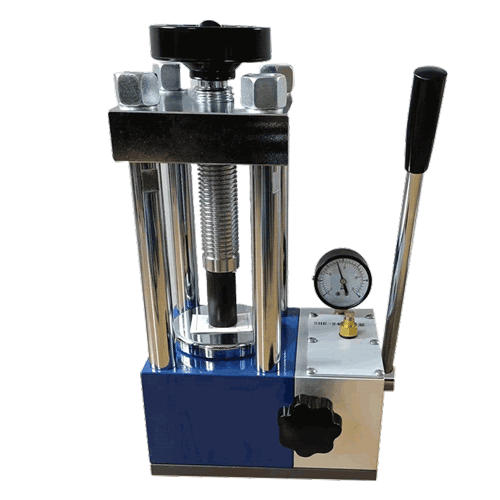
Key Technical Specifications of the TDP-0 Manual Tablet Press
Here are the critical parameters that define what the TDP-0 can do. Understanding these will help you decide if it fits your production needs:
| Parameter | Value |
|---|---|
| Automation Level | Semi-Automatic (Manual) |
| Capacity | Up to 1,000 tablets/hour |
| Maximum Pressure | 15 kN (approx. 1.5 tons) |
| Maximum Tablet Diameter | 12 mm (round) |
| Maximum Fill Depth | 15 mm |
| Maximum Tablet Thickness | 6 mm |
| Die Shape | Round (custom shapes available) |
| Weight | 32 kg |
| Dimensions | 33 x 22 x 52 cm |
| Warranty | 1 year |
These specifications make the TDP-0 a true lab scale tablet press. It’s not meant for mass production (that’s what rotary presses like the ZP series are for), but for jobs where precision and flexibility matter more than speed.
Common Applications: Where a Manual Pill Press Shines
You might be surprised by the variety of industries that rely on manual tablet presses. Here are some real-world uses:
Pharmaceutical R&D and Quality Control
Researchers use manual presses to make small batches of drug formulations for stability testing, dissolution studies, and bioavailability tests. You can quickly adjust the pressure or fill weight without wasting material.
Nutraceutical and Candy Production
Health supplement companies press vitamin tablets, herbal extracts, and even effervescent candy tablets with a manual press. The TDP-0 handles both simple powders and slightly sticky granulations.
Chemical and Material Science
Need to make a pellet for XRF analysis or a catalyst disk? The manual press gives you repeatable pressure and easy cleanup when switching between materials.
Ceramic and Powder Metallurgy
Small laboratories forming ceramic green bodies or metal powder compacts often use a manual press because it’s affordable and doesn’t require a dedicated power supply.
Manual vs. Automatic Tablet Press: Which One Should You Choose?
Tencan Powder offers both manual and automatic presses. How do you decide? Here’s a quick comparison:
- Manual Press (TDP-0): Best for low volume (under 1000 tablets/hour), frequent material changes, and tight budgets. You control every stroke, so you can feel the compaction quality.
- Automatic Electric Tablet Press: Ideal for medium to high volume (thousands per hour), continuous production, and when you need consistent output without manual labor. These machines use a motor-driven turret and automatic feeding.
If you’re just starting out or need versatile lab equipment, start with the manual press. You can always scale up later with an automatic electric tablet press from Tencan when volume demands it.
How to Use and Maintain Your Manual Tablet Press
Getting great results from a manual press isn’t complicated, but a few best practices help:
Setting Up the Machine
- Place the press on a sturdy, level surface. Its 32 kg weight keeps it stable.
- Install the correct die and punch set for your tablet size (round dies up to 12 mm are standard).
- Adjust the fill depth using the adjustment knob. Deeper fill = heavier tablets.
- Set the tablet thickness using the upper punch adjustment. Thinner tablets require more pressure.
Operating Tips
- Use granulated powder (not fine dust) for best flow and uniform tablets. If your powder is too fine, consider a dry granulator first.
- Apply steady, even pressure when turning the handle. Rushing can cause capping or sticking.
- After each tablet, inspect the die for powder residue. A quick wipe keeps the next tablet clean.
Maintenance Checklist
- After each use, clean all powder contact surfaces with a soft brush or damp cloth (no abrasive cleaners).
- Lubricate moving parts (the lead screw and pivot points) monthly with food-grade grease if used for edible products.
- Store in a dry environment to prevent rust. The TDP-0 uses a painted steel frame, but the tooling is tool steel—keep it oiled.
Why Choose Tencan Powder’s Manual Tablet Press?
There are plenty of manual presses on the market, but here’s what makes Changsha Tianchuang Powder Technology Co., Ltd. (Tencan Powder) stand out:
- Global support: Our warehouses in the USA, Canada, and Europe simplify customs and taxes. You get a single point of contact for shipping, duties, and after-sales service.
- Value for money: Starting at just US$299 per piece (FOB), the TDP-0 offers industrial-grade performance at a hobbyist price.
- Versatility: While the standard model makes round tablets, we can supply custom dies for shapes, letters, or logos.
- Upgrade path: If you ever need higher output, we offer the TDP-1.5 (15 kN, 3500-4800 tablets/hour) and full rotary presses like the ZP-35D (150,000 tablets/hour).
Frequently Asked Questions
Can this machine make candy tablets?
Absolutely! The TDP-0 is a popular choice for small candy makers. Just ensure your candy mix has a consistent granulation and the right moisture content. Many customers use it for pressed dextrose or fruit-flavored candy tablets.
Do I need electricity?
No, the manual press works entirely by hand. However, if you want to motorize it, you can add a small electric motor to the crank (check with our team for compatible kits).
What is the maximum tablet size?
Round tablets up to 12 mm in diameter. For larger diameters (up to 15 mm), see our TDP-1.5 model.
Is it easy to clean between different materials?
Yes. The die and punches are removable. A quick wash with ethanol or warm soapy water, dry, and reinstall. Perfect for switching between pharmaceutical and food products.
Ready to Start Pressing?
A manual tablet press is the gateway to on-demand tablet production. Whether you’re a researcher, a startup founder, or a hobbyist, the TDP-0 from Tencan Powder gives you the control and affordability you need. With a pressure capacity of 15 kN, die diameter up to 12 mm, and a production rate of 1,000 tablets per hour, it handles the most common tablet pressing tasks with ease.
Visit our Manual Tablet Press product page for full specifications, ordering information, and customization options. If you have questions about which press suits your material or batch size, our team at Tencan Powder (Changsha Tianchuang Powder Technology Co., Ltd.) is happy to help.
From hand-cranked simplicity to reliable results—your tablet production starts here.