
TENCAN / Equipment series
3D rotary vibrating screen
3D rotary vibrating screen uses vertical motor with eccentric weights for three-dimensional motion. Adjustable phase angle controls particle trajectory. Ideal for fine screening in chemical, food, and pharmaceutical industries.
| Effective diameter | 560~1750mm |
| Sieve specification | 0.02~50mm |
| Sieving efficiency | 85-95% |
These specifications describe the series. Confirm the selected model, power supply and configuration before ordering.
Request a quotationThe three-dimensional rotary vibrating screen uses an upright motor as the excitation source. Eccentric weights are installed on the upper, lower and both ends of the motor to convert the rotational motion of the motor into horizontal, vertical and tilted three-dimensional motion, and then transfer this motion to the screen surface. Adjusting the phase angles of the upper and lower ends can change the movement trajectory of the material on the screen surface. 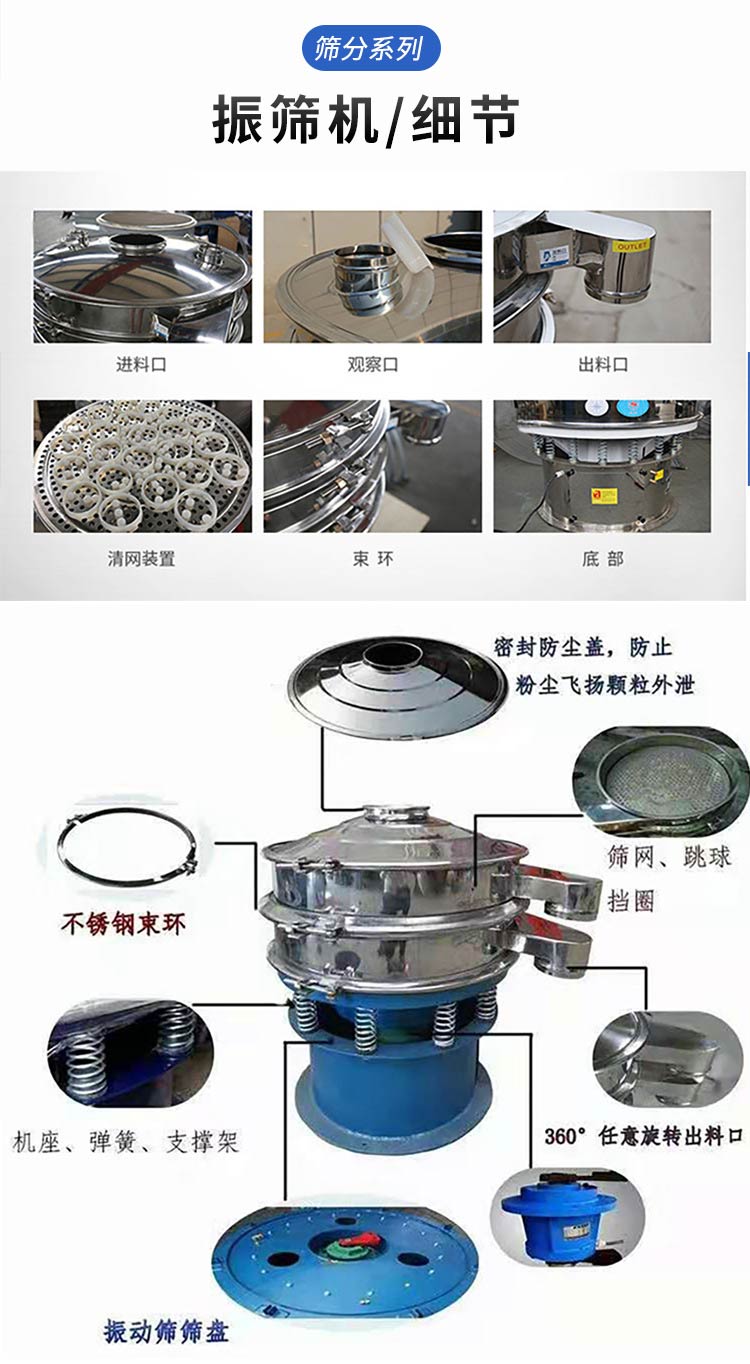
Technical parameters
| model | Effective diameter (mm) | Effective screening area (㎡) | Number of screening layers | Maximum material size (mm) | Screen specifications (mm) | Vibration frequency (r/min) | Double amplitude (mm) | Vibration force (N) | Motor power (Kw) | Screening efficiency% | Production (flour) kg/h |
|---|---|---|---|---|---|---|---|---|---|---|---|
| ZS-600 | 560 | 0.23 | 1-5 | 50 | 0.02~50 | 1440 | 2~3 | 5000 | 0.55 | 85-95 | 85-95 |
| ZS-800 | 760 | 0.44 | 1-5 | 50 | 0.02~50 | 1440 | 2~3 | 8000 | 0.75 | 85-95 | 85-95 |
| ZS-1000 | 930 | 0.68 | 1-5 | 50 | 0.02~50 | 1440 | 2~3 | 10000 | 0.75 | 85-95 | 85-95 |
| ZS-1200 | 1130 | 1 | 1-5 | 50 | 0.02~50 | 1440 | 2~3 | 15000 | 1.1 | 85-95 | 85-95 |
| ZS-1500 | 1430 | 1.60 | 1-5 | 50 | 0.02~50 | 1440 | 2~3 | 30000 | 2.2 | 85-95 | 85-95 |
| ZS-1800 | 1750 | 2.4 | 1-5 | 50 | 0.02~50 | 1440 | 2~3 | 50000 | 2.2 | 85-95 | 85-95 |
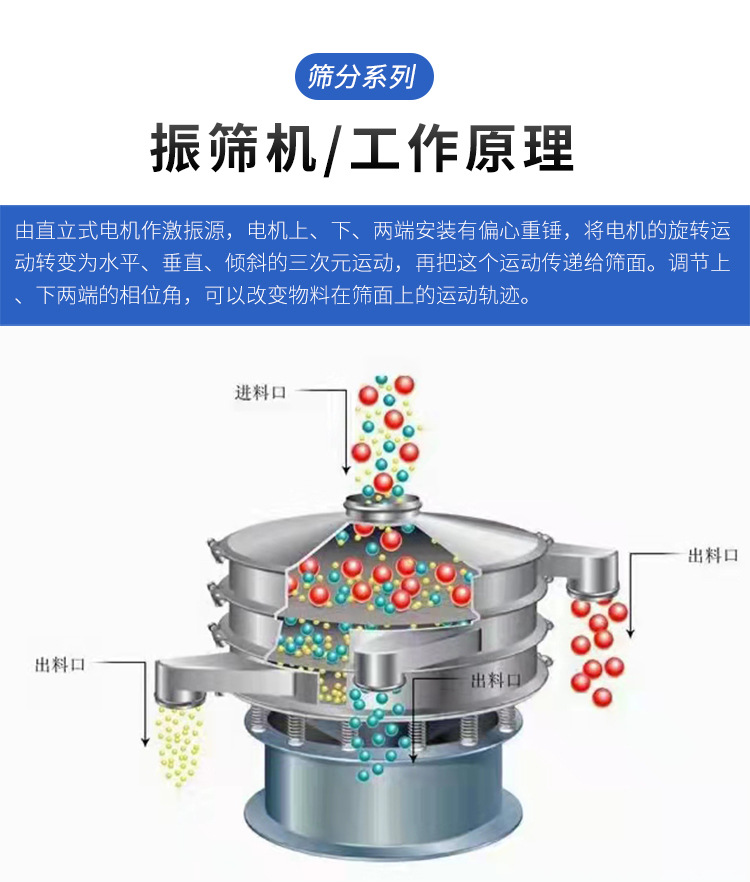
The three-dimensional rotary vibrating screen uses an upright motor as the excitation source. Eccentric weights are installed on the upper, lower and both ends of the motor to convert the rotational motion of the motor into horizontal, vertical and tilted three-dimensional motion, and then transfer this motion to the screen surface. Adjusting the phase angles of the upper and lower ends can change the movement trajectory of the material on the screen surface.
Before operation, review the selected model’s instructions and the material requirements.