
TENCAN / Equipment series
Ultrasonic planetary ball mill
Ultrasonic planetary ball mill with synergistic cavitation and acoustic flow for super-fine grinding, eliminating agglomeration in nanomaterials, new energy, and electronic ceramics.
| Grinding jar specification | 0.5L~50L |
| Feed particle size | Soil ≤10 mm, other materials ≤3 mm |
| Output particle size | Minimum attainable 0.1 μm |
These specifications describe the series. Confirm the selected model, power supply and configuration before ordering.
Request a quotationThe ultrasonic planetary ball mill is a new generation of high-energy grinding equipment developed based on the traditional planetary ball mill and integrating an ultrasonic oscillation system. it passes Planetary mechanical grinding and ultrasonic cavitation/acoustic flow effect The synergistic effect simultaneously achieves ultra-fine crushing and efficient dispersion of materials, fundamentally solving the problems that are prone to occur when conventional ball mills handle micron and nanometer materials. Sinking to the bottom, agglomeration, wall sticking, secondary agglomeration and other process problems.
Relying on the dual energy synergy of ball mill mechanical impact + ultrasonic cavitation, acoustic flow, and high-frequency vibration, compared with ordinary ball mills, Six outstanding advantages :
1. Completely inhibit powder agglomeration and greatly improve the dispersion effect (the core advantage)
Ultrasonic cavitation burst generates instantaneous high temperature, high pressure, and micro jets to break the intermolecular force/electrostatic adsorption between nanoparticles and disperse them while grinding, eliminating secondary agglomeration, agglomeration, tank bottom hardening, and material sticking to the wall after fine powder grinding. ; It is especially suitable for materials that are easily agglomerated, such as lithium battery materials, rare earth powders, nano-oxides, and magnetic powders, and effectively inhibits the agglomeration of magnetic powders.
2. The grinding efficiency is increased by 30%~50%, shortening working hours, saving energy and reducing consumption.
Mechanical grinding achieves coarse crushing of particles, ultrasonic micro-tearing and refinement, double energy superposition 1+1>2, and the grinding time is shortened by 1/3~1/2 at the same discharge fineness. ; There is no need for long-term no-load dry grinding and repeated feeding to break up agglomerations, reducing equipment energy consumption and grinding ball loss. ; The grinding speed of difficult-to-grind high-viscosity slurry and paste materials is particularly obvious.
3. The powder particle size is finer, the particle size distribution is narrow, and the product consistency is high
The limit of conventional ball milling is mostly at the micron level, and ultrasonic assistance can stably grind to the nanometer level of 50~500nm. ; Ultrasonic stirs the entire material evenly, the particles stay for even grinding time, the difference in particle size span D50/D90 is smaller, and the powder quality is stable. It is suitable for the production of precision powders such as MLCC electronic ceramics, polishing powder, and pharmaceutical raw materials.
4. Applicable to a wider range of materials and compatible with special working conditions
Material form: dry powder, aqueous slurry, organic solvent suspension, high viscosity paste, biological wet material all-round processing ; Special process: can be used with vacuum tank and inert gas protection (nitrogen/argon) to grind easily oxidized and hydrolyzable powders ; Some models are equipped with temperature control, suitable for heat-sensitive medicine and polymer materials. ; Special materials: biological cell wall breaking, catalysts, nano zero-valent iron, phosphors and other categories that are difficult to process with traditional ball mills.
5. Reduce wear and impurity pollution
In order to break up agglomerates, traditional ball mills need to increase the filling amount of the grinding balls and increase the rotation speed, which intensifies the wear of the tank and the grinding balls and introduces metal impurities. ; Ultrasound relies on sound field dispersion, which can reduce the grinding ball ratio and rotation speed, greatly reduce powder pollution caused by media wear, and improve the yield rate of high-purity powders.
6. Easy to use and friendly operating environment
The materials in the tank continue to flow in suspension, and there is no need to stop the machine midway to open the lid, scrape the wall, or turn over the material, and the automation continuity is better. ; The models with the same specifications are compact in size and have lower operating noise than ordinary high-energy ball mills. They are suitable for small-batch research and development in laboratories and pilot mass production. They can produce multiple sets of parallel samples at a time (four tanks can be ground simultaneously). ; Ultrasound has a mild activation effect, and grinding can also assist solid phase synthesis and surface modification, realizing the integration of grinding + modification and simplifying back-end processes.
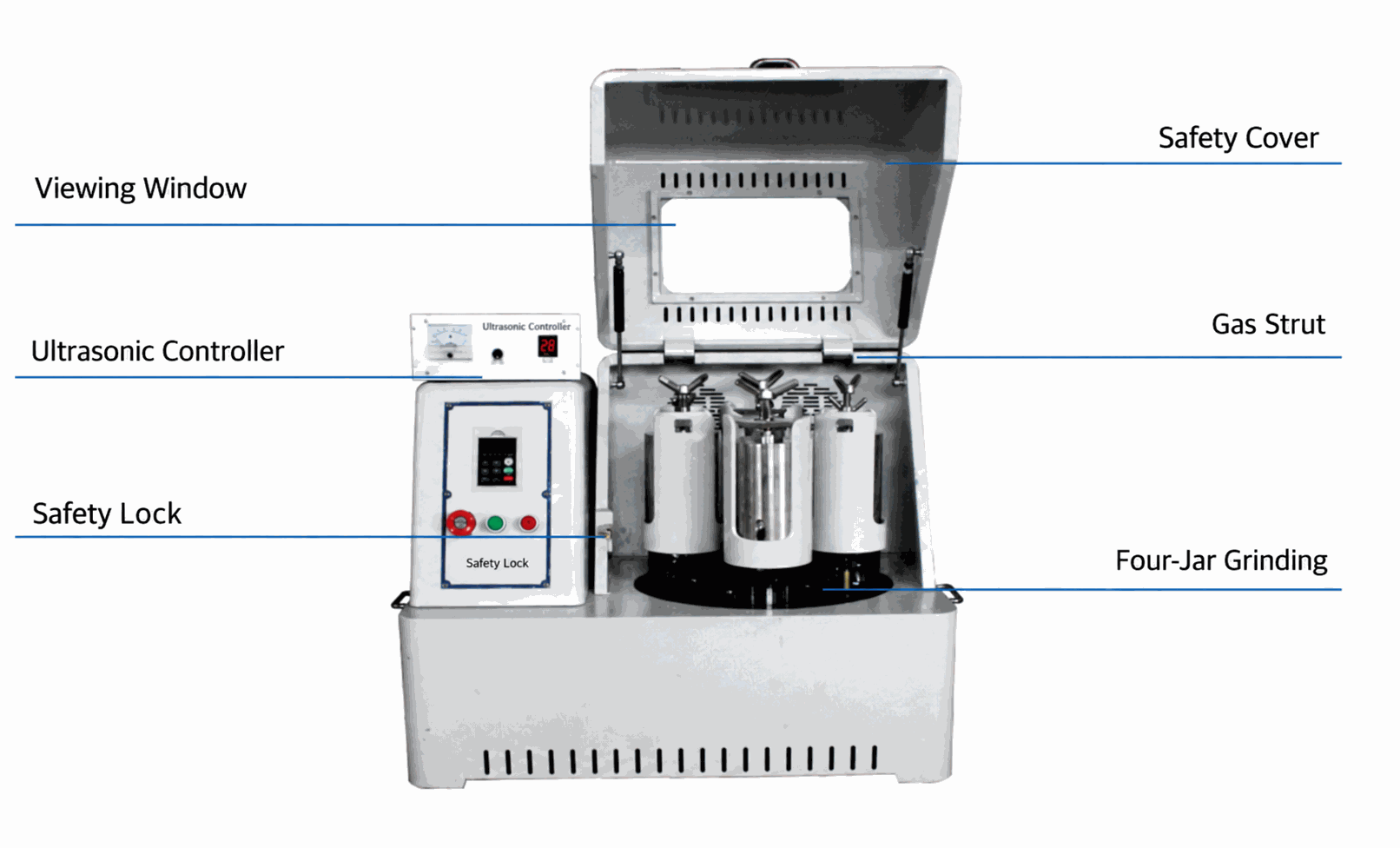
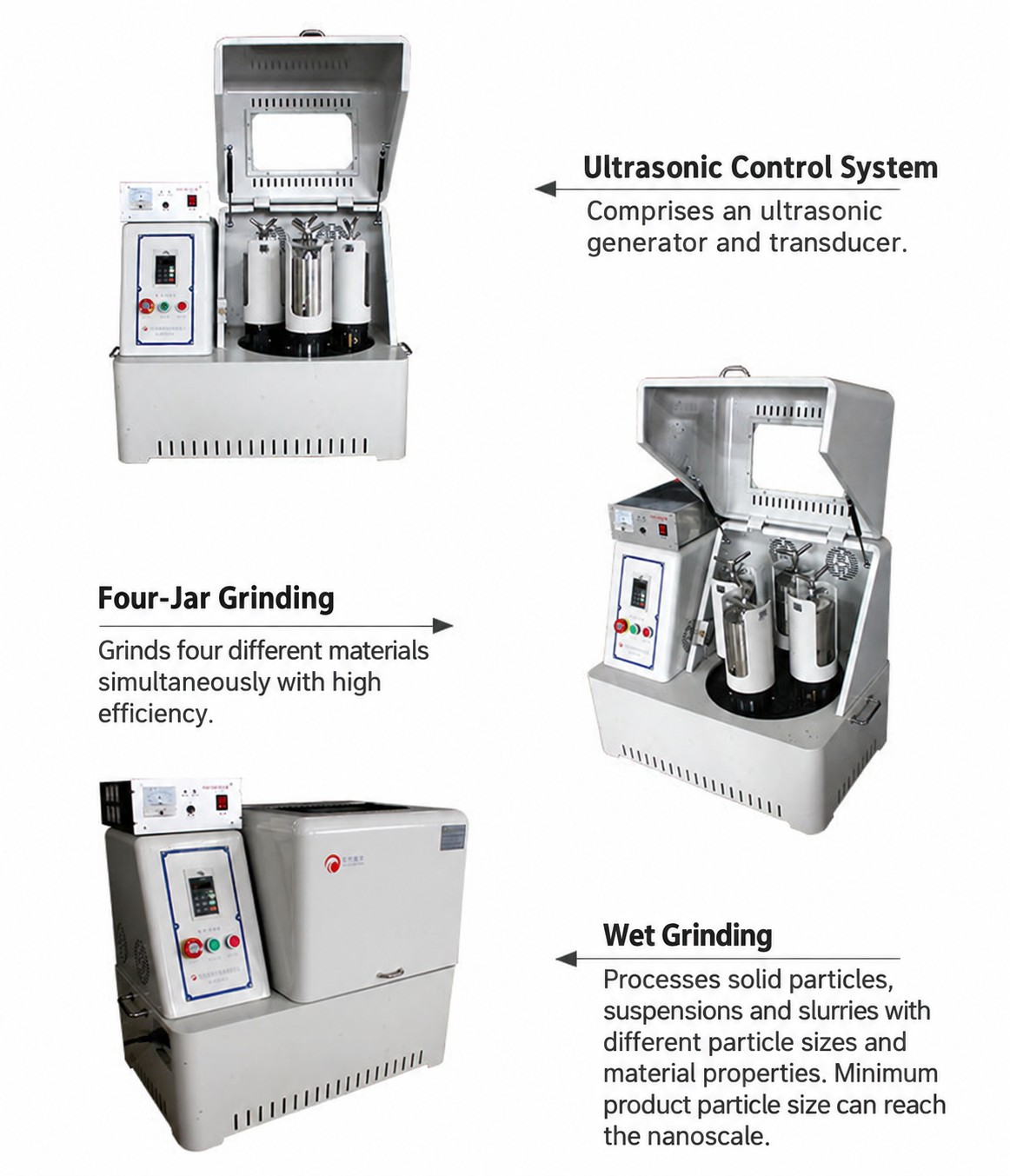
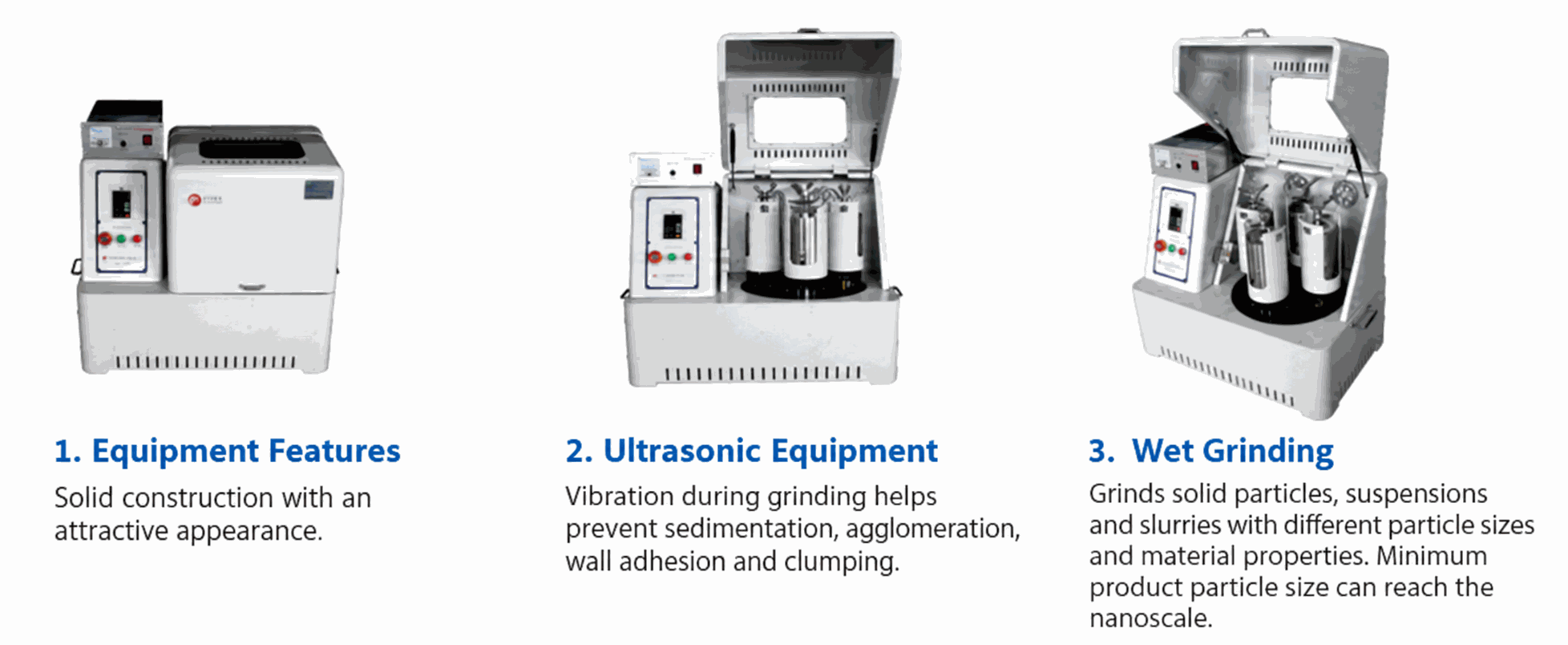
Ultrasonic planetary ball mills are widely used in scientific research institutes, university laboratories and corporate R&D and production departments, covering many high-tech fields such as new energy, electronic ceramics, biomedicine, chemical and environmental protection.
| Application areas | Typical uses |
|---|---|
| New energy materials | Ultra-fine grinding and uniform mixing of lithium battery cathode materials (lithium iron phosphate, ternary materials), silicon carbon anodes, fuel cell catalysts, etc. to improve battery energy density and consistency |
| Electronic ceramics and functional materials | High-precision grinding of MLCC dielectric materials, piezoelectric ceramics, magnetic materials (ferrite), rare earth polishing powder, etc., controlling the powder particle size to optimize the electrical performance of the device |
| Medicine and Biotechnology | Micronization of poorly soluble drugs (to improve dissolution), cell wall disruption, DNA/RNA extraction, and ultrasound assistance can reduce damage to heat-sensitive components |
| Chemical industry and environmental protection | Catalyst preparation and activation, nano zero-valent iron (for wastewater treatment), pigment and coating dispersion |
| Geology, metallurgy and others | Laboratory sample preprocessing and ultrafine crushing of brittle materials and fibrous materials such as ores, slag, glass, ceramics, etc. |
This device is mainly suitable for It can handle solid particles, suspensions and paste-like materials, and has good grinding effect on brittle, fibrous and medium-low hardness materials.
Technical parameters
| Transmission mode | gear transmission |
|---|---|
| working method | Two or four ball mill tanks work simultaneously |
| Maximum sample loading volume (material + grinding ball) | Two-thirds of the ball mill tank volume |
| Ball mill tank volume | Each can is 0.5L-50L, total volume is 0.2L-200L |
| Feed particle size | Soil material ≤10mm, other materials ≤3mm |
| Discharge particle size | The minimum can reach 0.1μm (different materials and grinding processes will vary) |
| Speed ratio (revolution:rotation) | 1:2 |
| Speed (rotation) | XQM-6Grinding tank rotation speed:0~670rpm For more details, see the main parameters of planetary ball mill |
| Speed regulation method | Brand inverter stepless speed regulation |
Ultrasonic planetary ball mill adopts“ Planetary mechanical grinding + ultrasonic assisted dispersion ”Dual crushing mechanism, the two energies are superimposed simultaneously in time and space to achieve efficient collaboration.
1. Planetary mechanical grinding (macro crushing)
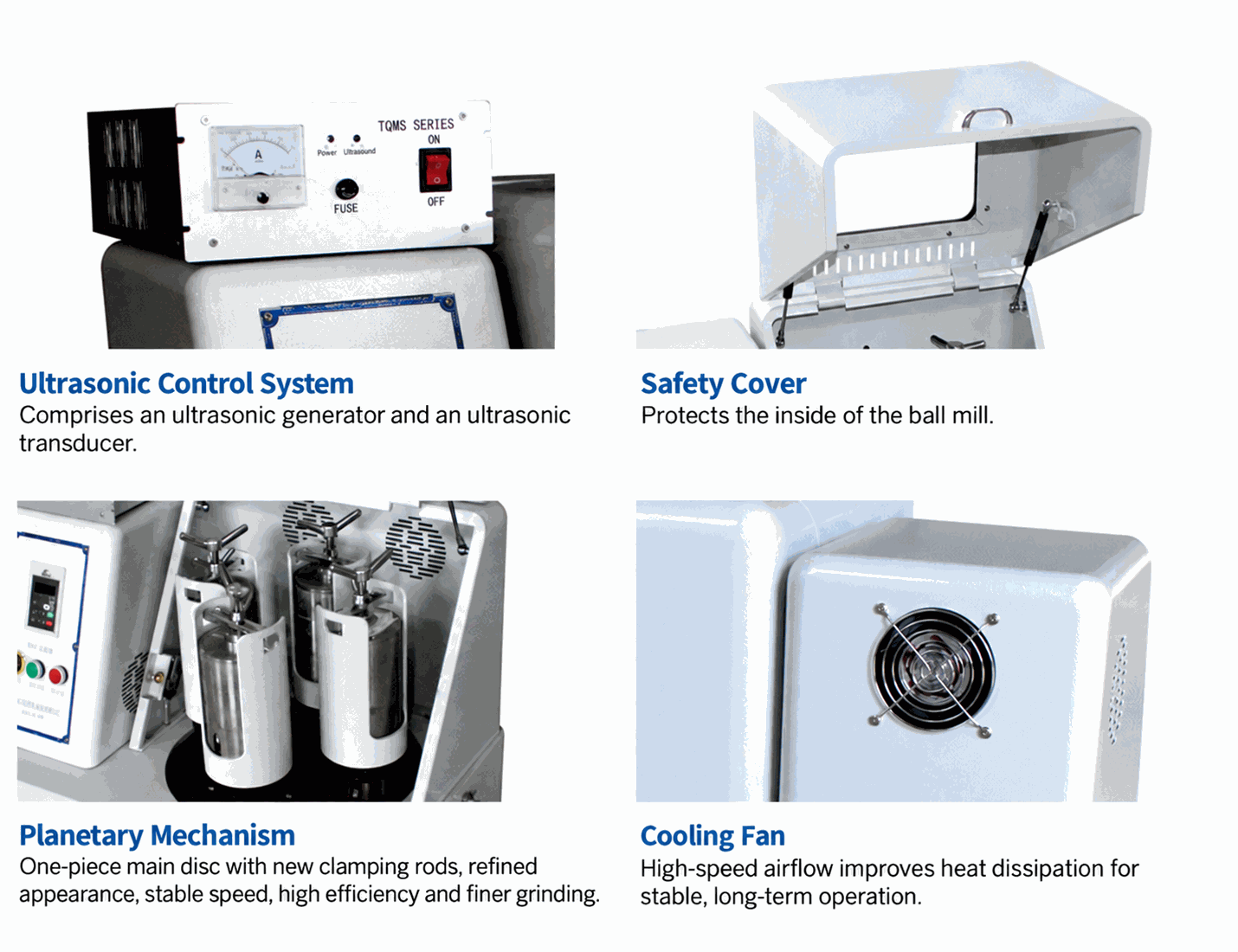
The main disk of the equipment revolves around the central spindle, and the ball mill tank installed on the main disk rotates around its own axis at high speed at the same time. The speed ratio between revolution and rotation is usually 1:2. This composite motion causes the grinding balls and materials in the tank to be subjected to multi-directional and high-frequency vibrations. Impact, Shear and Friction effect:
-
The grinding ball hits the material at extremely high speed in a high centrifugal force field to break large particles.;
-
The sliding friction and shearing between the grinding balls and between the grinding balls and the tank wall further refine the particles.;
-
The three-dimensional movement generated in the tank ensures that the material contacts the grinding media without any dead ends.
This process can quickly crush materials from millimeter level to micron or even sub-micron level.
2. Ultrasonic assisted dispersion (microscopic depolymerization)
The ultrasonic system consists of a generator, a transducer and a conductive slip ring. The generator converts power frequency electricity into high-frequency electrical oscillation (common frequency 20kHz ~ 40kHz), and the transducer converts it into mechanical vibration, which is transmitted to the inner wall of the rotating grinding tank through the conductive slip ring, causing the liquid medium to generate high-frequency mechanical waves. There are two main effects:
-
cavitation effect : Ultrasonic waves alternately produce tension and compression in the liquid. A large number of tiny bubbles are formed during stretching, and the bubbles instantly collapse during compression, generating local shock waves with high temperatures of thousands of degrees Celsius and hundreds of atmospheric pressures, breaking up the refined particle agglomeration structure and preventing secondary agglomeration.
-
Acoustic flow effect : Ultrasonic waves cause the macroscopic circulation flow of the liquid, keeping the materials in the tank in a state of motion, effectively preventing dense particles from sinking to the bottom or adhering to the tank wall, and ensuring grinding uniformity.
3. Synergy mechanism
Planetary motion provides continuous mechanical impact from the outside to continuously crush the particles; Ultrasonic waves continuously exert "anti-agglomeration force" from the inside, disintegrating each agglomerate before it is stable. The synchronized effect of the two greatly shortens the grinding time required to reach the target particle size, significantly improves the uniformity of the discharged particle size distribution, and enables the minimum discharged particle size to reach the nanometer level. This mechanism cannot be realized by traditional ball mills, and it is also the core technology that distinguishes ultrasonic planetary ball mills from ordinary planetary ball mills.
Before operation, review the selected model’s instructions and the material requirements.