
Heavy Vibrating Ball Mill — This is equipment for intensive grinding and homogenization of materials for sample preparation and technological research. In the powder processing chain, it usually takes place after preliminary crushing or reduction of the sample and before analysis, mixing, pressing or further processing. The fundamental difference from a drum mill is that the grinding chamber does not simply rotate, but oscillates with a given frequency and amplitude; Grinding media repeatedly impact the material, combining impact and abrasion. The specific capabilities of the model are determined by its passport, so the principles below should be correlated with the card heavy vibrating ball mill TENCAN.
What is a heavy duty vibrating ball mill and where is it used?
The name reflects that it belongs to a more massive class of vibration grinding equipment. The word “heavy” is not a universal guarantee of a certain performance: it indicates a reinforced design and a focus on heavier duty conditions, while the maximum weight, volume and operating time must be specified for a specific design. Therefore, when selecting, it is not enough to focus on the class of equipment - you need data from the card and technical description.
In laboratory and pilot industrial practice, such mills are used to prepare representative samples, finely grind fragile materials, homogenize powders, and study the effect of grinding on the properties of raw materials. Possible areas are minerals, ceramics, glass, slag, soils and other materials, if they are safe and do not require special temperature or atmospheric control. The list of applicable materials is always limited by the material of the chamber, grinding media, seals and operating conditions.
The vibratory ball mill should not be confused with a jaw crusher, roller crusher or cutting mill. Crushing reduces large pieces, and vibration grinding works with already prepared raw materials and provides finer dispersion. It is also not a bead mill: the latter is usually intended for liquid systems and in-line dispersion, while the vibratory ball mill can handle dry powders and suspensions, depending on the design.
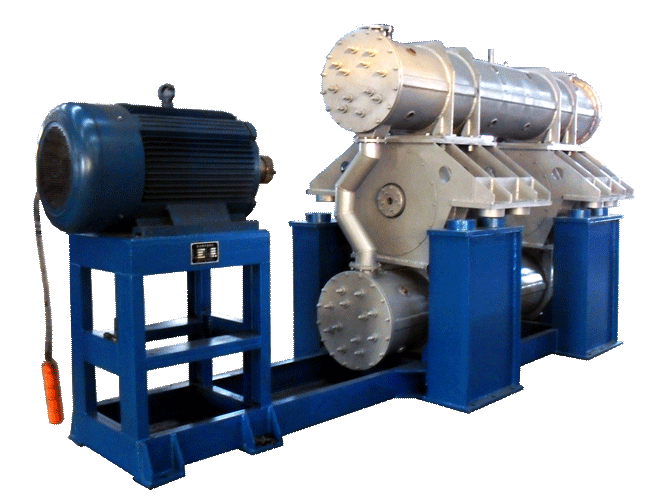
How does the vibration grinding process work?
In a vibration mill, energy is transferred to the material through the oscillating grinding chamber and the grinding media contained in it. When oscillating, the balls receive acceleration and collide with each other, with the walls of the chamber and with the particles of the sample. As a result, shock and shear loads act, the material cracks, wears out and is gradually crushed. The higher the impact intensity, the more energy is supplied to the sample, but this does not mean that any material can be crushed to an arbitrary size in one pass.
The result is influenced by the initial particle size, mineralogy and structure of the material, its hardness, fragility, humidity and tendency to agglomerate. What matters are the mass and diameter of the grinding media, the material they are made of, the degree of filling of the chamber, the ratio of the mass of the balls and the sample, the frequency and amplitude of vibrations, and the duration of processing. For dry grinding, dust formation, adhesion and particle sedimentation are important; for wet - medium, suspension viscosity, liquid separation and possible interaction with the material. Wet grinding can reduce dust and improve particle distribution, but requires subsequent filtration or drying and is not always suitable for analysis.
Mixing and chopping are not the same thing. If the energy of movement of the grinding bodies is insufficient, the powder may become more homogeneous, but there will be no noticeable reduction in particle size. If the task is to destroy agglomerates rather than primary particles, they speak of disagglomeration; its result depends on the environment and regime. Therefore, when choosing equipment, the goal is first formulated: to change the particle size, obtain a homogeneous sample, reveal the components, or just mix the powder.
Main components of a heavy vibration mill
The layout of different models may differ, but a vibrating ball mill can usually be divided into several functional groups. The listed elements describe the principle, and not the mandatory equipment of a particular machine.
Oscillatory drive
The electric motor is connected to a system that creates directional or circular vibrations of the working chamber. These can be unbalanced masses, an eccentric mechanism and elastic elements. The drive setting determines the frequency and amplitude, and therefore the nature of the impact on the load. When choosing, it is important to clarify which parameters are regulated, how they are controlled and whether protection against overload starting is provided.
Grinding chamber and grinding media
The chamber must withstand dynamic loads, ensure tightness and convenient unloading. Its material, wall thickness, presence of lining and method of fastening affect wear, cleaning and the possible introduction of impurities. Grinding media are selected based on density, hardness, size and chemical compatibility with the sample. Balls that are too large can result in excessively coarse grinding and increased wear, while balls that are too small may not provide the required impact energy; the optimum depends on the material and the task.
Frame, steering and protection
The massive frame and elastic supports reduce the transmission of vibration to the floor and foundation. For heavy equipment, stability, access to service points, door or casing locking, emergency stop and clear indication of modes are especially important. Noise and vibration in the workplace are not minor factors: they are taken into account when planning the room and organizing the workplace.
How to Read Vibration Mill Specifications
It is useful to think of technical specifications as conditions rather than as promises of results. Below are the parameters that most often require clarification.
| Parameter | What exactly to check |
|---|---|
| Chamber volume | The volume of one chamber or the total volume is indicated; what useful volume is permissible when working with grinding media. |
| Loading a sample | Recommended mass of material and ratio with the mass of grinding media; You cannot substitute volume instead of mass. |
| Frequency and amplitude | Setting range, measurement method, influence on intensity; not to be confused with drum speed. |
| Grinding media | Acceptable dimensions and materials, load weight, compatibility with camera and sample. |
| Size | Initial and achieved fineness, measurement method and conditions under which the result was obtained. |
| Cooling | Whether it is air or otherwise, how the temperature is controlled; The operating temperature of the chamber is not equal to the temperature of the sample. |
Separately, there is a distinction between productivity by mass per unit of time and one-time loading. The first depends on the material, the required size and the permissible cooling pause; the second is determined by the chamber volume and loading density. Drive power is also not a direct measure of performance: it indicates energy consumption, but does not take into account the efficiency of transferring energy to the sample. If a typical minimum size is given in the description, it is not guaranteed for any material and any mode.
Materials, grinding media and limitations
The choice of chamber material and grinding media is a compromise between wear resistance, contamination and cost. Stainless steel is useful for many purposes, but it cannot be considered chemically inert to any sample. Ceramics and other non-metallic materials can reduce the transfer of some metals, but their inherent resistance to impact and abrasion depends on the composition and conditions. Tungsten carbide, zirconia, agate or polymer coatings do not mean "zero contamination": there is always wear, cleaning and possible material transfer.
Before grinding, the hardness and abrasiveness of the sample, its tendency to stick, oxidation, decomposition and heating are assessed. For reactive, toxic or explosive substances, special measures are required, not just sizing the mill according to volume. If the material is temperature sensitive, check what kind of cooling is provided and how it affects the camera. Conventional air cooling doesn't become cryogenic just because the chamber needs to stay cold; Working with liquid nitrogen requires appropriate design and safety organization.
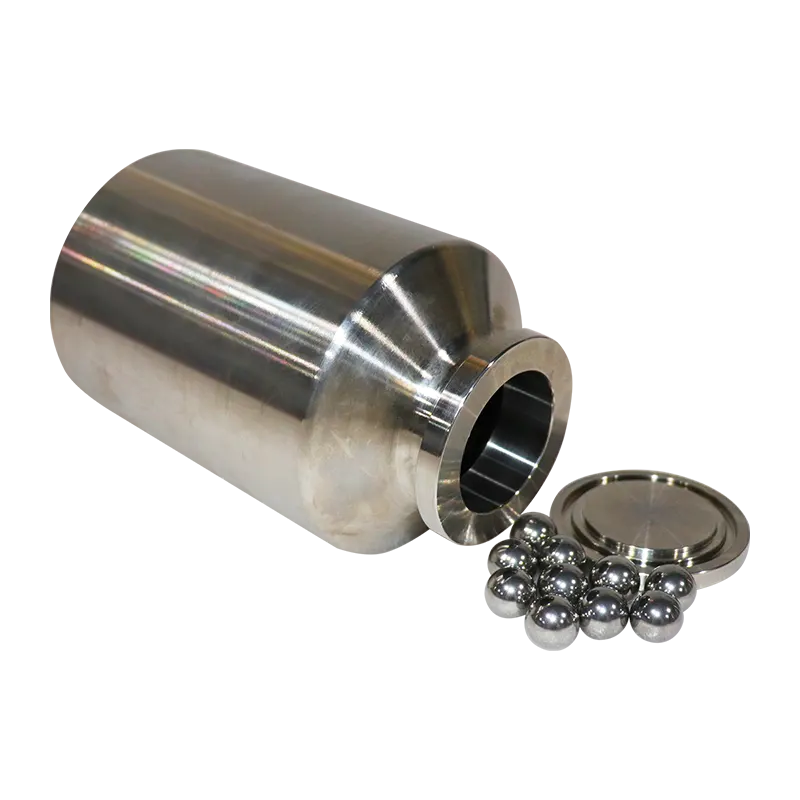
The photo shows a stainless steel grinding drum, a separate product designed for a roller mill. It is given as an example of the design of the grinding container, but does not confirm compatibility with the vibration mill. Even if the material seems suitable, it is necessary to check the fastening, volume, weight, permissible dynamic loads and the recommendations of the manufacturer of the particular machine. It is impossible to transfer the characteristics of one type of drum to another type of equipment.
Cleaning between samples is as important as material selection. Residues from the previous sample in the corners of the chamber, on seals and grinding media may distort the following analysis. The cleaning method depends on the material: dry blowing, rinsing, ultrasonic treatment or annealing are not always applicable and must be compatible with the design. Abrasion over time changes clearances, surface smoothness and grinding efficiency, so the condition of the chamber and balls is periodically monitored.
Selection criteria and compatibility
The selection begins with the task, and not with the name of the mill. It is necessary to determine what mass of sample is required per cycle, what the initial particle size is, what result is considered acceptable and by what method it will be measured. Then they check whether a particular model provides a suitable chamber volume and loading, whether it allows the required chamber material and grinding media, and whether the range of modes is sufficient for the required intensity. For batch sample preparation, issues of reproducibility, cycle time, cleaning and maintenance are added.
- Compare the useful volume of the chamber with the mass and bulk density of the sample, and not just with the passport volume.
- Specify the material of the chamber, seals and grinding media, as well as acceptable wear and cleaning method.
- Check how the frequency, amplitude and grinding time are set and controlled.
- Determine whether cooling is provided and whether sample heating can be controlled.
- Assess noise, vibration, equipment weight, and floor or foundation requirements.
- Ask for information on compatible accessories and do not assume that a container from another mill type will automatically fit.
- Compare results only under the same conditions: material, load, grinding media, mode and measurement method.
Compatibility is not just a geometric coincidence. The mounting of the camera, its weight, permissible accelerations, tightness and method of unloading must correspond to the specific machine. If you have a drum or glass from a roller, planetary or bead mill, it cannot be considered a replacement only in terms of material and volume. For heavy vibration equipment, dynamic balancing, the condition of the elastic elements and the absence of foreign objects in the vibration zone are additionally important.
Current equipment and accessories cards TENCAN collected at manufacturer's website. Before ordering, it is advisable to check the exact design, available options and operating conditions with the documentation; The article describes the principles of selection and does not replace the manual for a specific installation.
Short answers to frequently asked questions
How does a vibration mill differ from a planetary mill?
In a planetary mill, the chambers rotate around their own axis and around a common center, and in a vibrating mill, the chamber oscillates with a given frequency and amplitude. Both principles create impact and abrasion loads, but the nature of the movement, layout and conditions for selecting accessories differ. You cannot transfer the mode of one machine to another without checking.
Is it possible to use a drum from a roller mill in a vibration mill?
Only if the manufacturer has confirmed compatibility for a specific model. Material and volume alone do not prove this: fastening, strength under dynamic loads, tightness and permissible weight are important. A randomly selected container should not become part of the installation.
Does the mill guarantee the specified grinding fineness?
No. The achievable fineness depends on the source material, its hardness and structure, grinding media, loading, medium, time and measurement method. The catalog minimum is a guideline for certain conditions, and not a promise for any sample.
Is cooling necessary for vibration grinding?
It may be necessary if the material is sensitive to heat or the process takes a long time. Air cooling and liquid nitrogen cooling are different solutions; the first should not be called cryogenic. The specific method and its safety are determined by the design of the mill and the properties of the sample.