
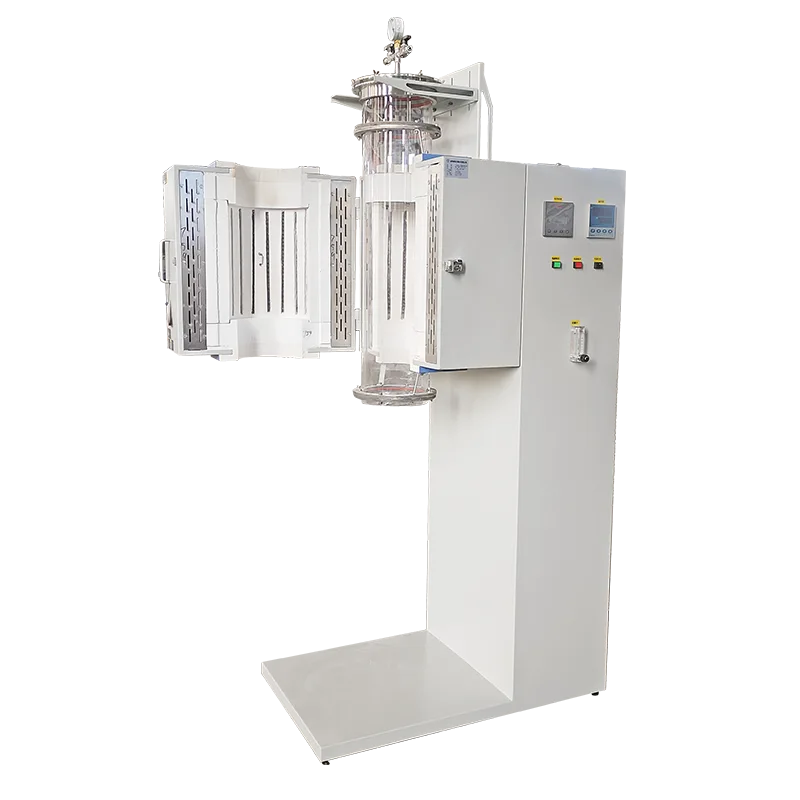
A vertical tube furnace is a heating installation, the working chamber of which is made in the form of a vertical pipe, and the heating elements surround it from the outside. The sample is placed inside the tube - in a crucible, boat or on a suspension - and heated according to a given program: for sintering, annealing, reduction, pyrolysis, roasting or synthesis. This geometry is used in laboratories, research centers and pilot plants when it is necessary to process powders, ceramics, metals, glass, carbon and composite materials in a controlled environment: in air, in an inert gas, in a reducing atmosphere or under reduced pressure.
In the technological route, the furnace takes place after the preparation of the charge - grinding, mixing, and, if necessary, pressing - and before the analytical and finishing operations. That is why, when selecting equipment, it makes sense to look at the entire chain: how the powder is prepared, in which crucible it is heated, what environment is required in the working area and at what speed the sample should cool. Vertical tube furnace TENCAN presented in the section on furnaces and heat treatment equipment.
Below we discuss the structure and operating principle of a vertical tube furnace, its differences from other types of heating equipment, areas of application, rules for reading characteristics and selection criteria. Specific values of parameters - temperature, pipe dimensions, kit composition - are taken from the product card and instruction manual: the same names of components for different models do not mean the same capabilities.
What is a vertical tube furnace: function and design
The task of a tube furnace is to provide the sample with a given temperature profile in a limited volume with a controlled gas environment. The working tube performs several functions at once: it serves as a reactor, separates the heaters from the sample, and forms a channel through which the gas flow moves. In a vertical arrangement, the pipe axis is directed upward, and this determines the loading method, the nature of gas movement and the cooling features of the sample.
What does the installation consist of?
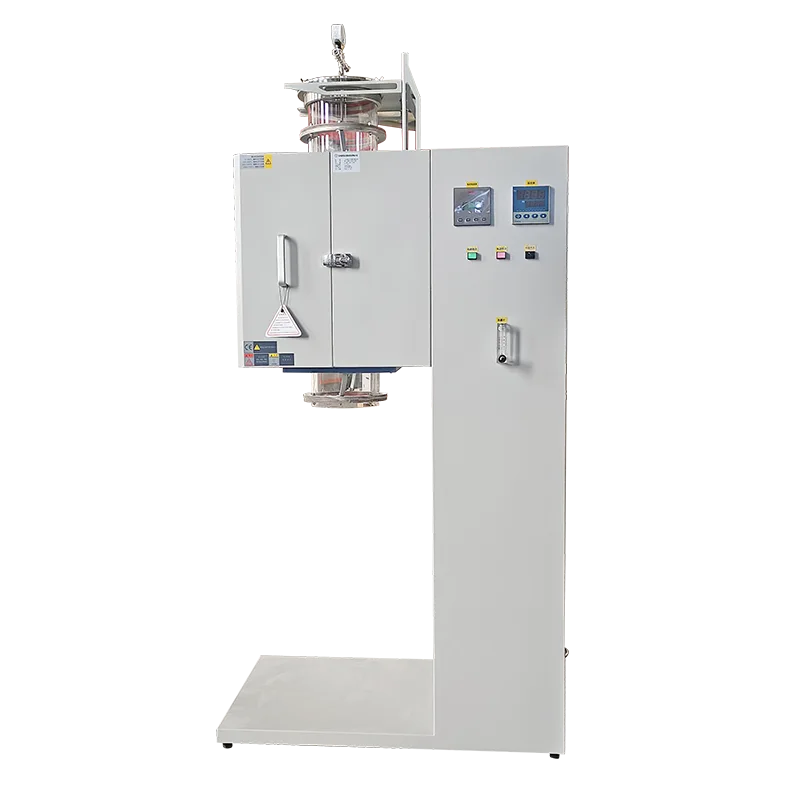
The design of tube furnaces usually includes several functional units. Their specific execution is determined by the product card and manual; The equipment and options of one model are not automatically transferred to the entire model range.
- Working pipe — quartz glass, aluminum oxide (corundum) ceramics or other material. The choice depends on the operating temperature, atmosphere and chemical compatibility with the sample and its decomposition products.
- Heating block — heaters distributed around the pipe, thermal insulation and protective casing. The temperature distribution along the height of the working area depends on the uniformity of their location.
- Flanges and seals top and bottom - provide the sealing required when working with protective gas or when vacuuming.
- Gas path — reducer, flow meter, shut-off and control valves, if necessary, a vacuum pump and pressure control devices.
- Temperature sensor and controller — a thermocouple in the working area and a programmable controller that sets heating, holding and cooling in steps.
- Base and frame, and for some versions - a mechanism for vertical movement of the crucible or sample inside the pipe.
Working principle
Heaters raise the temperature of the tube, and heat is transferred to the sample by radiation, through the gaseous medium and through the crucible or substrate. If gas is blown through a pipe, its flow in vertical geometry naturally moves from bottom to top, carrying volatile reaction products away from the hot zone. The direction of gas supply - from above or from below - is chosen according to the task: with direct and counter flow, the contact of gas with the sample and the removal of products develop differently.
The key difference between a tube furnace and a chamber or muffle furnace is the closed volume of the pipe with a small cross-section. It allows for faster atmosphere changes, less gas consumption, and more precise control of the environment around the sample, but limits the size and weight of the load.
Vertical and horizontal layout: what's the difference
The horizontal tube furnace is convenient for long samples and pulling the boat along the tube. The vertical layout solves different problems and has its own limitations.
- Loading. The crucible or boat is lowered into the pipe from above or fed from below, which simplifies the work with bulk powders.
- Symmetry of heating. The sample is surrounded by heaters on all sides, so the transverse temperature gradient is usually less than in chamber furnaces.
- Moving the sample. If the model is equipped with the appropriate mechanism, the sample can be quickly transferred to the cold zone of the pipe; This technique is used for hardening and fixing a high-temperature state.
- Compactness. The installation takes up less space than a horizontal furnace with a pipe of the same length.
Limitations are also related to geometry: long samples are inconvenient, and condensation of volatile products at the top of the pipe requires attention during maintenance. The choice between vertical and horizontal layout is determined by the shape of the sample, the required cooling rate, and the available space in the laboratory.
What problems are solved in a vertical tube furnace?
Typical applications involve the heat treatment of relatively small samples in a specified environment.
- sintering of ceramic and metal powders, including pre-pressed ones;
- annealing and reduction of oxides in an inert or reducing environment with mandatory consideration of safety requirements;
- pyrolysis and carbonization of organic precursors, production of carbon materials;
- synthesis and modification of catalysts, heat treatment of supports;
- gas-phase processes, including the deposition of layers and the formation of nanostructures;
- thermal testing of materials: assessment of shrinkage, phase transformations and heating behavior.
Limitations to keep in mind
The volume of the working area is limited by the internal diameter and length of the pipe, so large workpieces are not processed in a tube furnace. The pipe material sets not only the maximum temperature, but also the permissible chemistry: quartz and corundum behave differently when in contact with alkalis, fluorides and metal vapors. The cooling rate is limited by the thermal inertia of the installation, and rapid quenching is only possible if there is an appropriate mechanism for moving the sample. Finally, a tube furnace is not a high-pressure reactor: overpressure and tightness have their limits, which are indicated in the documentation. Assortment equipment TENCAN includes, in addition to furnaces, sample preparation devices - mills, mixers, presses - which allows you to build a coordinated chain of operations.
How to Read the Specifications of a Vertical Tube Kiln
Maximum and continuous operating temperature
These are two different parameters and should not be confused. The maximum temperature is a short-term limit, long-term operating temperature is the value at which the installation is designed to operate during its service life. The mode should be planned based on long-term temperatures, leaving a reserve: constant operation at the limit accelerates wear of the heaters and pipes. Separately take into account the temperature permissible for the pipe and crucible material: it may be lower than the capabilities of the heating block.
Pipe: material, diameter, length, hot zone
The internal diameter and length of the pipe determine the maximum sample size and useful volume. In this case, it is important to distinguish between the full length of the pipe and the extent of the zone with a uniform temperature: outside this zone, the temperature drops noticeably, and the sample extending beyond its boundaries is heated unevenly. If the documentation indicates the length of the heating zone, it is this, and not the total length of the pipe, that determines the working space.
Atmosphere, vacuum and gas flow
To operate in a protective environment, the tightness of the installation, permissible overpressure, maximum residual pressure and gas flow control range are essential. The purity of the gas also affects the result: traces of oxygen or moisture can change the course of the reaction. Working with hydrogen or carbon monoxide requires a separate safety assessment - ventilation, leak control and operating procedures, not just the choice of oven mode.
Heating speed, cooling and control accuracy
The heating rate determines the gradients within the sample and the risk of cracking; controller accuracy - mode reproducibility from experiment to experiment. It is necessary to distinguish between the speed set by the program and the real rate of change in the temperature of the sample itself: they do not always coincide. Air cooling and cryogenic processing are fundamentally different processes. Liquid nitrogen requires separate equipment and a separate technique, so conventional air cooling is not called cryogenic.
How to choose a vertical tube furnace for a specific task
The first step is to describe the sample and mode
Before comparing models, it is worth recording the mass and shape of the sample, the initial powder size, the required maximum temperature, holding time, medium, permissible impurities and the desired cooling rate. They separately formulate what exactly is considered the result: sintered material, recovered powder, coating or thermal analysis data. Without this, it is impossible to compare models with each other.
Coordination of materials
The material of the tube, crucible and substrate must be compatible with the sample at the operating temperature: interaction, adhesion, evaporation of components and transfer of impurities from the crucible to the sample are possible. For materials sensitive to contamination, this factor may be more important than the heating capacity of the installation.
Atmosphere, safety and accommodation
They check whether there is a gas supply, product outlet, ventilation of the room, power supply of the required power and a place for installation, taking into account access to the pipe from above. When working with flammable gases, the purge and control procedures are determined in advance.
Check the package according to the documentation
The heating block, controller, flanges, gas lines and movement mechanisms may be included as standard or supplied separately. The list of components and their parameters is specified in the product card: vertical tube furnace described there with an indication of the available versions. Discussion of selections does not replace the operating instructions for a specific installation.
Frequently asked questions
Is vertical tube furnace suitable for sintering metal powders?
Yes, if the temperature, atmosphere and pipe material are suitable for the task. Metals often require a protective or reducing environment, so gas tightness and gas purity are critical. The mode is selected according to the properties of a specific powder and the requirements for the sintered material, and not according to the general description of the furnace.
How does a tube furnace differ from a muffle furnace?
A chamber muffle furnace: the sample is located in the chamber volume, and it is more difficult to change the medium in it. Tubular operates in a narrow channel, which speeds up the replacement of the atmosphere and reduces gas consumption, but limits the size of the load. These are different tools, and they are selected according to the sample shape and environmental requirements.
Is it necessary to evacuate the pipe before supplying gas?
Depends on the sensitivity of the material to oxygen and moisture. In some cases, purging is sufficient, in others, preliminary evacuation with gas replacement is required. The criterion is the permissible content of impurities in the working environment, and not the convenience of the operation.
Can liquid nitrogen be considered part of normal furnace cooling?
No. Air cooling is the removal of heat by the installation itself, cryogenic processing is a separate process with liquid nitrogen and special equipment. It is impossible to call a conventional tube furnace cryogenic without confirmation from the documentation.