
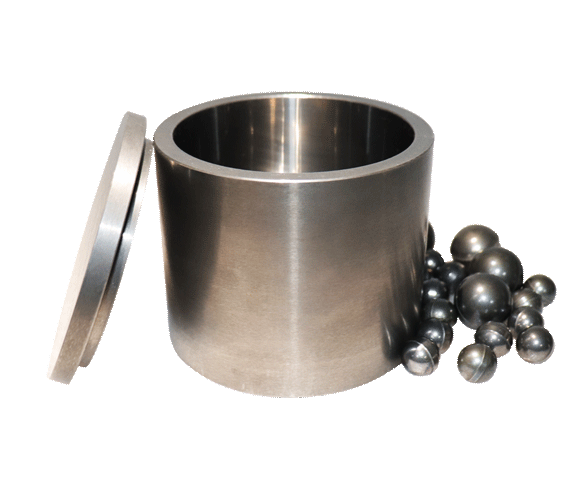
The tungsten carbide grinding bowl for planetary mill is the working vessel in which the sample and grinding media are kept during grinding. Its task is to hold the powder and balls, transfer energy to them from the planetary drive, ensure tightness and form a wear-resistant surface of the chamber. Such a glass is not an independent mill: it is installed in a specific model of a planetary mill and works only as part of this system. In the catalog TENCAN (Changsha Tianchuang Powder Technology Co., Ltd.) изделие представлено как tungsten carbide grinding bowl; Its function, limitations and selection criteria are discussed below without reference to unconfirmed parameters.
What is a tungsten carbide grinding bowl and where does it work?
In the technological chain of sample preparation, the glass is located between the sampling stage and the analysis operations. The source material is loaded together with the grinding media, the glass is closed, secured in the mill and the grinding mode is started. After grinding, the sample is unloaded and the glass is cleaned. For the laboratory, this is both a working unit and part of the measuring chain: the wall material, surface condition and quality of cleaning affect what ends up in the final powder.
The name of the material primarily describes the camera material, but not the entire process. Tungsten carbide is not “pure tungsten” or regular carbon steel. Technical products under this name often use a tungsten carbide-based carbide, which may contain a binder phase. Therefore, the same inscription on the card does not mean the same composition, wear and acceptable conditions. For a specific batch, the passport, composition, geometry and manufacturer’s recommendations are important.
It is necessary to distinguish between the glass itself, the grinding media and the mill. The glass does not create rotation and does not set speed; it only perceives the load and transfers it to the sample. The planetary mill provides a complex movement in which the glass rotates around its own axis and around the axis of the carrier. Due to this, the balls repeatedly collide with the material and wear it out. If the mounting dimensions, weight or fastening do not match the mill, proper grinding will not occur even if the glass material is suitable.
Design and working principle
A typical design includes a cup body, lid, seal and fastening elements. The exact set of nodes depends on the design, so it is impossible to transfer the characteristics of one glass to the entire assortment. For work, not only the internal volume is important, but also the wall thickness, the condition of the edge, the quality of the lid's fit and the ability to securely fix the glass in the socket. These parts determine rigidity, tightness and ease of cleaning.
Grinding in a planetary mill occurs due to impact and abrasion. The balls are accelerated and collide with each other and with the walls, destroying the sample particles. The glass material must withstand these loads, not deform and not become an additional source of powder. Tungsten carbide is valued here for its high hardness and wear resistance, but it also requires careful handling: the hard alloy can be brittle and sensitive to shock overloads.
Tightness is especially important when wet grinding and working with dusty powders. However, absolute tightness cannot be promised without testing the specific cap, seal and mode. If the process uses solvents or creates excess pressure, this must be consistent with the beaker and mill documentation. Normal laboratory air does not become cryogenic just because the sample is heated or, conversely, requires cooling.
Tungsten Carbide: Properties, Advantages and Limitations
Tungsten carbide has high hardness and density, so it is considered where resistance to abrasive wear is needed. Compared to softer materials, such a glass changes geometry more slowly during prolonged work with hard powders. High density increases the mass of the assembly, which can affect the balancing and load on the mill; this must be taken into account when choosing a standard size, and not just when assessing “strength”.
The advantage of the material does not mean the absence of impurities. When worn, tungsten and components of the binding phase, if present in the alloy, can pass into the sample. This is fundamental for trace analysis: even a small amount of metal can distort the result. The concept of “zero contamination” for the grinding bowl and grinding media is incorrect. It is more correct to talk about the acceptable level and method of control: blank experiment, analysis of a witness, comparison with alternative material.
The limitations of tungsten carbide are related to the brittleness, weight, cost and chemical resistance of a particular design. It should not be considered a universal container for any aggressive reagents. If work with acids, alkalis or unusual media is expected, a separate check of compatibility with the material of the cup, lid and seal is necessary. In tasks where even small traces of tungsten are unacceptable, agate, zirconium dioxide, corundum or polymer options are sometimes more appropriate, but the choice is made based on the entire set of conditions, and not on the word “solid” alone.
Dimensions, volume and loading: how to read specifications
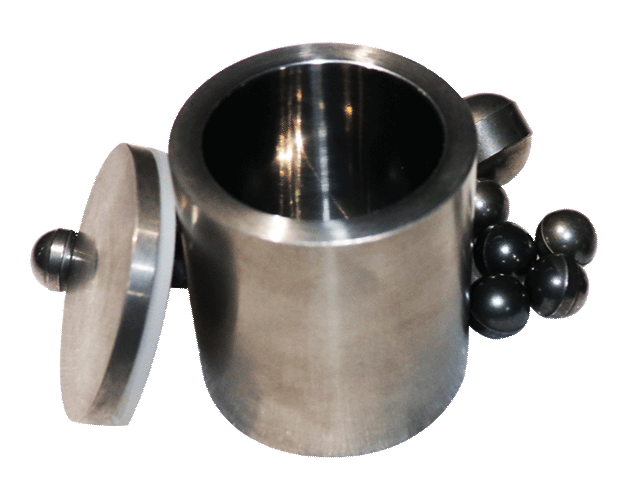
The first thing that needs to be separated is the nominal volume of one glass, the total volume of the set, free volume, loading weight and finished sample weight. These are different quantities. If the description indicates the volume of the glass, it is not equal to the mass of powder that can be obtained in one cycle. The working load depends on the density of the sample, the density and size of the grinding media, the desired size and permissible heating. Specific limits should be taken from the mill manual and product card, rather than calculated from a single number.
Too large a load reduces ball mobility, increases heat, and may reduce grind uniformity. Too little loading is also not always effective: the number of contacts decreases, and part of the energy is spent on empty space. Therefore, when selecting a glass, not only the dimensions are important, but also the reproducibility of the regime. The mass of the glass together with the balls and the sample must correspond to the permissible load of the mill; overload is not compensated by stronger material.
The final particle size depends on the initial particle size, sample hardness, medium, time, ball ratio and mode. Cup material affects wear and contamination, but does not guarantee a specific fineness for any powder. The standard minimum from the catalog cannot be automatically transferred to a specific material. If the card does not indicate the required dimensions or the units are in doubt, it is better to request clarification than to substitute a value from another model.
Compatible with mill, grinding media and applications
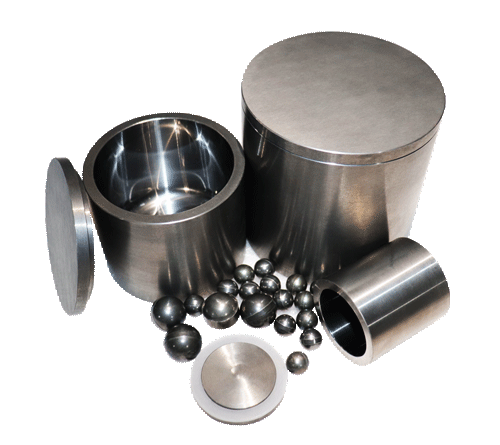
The compatibility of the glass with the planetary mill is determined by the seat, external dimensions, height, method of fastening, weight and permissible speed. The coincidence of the word “planetary” in the names does not prove that a particular glass will fit a particular machine. It also cannot be assumed that the grinding bowl is suitable for a roller, bead or vibration mill: these are different operating principles and different mounting units. The three-dimensional mixer solves the problem of mixing rather than planetary grinding; its presence in the assortment does not confirm compatibility with the glass.
The grinding media are selected together with the glass. It is necessary to take into account the material of the balls, diameter, quantity, density and wear. Using balls of the same material reduces the number of different sources of impurities, but does not completely eliminate wear. Mixing balls of different materials can complicate the interpretation of contamination. In addition, balls that are too large or heavy will increase the impact load, while balls that are too small may not be effective for a given particle size. These issues are resolved based on documentation and preliminary experiments, and not on the promise of a “universal” download.
Dry and wet grinding differ not only in convenience. Liquid media reduces dusting, can improve particle distribution and reduce aggregation, but adds requirements for containment, chemical compatibility and cleaning. After wet grinding, it is important to remove residual liquid, dry it, and check whether the sample material has changed. You cannot give a universal solvent recipe, temperature or time for all substances; Hazardous and reactive materials require separate instructions.
Tungsten carbide is typically considered for hard, brittle and abrasive applications where wear resistance and geometry retention are important. But suitability is determined by the permissible contamination and the analysis task. If tungsten trace control is critical, the cup material may be a limitation. If the sample is prone to sticking or requires very gentle handling, the benefits of carbide may not necessarily solve the problem. The choice is based on the properties of the sample and the requirements for the result, and not on the maximum hardness itself.
Wear, cleaning, addition of impurities and selection criteria
Wear is assessed by the condition of the inner surface, edge, cover and seal. The appearance of deep scratches, chips, changes in geometry or poor fit of the cover is a reason to stop work and clarify the permissibility of further use. Abrasive powder, long cycles, high speeds and improper loading will accelerate wear. A small loss of wall material may not be noticeable visually, but is important for trace analysis, so for sensitive tasks a blank test and periodic monitoring are used.
Cleaning should remove sample residues but not damage the surface. Typically a suitable solvent, a soft brush and rinsing and then drying are used; The specific method depends on the cup material, seal and manufacturer's instructions. Do not use aggressive reagents without checking compatibility. Effective cleaning between different samples is necessary, otherwise the previous sample will become a source of contamination. For wet grinding, it is especially important to check that no liquid remains in the pores, threads or seals.
When choosing, it is useful to go through the list. First, the task is determined: grinding, disagglomeration or mixing only. Then the required size, acceptable contamination and chemical environment are recorded. After this, the volume of one glass, the load weight, dimensions and attachment to the mill are checked. Grinding media, mode and cleaning are separately coordinated. At the end, they ask for the current card, material composition, available versions and operating conditions. This arrangement helps avoid turning a durable glass into a source of error.
In the card TENCAN The material specified for the product is “tungsten carbide” and the purpose is a grinding bowl for a planetary mill. This is enough to understand the product's place in the system, but not enough to assign any size, speed, or guaranteed purity to it. Missing parameters are not restored by guessing. If a specific mill requires a different size or design, this must be confirmed by documentation.
Brief answers to frequently asked questions
Is tungsten carbide beaker suitable for any sample?
No. It is being considered for hard and abrasive materials, but contamination tolerance, chemical compatibility and mill parameters remain a priority. Trace analysis of tungsten requires particularly stringent controls.
Can this glass be used for wet grinding?
Sometimes yes, if the specific design, cap and seal allow it, and the environment is compatible with the materials. You cannot transfer resolution from one model to all glasses; Proper cleaning and drying is required after work.
How is tungsten carbide different from agate or zirconium dioxide?
These are different materials with different balances of hardness, wear, weight, fragility and possible impurities. Tungsten carbide wins in terms of wear resistance, but can be heavier and is not suitable where traces of tungsten and binding components are unacceptable.
How to check compatibility with the mill?
It is necessary to compare the landing dimensions, fastening, weight, volume and permissible mode with the mill manual and the cup card. The name "planetary mill" is not enough. Please check the website for current information. TENCAN.