
A tungsten carbide grinding bowl is a replaceable working element of a planetary ball mill, inside which the sample is crushed and homogenized. Unlike cups made from soft materials, tungsten carbide is chosen for processing hard, abrasive and brittle samples where high wear resistance and minimal distortion of the particle size distribution are required. The glass is installed in the socket of the planetary mill carrier and, together with the grinding media, participates in a complex movement, providing an intense impact and abrasion effect on the material. More information about a specific model can be found on the page Tungsten Carbide Grinding Bowl for Planetary Mill.
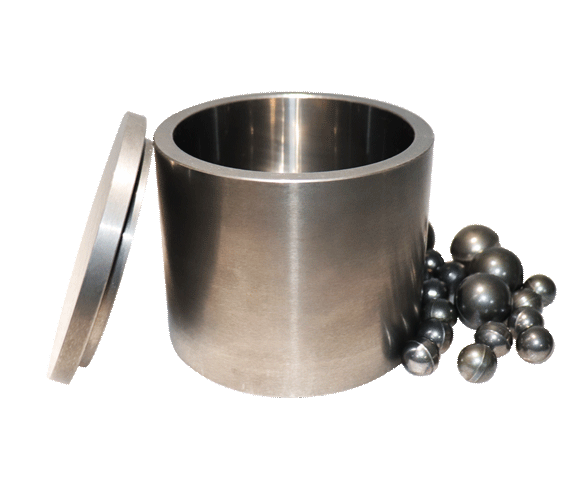
Function and place in the grinding process
The planetary ball mill operates on the principle of complex rotation: the grinding bowls rotate around their own axis and at the same time around the central axis of the carrier. The resulting centrifugal forces cause the grinding media to repeatedly hit the walls of the glass and each other, as well as grind the material. The glass in this system performs several tasks: it holds the sample and grinding media, transfers energy to them from the drive and protects the external environment from powder scattering. The grinding efficiency, sample purity and service life of the equipment directly depend on the properties of the beaker.
Grinding in a planetary mill is not just mechanical destruction. Depending on the mode and material, impact or abrasive loads predominate. Hard and brittle samples fail primarily through impact, while ductile or fibrous materials require shear forces. Tungsten carbide, having high hardness and density, transfers impact energy well, so it is often considered for tasks where it is necessary to quickly bring solid powder to micron and submicron sizes. However, such a glass is not a universal solution: for soft materials it may be redundant and introduce unwanted contamination.
Material: tungsten carbide
Tungsten carbide (WC) is a compound of tungsten and carbon that is sintered into solid products. In technology, most often they use not pure WC, but a hard alloy based on it, where cobalt or another metal acts as a binder. It is the composition of the binder that largely determines the strength, viscosity and tendency to chemically interact with the sample. The product card only indicates “tungsten carbide,” so before choosing, you should check with the manufacturer for the exact brand composition if it is critical for trace analysis.
Hardness and wear resistance
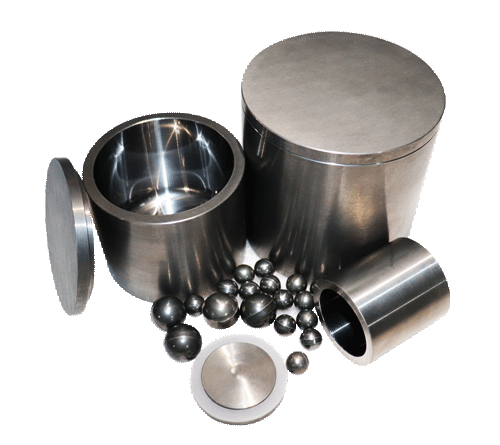
Tungsten carbide is second in hardness only to diamond and some superhard materials. This makes it attractive for grinding abrasive samples: oxides, carbides, minerals, ceramics, slags. High wear resistance means that the glass retains its geometry longer and changes its granulometric composition less due to its own wear. However, wear resistance does not equal absolute immutability: with prolonged use, even WC wears out, especially when processing very hard materials.
Density and grinding energy
The density of tungsten carbide is significantly higher than that of steel, agate or zirconium oxide. This affects the dynamics of the process: heavier grinding media and bowl walls transfer more kinetic energy during collisions. As a result, grinding can proceed faster and achieve smaller particle sizes in the same time. But high density increases the load on the bearings and mill drive, so when choosing a glass it is important to comply with the weight restrictions specified by the equipment manufacturer.
Introduction of impurities
No grinding bowl is completely inert. During the grinding process, the material of the bowl and grinding media wears out, and wear products enter the sample. Tungsten carbide is characterized by the addition of tungsten and, if a cobalt binder is used, cobalt. Even small amounts of these elements can distort trace analysis results. Therefore, the “zero pollution” claim does not apply to WC glasses. If the sample is subsequently tested for W or Co, it is worth considering alternative materials such as agate or zirconia, or performing blank runs to evaluate the background.
Comparison with other materials
Agate and zirconium oxide contaminate the sample with metals less, but are inferior to tungsten carbide in hardness and density. Agate is fragile and not suitable for very hard materials. Zirconium dioxide is more viscous, but can also introduce traces of zirconium. Stainless steel is cheaper, but wears quickly in abrasive tests and is contaminated with iron, chromium and nickel. Polymer cups (nylon, PTFE) are suitable for soft materials and do not introduce metals, but do not withstand high impact loads. The choice is always a compromise between grinding speed, wear and cleanliness.
Design and Compatibility
A grinding bowl is more than just a container. It must fit accurately into the seat of the planetary mill, withstand high centrifugal loads and ensure tightness. Compatibility is determined by several parameters: fit dimensions, fixation method, volume and weight. There is no universal cup that would fit all models of planetary mills, even within the same manufacturer.
Geometry and fit dimensions
The outer diameter, height, shape of the flange and the location of the fixing elements must correspond to the carrier socket. If the cup is not the right size, it may not clamp properly, may move during rotation, or cause dangerous vibration. In addition, different mills are designed for different volumes of glasses. Using a bowl that is too heavy or large may exceed the load capacity of the drive. Therefore, when ordering, always check the model of the mill and the catalog number of the glass.
Lid and sealing
For wet grinding and work in an inert atmosphere, tightness is important. The cap usually has an O-ring or gasket. The seal material must be compatible with the solvent or gas used in the process. For example, some elastomers swell in organic solvents, resulting in depressurization and sample loss. If you plan to grind with a liquid medium, check whether the glass is designed for this mode and what seals are supplied.
Grinding media
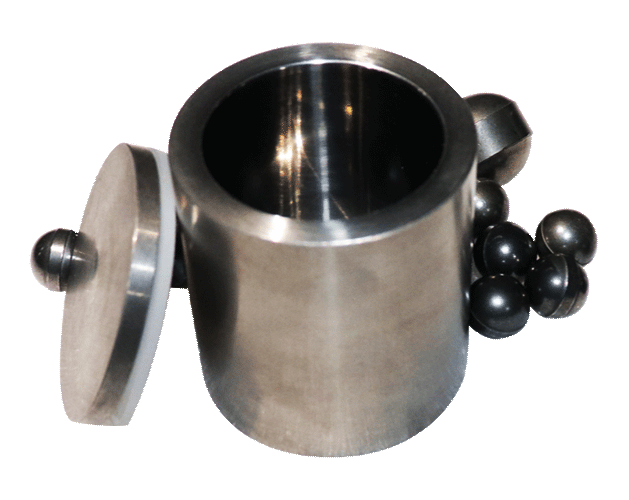
Grinding media are the second half of the system. For tungsten carbide cups, it is logical to use balls of the same material to reduce the risk of heterogeneous contamination. However, this is not necessary: sometimes zirconia or steel balls are chosen if their density and chemical resistance are better suited for a particular sample. It is important that the diameter and number of balls correspond to the volume of the glass and do not create excess pressure on the walls. The manufacturer usually provides loading weight recommendations that should not be exceeded.
How to read specifications correctly
There are different numerical parameters in the descriptions of grinding bowls, and it is easy to confuse them. Below we explain what typical values mean and what to pay attention to.
Cup volume and loading
The nominal volume of the glass is the full internal capacity. The working volume that can be occupied by the sample and grinding media is usually from one third to one half of the nominal value. If you add too much, the grinding media will not be able to move freely and grinding will slow down. In addition, the mass of the sample depends on its bulk density: a light powder will occupy a large volume with a low mass, a heavy powder - vice versa. Therefore, when selecting a glass, they are guided not only by volume, but also by the desired mass of the sample and the density of the material.
Dimensions and weight
The overall dimensions of the glass are important for compatibility with the mill. The mass of the cup affects the balancing of the carrier: if the cups in opposite sockets have different masses, vibration occurs. Some manufacturers require the same cups and the same loading in all positions. Therefore, you should not replace one glass with another without checking the permissible imbalance.
Temperature and pressure
The characteristics of the glass usually do not indicate the operating temperature, since it is determined by the grinding process. During intense grinding, the temperature inside the beaker may rise. Tungsten carbide is heat resistant, but sealing materials may have limitations. If cryogenic grinding with liquid nitrogen is required, a regular beaker does not automatically become cryogenic: special designs and manufacturer confirmation are required. The pressure in the sealed glass is also not a standard parameter and should not be calculated independently without instructions from the manufacturer.
Application and Limitations
Suitable materials
Tungsten carbide glasses are most often used for hard, brittle and abrasive materials: minerals, ores, glass, ceramics, oxides, carbides, metal powders, catalysts. They work well in dry and wet grinding as long as the material does not interact with the components of the glass. For very hard samples, a WC beaker may be the only option that will withstand long-term loading without rapid wear.
Restrictions
The main limitation is the possible contamination of the sample with tungsten and cobalt. For trace analysis, these elements may be critical. In addition, tungsten carbide is a heavy material and its use increases the load on the mill. It is not suitable for soft, viscous or fibrous materials where shear rather than impact is required; in such cases, it is better to choose other materials or types of mills. Finally, the bowl must be compatible with the specific planetary mill model, not just the drive type.
Selection criteria and cleaning
Selection for the task
When choosing a tungsten carbide glass, consider:
- sample hardness and abrasiveness;
- required final fineness and grinding energy;
- permissible level of sample contamination;
- chemical compatibility with solvents and gases;
- compatibility with the mill model in size and weight;
- availability of grinding media of suitable material and size.
If sample purity is more important than wear rate, agate or zirconia is the choice. If you need to grind a particularly hard material and the loss of a few tenths of a percent of impurities is acceptable, tungsten carbide provides an advantage. In doubtful cases, it is useful to carry out a test grind and analyze the background.
Cleaning and Maintenance
The beaker is cleaned after each grind to avoid cross-contamination between samples. Typically a soft brush, a suitable solvent and an ultrasonic bath are used if permitted by the manufacturer. Aggressive acids can destroy the cobalt bond, so their use without consultation is not recommended. The O-rings are removed and washed separately, and replaced when worn. Regularly inspect the internal surface: cracks, chips, deep scratches or discoloration indicate the need for replacement. A worn glass not only makes grinding worse, but also increases sample contamination.
Frequently Asked Questions
Can a tungsten carbide beaker be used for wet grinding?
Yes, if the seal and cup material are compatible with the liquid. Water is usually safe, but organic solvents may attack the gaskets. Before use, check the manufacturer's recommendations.
Which grinding media material should I choose for the WC cup?
Optimally, tungsten carbide balls are used to minimize heterogeneous contamination. If this is not possible, select a material that will not interfere with subsequent analysis and has a suitable density.
How can you tell if a glass is worn out?
Signs of wear: chips, cracks, ring wear, darkening of the surface, increased grinding time. If such defects are detected, the glass is replaced.
Does tungsten carbide introduce contamination into the sample?
Yes, any material wears out. WC can add tungsten and cobalt to the sample. The statement about the complete absence of pollution is incorrect. For trace analysis, this factor is taken into account.
Is this beaker suitable for any planetary mill?
No, compatibility is determined by fit dimensions, volume and weight. It is necessary to check with the passport of a specific mill. Details are on the page goods.
Range of grinding bowls and grinding media TENCAN includes other materials, which can be found at manufacturer's website.