
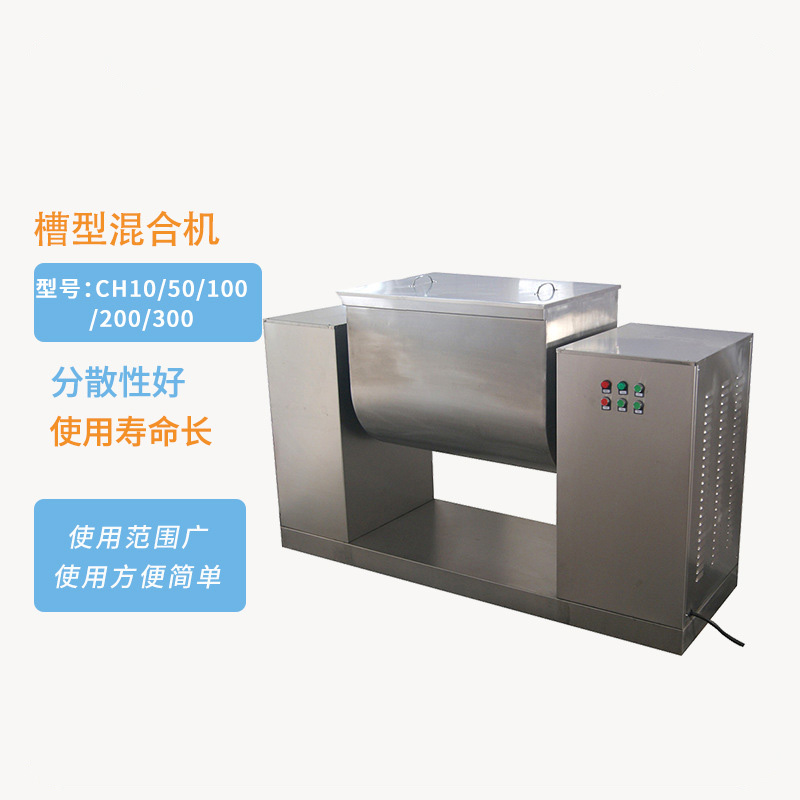
A horizontal trough-type mixer is equipment for averaging and mixing bulk materials, granules and pasty masses in a working chamber made in the form of a trough. In the process chain, it is usually located between the dosing of components and the next operation - molding, drying, sintering, packaging or sampling. In the catalog TENCAN the product is presented on the page horizontal trough type mixer; The specific design, dimensions and equipment should be checked using the current card.
Such equipment solves the problem of distributing components, rather than reducing particle size. It is important to separate this: a ball, planetary or bead mill changes the particle size due to grinding media and grinding energy, while a trough mixer creates directed movement of the material and its repeated redistribution. If the technological goal is grinding, the mixer does not replace the mill; if the goal is to obtain a homogeneous mass from several fractions, additives or a binder, we are talking about a different operation.
What is a horizontal trough type mixer and where is its place in the process?
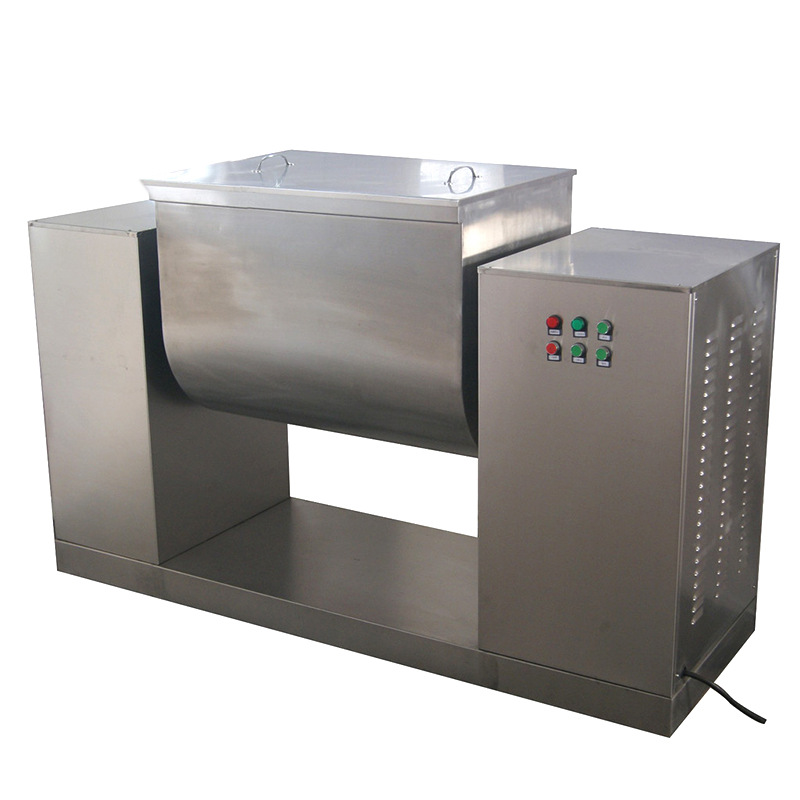
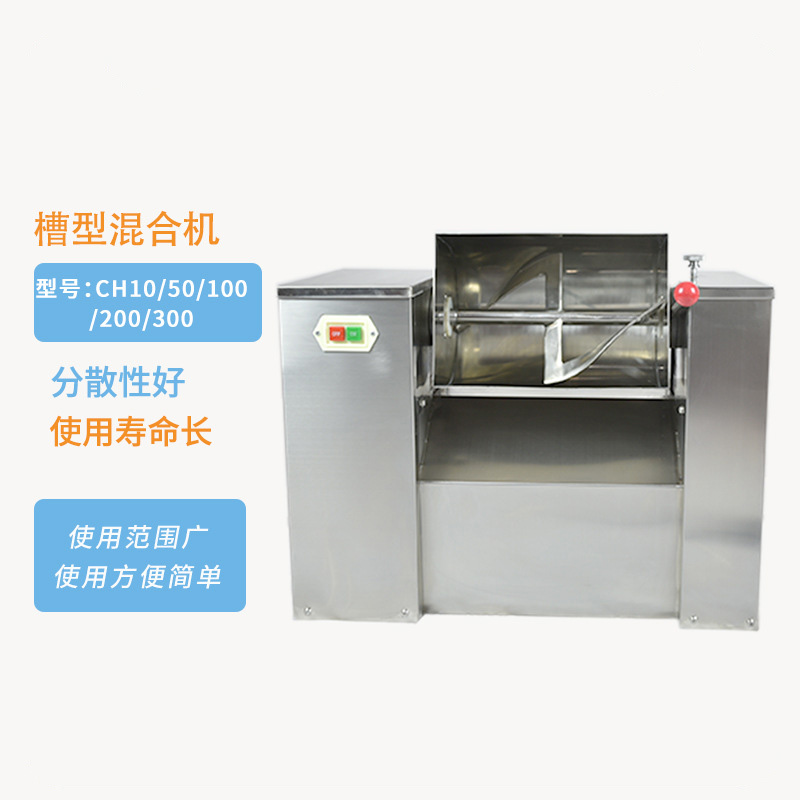
The name indicates two design features: the working chamber has the shape of a trough, and the shaft with mixing elements is located horizontally. The material is loaded into the trough, grabbed by blades or knives and moved along and across the working area. As a result, the components are repeatedly redistributed, the lumps are partially destroyed, and liquid, if added, is distributed over the surface of the particles.
The trough design is found in tasks of different scales, however, the properties of one standard size cannot be transferred to the entire series: the geometry of the trough, the shape of the blades, the drive, seals and unloading may vary. For a specific model, it is precisely those parameters that are confirmed in the card that are important, and not general assumptions based on the name.
The location of the mixer in the production line is determined by the task. This may be preparing the charge before pressing, averaging the powder before packaging, introducing a small additive, pre-mixing the components before granulating, or preparing a paste. In each case, the requirements for uniformity, cycle time, cleanliness and contact materials are different, so the same machine does not have to be optimal for all of these operations.
Design and working principle
Main nodes
- Trough. The working chamber in which the material is located. Its shape, useful volume and wall material affect loading, flow and cleaning.
- Horizontal shaft. Carries mixing elements and transmits torque to them. Stiffness, alignment and quality of seals are important for a shaft.
- Blades or knives. Create material movement. Their number, installation angle, pitch and gap relative to the walls determine the nature of the circulation and the absence of stagnant zones.
- Drive. Provides shaft rotation. When selecting, not only the rated power is taken into account, but also the starting torque, loading density and possible medium resistance.
- Unloading unit. Determines how completely and conveniently the finished mass is unloaded. For different materials, the shape of the hole, location and method of closing are important.
- Cover and seals. They limit dust, protect from external contamination and can participate in organizing the supply of liquid or removal of gases, if provided for by design.
- Fluid supply system. When mixing wet or introducing a binder, it should ensure uniform distribution without local waterlogging.
The specific set of components and materials of execution is determined by the manufacturer. Any option mentioned for one faucet should not be assumed to be standard on another. Before ordering, it is useful to check the list of components, contact material, type of unloading and washing requirements.
What happens to the material
A trough mixer combines several mechanisms. Large-scale circulation carries material from one part of the chamber to another; shear deformations act in the zones between the blades and the wall; gradual mutual penetration of particles ensures diffusion leveling of the composition. For bulk materials, shedding, rolling and destruction of fragile agglomerates are also important.
Rotation speed and blade shape affect intensity, but are not the only indicator of quality. Excessively vigorous application may overheat sensitive material, crush fragile granules, or increase dusting. Too weak - leaving stagnant zones and lumps. Therefore, the operating mode is selected for a specific mixture, and not just for the name of the equipment.
Mixing time depends on the initial heterogeneity, bulk density, particle size distribution, moisture content, tendency to agglomerate and the required homogeneity. One time value from the passport cannot guarantee the same result for any powder. If the material is prone to clumping or sticking to walls, design and cleaning become as important as the drive.
Dry, wet mixing and paste preparation
Dry mixing is used when components must remain free-flowing. The main risks here are the segregation of particles of different densities and sizes, dusting, sticking to working parts and incomplete unloading. For such applications, sealing, efficient unloading and the absence of areas where material is retained are important. Not every seal automatically makes a machine suitable for handling fine powders; this issue needs to be verified by execution.
Wet mixing involves the introduction of a liquid or binder. The task is not only mixing, but also uniform wetting of the surface of the particles. If the liquid is applied locally, dense lumps may form, which are then difficult to distribute. Therefore, in such processes, the feeding method, the loading sequence and the ability to regulate the amount of liquid are important. Specific formulations and regimens for hazardous or reactive components should be determined by documentation and internal procedures rather than by a general clause.
When preparing pastes, the load on the drive and working parts increases, and the properties of the mass depend on humidity, dispersion and the nature of the binder. The paste can have a high resistance to movement, so it is especially important to confirm the suitability of a particular design. Don't assume that a mixer that handles dry powder is automatically suitable for thick paste.
It is necessary to distinguish between mixing, wetting and deagglomeration. A mixer can distribute ingredients and partially break up soft lumps, but it is not a mill and does not replace the grinding operation. If the application requires achieving a specified particle size distribution, different equipment or a separate processing step will be required.
How to read the characteristics of a mixer
It is useful to separate geometric, kinematic and operational parameters in the equipment card. Even correct numbers can be misunderstood if you don't consider what they refer to.
- Geometric volume of the trough. This is not yet a useful download. The working volume is usually less than full, since the material must move freely and the blades must not operate in a crowded chamber.
- Weight of the party. It depends on the bulk density and cannot be converted from liters by simple equality. For light powders and dense granules, the same container gives different masses.
- Mixing time. This is a technological parameter, not a universal constant. It must be validated for the specific mixture and required homogeneity.
- Shaft rotation speed. By itself, it does not describe the intensity of the impact: the diameter and geometry of the blades are important, so the peripheral speed on the working body is also useful.
- Drive power. It is evaluated along with the starting mode, loading density and type of environment. For pastes and wet masses, the torque reserve is more important than the nominal figure alone.
- Contact material. Stainless steel, polymer coating or other options have different limits for abrasiveness and chemical resistance. The material should not be selected based solely on appearance.
- Unloading and cleaning. Ease of unloading, access to internal surfaces and washability influence product loss and the risk of cross-contamination between batches.
- Additional features. Fluid supply, cap, seals, sensors and other components must be confirmed for the selected design. The option does not automatically become a standard.
Productivity in kilograms per hour cannot be derived only from the volume of the trough. It depends on the load weight, cycle time, loading and unloading operations, material density and uniformity requirements. For one task, a short cycle will be decisive, for another - careful handling of granules or thorough cleaning.
Materials, limitations and selection criteria
Material and wear
When choosing the material of the trough, blades and seals, abrasiveness, acidity or alkalinity of the medium, temperature, tendency to stick and the permissible level of contamination are taken into account. Abrasive powders gradually wear out working parts and walls; soft polymer materials may be appropriate for delicate products, but have their own loading and cleaning limitations. Stainless steel does not mean complete absence of wear or transfer of impurities: the specific grade, surface condition and operating conditions are important.
Application Limitations
The trough mixer is not a universal solution for all materials. Strongly adhesive masses can form stagnant zones, fragile granules can be destroyed, and heat-sensitive components can heat up from mechanical work. For flammable and toxic powders, special measures are required, confirmed by the design, and not just a general idea of u200bu200btightness. You should not transfer the parameters of one mixer to another without checking the geometry, drive and materials.
Separately, it is necessary to distinguish between a laboratory experiment and a production cycle. In the laboratory, low sample weight, reproducibility, and ease of cleanup are important; in production - stability of loading, unloading, maintenance and repeatability from batch to batch. The same equipment name does not guarantee the same result at different scales.
Selection procedure
- Formulate a technological goal: averaging, adding an additive, wetting, preparing a paste, or preparing for the next operation.
- Describe the material: bulk density, particle size distribution, moisture content, abrasiveness, tendency to stick together and acceptable contact with machine materials.
- Determine a reasonable mass per batch and the desired cycle, not just the total trough volume.
- Check whether a dry or wet process is required, how the liquid is supplied and how uniformity is controlled.
- Coordinate the material of the working parts, seals and discharge unit with the requirements for product purity.
- Assess maintenance: access for cleaning, replacement of wear parts, safety of loading and unloading.
- Check the selected design with the manufacturer and request confirmation of parameters for a specific task.
Current information on the selected equipment is available on the page horizontal trough type mixer. If you need to compare designs or clarify the equipment, it is useful to start from the properties of the material and the actual cycle, and not just from the appearance of the machine. General product directions TENCAN presented on manufacturer's website.
Frequently asked questions
How is a trough mixer different from a ball mill?
A ball mill reduces particle size by impact and abrasion of the grinding media. The trough mixer is designed primarily to redistribute components and obtain a more homogeneous mass. If grinding is needed, mixing alone is not enough.
Can wet materials and pastes be mixed in it?
This depends on the specific design, drive, blade geometry and unloading. The ability to work with paste must be confirmed for the selected model. A dry powder mixer cannot be assumed to be automatically suitable for thick mixtures.
What is more important: trough volume or loading weight?
The payload expressed in mass for a particular material is important for selection. The volume of the trough is only a geometric characteristic. Lot weight depends on bulk density, allowable fill, and material flow requirements.
How to evaluate the quality of mixing?
You need a sampling plan and a homogeneity indicator related to the task: distribution of the key component, absence of lumps, stability of moisture or granulometry. Visual assessment is useful but does not replace measurement. The mode and time are checked on a real mixture.