
A toothed roll crusher is an equipment for crushing lump material, in which destruction occurs between rotating rolls with teeth. On the website TENCAN presented gear roller crusher as equipment for crushing. Its task is to reduce large pieces to a state suitable for the next operation: screening, sample reduction, mixing or fine grinding. This is not a powder mill, but a machine of a previous stage, and should be judged by different criteria than a planetary or drum mill.
What is a gear roll crusher and its place in material preparation
In the technological chain, such a crusher usually occupies a place between the reception of raw materials and fine grinding. If material arrives in pieces that are too large for the mill, screen, or sample divider, you must first reduce the size. This is why crushing is used. The toothed roll crusher grabs the piece with work rolls, crushes it and produces a product with a narrower size range than the original material.
It is important to distinguish between crushing and grinding. Crushing refers to obtaining a lumpy product, grinding refers to finer grinding. A gear crusher can prepare material for grinding, but is not a replacement for a ball or planetary mill. If the task is to obtain a fine powder with a given particle distribution, the grinding media, the medium, the time and the mill mode, and not just the crusher gap, become decisive.
For laboratory sample preparation, not only the final size is important, but also the representativeness of the sample. Too much over-grinding of some of the material, uneven feeding or loss of fines during unloading can distort the result of subsequent analysis. Therefore, the crusher is considered as part of a system: loading, crushing, unloading, sample reduction and cleaning must be coordinated with each other.
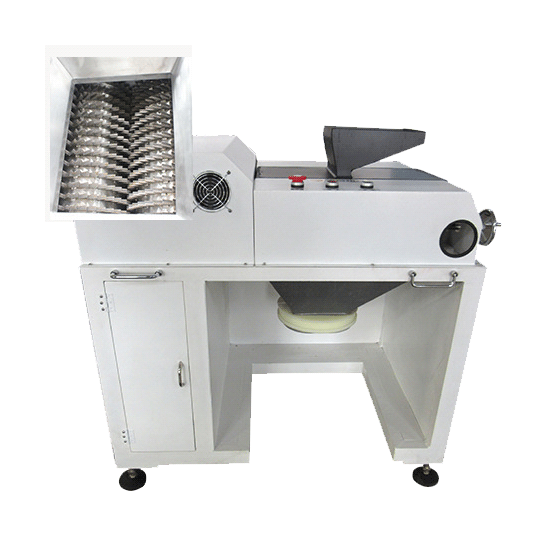
Design and principle of operation
A typical gear roll crusher configuration includes a frame, one or two work rolls, bearings, drive, feed hopper, discharge unit and clearance adjustment system. In a two-roll design, the rolls rotate towards each other. The material is fed from above, enters the space between the rolls, is captured by the teeth and is destroyed under the action of compression, shear and splitting. After reducing the size, the pieces pass through the discharge slot.
The teeth perform not only a transport function. They increase adhesion to the piece, create local stress concentrations and promote splitting of the brittle material. Therefore, tooth shape, pitch and height influence grip, feed stability and product character. Smooth rollers operate differently: they are less likely to pick up large pieces and are more often used for finer or more uniform compression. Gear and smooth roller crushers are not interchangeable without testing.
The gap between the rolls is one of the main adjustable parameters, but not the only one. The actual size of the product is influenced by the original size, strength and fragility of the material, humidity, uniformity of feed, condition of the teeth and rotation speed. Increasing the gap usually shifts the product towards larger fractions, but the specific particle distribution is still tested on real material.
The drive ensures the rotation of the rolls and must overcome not only the working load, but also starting torques, possible jamming and uneven feed. Therefore, drive power cannot be read as a direct indicator of product thinness. A more powerful machine will not necessarily produce finer material if the roll geometry and mode are not suitable for the task. The frame, guards and emergency shutdown system are related to operational safety; their presence and condition are checked before work begins.
The role of teeth and roll profile
The profile of the teeth determines how confidently the material is grabbed and how the load is distributed. Large teeth with a large pitch are usually geared towards larger pieces, while a more frequent and lower serration may be appropriate for a different range. At the same time, it is impossible to transfer the geometry of one design to the entire family of crushers: even machines with similar names can have different rolls, drives and adjustments.
The wear of the teeth gradually changes the working gap and the shape of the gripper. As it becomes dull, performance may decrease, and the proportion of unwanted coarse fractions may increase. Therefore, the condition of the working elements should be included in the maintenance schedule, and not evaluate the crusher only according to the passport adjustment. The material of the teeth and bands affects the durability and possible transfer of impurities, but the specific choice must be agreed with the manufacturer and operating conditions.
What determines size and productivity
Product size depends on a combination of clearance, tooth profile, initial particle size distribution and material properties. Soft and brittle material breaks down more easily, but can produce more fines; durable and abrasive requires a different test. Wet or sticky material can stick to rollers and reduce throughput. For each case, a trial test is important, rather than transferring values from other raw materials.
The productivity of a roller crusher depends on the feed size, bulk density, gap, rotation speed, loading uniformity and the permissible degree of overgrinding. You cannot compare machines based on just one performance figure: the conditions for obtaining it may vary. If the material, feed size and gap are not specified in the specification, the value remains a guideline and not a guarantee for a specific sample.
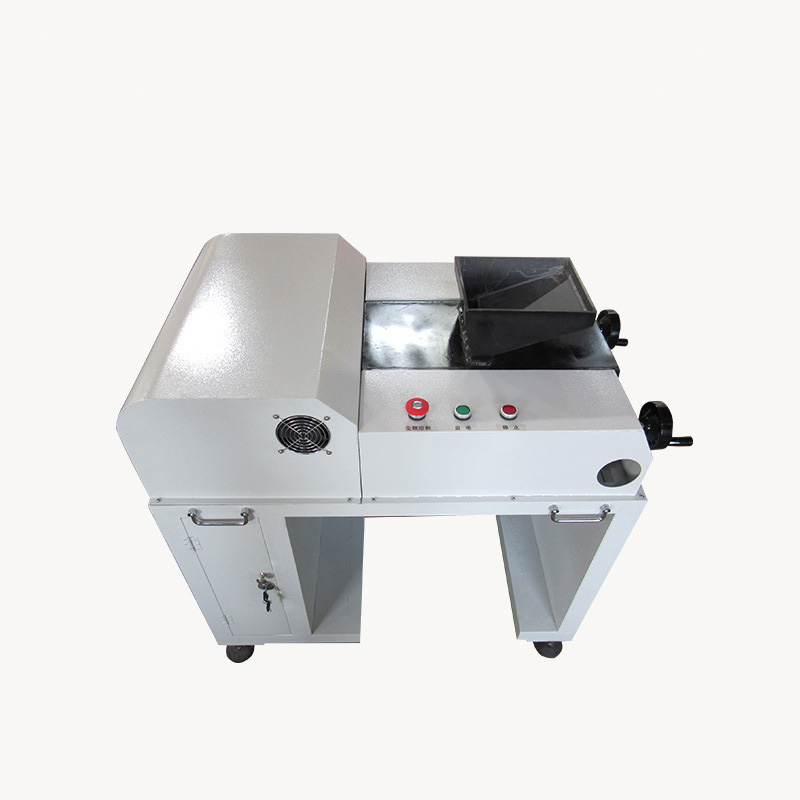
Tooth Roll Crusher TENCAN: how to read parameters and equipment
When selecting a performance TENCAN It is useful to divide the questions into two groups: what you need to get and what conditions the machine will provide. The first group includes the initial size, the required size of the product, the permissible proportion of fines, the properties of the material and the required productivity. The second includes the number and dimensions of rolls, tooth profile, gap range, drive, loading and unloading units, cleaning capabilities and dust removal measures. Specific values should be checked against the current product data sheet and agreed with the supplier.
- The diameter and working length of the rolls describe the working area, but do not themselves determine productivity.
- The maximum feed size must be matched to the tooth profile and gripping conditions; it cannot be derived only from the size of the gap.
- The gap adjustment range shows the ability to adjust, but the actual product size depends on the material and mode.
- The power and type of drive are important for starting and operating under load, but do not promise certain finesse.
- The material of the teeth and working surfaces determines wear resistance and requires separate approval.
- Loading, unloading, dust removal and cleaning affect the convenience of work no less than the main working element.
You need to be especially careful with parameters that are called the same in different sources. For example, "outlet size" could mean a typical range, a specific test result, or the size of the discharge slot. "Performance" may refer to a different material and a different setting. If the units of measurement or conditions are not specified, it is better not to use the value for selection without specification.
Options should not be considered standard equipment. The presence of adjustment, fencing, a specific hopper or unloading unit must be checked for a specific design. This is especially important when comparing offers: the same equipment name does not mean the same configuration.
Materials, limitations and sample preparation
The gear roller crusher is most suitable for brittle and moderately strong lump materials that can be captured by rollers and crushed without plastic deformation. In laboratory practice, it is considered for the preparation of samples of ore, mineral raw materials, ceramic components, coal, coke and other materials after checking their behavior. However, belonging to the class of crushers does not make the machine universal: each material requires an assessment of size, strength, moisture and abrasiveness.
Plastic, viscous and fibrous materials can clog the space between the rolls and stick to the teeth. For them, roller crushing is often less convenient than other grinding principles, but the final conclusion is made by testing. High humidity also requires attention: it affects flowability, gripping and unloading. If the material is prone to caking, the same gap setting may produce inconsistent results.
Abrasive materials accelerate wear of teeth and working surfaces. This is not only an operating expense, but also the risk of material from the working parts getting into the sample. You shouldn't promise "zero pollution": even durable material will wear out over time. For sensitive assays, workpiece material, purification, and impurity control procedures must be discussed separately. If the sample is intended for elemental analysis, the issue of compatibility becomes part of the equipment selection.
When preparing a sample, it is important not to over-grind the material to a state that interferes with the next operation. After crushing, the sample is usually reduced, mixed or screened. Each pouring and unloading must be organized so as not to lose the fine fraction and not contaminate the material. The crusher is cleaned between different samples; For particularly sensitive cases, a separate work kit or different preparation procedures may be required.
Operating a crusher requires safety guards, dust and noise control, and an understanding of emergency stops. Do not operate the machine without studying the manual for the specific version. The general principles described here help to ask questions correctly, but do not replace installation, configuration and maintenance instructions.
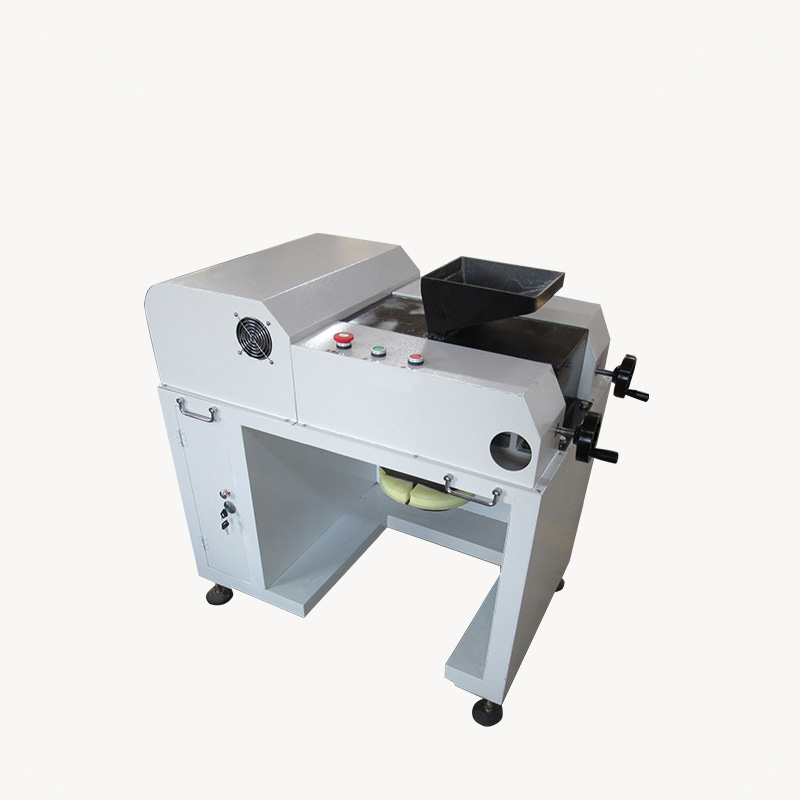
How to choose a crusher and check compatibility with the line
The choice begins not with the model, but with the description of the operation. You need to know what pieces enter the crusher, how their size is distributed, how strong and abrasive the material is, and whether there is a tendency to stick. Then the requirements for the product are formulated: maximum size, permissible fraction of fines, shape of pieces and permissible transfer of impurities. After this, it is checked whether a particular design can operate in this range and with such a feed.
- Describe the starting material and its size, including maximum pieces and fraction of fines.
- Set the required product size and acceptable overgrinding.
- Determine the required productivity and operating mode: periodic or continuous.
- Check the clearance, tooth profile, drive and loading units for the selected design.
- Coordinate cleaning, dust removal, safety and compatibility with downstream equipment.
Line compatibility is not limited by the size of the discharge slot. Too large a product may not pass into the receiving unit of the next machine, and too small a product may change the behavior of the sample during screening or division. If a mill is installed after the crusher, it is important to understand the permissible size of its feed. If a sample reducer is used, consideration must be given to how the material is distributed by size.
To make responsible selections, it is helpful to test crush on a representative sample and evaluate not only the average particle size, but also the particle distribution. One successful result does not guarantee work on another material. If the data contradicts each other or the conditions are not specified, the questionable value is omitted and clarified with the manufacturer. This approach is more reliable than transferring the characteristics of one model to the entire range.
Brief answers to frequently asked questions
How does a gear roller crusher differ from a smooth roller crusher?
The toothed one better grips lump material and creates local stresses, therefore it is often suitable for larger crushing. Smooth rollers are designed for more uniform compression and a different product range. The choice depends on the material and the task, not on which type is “better” per se.
Is it possible to obtain fine powder using such a crusher?
No, this is a crushing and intermediate preparation machine, not a fine grinding machine. The fineness and distribution of powder particles is ensured by a mill with suitable grinding media and mode. The crusher only prepares food for it.
Is it enough to know only the required product size?
Not enough. Information is needed about the material, initial size, humidity, abrasiveness, productivity and permissible overgrinding. The same gap can give different results on different materials.
Is the crusher suitable for wet and sticky material?
This requires a separate check. Wet material can stick to the teeth and reduce throughput. It is impossible to promise stable performance in advance without testing on specific raw materials.
How can I reduce the risk of sample contamination?
It is necessary to take into account the wear of working elements, the quality of cleaning and the possibility of selecting a separate kit for sensitive samples. The crusher material does not automatically provide “zero” pollution; Compatibility with the analysis is checked separately.
Tooth Roll Crusher TENCAN occupies an understandable place in the preparation of material: it reduces the size of the pieces before more delicate operations. When choosing, it is important to read the parameters along with the conditions for their receipt, check compatibility with the material and line, and not transfer the properties of one design to the entire category of equipment.