
Electric stirring lifting ball mill is an equipment for fine grinding of powder materials, in which the grinding media moves in a stationary grinding chamber under the action of a rotating stirrer. The electric lifting mechanism is not involved in grinding: it is designed to raise and lower the working unit, which facilitates maintenance, chamber changes, product unloading and cleaning. IN catalog TENCAN such a machine is represented in the group of ball mills with stirring, and electric lifting stirring ball mill card contains parameters for a specific execution.
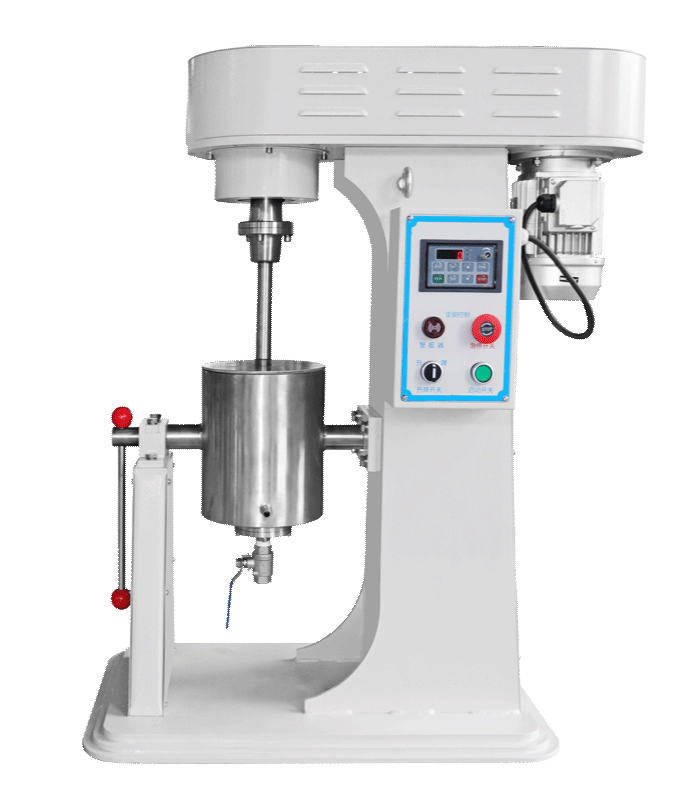
What is Electric Lifting Stirring Ball Mill
Unlike a drum mill, where grinding occurs by rolling grinding media inside a rotating drum, in a mixing machine the chamber remains stationary. The work is done by the mixer: it transfers energy to the grinding bodies, and they transfer energy to the powder being processed. This scheme makes it possible to concentrate the impact in the working volume and more accurately control the mode, but it requires proper matching of the chamber, stirrer, grinding media and sample properties.
Typical elements of such a plant include a stationary grinding chamber, a mixing element, a variable rotation drive, a set of grinding media, an electric lifting mechanism, a control panel and safety elements. In a specific design, some of the components may differ: for example, the lift may act on a chamber, console or other working element, and the chamber may be designed for dry or wet grinding. These parts should not be assumed by name - they are verified using the model's documentation.
Electric lift is primarily a service function. It reduces manual handling when lifting a heavy assembly, but does not replace locking, securing and safe handling procedures. Before use, it is important to ensure that the unit is protected against accidental start-up, that the raised unit is in a stable position and that there is sufficient access for cleaning.
How does stir grinding work and why do you need electric lifting?
The stirrer creates a flow in the chamber, which draws the grinding media into motion. Comminution occurs through a combination of impact, abrasion and shear loads between bodies and particles. The intensity depends on the geometry of the mixer, its rotation speed, the properties of the grinding media, the degree of filling of the chamber, the viscosity of the medium and the initial size of the material. Therefore, the same grinding time does not in itself guarantee the same particle size distribution for different powders.
For dry grinding, the flowability of the material, the tendency to agglomeration and sticking, as well as heat generation are important. For wet grinding, the viscosity of the suspension, the resistance of particles to sedimentation, and the compatibility of the liquid with the material of the chamber and grinding media are key. Wet grinding is not automatically finer: it may help dispersion, but it also makes product separation, cleanup and contaminant control more difficult.
Electric lifting is especially useful where the chamber or work unit is heavy and requires frequent access. After grinding, the unit is raised to provide space for unloading, inspection and cleaning. In this case, you should not rely on the lift as a means of fixation: servicing is carried out only in the position specified by the manufacturer, in compliance with the requirements of the manual.
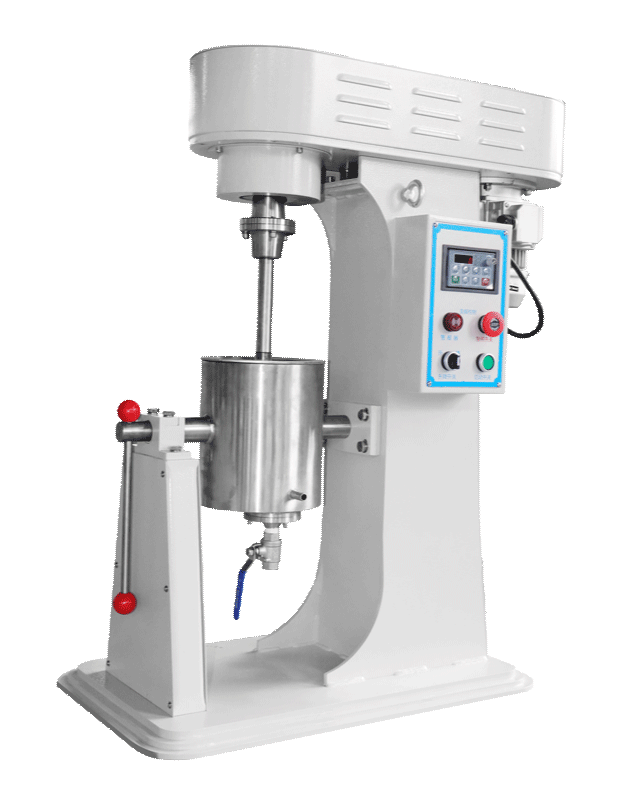
How does this type differ from planetary and other mills?
The stirring ball mill is often considered alongside the planetary, bead and drum mills, although these are different principles. The planetary mill uses complex rotation of the grinding bowls: the combination of rotation around its own axis and around the central axis creates high impact energy on relatively small samples. In a mixing machine, the chamber is stationary, and the movement is created by the stirrer, so the ease of operation, volume and requirements for grinding media will be different.
| Equipment type | What's moving | What to look for |
|---|---|---|
| Ball mill with stirring | Mixer and grinding media; the camera is motionless | Coordination of agitator, grinding media, loading, cooling and unloading convenience |
| Planetary Ball Mill | Grinding bowls undergo complex rotation | Beaker volume, sample weight, heating, beaker and grinding media material |
| Drum or roller mill | The drum rotates on rollers | Rotation speed, filling degree, drum volume, grinding time |
| bead mill | Rotor and small grinding media in a liquid medium | Suspension viscosity, bead size, dispersion and cooling |
A bead mill and an agitated ball mill may be similar in the idea of transmitting energy through the grinding media, but are not interchangeable without testing. Bead systems typically handle fine solids and slurries, while an agitated ball mill can be designed for a different range of particle sizes and operating conditions. You cannot transfer the parameters of one machine to another just because of a similar name.
Grinding bowls for planetary mills are also not automatically compatible with the mixing unit. Even if the cup material is suitable for the sample, the fit dimensions, fixation method, sealing and loading conditions may not be the same. Compatibility is confirmed by documentation or manufacturer, not by visual similarity.
How to read the characteristics in the equipment card
When choosing an electric lifting stirring ball mill, it is useful to separate the parameters according to their meaning. The model name indicates the type of drive and the presence of lift, but does not replace the study of displacement, permissible load and materials of execution.
- Chamber volume — geometric characteristic. It is not equal to the mass of the sample that can be loaded into a particular process.
- Workload — the amount of material and grinding media permissible for normal operation. It cannot be removed only from the full volume of the chamber.
- Total volume only makes sense for multi-camera performances; for a single camera, it should not be confused with performance over time.
- Diameter and material of grinding media influence impact energy, wear and the minimum achievable fineness. Bodies that are too large may not be suitable for fine grinding, while bodies that are too small may not provide the required energy.
- Mixer rotation speed — one of the main operating parameters. If the card shows peripheral speed, it should not be confused with engine speed.
- Drive power characterizes the capabilities of the equipment, but does not guarantee the specified grinding fineness for any material.
- Chamber and stirrer material determines wear resistance and possible transfer of impurities.
- Cooling can be air or liquid; the presence of cooling does not make the process cryogenic without separate confirmation.
- Electric lift requires a headroom for the room, access for maintenance and checking of locks.
It is especially important not to confuse maximum volume, workload, and productivity. Loading depends on the bulk density of the powder, the density of the grinding media, the permissible degree of filling and the thermal regime. Just because a card states a typical minimum particle size does not mean that any sample will be reduced to that size: the result will depend on the starting material, medium, time, energy and measurement method.
For heat-sensitive materials, it is necessary to separately clarify what kind of cooling is provided and how the temperature is controlled. The air temperature in the room or the surface temperature of the installation is not equal to the temperature of the sample inside the chamber. Without measurements, it is impossible to say that the process took place without overheating.
Materials, environment and limitations
The choice of chamber material and grinding media is a compromise between wear resistance, chemical resistance, cost and contamination tolerance. Stainless steel is convenient for many tasks, but is not universal: with intense wear, metal particles can enter. Ceramic, zirconia, tungsten carbide, or polymer coatings may be appropriate in some applications but undesirable in others. No material provides “zero contamination” without consideration of sample, treatment and cleaning.
For abrasive powders, the wear rate increases, so the service life of the chamber and grinding media, as well as the ability to control wear products, should be assessed. For soft or viscous materials, not only grinding becomes more important, but also preventing sticking, agglomeration and uneven discharge. In such tasks, the correct degree of filling, choice of medium and, if necessary, changing the mode help, rather than simply increasing the grinding time.
Dry and wet grinding differ not only in the presence of liquid. In the wet process, it is necessary to take into account the compatibility of the liquid with the construction materials, the possibility of forming a suspension, viscosity and subsequent separation of the product. In the dry process, dust formation, heat generation and moisture content of the initial powder are significant. For hazardous substances, regimes cannot be selected according to a general clause: specific installation guidance, risk assessment and acceptable protective measures are required.
Separately, it is worth distinguishing between grinding and mixing. A stirring mill can distribute components evenly, but its main purpose is to reduce particle size. If only powder mixing is required, a mixer may be more appropriate; If disagglomeration in liquid is required, it is necessary to check whether the selected type of equipment and the material of the grinding media are suitable.
Selection criteria, compatibility and frequently asked questions
Selecting an electric lifting stir ball mill starts with the application, not the maximum capacity. First, the starting material, the required particle size and its control method, acceptable contamination, dry or wet process, and the available space are formulated. Then check which parameters are confirmed in card of a specific model.
- Determine the sample mass and workload range, not just the total chamber volume.
- Match the material of the chamber, agitator and grinding media to the sample chemistry and wear tolerance.
- Check whether the version is designed for dry or wet grinding and which media are acceptable.
- Check the type of cooling and method of temperature control if the process is heat sensitive.
- Consider lift height, cleaning access, unit stability, and space requirements.
- Request a manual, supplies list, and safe maintenance procedures.
Accessory compatibility is confirmed for the specific machine. Grinding bowls, grinding media or seals from the planetary unit should not be transferred to the mixing mill simply because they are made of the correct material. Fitting dimensions, fastening, load capacity and cleaning must be confirmed by the manufacturer.
Frequently asked questions
Is this a planetary mill?
No. In a planetary mill, the grinding bowls rotate along a complex trajectory, but in a mixing installation, the chamber is stationary and the work is created by the stirrer. These types differ in design, loading and selection conditions.
Why do you need an electric lift if the grinding is done by a motor?
The lift does not affect the grinding. It facilitates access to the working unit during unloading, cleaning and maintenance, especially if the chamber or unit is heavy.
Can one camera be used for different materials?
This depends on the requirements for purity and acceptable transfer of impurities. Abrasive or chemically active materials may require special cleaning or a separate chamber; Decisions are made based on management and pollution risk assessment.
Is it enough to know the volume of the chamber for selection?
No. The working load, the density of the material and grinding media, the permissible degree of filling, the rotation mode and the heat balance are required. Chamber volume is only one of the characteristics.
Can conventional cooling be considered cryogenic?
No. Air or liquid cooling in itself does not mean a cryogenic process. Cryogenic work with liquid nitrogen must be directly supported by performance and documentation.