
What kind of equipment is this and where does it stand in the technological chain?
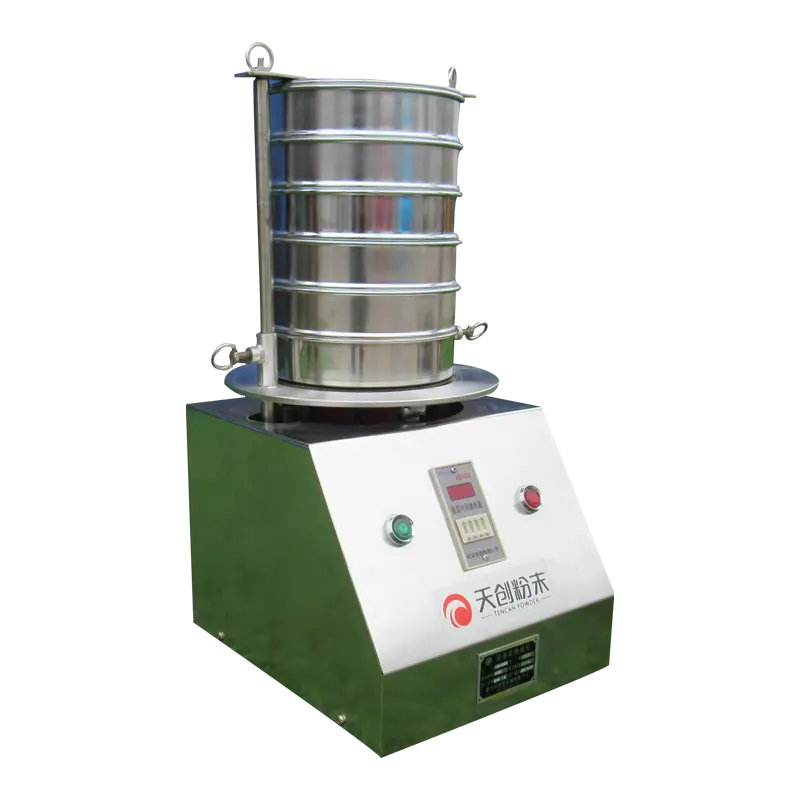
A stainless steel vibrating screen is equipment for sifting bulk materials, in which separation occurs due to vibrations of the sieve surface. In laboratory practice, such a product is often called a vibrating sieve: the term emphasizes classification by size rather than crushing. The device is installed after grinding, granulation, drying or mixing, when it is necessary to obtain a fraction with a controlled upper particle size, remove large inclusions, or prepare a sample for the next analysis. Stainless Steel Vibrating Screen in the catalog TENCAN refers to screening equipment and not to mills or crushers.
The key difference from a shredder is that the screen does not create new surfaces or reduce particles. It passes material smaller than a given size through the sieve cells and leaves a larger fraction on the sieve. Therefore, the result depends not only on the drive, but also on the state of the sieve, feeding method, powder properties and unloading conditions. If a process flow requires simultaneously reducing particles and separating them by size, these are two different operations; they should not be mixed in the same description.
How does a vibrating screen work and what components are important?
The principle of operation is based on imparting vibrations to the sieve - reciprocating, circular or elliptical. The powder is fed onto the sieve surface, distributed over it under the influence of vibration, and particles smaller than the cell size pass into the sub-sieve space. Larger particles move to the unloading unit. In the simplest case, the apparatus divides the material into two fractions - passage and exit; with several sieves or collections, division into a larger number of classes is possible. The specific layout depends on the model, so the number of decks, drive type and unloading method are checked on the product card.
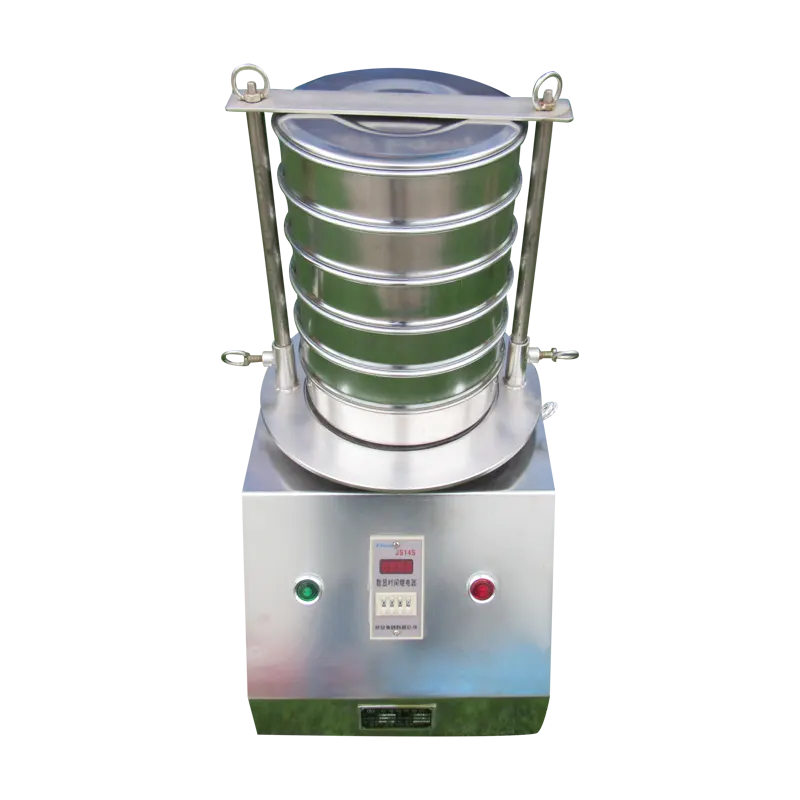
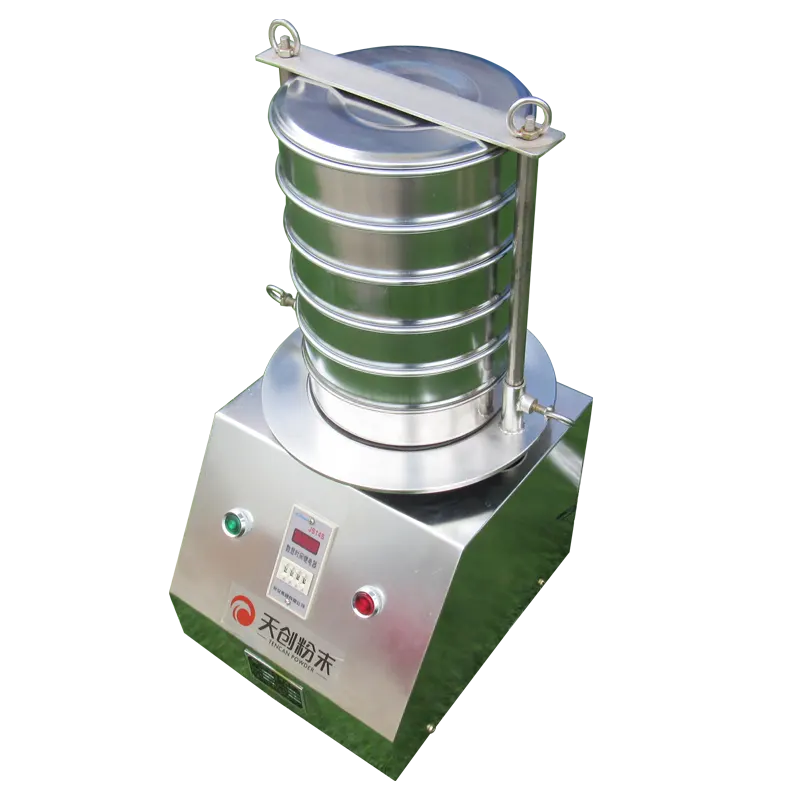
A typical design includes a frame or housing, a sieve element, a vibration drive, elastic supports or hangers, a loading pipe, a lid and unloading units. Not all of the listed elements are present in every design: for example, the lid may be removable, and the unloading may be single- or double-flow. For selection, the material of the contact parts, access to the sieve, the method of tensioning it, and the ability to quickly clean are important. If the sieve is changed without disassembling the entire apparatus, this reduces the risk of damage to the edges and simplifies condition monitoring.
The mode of movement of the material affects the residence time of the powder on the sieve. If the feed is too high, the layer becomes thick, small particles do not have time to pass into the cells, and some of the material goes to waste. Feeding too little reduces productivity but increases the likelihood of more complete separation. Amplitude, frequency and angle of inclination of the sieve are the parameters of a specific installation; they should not be transferred from one model to another without verification. For a laboratory task, reproducibility is more important than maximum speed: the same feed conditions and sieving times give comparable results.
How to read characteristics and not confuse cell size with fraction
When describing a vibrating sieve, not only dimensions are important. It is important for the engineer and laboratory technician to distinguish between the nominal cell size, the actual separation limit and the size of the resulting fraction. These quantities are related, but not identical. In addition, pass performance cannot be assessed in a single number without specifying the material, moisture content, bulk density and feed mode.
Cell size, wire diameter and open cross-section
The nominal mesh size indicates the geometric mesh clearance, but the actual separation limit depends on the wire diameter, particle shape, particle aggregation and mode. An elongated particle can pass through a hole that is smaller than its length, and the soft agglomerate can break down when moving through the sieve. Therefore, the nominal size is not equal to the guaranteed maximum particle size in the passage. For reproducible results, it is important to record not only the size of the sieve, but also its condition, tension and cleaning method.
Capacity and feeding mode
Productivity depends on the screen area, layer thickness, material movement speed and the proportion of particles that must pass through the cells. Powder with high adhesion or high humidity forms agglomerates and clogs the mesh, so a passport assessment without taking into account the properties of the sample says little about the actual operation. In the laboratory, what is often more important is not maximum throughput, but repeatability: the same sample, the same loading method and the same sieving time.
Material of execution and cleaning
Stainless steel makes it easier to clean and reduces the risk of corrosion compared to regular carbon steel, but does not make the unit suitable for all environments. The steel grade, surface treatment, type of welded joints and screen material must be checked separately. If work with aggressive substances is expected or cleaning validation is required, the phrase “stainless steel” alone is not enough. It is also important that the screen can be removed, inspected and replaced without damaging the seals or edges.
Materials, applications and limitations
Vibratory sieving is used for control separation after grinding, preparing fractions for analysis, removing large inclusions and increasing powder uniformity. In such operations, the screen complements the mill, but does not replace it: it does not reduce particle size or provide grinding. If the material contains strong agglomerates, they may remain in the aggregate, even if the individual particles within the agglomerate are smaller than the cell. To destroy such formations, a separate operation is needed, and not a blind increase in amplitude.
On website TENCAN Screening equipment is allocated in a separate direction, which helps to compare it with mills, crushers and mixers by purpose, and not just by appearance. At the same time, a vibrating screen should not be confused with a drum or planetary mill: the latter work with grinding media and are designed to reduce particle size. The screen works with already prepared bulk material and is responsible for separation by size.
Limitations are related to the properties of the powder and operating conditions. Sticky, wet, highly electrified and fibrous materials are screened worse than free-flowing materials. Abrasive particles accelerate wear of the screen and contact surfaces, and chemically active media require checking the compatibility of all materials. The possibility of wet sifting should not be assumed by default: if it is not indicated on the card, the mode requires separate confirmation. For combustible dusts and toxic powders, a project-specific assessment of safety, extraction and air purification is required.
- control sifting after grinding;
- separation into fractions before analysis or pressing;
- removal of large inclusions and foreign particles;
- preparation of a homogeneous sample for further testing.
How to select equipment and check compatibility
The choice starts with the problem, not with the model. First, it is determined whether one separation boundary or several fractions is needed, what sample is processed per cycle, how the material is fed and where it is unloaded. Then the properties of the powder are checked: bulk density, moisture content, tendency to stick together, abrasiveness and chemical reactivity. Only after this does it make sense to compare designs based on sieve area, drive type, materials and ease of maintenance.
- Purpose of the operation: control sifting, preparative separation or removal of large fractions.
- Compatibility with sample: material of screen, housing and seals, risk of corrosion and introduction of impurities.
- Screen size and condition: nominal mesh, availability of spare screens, method of tensioning and replacement.
- Loading and unloading: volume of the receiving container, installation height, ease of unloading the exit and passage.
- Cleaning: accessible to internal surfaces, can be disassembled, compatible with solvents and detergents.
- Safety: dust generation, noise, grounding and requirements for working with hazardous powders.
Compatibility with adjacent equipment is checked by the geometry and logistics of the process: loading height, location of discharge pipes, capacity of collectors and ease of replacing the screen should not create unnecessary spills. If the apparatus is to be operated in line with a mill, it is useful to separate the operations in time: first grinding, then sifting, rather than attempting to combine them in one unit without a proven design. Card stainless steel vibrating screen serves as a starting point for clarifying the configuration, but specific parameters are still checked against the task and the manufacturer’s documentation.
Brief answers to frequently asked questions
How is a vibrating screen different from a ball mill?
The screen separates particles by size using a sieve and does not contain grinding media. A ball mill grinds material through impact and abrasion. These devices can stand side by side in the technological chain, but perform different functions and do not replace each other.
Is it possible to sift wet powder?
Wet material often forms agglomerates and passes through the cells less easily. The possibility of wet or wet sieving depends on the specific design and must be confirmed. Without such a check, you should not plan a regime based only on the name of the equipment.
What is more important - mesh size or sieve material?
Both parameters are important, but for different reasons. Mesh size determines the separation area, and screen material affects wear, cleanup, and sample compatibility. You cannot select a sieve based on just one number if the powder properties and purity requirements are unknown.
Is stainless steel enough for aggressive environments?
No, the name of the material does not in itself guarantee resistance to any chemicals. It is necessary to take into account the steel grade, the concentration and temperature of the medium, as well as the material of the seals and screens. For non-standard conditions, a separate compatibility check is required.
Selecting the right stainless steel vibrating screen is based on sample properties and size requirements, not on maximum throughput. By defining the separation size, wear tolerance, cleaning method, and discharge conditions in advance, the machine becomes a repeatable powder preparation tool rather than a source of inconsistent results.