
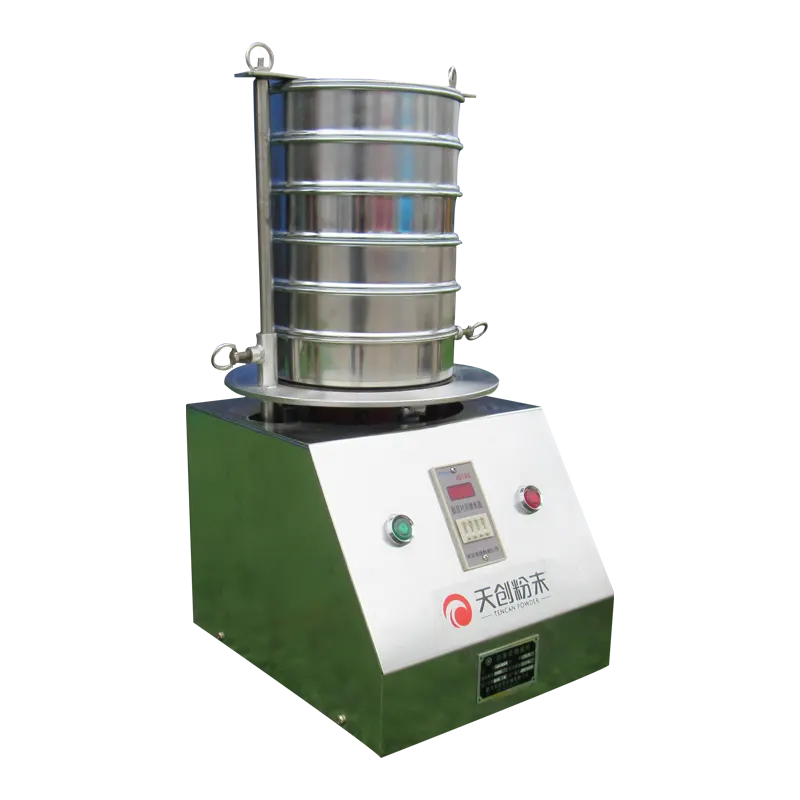
Stainless steel vibrating screen is an equipment for separating bulk materials by size. Powder or granules are fed onto an oscillating sieving surface: particles smaller than the cell pass through it, larger ones remain in the product over the screen. In the process chain, such a screen is usually located after grinding, mixing or drying and before packaging, pressing or the next operation. Its task is not to grind the material, but to separate fractions, remove large inclusions and make the composition of a sample or batch more predictable. In line TENCAN (Changsha Tianchuang Powder Technology Co., Ltd.) This equipment belongs to the screening series; specific design, dimensions and equipment are specified in stainless steel vibrating screen card.
Function and place in the technological chain
Sifting solves several practical problems. It allows you to obtain a fraction with a given upper limit of size, separate large aggregates after dry grinding or granules that did not pass through the sieve, and also control the fractional composition of the intermediate or finished product. In the laboratory, a vibrating sieve is often used to prepare a sample for analysis and check the completeness of grinding; in production - at the entrance of raw materials, between stages or before packaging. However, the screen does not replace a crusher or mill: if the main task is to reduce the particle size, grinding equipment is first selected, and screening is used as classification or control.
How does a stainless steel vibrating screen work?
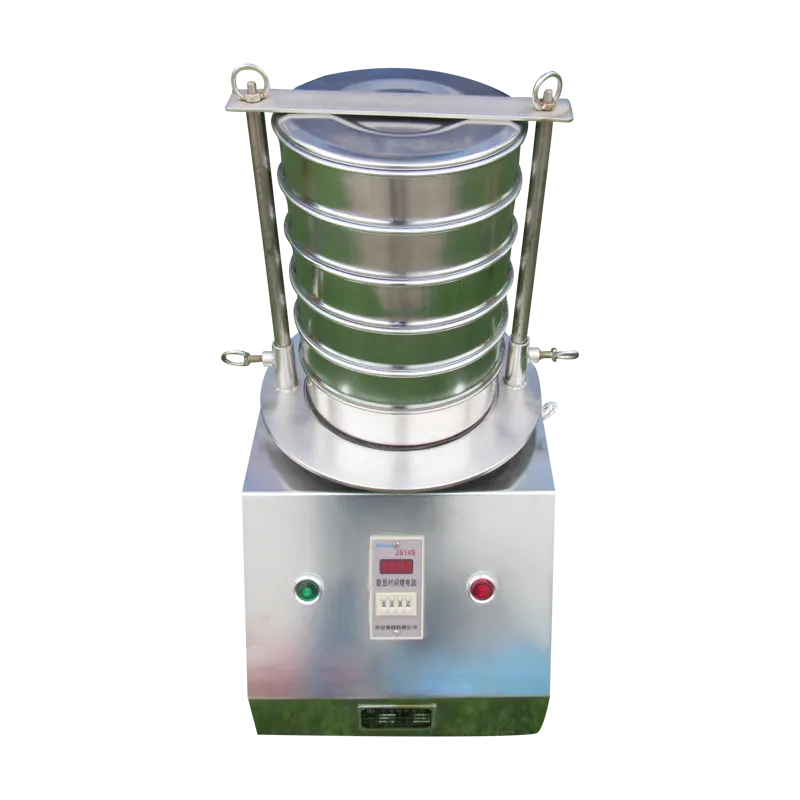
A typical apparatus includes a screening surface, a housing or frame, a drive with unbalanced masses, elastic elements and unloading pipes. The specific layout depends on the version, so this is a general diagram and not a description of all models without exception.
Screening surface
The screening part can be a mesh, perforated sheet or other profile. For stainless steel, the cell size, wire diameter, live cross-section, tension and fastening method are important. The smaller the mesh, the higher the risk of clogging and the thinner the wire usually is; this affects strength and resource. The mesh is not an absolute filter: the separation efficiency depends on the shape of the particles, their tendency to aggregate, humidity and vibration mode. The nominal mesh size is a sieve parameter and not a guaranteed size of all particles in the under-sieve product.
Drive and vibration
Vibrations are created by a drive, usually an electric motor with eccentric weights or another vibration mechanism. Amplitude and frequency determine how material moves through the screen and how much particles contact the screening surface. Too weak a mode leads to material accumulation and clogging of cells; too intense can cause dusting, destruction of fragile granules and increased wear. The setting must be appropriate to the material and task. The numerical values of amplitude, frequency and slope for a specific model should be looked at in its documentation; You cannot transfer them from another device.
Housing, frame and unloading
The housing and frame provide rigidity and hold the screening part in the desired position. Elastic elements isolate vibrations and reduce the load on the base. Unloading units divide the material into fractions: the under-grid product leaves through the lower part, the over-grid product through a separate pipe. If the execution is multi-deck, the number of fractions may be greater; this must be explicitly stated in the specification. For a stainless steel screen, the steel grade, surface condition, welds and the presence of cavities where residues can be retained are separately specified.
How to correctly read the characteristics of a vibrating sieve
The equipment card usually contains dimensions, material, number of screening surfaces, drive parameters and productivity. These values should not be read in isolation. Productivity depends on bulk density, particle size distribution, moisture content, flowability, required separation efficiency and feeding method. The same sieve on different materials can operate with different throughputs.
Coarseness and cell size
Cell size is a key parameter, but not the only one. A distinction must be made between the nominal screen opening, the particle size of the feed material and the actual separation limit. Particles close to the cell size may exhibit ambiguous behavior: some pass through, others remain due to shape, orientation, or clumping. For fine powders, electrostatics and aggregation are important; for wet materials - cohesion and clogging. If a narrow fraction is required, one sieve may not be enough: sometimes a sequential scheme with several sieving surfaces or additional preparation of the material is needed.
Capacity and feeding mode
Productivity cannot be considered as a constant value without specifying the material and separation criterion. With a high feed rate, the layer of material on the sieve becomes thicker, small particles do not have time to pass through, and efficiency decreases. If the flow is too low, the equipment does not operate efficiently. Practical selection begins with a trial batch: the behavior of the material, clogging, dust formation and the quality of the resulting fractions are assessed. A continuous process additionally requires a stable feeder and coordination of output with neighboring operations.
Material and contact surfaces
Stainless steel is usually chosen for its corrosion resistance and cleanability, but this does not automatically mean it is free from contamination. It is necessary to clarify the grade of steel, which parts are in contact with the product, how the surfaces are treated and how the joints are sealed. Abrasive powder can wear out the mesh and unloading elements; Sticky material - accumulates in corners. If a product is sensitive to metal transfer or requires proven compatibility, this is verified by documentation and test results, and not just by the name “stainless steel.” TENCAN indicates stainless steel in the product name, but please check product card and specification for specific materials and options.
For which materials is screening suitable?
Vibratory sieving is used for dry bulk materials: powders, granules, crystals, mineral fillers, chemical products and other similar systems. It is convenient where you need to separate a large fraction, break up weak agglomerates, or obtain several size classes. Suitability is determined not by the industry, but by the behavior of a particular material. Powder with high humidity, greasy or highly electrified material may clog the sieve and require other preparation methods. Fragile granules can be destroyed by vibrations, and abrasive particles can accelerate wear. Therefore, before choosing, it is useful to have a sample and formulate what is considered a quality result: maximum fines yield, absence of large inclusions, or stability of the separation boundary.
Dry and wet processes
Dry sieving is the most obvious mode for powders and granules. Wet screening can be used for slurries and wet systems, but requires proven design: drainage, drive protection, seal and material compatibility with the liquid. It should not be assumed that any laboratory sieve is suitable for the wet process just because it is made of stainless steel. If the card does not clearly indicate wet execution, this issue must be clarified separately. It is also important to distinguish between equipment washing and wet screening as a technological operation.
Limitations: moisture, clumping, electrostatics
The main limitations relate to the behavior of the material on the screen. Moisture increases cohesion and small particles can clog the cells; Such products sometimes require pre-drying or special measures, but they should not be invented without testing. Electrostatic powders stick to the walls and mesh, reducing yield. Fibrous or plastic materials may form “bridges” over the holes. Moreover, vibration is not grinding: if the particles are firmly aggregated, sieving will not break them down to their original size. In such cases, the problem of grinding or disagglomeration is first solved, and the screen is used for subsequent classification.
How to choose a vibrating screen for the task
The choice begins with a description of the material and purpose, not with a list of options. It is necessary to indicate what exactly is being sifted: chemical powder, mineral raw materials, granulate or other product; what is the initial size and what fraction is required; what is the bulk density and moisture content; Is there any abrasiveness, corrosiveness, tendency to stick together or dust? Next, the operating mode is determined - periodic or continuous, the required number of fractions, permissible productivity and feeding method. For the laboratory, small sample volume, ease of cleanup, and reproducibility are important; for the production area - flow stability, unloading and integration with the line.
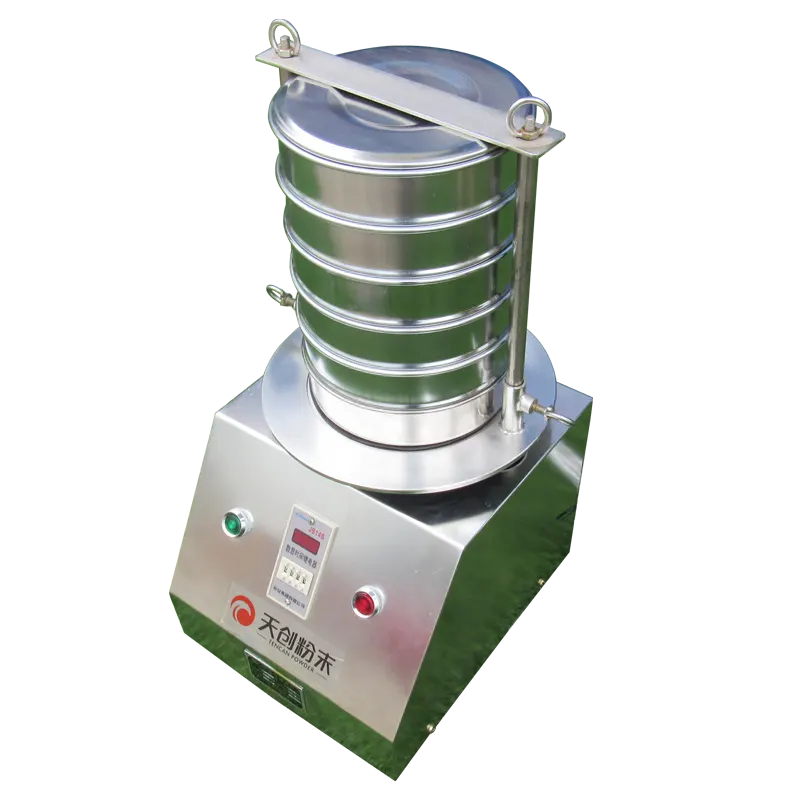
The second step is checking execution. They look at the size of the sifting surface, the type and size of the cell, the mesh material, the fastening design, the number of sifting surfaces and discharge pipes. For a stainless steel screen, the steel grade and contact surfaces are specified. If working with fine powders is expected, clogging and cleaning methods are discussed separately; if with abrasives - wear and availability of replacement of wear parts. You should not select equipment based solely on maximum productivity: actual throughput depends on the material and the required efficiency. On website TENCAN You can check product directions, and the specific model and options can be checked using the product card and specifications.
The third step is testing on a representative sample. A small test shows how the material behaves on the sieve, how much fraction is obtained and whether the surface is clogged. If testing is not possible, allow for a margin on the sifting area and the possibility of adjusting the mode. For tasks where the result depends on many factors, it is better to formulate process requirements rather than promise a universal performance figure.
Cleaning, wear and quality control
After each operation, it is important to remove any remaining material from the previous material. Stainless steel makes cleaning easier, but does not eliminate it: particles can become trapped in the mesh, under seals, in discharge pipes and on welds. The cleaning method depends on the design: in some places a dry brush and vacuum are sufficient, in others disassembly of the sieving part is required. Water and detergents are only permitted if they are compatible with the materials and do not pose a corrosive or biological risk; After wet cleaning, drying is necessary. Do not use aggressive reagents or abrasive cleaning without confirmation from the manufacturer.
Wear primarily affects the mesh, seals and attachment points. The abrasive material gradually changes the geometry of the cells, and incorrect mesh tension can lead to sagging and uneven sifting. Regular inspection helps you spot tears, loose fasteners and blockages before they affect your results. For quality control, it is useful to record not only the fraction yield, but also the state of the sieve, feeding mode and operation time. If the result changes without changing the material, first check the integrity and tension of the screening surface, not just the drive settings.
Frequently asked questions
How is a vibrating screen different from a ball mill?
The screen separates the particles by size, and the mill reduces their size due to grinding bodies and movement. If you want to get a finer powder, sifting alone is not enough; If you need to separate a large fraction after grinding, a screen is appropriate. These devices can operate in series, but do not replace each other.
Is it possible to sift wet powder?
Depends on the material and execution. Moisture increases sticking and the risk of plugging, so wet systems often require wet execution or pre-conditioning. Without confirmation in the documentation, a conventional dry sieve cannot be considered suitable for the wet process.
Does the cell size guarantee an accurate separation boundary?
No. The nominal mesh size is a characteristic of the sieve, and the actual separation depends on particle shape, moisture content, feed, amplitude and aggregation tendency. Some particles near the boundary may end up in the wrong fraction. For narrow requirements, testing on real material is required.
What should I check before ordering?
Material, initial and required size, humidity, bulk density, abrasiveness, number of fractions, operating mode, required productivity and cleaning conditions. You also need to check the grade of stainless steel, contact surfaces, type of screening surface and the presence of the necessary options in the specification.