
A rotary tube furnace is an installation for the heat treatment of bulk materials, in which the sample is located in a working tube, and the tube rotates around a longitudinal axis. This scheme is used for drying, calcination, reduction, sintering, pyrolysis and other processes where renewal of the layer surface and more uniform heating are important. In the process chain, the oven is usually located after dosing, mixing or granulating and before cooling, discharging and analyzing the product.
On the website TENCAN (Changsha Tianchuang Powder Technology Co., Ltd.) представлена Rotary tube furnace. Specific temperatures, dimensions of the working pipe, permissible atmosphere, rotation speed and productivity depend on the design, therefore the article explains the principle and logic of choice, and does not replace the technical specifications of the installation. Before selection, you should check the specific model card and instruction manual.
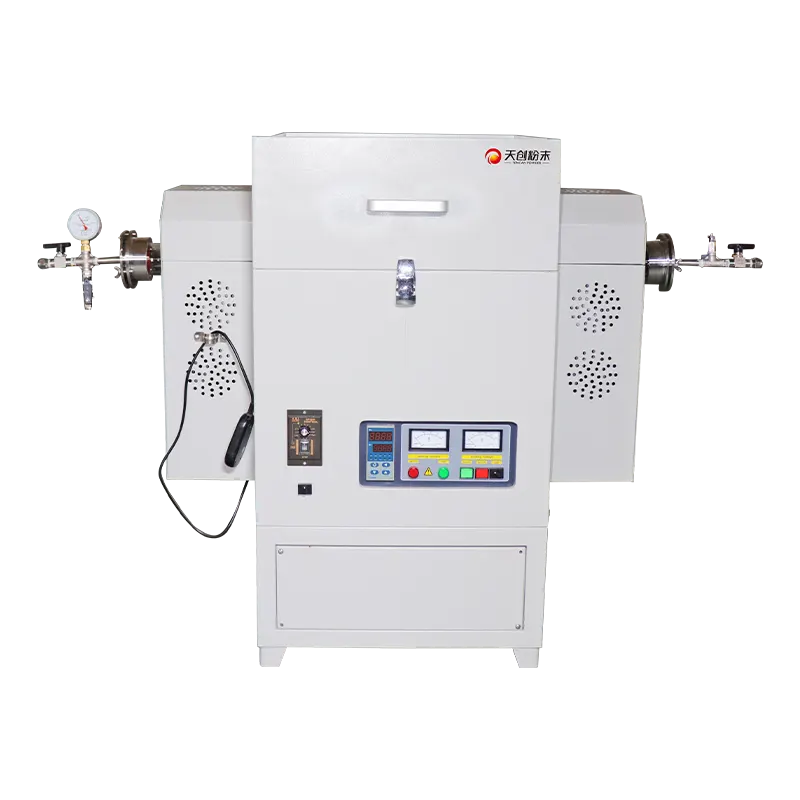
What is a rotary tube furnace
Unlike a static tube furnace, where the material lies motionless in a boat or on a support, here the working tube rotates slowly. The word “rotary” in the name refers specifically to the rotation of the pipe, and not to the cutting rotor or grinding mechanism. When turning, the layer of powder or granules periodically rises and crumbles, due to which the particles more often come into contact with the heated wall and gaseous environment. This can reduce the uneven heating across the cross section of the layer, but does not eliminate the limitations associated with the thermal conductivity of the material, its bulk density and tendency to stick together.
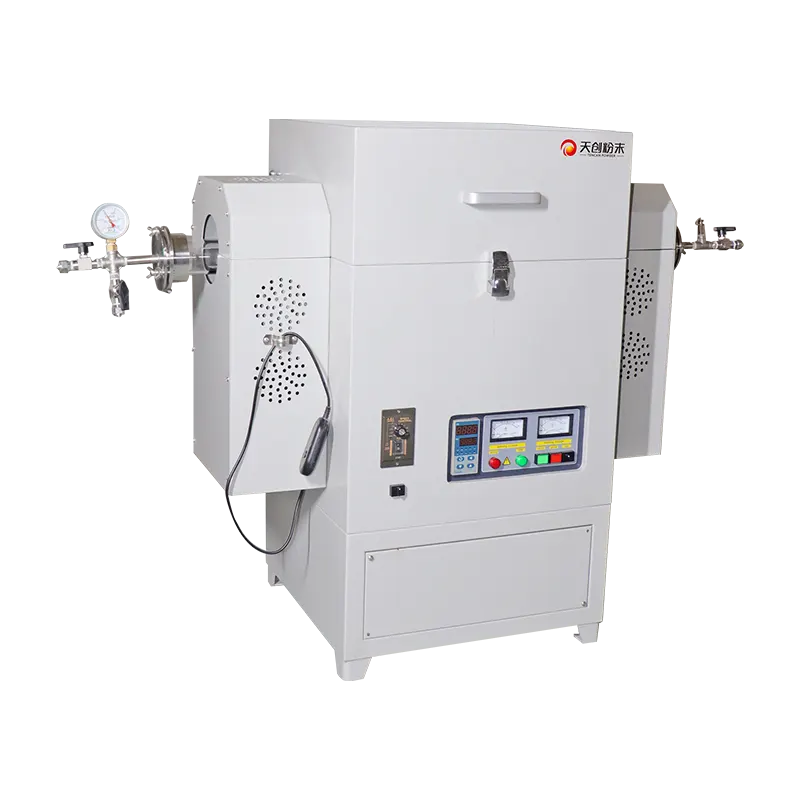
A typical design includes a work tube, heating block, thermal insulation, supporting frame, rotation drive, support rollers or bearing units, seals, gas supply system, loading and unloading devices, temperature sensors and a controller. In a specific design, some components may be designed differently, and some functions - for example, evacuation, purging or forced cooling - may be an option and not a standard. Therefore, the presence of a particular node must be confirmed by the card and specification, and not assumed by appearance.
The rotary tube furnace does not replace the ball mill, mixer or high pressure reactor. Rotation can indeed mix the layer a little, but the main purpose of the equipment is to heat and hold at a given temperature and, if necessary, in a controlled environment. If it is necessary to change the particle size, reduce agglomerates, or obtain a homogeneous mixture, separate equipment is used for this, rather than assigning the grinding function to the furnace.
How does a rotary tube furnace work?
The operating cycle usually includes loading the material, purging or creating the desired atmosphere, heating to a given temperature, holding, cooling and unloading. Depending on the design, the furnace can operate periodically or maintain a continuous supply of material; This is an important characteristic that cannot be deduced from the name alone. For one model, only periodic mode is allowed, for the other - semi-continuous or continuous. In addition, the possibility of pipe tilting, rotation during heating and cooling, and operation under pressure or vacuum must be explicitly confirmed by the manufacturer.
Heat is transferred to the material from the pipe wall, by radiation from heaters and through the gaseous environment. During rotation, the surface of the layer is renewed, so local overheating and cold zones are less pronounced than in a dense fixed layer. However, uniformity depends not only on rotation: the heating rate, temperature distribution along the length of the pipe, load mass, material properties and holding time are important. Rotating too quickly can raise dust, increase abrasive wear, and carry away small particles in the gas flow. Rotating too slowly does not update the layer sufficiently.
The role of rotation and filling of the pipe
The rotation speed and the degree of filling of the pipe are related. With a small load, the material moves more, but the cycle productivity decreases. With a large load, part of the layer may remain inactive, and the resistance to gas flow increases. There is no universal rotation speed suitable for all powders: heavy granules require one mode, light dusting powder requires another. Optimal conditions are usually selected based on the results of trial runs, monitoring product uniformity, dust removal and pipe condition.
Atmosphere and sealing
The furnace can operate in air, in an inert or reducing atmosphere, as well as in a vacuum, if provided for by the design. Inert gas does not automatically eliminate oxygen from the working volume: the quality of the purge, the tightness of the seals, gas flow, flow direction and control of residual oxygen are important. Sample decomposition products, moisture and condensation must be removed from the working area, otherwise they can interact with the material, contaminate the pipe and affect sensor readings. For outgassing processes, the exhaust and compatibility of the pipe material with the substances formed are especially important.
Heating, holding and cooling
The maximum temperature specified for the oven is not the long-term operating temperature of any specimen. The heater limit may be higher than the temperature allowed by the pipe, seals, boat or the material itself. In addition, the temperature of the working area is not identical to the measured temperature of the sample: it depends on the mass of the load, the thermal conductivity of the powder and the rotation mode. Cooling is also part of the process. Rapid cooling can create thermal stress in the material and pipe elements, while slow cooling can increase the cycle time. The specific cooling rate and acceptable environment should be checked for the selected model.
What parameters are important to read on the card?
The product card helps you compare designs, but only if the units are the same and the test conditions are the same. Temperature, capacity or pipe size cannot be mechanically transferred from one model to the entire range. It is useful to separate equipment parameters and process parameters: for example, the volume of the pipe does not indicate the mass of the load, and the maximum temperature does not indicate the permissible holding time.
| Parameter | What does it mean | What to clarify |
|---|---|---|
| Maximum temperature | The limit that the heating system can provide | Continuous operating temperature, atmosphere, load weight and pipe material |
| Heating rate | Permissible rate of temperature rise | Sample limitations, uniformity along the length of the tube, sintering behavior |
| Pipe dimensions and material | Working area and material contact environment | Inner diameter, usable length, heating zone, sample compatibility |
| Rotation speed | Working tube rotation frequency | Control range, stability, effect on dust entrainment and wear |
| Performance | Amount of material per cycle or per time | Bulk density, permissible filling, duration of heating and cooling |
| Atmosphere | Air, inert gas, reducing medium or vacuum | Gas flow, cleanliness, tightness, exhaust, oxygen control |
| Cooling | Method for reducing temperature after holding | Natural or forced, medium, speed and sample temperature |
| Control and Security | Programs, sensors, interlocks and emergency functions | Protection limits, alarms, procedures for deviations |
If a value is given without units, contradicts another parameter, or appears unclear, it is better not to use it for calculation, but to ask for confirmation. For example, pipe volume and working load are different quantities; sample weight and productivity per hour are also not the same thing. For a correct comparison, it is necessary to bring the data under the same conditions: the same temperature, atmosphere, exposure time and measurement method. A parameter of one model does not become a characteristic of the entire range.
Materials, objectives and limitations
The rotary tube furnace is suitable for powders, granules and small pieces as long as their behavior in the rotating tube is predictable. In laboratory and industrial practice, such installations are used for drying, calcination, reduction, sintering, pyrolysis and activation. Typical materials include oxides, ceramic charges, catalysts, carbon materials and metal powders, but suitability is determined by the specific temperature, atmosphere and compatibility with the pipe material. It cannot be said that the same oven is equally suitable for all of the listed tasks.
The limitations are related to the principle of rotation itself. Materials that are sticky, fusible, or prone to agglomeration may stick to the walls and form lumps. Highly dusty powders require careful selection of gas flow and rotation speed, otherwise carryover of the fine fraction is possible. Abrasive materials accelerate pipe and seal wear, and corrosive gases require compatible materials of construction. In such cases, a static oven, chamber oven, or other heat treatment design is sometimes more appropriate rather than a one-size-fits-all solution.
Contact materials require special attention: working pipe, boats, substrates, seals and gas lines. Transfer of impurities is possible even when using ceramics or special alloys, so the expression “zero contamination” is unsuitable as a technical promise. Temperature, atmosphere, chemical compatibility, cleaning and replacement of wear parts must be taken into account. If the pipe material is not confirmed for a particular sample, testing or consultation with the supplier is mandatory.
Selection criteria and compatibility
The choice does not start with the maximum temperature, but with the task and properties of the sample. It is useful to record the mass of the load, bulk density, initial particle size, humidity, flowability, tendency to dust and gas evolution. Then the target temperature and holding time, acceptable atmosphere, heating and cooling rates, and cleanliness and cleaning requirements are specified. To scale, it is important to understand whether the process will be batch-based or whether a continuous feed will be required.
- Loading weight and volume, permissible pipe filling.
- Maximum and long-term operating temperature taking into account the pipe material.
- Atmosphere, gas flow, tightness and removal of decomposition products.
- Rotation speed, tilt capability and cooling mode.
- Compatibility of the sample with pipe, boats and seals.
- Ease of cleaning, maintenance and replacement of wear parts.
Compatibility is checked in several areas: the working material must not destroy the pipe, the released substances must not damage seals and gas lines, and the temperature must not exceed the limit for the weakest element. Accessories and equipment are selected for a specific oven; Compatibility with other equipment is not assumed by default. If the card does not contain the required confirmation, you should request it from the supplier. Additional equipment areas TENCAN can be found out at company website.
Questions and answers
How is a rotary tube kiln different from a horizontal tube kiln?
In a horizontal static furnace, the material usually lies motionless, so heating depends on the thermal conductivity of the layer. In a rotary pipe, the pipe rotates and the layer is renewed, but moving components appear, there is a risk of dust and higher requirements for seals. The rotary circuit is not always better: for some samples, the static mode is simpler and safer.
Is it possible to work in an inert atmosphere?
Only if this is provided for by the design of the furnace. It is necessary to check the tightness, permissible gas flow, exhaust, control of residual oxygen and compatibility of seals with gas. An inert environment does not eliminate gases released from the sample, so a devolatilization system is also important.
Is rotation necessary for sintering?
No. Rotation helps to renew the surface of the layer, but may not be desirable for fragile, sticky or easily dusty materials. The possibility of static mode, turning off rotation or changing its speed is specific to the specific model and must be confirmed in the manual.
How to choose the material of the working pipe?
Operating temperature, atmosphere, sample reactivity, decomposition products, heating and cooling rates, and cleaning method are taken into account. You cannot select based on maximum temperature alone: a material suitable for air may not be suitable in a reducing environment or in contact with aggressive substances.
Can the oven be used for chopping or mixing?
No, this is heat treatment equipment. Rotation may agitate the bed slightly, but is not a substitute for a ball mill, mixer, or deagglomerator. If it is necessary to change the particle size or obtain a homogeneous mixture, use separate devices compatible with the material and the task.
Before ordering a rotary tube furnace, it is worth formulating not only the temperature, but also the full cycle: loading, atmosphere, heating, holding, cooling, unloading and cleaning. This approach helps to select a design based on real conditions and not transfer the characteristics of one equipment to another process.