
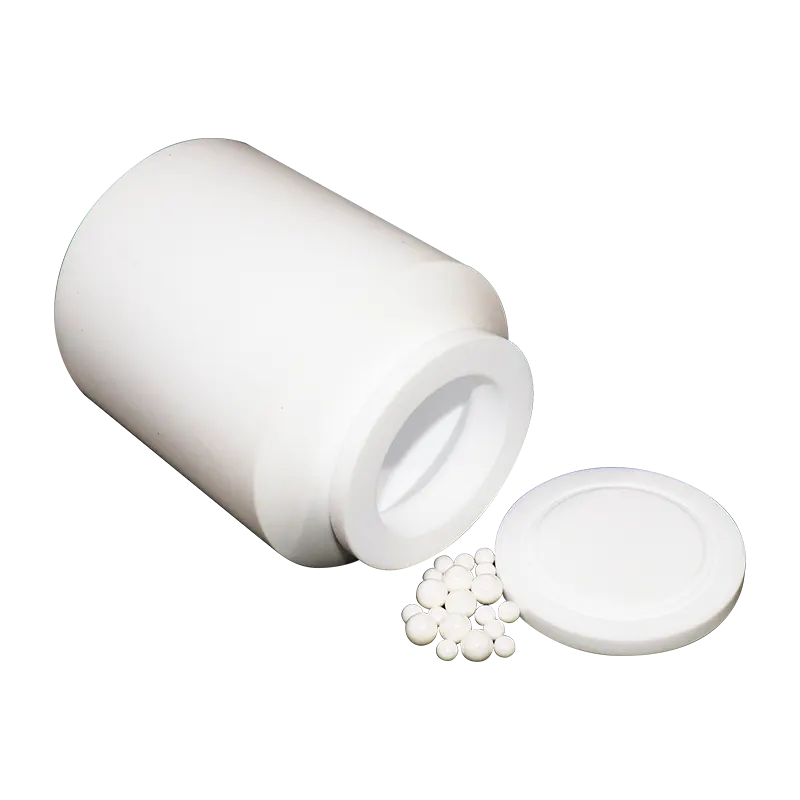
The PTFE grinding drum is a cylindrical working vessel for a roller ball mill in which the sample and grinding media are driven by the rotation of the drum on driven rollers. Its job is to hold the load, ensure contact of the material with the grinding media, and keep the sample clean enough for subsequent analysis. In the catalog TENCAN the product is presented as PTFE grinding drum; This is a sample preparation accessory and is not a stand-alone mill or planetary grinding bowl.
Where is the drum located in the grinding circuit?
In a roller ball mill, the drum rests on two or more rotating rollers. The drive is not transmitted through the lid or shaft inside the container: the movement is generated by friction between the outer surface of the drum and the rollers. Inside the drum there is a sample and grinding media - usually balls. As they rotate, they rise and fall again, and also roll along the wall. This mechanism differs from planetary grinding, where the glass makes a complex movement in a planetary disk, and from a bead mill with a high-speed stirrer.
The grinding drum does not determine the rotation speed, plant productivity or final particle size. These indicators are determined by the mill, mode, environment, source material and measurement technique. The drum affects other things: useful volume, tightness, sample loss, wear and possible introduction of impurities. Therefore, when selecting, they first formulate the grinding task, and then check whether a particular container is suitable in size, material and method of fastening.
How does a drum differ from a planetary glass?
The planetary cup is usually installed in the socket of the planetary mill and the lid is fixed with a standard mechanism. The drum for a roller mill has a different geometry and outer seating surfaces: it must lie stably on the rollers, rotate without beating and not move along the axis. Even containers that are close in volume may not be interchangeable. The names “glass”, “drum” and “can” should not be used as synonyms when ordering: in the technical documentation, the type of mill, outer diameter, length and method of sealing are important.
A roller ball mill is also not a roller crusher. In a crusher, the material is destroyed between the rolls, and in a roller ball mill, grinding occurs inside a rotating container due to grinding media. Understanding this difference helps to avoid attributing the functions of a crushing or beading equipment to the drum.
Dry and wet grinding
In dry mode, the drum is filled with powder and grinding media; After grinding, the contents are unloaded and, if necessary, sifted. Dry grinding is convenient for materials that cannot or are undesirable to be mixed with liquid, but it can be accompanied by dusting, sticking and aggregation of small particles. In wet mode, liquid medium is added. This can improve particle distribution and reduce dusting, but requires good sealing of the lid, consideration of slurry viscosity and more thorough cleaning. PTFE's chemical resistance alone does not prove that a particular cap will withstand the selected application without leaking.
A distinction must be made between grinding and disagglomeration. If the task is to destroy large particles, the energy of the grinding media, their size and grinding time are important. If you only need to separate the units, the mode may be softer, and the risk of overgrinding and contamination may be more noticeable. This is especially important for a PTFE drum: soft wall material alone does not guarantee “gentle” grinding if the grinding media and speed are incorrectly selected.
Why is PTFE used and where are its limits?
PTFE is polytetrafluoroethylene, often called PTFE. In laboratory practice, it is valued for its chemical inertness, low coefficient of friction and ability to work with many aggressive environments. For a grinding drum, this means that the wall material is less prone to chemical interaction with the sample than many metals, and the surface is easier to clean from some contaminants. However, PTFE is not universally resistant to all chemicals and does not eliminate mechanical wear.
Chemical resistance does not equal no reaction
The list of media acceptable for a particular product must be confirmed by the manufacturer's documentation. General information about PTFE cannot be transferred to any brand, temperature or concentration. If wet grinding with a solvent, acid or alkali is planned, check the compatibility of not only the drum, but also the lid, seal, grinding media and material that will come into contact with the liquid. The question “what solvent can be used” is not solved just by the word PTFE in the name.
Softness, wear and contamination
PTFE is softer than steel, corundum and zirconia. Therefore, with intense friction against the walls, especially with dense grinding media, wear of the surface and the appearance of particles of drum material in the sample are possible. This does not mean that PTFE is always unsuitable: for many applications its benefits are more important than wear. But the promise of "zero pollution" is technically false. It should be assessed whether the PTFE particles are critical for subsequent analysis, whether this level of impurities is acceptable, and whether the intensity of the regime can be reduced.
Wear is affected not only by the wall material, but also by the size of the grinding media, their density, hardness, degree of filling of the drum, rotation speed, grinding duration and sample properties. You cannot choose a drum only according to the principle “the heavier the grinding media, the better.” Loading that is too aggressive will accelerate the wear of the container and increase the risk of contamination, while loading that is too soft may not produce the desired grinding.
What to check in the product card
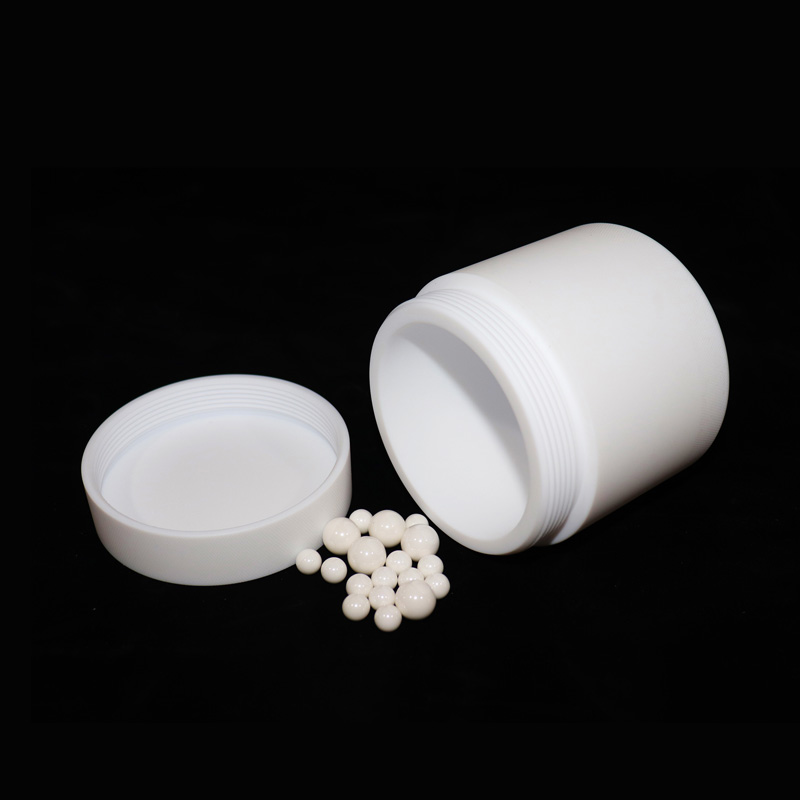
For a drum, not only the words “made of PTFE” are important, but also geometric and operational data. Below is a list of parameters that should be checked with the card and passport of a specific product. If a value is missing or the units of measurement are in doubt, they don’t make it up: they ask the supplier for clarification.
| Parameter | Why is it needed? |
|---|---|
| Inner diameter and inner length | They determine the useful volume and permissible loading, but are not equal to the sample mass. |
| Outer diameter and length | Check the installation on the rollers of a specific mill, stability of rotation and absence of displacement. |
| Wall and bottom thickness | Related to rigidity, mass and wear resistance; should not be replaced by assumption. |
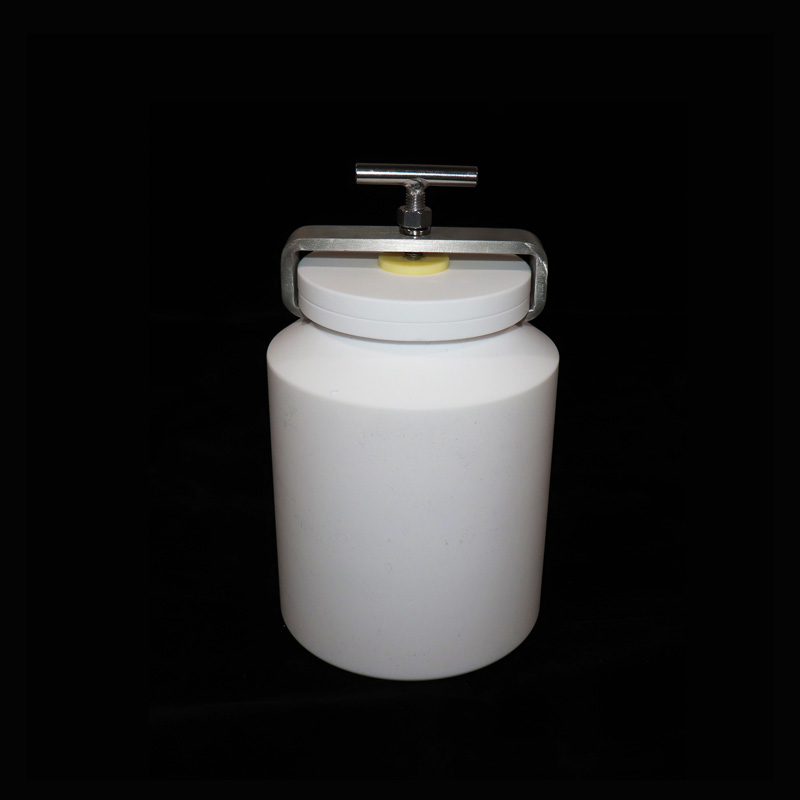
| Cover and seal | They determine the convenience of closing, the risk of leakage in wet mode and dust loss. |
| PTFE grade and filler content | Different brands may differ in wear resistance and acceptable environments. |
| Permissible temperature range | Needed for drying, wet grinding and operating conditions; does not carry over from the general description of PTFE. |
| Cleaning method | Avoids scratches, deformation and cross-contamination between samples. |
Separately check what exactly the indicated volume means: the geometric capacity of the drum, the recommended loading or the volume of one glass in the set. For a roller mill, it is useful to know the weight of the empty drum: it affects the load on the rollers and ease of handling. However, without a passport, you cannot assign a specific load by weight or volume solely on the basis of appearance.
Compatible with mill and grinding media
The first level of compatibility is mechanical. The drum must match the roller mill in outer dimensions, weight and seating surfaces. A product cannot be assumed to fit any installation simply because it is designed for roller grinding. On website TENCAN different areas of laboratory and industrial equipment are presented; The drum card should be compared to a specific mill model and not to the range as a whole.
The second level is compatibility with grinding media. For PTFE drums, it is especially important to consider the hardness and density of the balls. Ceramic, corundum, zirconium or steel grinding media have different effects on the wall and contaminate the sample in different ways. The choice of grinding media material is discussed in conjunction with the drum material, grinding objective and cleanliness requirements. If the product card does not contain confirmation of compatibility with a specific type of grinding media, this condition is checked separately.
The third level is chemical compatibility with the sample and medium. PTFE may be suitable for many aggressive materials, but the cap, seal and grinding media may have other limitations. For wet grinding, check the tightness, temperature and possible swelling or deformation of the sealing elements. For dry grinding, powder adhesion, electrostatics and complete discharge are important. None of these issues can be resolved by the name of the material alone.
Can the drum be used for cryogenic grinding?
Cryogenic grinding involves cooling, often liquid nitrogen, and requires special mill design and safety precautions. A conventional PTFE grinding drum should not automatically be called cryogenic: the temperature of the working area of the machine is not equal to the temperature of the sample, and the material of the drum and seals may have their own limitations. The possibility of such a mode is confirmed by documentation for a specific system, and not by the general properties of PTFE.
Wear, cleaning and cross contamination
Monitoring the condition of the drum begins with an inspection before and after each series. The surface should be free of deep scratches, burrs, darkening, dents and edge deformation. The lid should close properly, without distortion. If signs of wear appear or the material begins to leave marks on the sample, the drum is removed from critical work and the cause is assessed: too heavy grinding media, excessive speed, incorrect loading, abrasive sample or incorrect cleaning.
Cleaning without damaging the surface
PTFE is easily scratched by abrasive powders and hard brushes. For cleaning, use soft tools and cleaning agents that are approved for this material. After wet cleaning, the drum is thoroughly rinsed and dried; The temperature and drying method are checked according to the documentation, since overheating can deform the product. You should not use a wire brush or abrasive paste just for the sake of speed of cleaning: the damaged surface is then more difficult to wash and retains sample residues more strongly.
How to reduce carryover between samples
It is best to provide separate labeling for different materials and, where possible, a separate container. Between samples, multi-stage cleaning is performed: the bulk of the powder is removed, washed with a compatible product, rinsed and dried. If the assay is sensitive to organic traces or ions, the cleanup procedure should be consistent with laboratory procedures. No transfer can be guaranteed just because the surface appears clean.
How to choose a drum for the task
- First, determine the type of mill: for a roller ball mill, you need a drum of the appropriate geometry, and not a planetary glass.
- Check external dimensions and weight with the specific installation; Check the stability of the rollers and the absence of runout.
- Clarify the payload and do not confuse the concepts of total volume, working volume and mass of the sample.
- Assess the chemical compatibility of the sample, fluid, grinding media, cap and seal.
- Understand whether the penetration of PTFE particles into the sample is critical and what wear is acceptable in the planned mode.
- Provide cleaning, drying, labeling and storage to reduce cross-contamination.
- If temperature, speed, volume or compatibility data is missing, ask for confirmation rather than substitute values by analogy.
As a guide, you can formulate the problem as follows: “you need a PTFE grinding drum for a roller mill, work with such and such a sample, dry or wet mode, such and such cleanliness requirements and such and such available volume.” After this, the product card, mill dimensions and acceptable grinding media are checked. This procedure reduces the risk of buying a container that is suitable for the material, but not suitable for the geometry or operating conditions.
Brief questions and answers
Why is PTFE better than stainless steel?
PTFE is chemically more inert than many metals and does not contain metal components that could pass into the sample. At the same time, it is softer, wears out more and requires more careful cleaning. The choice depends on the analyte, acceptable impurities and aggressiveness of the environment.
Can the drum be washed in a laboratory sink?
The decision depends on the design, cover, seal and manufacturer's recommendations. High temperature and detergents can affect the PTFE and sealing elements. Without confirmation, it is safer to use manual cleaning with mild products.
Is the drum suitable for a planetary mill?
As a rule, no: the planetary cup has a different geometry and method of fixation. Even if the dimensions appear close, compatibility with the socket, cover and counterweight must be confirmed for the specific model.
Why can't we promise zero pollution?
Any contact of the sample with the wall and grinding media is accompanied by wear. PTFE reduces chemical interaction but does not eliminate mechanical particle transport. The level of acceptable contamination is determined by the task and method of analysis.