
The polyurethane grinding drum is a replacement container for a roller ball mill in which the sample and grinding media are placed. When the drum rotates on rollers, the material is abraded and crushed during collisions; The drum itself determines the load volume, contact with the environment and some of the pollution conditions. In line TENCAN this performance is presented as a separate card polyurethane grinding drum; This is not a universal container for any mill and not a “lining” for any machine.
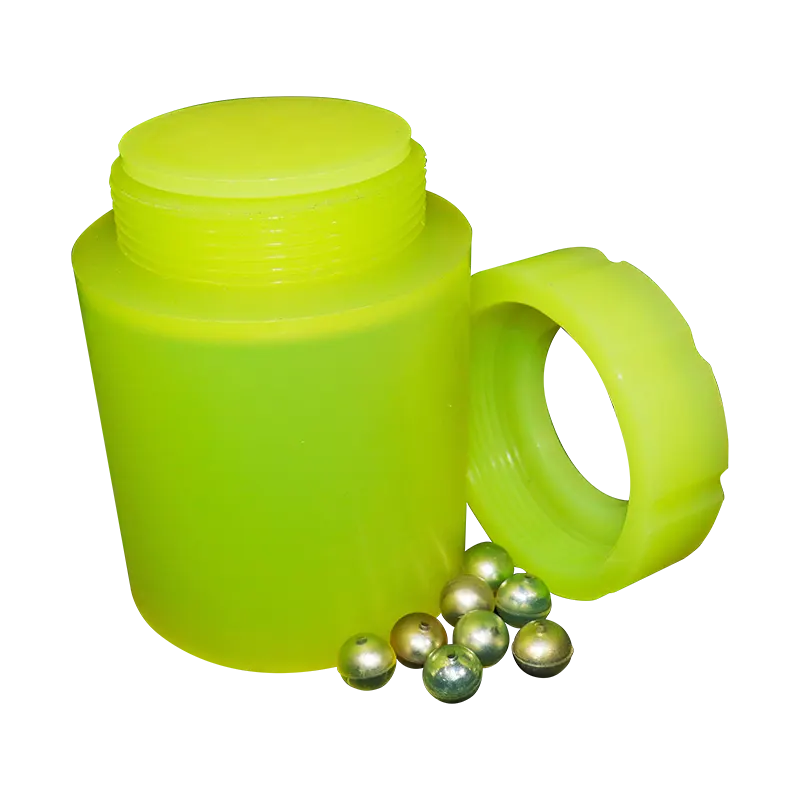
Place of the drum in a roller mill
A roller ball mill operates by friction of a drum against rotating rollers. Inside the drum, the grinding media rise and then roll or fall, creating abrasion and impact loads. The drum here is not a drive or an independent grinder, but a working volume that closes the process: the trajectory of the bodies, payload and sample losses depend on its geometry.
Therefore, the properties of the drum cannot be assessed separately from the mill. Even a drum of suitable material must match the rollers in outer diameter, length and seating elements, and the cover must not touch the frame or casing. If the product description does not confirm compatibility with a specific model, such compatibility cannot be considered proven.
The roller drum is not equal to the grinding bowl of a planetary mill. In a planetary machine, the glass undergoes complex rotation and experiences other accelerations; the fastening, cover and seal there are usually designed for a different mode. The similar cylindrical shape does not make these parts interchangeable. A bead mill with a rotating stirrer is also a different principle: there the medium is mixed by a rotor, rather than a rolling drum.
Polyurethane as a material: what does it change?
Polyurethane is an elastomer, not a metal or sintered ceramic. For a grinding drum, not only chemical resistance is important, but also elasticity, resistance to abrasive wear, the ability to absorb shock and maintain shape under load. These properties depend on the polyurethane formulation, so the name of the material alone cannot attribute specific hardness, heat resistance or chemical versatility to the product.
A more elastic wall can soften some of the impact interactions. For brittle and very hard materials, this is not always a plus: hard ceramics or steel transmit energy differently, and polyurethane can partially dissipate it. You need to compare drums under the same grinding conditions, and not just by material.
The polymer surface does not guarantee chemical inertness. Some organic solvents, oils, concentrated reagents and elevated temperatures may cause swelling, softening or accelerated aging. A specific list of acceptable environments must be confirmed by execution documentation; the everyday formulation “polyurethane is resistant to chemicals” is not sufficient for choosing a drum.
The temperature factor also requires checking. During prolonged grinding, mechanical energy is converted into heat and the drum can become hot. Polyurethane as a class usually has a lower permissible temperature ceiling than steel or ceramics, but it is impossible to transfer the general property to a specific part without passport data. If the process is heat sensitive, mode and cooling are discussed separately.
Design and performance without fictitious classification
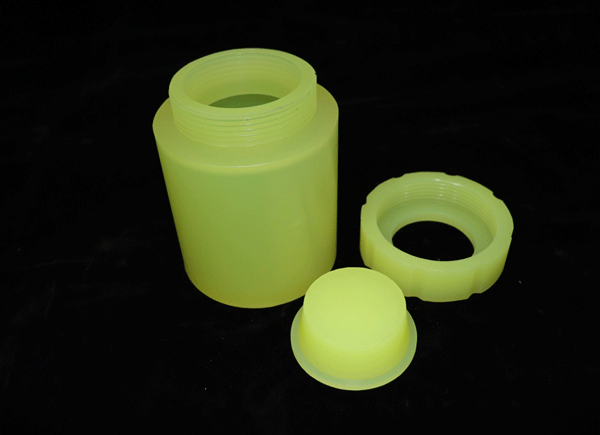
The materials provided indicate one product - a polyurethane grinding drum for a roller mill. It does not follow from this that there is a division into “light”, “reinforced” or “laboratory” types based on color or shape. Actual options, if any, are determined by size, wall thickness, cover design, seal, and method of fixation; these signs must be taken from the description of a specific performance.
The drum body, internal cavity, cover, seal and fastening elements are checked. For a polymer part, the condition of the edges, the absence of cracks and the quality of fit of the lid are especially important: it is in the gaps and microcracks that powder and wear particles are retained. If the design includes a metal shell, insert or reinforcement, the contact areas with the sample should be clearly described and not inferred from a photograph.
The drum should not be called a “mill”. It does not create rotation or set the grinding speed; This is done by a roller installation. Nor can it be attributed to the functions of sifting, mixing or classifying. Sifting after grinding is a separate operation for which other equipment is used, for example three dimensional vibrating screen; this does not make the screen part of the drum and does not confirm their automatic compatibility.
How to read sizes, volume and mode
Geometric and working volume
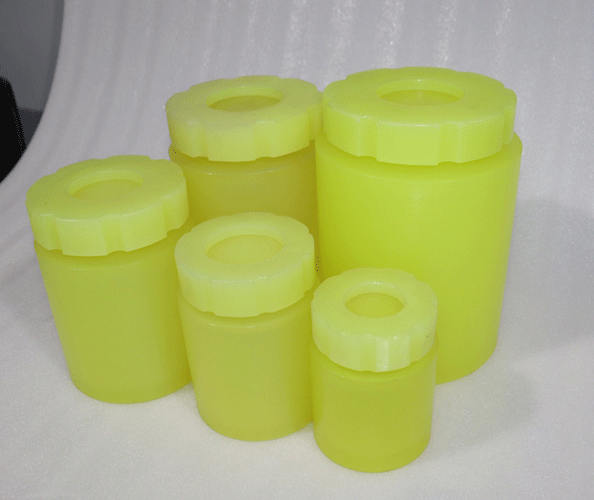
The nominal volume of the drum is not the same as the amount of sample that can be loaded. Part of the cavity is occupied by grinding media, while part remains free for movement and pouring. The working load is always less than the geometric volume, and its permissible proportion depends on the diameter, length, weight of the bodies and management requirements. You cannot transfer a number from one performance to the entire series.
It is necessary to distinguish between the volume of one drum, the total volume of the set and the mass of the sample per cycle. If the description states volume in liters, this may be the internal geometric capacity rather than the payload. For calculations, it is better to use the internal diameter and useful length, but the final check is carried out according to the passport and actual filling.
Diameter, speed and energy
The drive of a roller mill is usually characterized by the speed of rotation of the rollers. This is not the same as the drum rotation speed: with different drum diameters, the same roller speed gives different peripheral speeds and a different pattern of movement of the grinding media. It is incorrect to compare modes only by the number of roller revolutions, without knowing the diameter.
A large drum at the same rotation speed has a higher peripheral speed on the wall and a different lift of the bodies. Therefore, transferring the mode from a snare drum to a large drum without recalculation and verification does not guarantee either the size or safety of the material. The critical speed at which bodies stop rolling is also related to the internal diameter; There is no universal number for all reels.
Weight and performance
For a grinding drum, it is more correct to talk not about productivity in tons per hour, but about the mass of the batch per cycle and the reproducibility of the result. The load mass consists of the sample and grinding media; Overloading increases stress on the rollers, cover and seal. If the maximum mass is not specified, it cannot be inferred from volume or appearance.
The final fineness depends on the source material, its hardness, medium, size and density of grinding media, time and mode. The same drum does not guarantee the same particle distribution for different powders. A typical catalog result is a guide for certain conditions, not a promise for any sample.
Dry and wet grinding have different effects on the drum. In a dry process, the powder may stick, create dust and be difficult to unload; when wet, a liquid medium appears, which changes the chemical contact with the polyurethane and requires testing of resistance. Wet grinding does not always produce less wear, and dry grinding is not always easier: the properties of the sample, the viscosity of the medium and the admissibility of subsequent drying are decided.
Wear and transfer of impurities
The polyurethane drum wears out when abraded by grinding media and powder. Abrasive and angular particles, large feed fractions and dense grinding media accelerate wear. The polymer can gradually wear out, abrasions, scratches and indentations appear on the surface; material is retained in them, and wear products enter the sample.
Why Polyurethane Doesn't Mean Zero Pollution
The statement about “completely free of contamination” for a polymer drum is incorrect. Polyurethane contains a polymer base and additives, and when worn, particles form. Steel or ceramic grinding media can also wear and contribute. The final contamination is determined by the “drum - grinding media” pair, sample, mode and sensitivity of the analysis.
If trace amounts of polymers, organic additives or wear-related elements are being analyzed, polyurethane may not be suitable. For such tasks, a control blank grinding without a sample or with an inert model, as well as a separate drum for sensitive samples, are useful. This does not prove suitability at all, but it does help evaluate the contribution of capacitance.
Signs of wear and what to do
Inspect the inside surface, edges, cover and seal. Cracks, deep grooves, stickiness, loss of shape, peeling or permanent deposits after cleaning are signs in which it is better to remove the drum from critical work. Color change in itself is not a measurement of wear, but may indicate contamination or aging of the material.
Do not grind or trim the polyurethane surface without the manufacturer's instructions: this can change the geometry, disrupt the seal and increase the transfer of impurities. Replacing the drum must take into account not only the outer diameter, but also the fit on the rollers, the cover and the permissible mode.
Cleaning and preparing for the next sample
After unloading, remove the grinding media and the remaining powder, then clean the cavity and lid. The cleaning method depends on the sample material and the chemical resistance of the specific polyurethane. Any solvents, alkalis, acids or hot water cannot be considered safe in advance; an aggressive environment can change the surface faster than abrasive wear.
For everyday cleaning, soft tools that do not leave scratches are usually used. Metal scrapers and abrasive sponges create a microrelief in which particles are retained. Particular attention is paid to the cap gap, threads, O-ring and edges: this is where the remaining sample is transferred to the next batch.
After wet cleaning, the part is thoroughly dried under conditions acceptable for the polymer. Polyurethane should not be dried with an open flame, hot oven, or other method not approved for the material. If the drum is used for different substances, a washing procedure and residue control are needed; For trace analysis, visual inspection alone is not enough.
Compatibility: drum, sample, grinding media and mill
With sample and environment
First, the sample is assessed: hardness, initial particle size, abrasiveness, tendency to stick, presence of solvent and process temperature. Polyurethane is not appropriate for every sample. For very hard and large particles, the energy of the elastic wall may be insufficient, and for sensitive organic matter, on the contrary, the polymer itself will become an obstacle.
With grinding media
The grinding media must match the drum in weight, size and material. Large and dense bodies increase impact loads and wall wear; soft or contaminating bodies can be a major source of impurities. You cannot choose bodies only according to the principle “the heavier, the better”: the entire regime and compatibility of the pair, confirmed for a specific performance, is important.
With equipment
For a roller mill, check the outer diameter, length, weight, fit, clearance to the rollers and free movement of the cover. A drum from one setup does not become compatible with another just because it has a similar volume. You need to be especially careful with planetary, vibration and bead mills: they have different fastenings, accelerations and methods of energy transmission.
Brand TENCAN does not in itself confirm the compatibility of any parts with each other. If the product card does not directly indicate the mill model, separate confirmation is required. The current range and product cards are shown at website TENCAN; for selection, use the description of a specific drum, and not general assumptions from a photograph.
Selection criteria
Practical choices start with the task, not the color or appearance of the drum. It is useful to record the sample weight per cycle, required size, acceptable contamination, operating environment, temperature, cleaning method and mill model. It is then checked that the internal volume and workload are sufficient and that the external dimensions and fastenings are suitable for the installation.
- Material of sample and grinding media: evaluate abrasiveness, hardness and possible contribution to contamination.
- Chemical Resistance: Confirm contact with solvent, oil or reagent for specific polyurethane.
- Temperature: Do not exceed the permissible range that should be specified for the product.
- Geometry: Check the internal volume, external diameter, length, cover and seal with the mill.
- Cleaning: make sure that the surface can be cleaned without abrasive or aggressive media.
- Analytics: for trace measurements, provide a control experiment and a separate container.
- Spare parts: Check availability of covers and seals if supplied separately.
If requirements exceed the capabilities of polyurethane, other drum materials are considered. Polyurethane is not universally superior: it is useful where resilience, abrasion resistance and mild chemical environments are important, but is limited in temperature, hardness and contribution to fouling. The final choice is confirmed by testing on a real sample.
Brief questions and answers
Does the polyurethane drum provide complete absence of contamination?
No. The polymer surface wears out, and particles of material and additives can get into the sample. The risk depends on the mode, grinding media, sample and sensitivity of the analysis; For trace work, supervision is required.
Can such a drum be used in a planetary mill?
Only if compatibility is directly confirmed for a specific model. The roller drum and bowl of the planetary mill differ in their mounting, cover and loading conditions; The cylindrical shape alone does not prove this.
How to choose drum volume?
First, the mass of the sample and grinding media is determined, then the working volume is checked, and not just the geometric capacity. The drum cannot be filled to the top: the possibility of body movement must remain, and the permissible load is indicated for a specific performance.
Can the drum be washed with any solvent?
No. Chemical resistance depends on the polyurethane formulation and temperature. Before using an aggressive agent, confirmation of compatibility is required; After washing, it is important to remove residues and dry the product in an acceptable manner.
How is polyurethane different from steel or ceramics?
It is more elastic and usually less rigid, distributes impact energy differently and has other temperature and chemical limitations. Steel and ceramics are also not free from wear; choices are made based on the task, not on the promise of “zero pollution.”