
A polyurethane grinding bowl is a replaceable grinding container of a planetary ball mill, the body and internal working surface of which are made of polyurethane. The glass is installed in the seat of the mill carrier, the sample and grinding media are loaded inside, after which the mill sets the glass into planetary motion. The purpose of such a container is to grind and homogenize the sample in contact with an elastic polymer, when constant contact with steel, hard ceramics or agate is undesirable for one reason or another. In nomenclature TENCAN This is a separate item in the line of grinding bowls: polyurethane grinding bowl for planetary mill. Next we'll talk about material, wear, cleaning, sizing and compatibility - these are the topics that will determine whether a glass will be suitable for a particular sample and a particular mill.
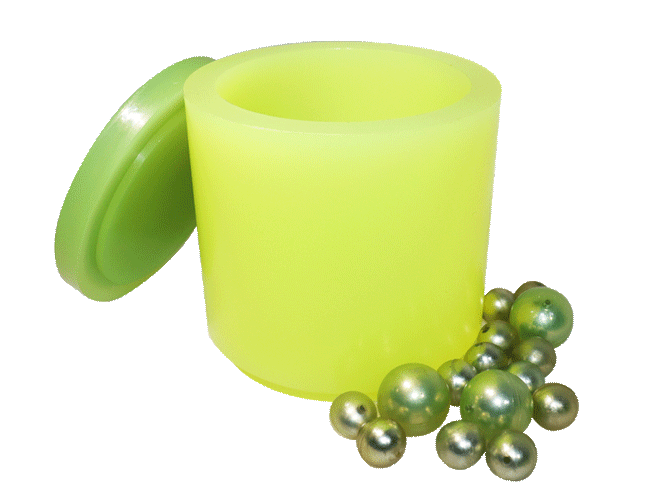
What is polyurethane grinding bowl and where is it found in the process
The grinding bowl is a consumable element of the grinding set, and not an independent device. The kit is structured like this: a mill with a carrier, landing sockets, glasses, grinding media, a sample. The mill sets the movement and duration of processing, the grinding bodies transmit the energy of impact and friction, and the glass forms the working chamber: it holds the sample and the grinding bodies, limits the volume, is closed with a lid and is in contact with the sample with the entire inner surface.
From this follows the main thing for practice: the glass cannot be considered in isolation from the mill and grinding media. The tribosystem “inner wall of the glass - grinding body - sample particle” determines both the efficiency of grinding and what substances will get into the sample. If the glass material is softer than the material of the grinding media, the wall will wear out first; if the grinding media are softer, their shape and mass will change. Therefore, the question “polyurethane or stainless steel” is not a question of convenience, but of the permissible level of impurities and the nature of the sample.
The polyurethane cup belongs to the family of cups for planetary mills. The manufacturer also produces containers made of stainless steel, zirconium dioxide, corundum, agate, nylon, PTFE, tungsten carbide, that is, the choice is made within one line for different tasks. The material of the beaker does not improve or deteriorate the mill itself - it affects the contact with the sample. A general list of equipment directions is given at website TENCAN (Changsha Tianchuang Powder Technology Co., Ltd.).
Design and working principle: glass in a planetary mill
How does grinding energy occur?
In a planetary mill, the glass rotates around the common axis of the carrier and at the same time around its own axis, and in the opposite direction. Due to the addition of these movements, the grinding bodies are periodically pressed against the inner wall, roll down it and hit the loaded material and the wall with acceleration. Grinding occurs due to impact and shear, that is, the destruction of particles and their abrasion are combined. The higher the speed and the greater the mass of the grinding media, the more intense the impact on the sample - and the higher the load on the inner surface of the glass.
The glass here performs three functions: it holds the load, transfers mechanical energy to it through the wall and closes the work area. For wet grinding, the tightness of the lid is important, for dry grinding - the absence of dust loss. None of these functions depend on how “powerful” the mill seems: the selection of the glass is based on the seat, volume and material.
The role of grinding media and system boundaries
The grinding bodies and the glass form a pair, which is selected together. Bodies made of stainless steel, zirconia, agate, corundum, tungsten carbide or polyurethane-coated balls vary in density, hardness and tendency to introduce impurities. In an elastic glass, the impact load is distributed differently than in a steel or ceramic one: part of the energy is dissipated in the polymer, so the processing mode may require clarification compared to a rigid container.
It is important here not to mix equipment classes. For example, laboratory horizontal bead mill with pin rotor — This is a device with a grinding chamber, a rotor and beads, where grinding occurs in a liquid medium using a different mechanism. The replacement bowl of a planetary mill is not the grinding chamber of a bead mill and does not replace its parts; Compatibility between these families is not assumed by default.
Why is a glass considered a consumable item?
The inner surface of the glass constantly works under conditions of impact and abrasive wear. Even with careful use, it gradually changes its geometry, and the lid seal loses its elasticity. That is why the glass is a replaceable accessory and not part of the mill body. The service life of a particular glass is determined by the sample material, mode, type of grinding media and the number of cycles, so there is no single “service life” for the entire line.
Polyurethane as a material for grinding containers
What does elasticity give?
Polyurethane is an elastomer: it can be reversibly deformed and transmits shock worse than metal or dense ceramics. The practical implications for sample preparation are that noise and vibration are reduced, the risk of chipping and brittle failure of the container itself is reduced, and fewer hard inorganic particles are introduced into the sample. For soft, fibrous, polymer, composite and moderately hard materials, this combination is often more convenient than a steel cup.
The elastic wall also has a second side: part of the impact energy is dissipated, so it may take more time or a different set of grinding media to achieve the same result. The mode parameters should be clarified according to the mill documentation, and not transferred mechanically from rigid containers.
What polyurethane doesn't solve
Polyurethane is not a “free” material. It is softer than steel, ceramics and tungsten carbide, and with intensive work its surface wears out, releasing polymer particles into the sample. This may be acceptable for organic and polymer samples, but not for inorganic analysis for trace elements. In addition, the polymer is sensitive to temperature and to some solvents: it can soften when heated and swell when in contact with aggressive media. This limits the use of long-term wet grinding in such liquids and does not automatically transfer to polyurethane the regimes developed for agate or zirconium dioxide.
Separately, it is worth mentioning cryogenics. Liquid nitrogen cooling is a separate task with separate equipment and refrigerant flow; a regular polyurethane beaker does not turn into a cryogenic system just because the sample has been pre-cooled. If the fragility of the sample is critical, the issue is resolved by selecting a cryogenic mill, and not by choosing a polymer.
Wear, contamination and cleaning
The wear of the polyurethane cup appears gradually. First, the color and shine of the inner surface changes, then matte zones, scratches, local dents appear, and towards the end of the service life - loss of shape and deformation of the edge under the cover. Wear of the seal is noticeable by traces of leakage during wet grinding and by the appearance of dust under the lid during dry grinding. Any of these signs means that further grinding will be accompanied by an increased amount of polymer in the sample and a deterioration in reproducibility.
Cross contamination is a second issue that is often overlooked. Residues of the previous sample in microcracks and at the edge may enter the next sample. The practice is to clean the glass immediately after the cycle, rinse with a compatible solvent, then with neutral water, dry without heating above the permissible level, and store closed. Abrasive scrapers, metal brushes and hard powders are not suitable for cleaning polyurethane - they create risks that then retain the material. If the samples are from different classes of materials, it is wiser to secure separate glasses for them than to try to wash one.
The introduction of impurities also depends on the hardness ratio. Hard abrasive materials - for example, corundum, silicon carbide, quartz, sintered ceramics - quickly wear out the elastic wall during high-energy processing; In such applications, polyurethane is usually not chosen. Soft and moderately hard samples wear it out more slowly, but here too you should monitor the condition of the surface and do not assume that soft material guarantees the purity of the sample.
How to read the characteristics of a glass: volume, dimensions, fit
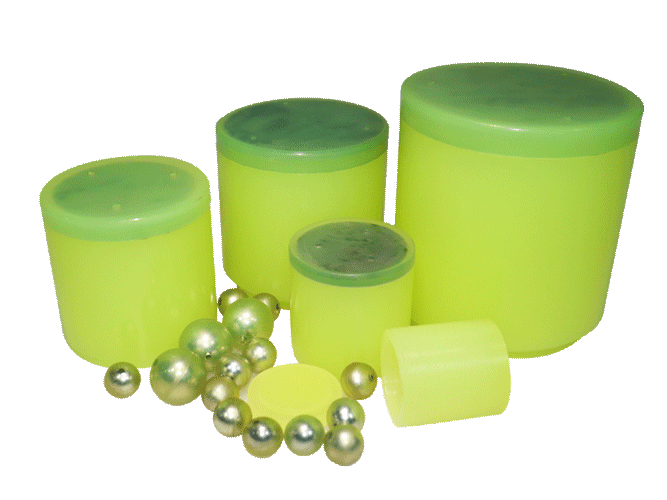
Nominal volume, workload and sample weight
The first thing to differentiate is that there are three different quantities. The nominal volume of a glass describes the geometric capacity of the container. The working load is the part of this volume that the sample and grinding bodies together occupy: it is always less than the nominal value, otherwise the bodies have nowhere to move and grinding practically stops. The mass of the sample is already a consequence of the selected loading and bulk density of a particular material. Productivity over time is the fourth value, depending on the mode, initial size and properties of the sample; it is not determined by the volume of the glass.
The achievable particle size is also not a property of the glass. It depends on the sample material, its initial size, type and size of grinding media, duration and method of measurement. Typical guidelines from the catalog refer to specific conditions and are not guaranteed for any sample, therefore for each new task the result is checked experimentally.
Grinding media: material and size
Large bodies give a stronger blow, small ones give more contacts and work better for abrasion and deagglomeration. A combination of different sizes sometimes produces a more uniform particle size distribution more quickly. The material of the bodies is chosen so that the unwanted impurity is predictable: balls with a polyurethane coating are closer in nature to the elastic wall, balls made of zirconium dioxide or tungsten carbide give a high density, but also a more rigid impact on the wall. Compatibility tables and loading tolerances should be taken from the specific mill documentation.
Cover, seal and seat
The lid is responsible for tightness and dust loss, and the o-ring is responsible for working with liquids. The seat is the geometry of the carrier socket: diameter, height, method of fixation. A glass that does not fit the seat does not become compatible due to its similar volume; this is verified against the mill documentation. Permissible speeds are also checked: exceeding the speed accelerates wear of the polymer and heating of the sample.
Compatibility, suitable materials and selection criteria
A polyurethane cup is appropriate where it is necessary to avoid contact of the sample with metal or hard ceramics and where the sample is not highly abrasive. These are soft polymers, elastomers, composites, fibrous materials, some food and biological samples in dry or moderate wet mode. Limitations: hard abrasives, high-energy modes, prolonged contact with aggressive solvents, tasks where minimal addition of organic carbon is required.
The differences in processes are also worth keeping in mind. Dry grinding in a polyurethane cup is convenient where the material is not prone to sticking to the elastic wall; Wet grinding requires testing for tightness and chemical resistance. Particle destruction and disagglomeration are not the same thing: an elastic wall works well to destroy agglomerates, but the abrasion of primary particles in it is slower than in a rigid container. And finally, grinding is not the same as mixing: the mixer mixes the components, and the glass with grinding media is designed to reduce coarseness.
The practical selection procedure is as follows: determine the nature and hardness of the sample; evaluate acceptable impurities; select the material of the glass and grinding media as a pair; check the seat and nominal volume according to the mill documentation; set workload and mode; carry out a trial run and evaluate the particles, wear and purity of the sample. If cleanliness requirements are high, it is worth considering containers made from other materials presented in the line, such as zirconia, agate or PTFE, since there is no universal material without compromise.
Frequently asked questions
Can a polyurethane cup be considered “non-polluting”?
No. The polymer is softer than most grinding media and wears out during operation, so its particles can get into the sample. The question is not whether there is an introduction of impurities, but whether it is acceptable for a particular analysis.
Is this glass suitable for hard ceramics and abrasives?
Usually not: hard abrasive materials quickly wear out the elastic wall. For such tasks, it is more rational to choose containers from harder materials, and check the specific solution against the product documentation and the results of trial grinding.
How to distinguish beaker wear from sample contamination?
Guidelines - the condition of the internal surface and seal: matte areas, scratches, edge deformation, traces of leakage or dust under the cover. If these signs persist after cleaning, the glass has expired.
Can one glass be used for different samples?
Technically possible, but changing material grades increases the risk of cross-contamination. If samples are analyzed for trace elements or differ in hardness, it is more reliable to secure separate beakers for different types of samples.
Is a polyurethane cup a substitute for a cryogenic mill?
No. The elastic polymer does not provide liquid nitrogen cooling and does not convert conventional grinding into a cryogenic process. For fragile and heat-sensitive materials, a separate cryogenic system is required.