
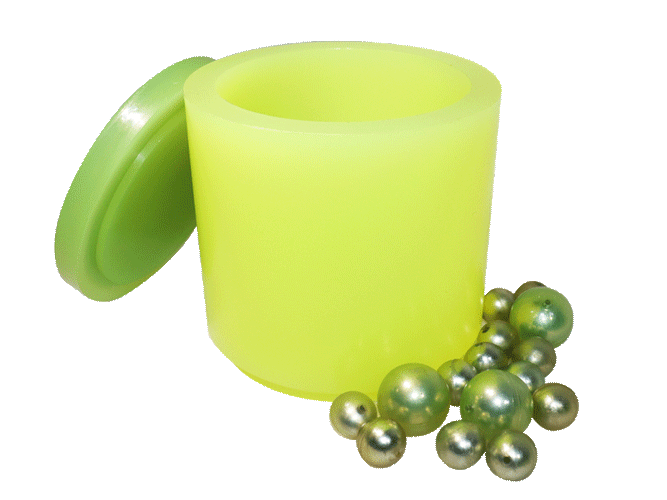
A polyurethane grinding bowl for a planetary mill is a replaceable working chamber in which the sample is crushed and mixed together with grinding media. It is installed in the socket of the planetary mill, rotates together with the carrier and receives additional acceleration due to counter-rotation. The purpose of such a glass is to hold the sample and grinding media, transfer impact and abrasion energy to them, and also minimize unwanted transfer of material into the sample. Polyurethane is chosen in cases where elasticity, abrasion resistance and a relatively soft effect on the sample are important. In the card TENCAN this product is presented as polyurethane grinding bowl for planetary mill.
Function and place in the sample preparation system
A planetary ball mill is a laboratory device in which grinding bowls are mounted on a rotating carrier disk. When the carrier rotates, the glasses move along a circular path, and due to counter-rotation or the geometry of the drive, the grinding bodies inside the glass receive a complex movement. Centrifugal forces arise, which press the balls against the walls and then change direction. As a result, the material is crushed by impact and abrasion. The glass here is not just a container: it determines the useful volume, the shape of the chamber, the compaction conditions and the nature of the contact of the grinding media with the wall.
Polyurethane glass occupies a niche between softer polymer and harder ceramic or metal versions. Its elasticity can reduce shock loads on the beaker itself and on large, fragile particles, but at the same time reduces the energy transferred to the sample compared to rigid materials. Therefore, the choice of polyurethane is always a compromise between sample purity, cup wear, required coarseness and type of material. Polyurethane does not make grinding “ideal” and does not cancel the dependence of the result on the initial size, mode, grinding media and sample properties.
Design and features of polyurethane version
A typical grinding bowl for a planetary mill consists of a body, a cover, a sealing element and a fixation unit. The housing absorbs the load from the grinding media, the lid closes the chamber, the seal prevents the sample from spilling out and flowing out, and the fixation holds the glass in the socket at high speed. In the polyurethane version, the body can be entirely cast or made from a polyurethane blank, and the corresponding parts - cover, rings, inserts - are made of compatible materials.
The word "polyurethane" describes not just one substance, but a family of elastomers. Their properties depend on the formulation, hardness, degree of crosslinking and fillers. One polyurethane may be more wear-resistant, another may be more flexible, and another may be better able to resist a particular solvent. Therefore, it is impossible to transfer the characteristics of one polyurethane product to all glasses of this type. For a specific model, you need to clarify hardness, permissible temperature, chemical resistance and cleaning recommendations. If the product card does not contain a value that is important for the task, it should be requested from the manufacturer, and not guessed at.
Why does the glass material affect the grinding result?
During grinding, the glass and grinding media come into contact with the sample. If the beaker material is softer than the grinding media or sample, the walls may wear out. Wear products enter the sample, and this is important to take into account during subsequent analysis. Polyurethane is generally softer than zirconia, corundum, tungsten carbide or steel. This means that when working with hard abrasive materials, wear on the polyurethane cup may be more noticeable, and the risk of polymer particles being ingested may be higher. However, for soft and medium-hard samples, as well as for tasks where metal transfer is unacceptable, polyurethane may be more suitable than steel cups.
It is important to distinguish between comminution and disagglomeration. In the first case, you need to destroy the particles and reduce their size. In the second, the agglomerates are broken down, not necessarily by crushing the primary particles. A polyurethane beaker with relatively soft walls is more often considered for disagglomeration, soft grinding and mixing, but the decision depends on the specific sample. It cannot be said that polyurethane is suitable for any material or that it provides "zero contamination": wear and contaminant transfer are a matter of conditions, not just the name of the material.
Another factor is the shape and mass of the grinding media. Large and heavy balls give stronger impacts, but increase the load on the walls. Small balls increase the number of contacts and can accelerate abrasion, but are less effective at breaking up large particles. For a polyurethane cup, it is especially important to coordinate the material of the balls: if the balls are much harder than the cup, the wear of the walls will be determined by the “ball-cup” pair. Sometimes polyurethane-coated grinding media or less hard materials are used for such bowls, but this is not a universal rule, but an option that needs to be checked for a specific task.
Comparison with other grinding bowl materials
Grinding bowls are made from different materials, and each has its own area of application. Agate has high purity and moderate hardness, but is not considered one of the most wear-resistant, heavy-duty materials. Zirconia and corundum are harder ceramic options that are more often considered for abrasive testing, but they can introduce impurities and require careful cleaning. Tungsten carbide is used where high hardness and wear resistance are needed, but it does not exclude contamination and is usually more expensive. Stainless steel is useful for many tasks, but can tolerate iron, chromium and nickel. PTFE and nylon are polymeric materials valued for their chemical inertness or elasticity, but their mechanical resistance and temperature limits are limited.
Polyurethane in this series stands out for its combination of elasticity, impact strength and abrasion resistance. It can be useful for samples that are sensitive to metal contamination and for processes where harsh impact of ceramics or metal is not desired. However, polyurethane is not chemically inert in all environments: some solvents, oils and aggressive liquids can cause swelling, softening or accelerated wear. In addition, when heated, polymers can lose their mechanical properties. Therefore, before wet grinding, you need to check the compatibility of the liquid with the glass material, and not rely only on the general description.
It is worth mentioning separately about “soft” grinding. The polyurethane cup does not turn the planetary mill into a mortar and does not guarantee the preservation of the shape of the particles. It only changes the distribution of contact loads. If the task is to obtain a very fine powder from a hard mineral, a polymer cup may not be the best choice due to low rigidity and increased wear. If you need to delicately process soft, fibrous or composite materials, polyurethane may be more appropriate than steel or hard ceramics.
Size, volume and compatibility with planetary mill
When selecting a grinding bowl, it is important to distinguish between several values. The volume of one glass is the geometric capacity of the body. The total volume is the volume of all glasses installed in the mill. Working load - the amount of sample and grinding media that is actually loaded. Sample weight is the weight of the sample before or after grinding. These concepts are not interchangeable. It cannot be assumed that a glass with a volume of, for example, 100 ml is always filled with 100 ml of sample: a significant part of the chamber is occupied by grinding media, and there must be free volume for movement.
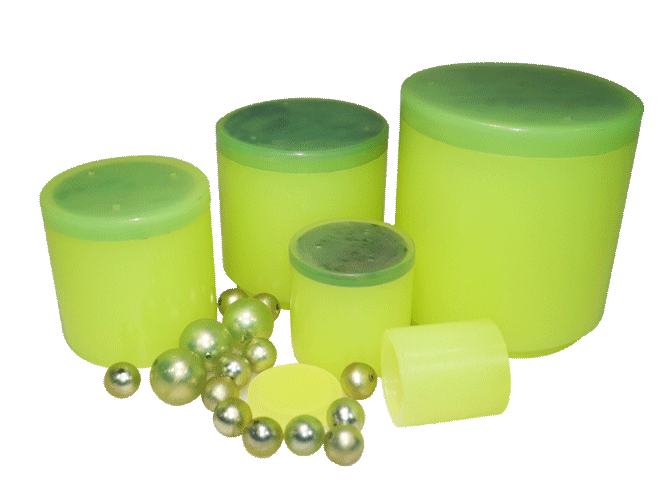
The compatibility of a polyurethane cup with a planetary mill is determined not only by volume. It is necessary to check the mounting dimensions, height, diameter, method of fastening, type of cover and seal. Different models of planetary mills have different sockets and fixation systems. A glass that fits one model may not fit another. Therefore, when choosing, you cannot limit yourself to the name “polyurethane cup”: you need to open the product card, clarify the available standard sizes and compare them with the mill’s passport. On the website TENCAN Different groups of equipment and accessories are presented, and correct selection requires verification for a specific model.
The grinding media must also match the glass. Balls that are too large may not fit into the neck or create an uneven load. Too fine - increase grinding time. The material of the balls affects wear and contamination. If you select balls made of a harder material for a polyurethane cup, the walls will wear out faster. If you choose balls that are too soft, they may become deformed or lose mass quickly. The optimal combination is determined by the sample, the required size and the permissible level of impurities.
Contamination, wear and cleaning
Contamination during grinding can come from several sources: bowl material, grinding media material, previous sample, detergents and the environment. Polyurethane is no exception. If the beaker wears out, particles can get into the sample. If another material was previously ground in the beaker, the residue may be carried over to the next sample. Therefore, cleaning is the same part of the technique as choosing a mode. Polyurethane is sensitive to abrasion and some solvents, so hard metal brushes and aggressive chemicals without proven compatibility are not suitable for it.
It is generally recommended to remove the bulk of the sample with a soft instrument, then rinse the glass with a compatible detergent or solvent, if approved by the manufacturer, and dry thoroughly. You should not leave liquid in a glass for a long time if its effect on polyurethane has not been tested. You also need to inspect the seals and lid: even minor damage can lead to leakage of suspension or dust. If the glass has discoloration, cracks, dents, odor, or loss of elasticity, this may indicate wear or chemical damage. In this case, it is better to replace the product rather than continue working with the risk of contamination and leakage.
The wear of the polyurethane cup depends on the hardness of the sample, the size and material of the balls, rotation speed, grinding time and the presence of liquid. It is impossible to name a universal service life: in some conditions the glass can withstand many cycles, in others it wears out faster. When planning experiments, it is useful to keep a journal: record the material, mode, load weight and state of the beaker. This helps to notice the moment when wear begins to affect the result and replace the equipment in time.
For what materials and tasks is polyurethane suitable?
A polyurethane grinding bowl is more often considered for soft to medium-hard materials, for samples where metal transfer is not acceptable, and for applications where a gentler mechanical action is required. It can be used for dry and wet grinding if the liquid is compatible with polyurethane. In wet grinding, it is important to consider that the media may accelerate wear or cause swelling of the polymer. In dry grinding, you need to monitor the heating: long-term operation without pauses increases the temperature of the glass, which is undesirable for the polymer.
The restrictions are also significant. For hard abrasive minerals, coarse grains and high-energy applications, polyurethane may not be the best choice. For cryogenic grinding with liquid nitrogen, a conventional polyurethane cup should not be considered suitable without confirmation from the manufacturer: at low temperatures, polymers change mechanical properties. Aggressive solvents and strong oxidizing agents require separate chemical resistance testing. Also, you should not use a polyurethane glass as a universal container for any substances just because it is “soft” and “not metallic”.
When choosing between polyurethane and other materials, it is helpful to answer a few questions. What impurities are acceptable in the sample? How hard and abrasive is the sample? Will the grind be dry or wet? What liquid is used? What volume of glass is needed? What grinding media are available? How often will you have to clean the equipment? The answers help to understand whether polyurethane really solves the problem, or whether its elasticity creates more limitations than advantages.
Selection criteria and questions to the supplier
Before ordering a polyurethane grinding bowl, it is worth making a list of requirements. It includes: planetary mill model, required number of glasses, volume of each glass, type of fastening, sample material, permissible impurities, type of grinding media, grinding medium, operating temperature and cleaning method. If at least one point is unclear, it needs to be clarified. You cannot transfer the characteristics of one glass to the entire range: different models have different sizes, wall thicknesses, seals and permissible conditions.
It makes sense for the supplier or manufacturer to ask specific questions: what polyurethane is the cup made of, what is its hardness, what solvents and temperatures are acceptable, what grinding media are recommended, how to check for wear and how to clean the product. If the product card does not contain the required parameter, request it separately. This is not a formality: the reproducibility of grinding and the purity of the sample depend on the compatibility of the beaker with the mill and the sample. In the card polyurethane grinding bowl TENCAN basic information about the product is indicated, and details for a specific task are best agreed with the supplier.
Do not automatically assume that equipment for other purposes is compatible with this glass. For example, a tablet press solves the problem of molding rather than grinding, and its equipment has different requirements. Planetary mill, bead mill, drum mill and roller crusher are different machines with different operating principles. The equipment of one group does not become universal for another. For the polyurethane cup, the main context is the planetary ball mill, and compatibility must be confirmed specifically for it.
Frequently asked questions
How is a polyurethane cup different from a nylon cup?
Both nylon and polyurethane are polymers, but their properties depend on the brand. Polyurethane is often more flexible and impact resistant; nylon may have different chemical and wear resistance. You cannot choose a material just by its general name: you need to look at the specific brand, hardness and manufacturer’s recommendations.
Can a polyurethane cup be used for wet grinding?
Wet grinding is possible if the fluid is compatible with the polyurethane and does not cause swelling, softening or accelerated wear. Conditions vary for water, alcohols and other media. Before work, you should check the chemical resistance and tightness of the glass.
Is the polyurethane cup suitable for cryogenic grinding with liquid nitrogen?
Regular polyurethane cup should not be considered intended for direct contact with liquid nitrogen without confirmation from the manufacturer. At low temperatures, polymers can become brittle. If cryogenic grinding is required, you must select equipment specifically designed for such conditions.
How can you tell if a glass is worn out?
Signs may include cracks, dents, loss of elasticity, discoloration, odor, leakage, and noticeable loss of wall material. If the glass no longer holds the sample or traces of the previous sample remain after cleaning, it is better to replace it.
Can this glass be placed in any planetary mill?
No, compatibility is determined by the mounting dimensions, volume, type of fastening and cover. Even if the glass is similar in appearance, it may not fit a particular model. Before purchasing, you need to check the characteristics with the mill's passport.
The polyurethane grinding bowl is a specialized tool and not a universal replacement for all other materials. Its benefits are evident where elasticity, toughness and reduction of metal contamination are required. Limitations relate to heat, chemical resistance, wear and compatibility with grinding media. The right choice begins with understanding the task, and not with the name of the material. If you check the mill model, volume, media and acceptable impurities, a polyurethane cup can be a workable solution for sample preparation.