
A polyurethane grinding bowl for a planetary mill is a replaceable working container that houses the sample and grinding media. It is installed in a planetary mill and together with it participates in the transfer of grinding energy: the glass rotates around its own axis and around a common axis, and the balls repeatedly collide with the material, walls and lid. In nomenclature TENCAN This product belongs to polyurethane grinding bowls; its purpose is to create a closed grinding chamber for applications where the selected polymer is compatible with the sample, medium and mode. Polyurethane Grinding Bowl for Planetary Mill is not an independent mill and does not set the grinding speed or energy: these parameters are determined by the equipment and the selected program.
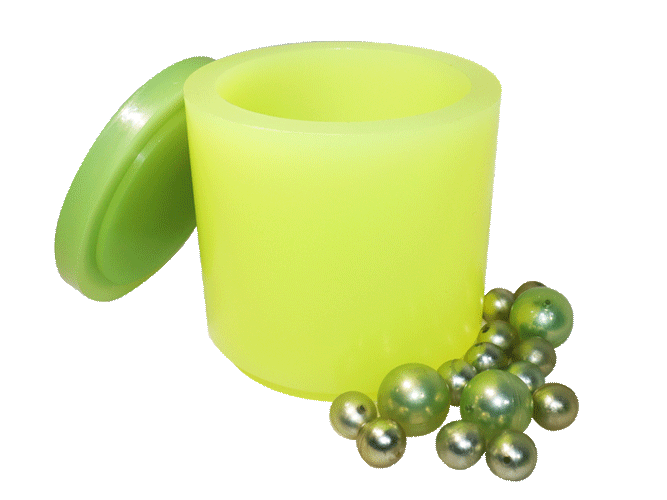
Place of the glass in the planetary mill
In a planetary ball mill, the grinding bowl is fixed in a planetary disk. When the disk rotates and the glass itself rotates, the grinding bodies acquire acceleration and transfer energy to the sample through impact and abrasion. Therefore, a glass is not just a container for powder. Its geometry, mass, rigidity, the condition of the cover and seal affect how the loads are distributed and how stable the process is.
The polyurethane cup performs several functions. It holds the sample and grinding media, limits dust and material loss, provides a chamber for dry or wet grinding, and separates the sample from the environment. At the same time, the glass material is in contact with moving balls and abrasive particles, so its wear and possible transfer of impurities is not a secondary issue, but part of the choice of equipment.
The glass does not “improve” the grind on its own. The result depends on the mill, grinding media, ball-to-sample mass ratio, time, speed, initial particle size and material properties. A polyurethane cup can only be appropriate when its material, dimensions and design correspond to the specific task, and not just the name of the equipment series. The grinding bowl for a planetary mill should not be confused with the chamber of a bead mill or the drum of a roller mill: they are different units with different requirements for fastening, wear and cleaning.
Polyurethane as a grinding bowl material
Polyurethane is a polymer material that is used as an elastomer in technical products. Depending on the formulation, it can combine elasticity, abrasion resistance and resistance to deformation, but these properties are not the same for all polyurethanes. For a grinding bowl, not only mechanical properties are important, but also chemical resistance, permissible temperature, tendency to swell, behavior in contact with water and solvents, as well as the composition of additives.
In planetary grinding, the polymer wall absorbs ball impacts differently than steel or ceramic. It can deform, absorb some of the impact load and reduce noise, but at the same time accumulate fatigue damage. For soft and non-abrasive samples this may be an advantage; for solid abrasive particles - the cause of accelerated wear. Therefore, the expression “polyurethane cup” in itself does not indicate either the resource or suitability for a particular powder.
Why you can’t judge by the word “polyurethane”
Polyurethanes differ in chemical structure, hardness, fillers and stabilizers. One material may be designed to work with aqueous media, another - for contact with certain oils or solvents; resistance to one substance does not mean resistance to another. Hardness also does not equal wear resistance: a softer polymer sometimes resists impact loads better, but is more quickly abraded by abrasives.
For a laboratory problem, it is useful to separate three questions: will the beaker withstand mechanical conditions, will it change the sample chemically, and will the level of impurities that its wear produces is acceptable. The answers to them are not always the same. For example, a beaker may mechanically withstand grinding, but release polymer particles that are unacceptable for trace analysis. Or vice versa: the material is chemically inert to the sample, but quickly wears out on solid powder.
What to clarify about the material
When choosing, you should ask for the brand of polyurethane, hardness, density, permissible temperature range, list of chemically compatible media and cleaning recommendations. Information on the presence of fillers, dyes and other additives, as well as data on the behavior of the material during prolonged contact with liquid, is useful. If these parameters are not confirmed, the "zero contamination" or versatility of the glass cannot be promised.
They separately specify whether the polyurethane is food grade or medical grade - only if this is documented. For routine laboratory applications, such labeling is not necessary, but when working with pharmaceutical, food, or biological samples, it may be important. The properties of one brand of polymer should not be transferred to the entire range.
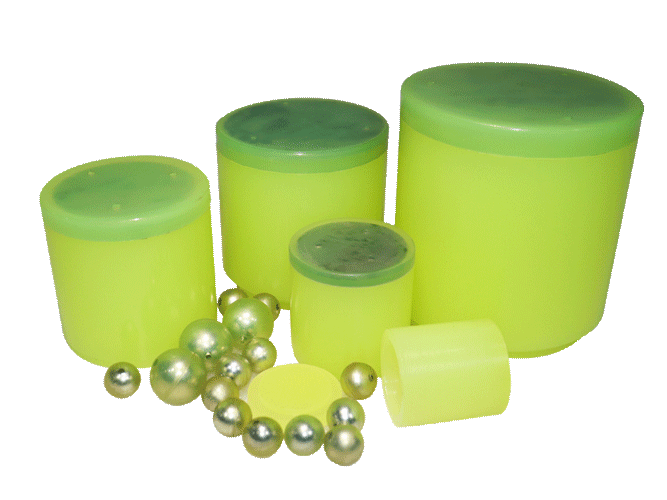
Wear, soiling and cleaning
The wear of the polyurethane cup in a planetary mill occurs through several mechanisms. Abrasive particles scratch and cut the surface, balls strike, and repeated deformation of the wall gradually accumulates fatigue changes. The higher the grinding energy, the larger and harder the particles, the greater the mass of the balls and the duration of the process, the more noticeable the wear. It is also influenced by the properties of the medium: water, acid, alkali or solvent can change the surface of the polymer, cause swelling or accelerate destruction.
Wear products are not only large debris. The sample may contain small polymer particles, fillers, residues from a previous sample, and substances used for cleaning. For most applications, sample preparation does not require complete absence of impurities, but for trace elemental analysis, catalysis, semiconductor materials, or surface studies, this issue becomes critical.
Ways to introduce impurities
Sources of pollution should be considered along the entire chain. These are the bowl and lid material, seal, grinding media, chamber atmosphere, unloading tools, storage utensils and cleaning agents. A polyurethane cup does not automatically eliminate these sources. If the laboratory has adopted impurity control, it requires separate procedures: blank grinding, background analysis, control of sample weight before and after, checking the purity of grinding media.
You need to be especially careful with traces of metals and other elements if they are target or interfering. A polymer cup may be preferable to a metal cup when in contact with an aggressive environment, but this does not mean that it is suitable for every element. The decision is made based on the results of control experiments and data on the composition of the material, and not on the general phrase “the polymer is inert.”
How to organize cleaning
Cleaning should remove sample residues but not damage the surface of the beaker. Abrasive powders and wire brushes can leave scratches in which particles can then accumulate. An aggressive solvent can cause swelling, clouding or cracking of polyurethane, so its applicability is checked according to the manufacturer's recommendations and chemical compatibility data. After wet cleaning, the glass is thoroughly dried; Residual liquid may affect dry grinding and the flowability of the powder.
It is useful to have separate beakers for different sample classes, or at a minimum to maintain a contact and cleanup log. The seal and cover are inspected before each use: cracks, cuts and loss of elasticity are unacceptable. If the surface has become rough, deep scratches or discoloration have appeared, this is a sign of wear and a reason to replace the part. Do not compensate for wear by increasing the grinding time: this increases the load and can increase contamination.
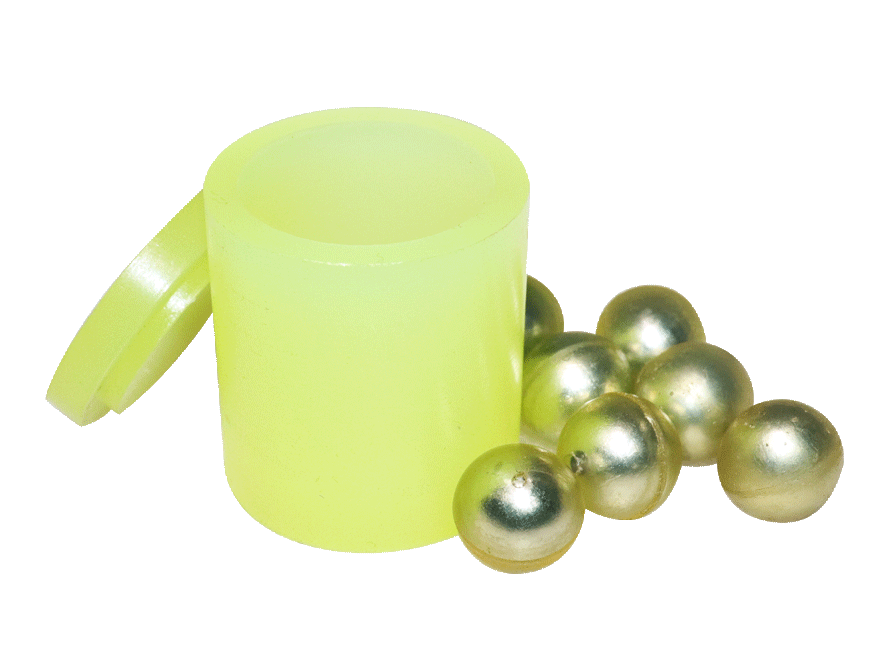
Dimensions, volume and compatibility
When selecting a glass, it is important to separate the nominal volume, useful volume and working load. The nominal volume is a designation of the standard size, the useful volume is limited by the structure and the lid, and the working load depends on the mass of the balls, the bulk density of the sample and the permissible filling. You cannot transfer the volume of one glass to the entire assortment or assume that the entire volume can be filled with powder.
Beaker volume, sample loading and weight
The product card or manufacturer's confirmation must indicate the internal and external dimensions, weight of the glass, neck diameter, lid design and seals. For a planetary mill, the landing dimensions, method of fixation and permissible weight are important, otherwise the balancing will be disrupted. A glass that is too heavy or asymmetrical increases the load on the drive and fastening; too loose - it may move.
The mass of the sample cannot be identified with the volume of the glass. For a specific mode, you need to know the recommended ratio of the mass of grinding media and the sample, the permissible degree of filling and the maximum size of the initial particles. This data depends on the mill and the method, not just the beaker material. If the description does not contain the required parameter, it is requested rather than calculated by analogy with another model.
Compatible with mill and grinding media
The compatibility of a glass with a mill does not follow from the fact that both products belong to the brand TENCAN. It is necessary to check the mill model, seat, clamping method, permissible weight, speed, cover design and sealing requirements. In the catalog TENCAN There are different series of planetary mills, and the choice of equipment begins with the specific machine, and not with the general name of the material. catalog TENCAN helps to see the directions of the equipment, but does not replace checking compatibility according to the documentation.
The grinding bodies form a single pair with the glass. The material of the balls must be compatible with the sample and the wall; balls that are too large or heavy increase wear, while balls that are too small may not provide the required energy. You cannot accidentally combine a polyurethane beaker with any balls just because they are in the laboratory. For a control experiment, it is useful to use one batch of balls and record their material, diameter and mass.
Dry and wet grinding
Dry grinding is convenient for bulk materials, but can be accompanied by dust, heating and sticking. Wet grinding introduces a liquid medium that must be chemically compatible with the polyurethane and not erode the seal. Liquid also influences aggregation, sedimentation and subsequent drying. The presence of liquid does not guarantee disagglomeration: it is a separate process depending on the environment, time and energy.
If the glass is intended to be used in wet mode, it is necessary to confirm the resistance of the material to a specific solvent or solution, permissible temperature and tightness. For dry operation, electrostatics, powder abrasiveness and cleanability are important. In both cases, the temperature of the mill working area should not be confused with the temperature of the sample: the heating in the grinding zone may be higher, and the measurement requires a separate assessment.
Selection criteria and limitations
A polyurethane cup is considered when a polymer grinding chamber with elastic contact and the ability to work with samples for which the material is compatible is needed. It can be convenient for tasks where polymer contact is acceptable and confirmed by control experiments. But this is not a universal solution and is not a replacement for ceramic, agate or tungsten carbide in all cases.
When a polyurethane cup is considered
Limitations are primarily related to wear, temperature and chemical resistance. Hard abrasive powders, long-term high-energy grinding and aggressive solvents require special testing. Polyurethane should not be considered a cryogenic material: cooling with liquid nitrogen is a separate function of the mill, and an ordinary glass does not become cryogenic due to the presence of cooling in the equipment. Also, the performance of the mill or the ability to achieve a given size cannot be attributed to the glass without testing.
For trace analysis, a polymer may not be the best choice if it contains additives or if wear makes a significant contribution. In such problems, several materials are compared and a blank experiment is carried out. For routine preparation where polymer contact is acceptable, a polyurethane cup may be practical. However, the decision rests with the methodology and supported data, and not with a general statement of “chemical inertness.”
Checklist before ordering
Before ordering, it is useful to record: the type of sample, its hardness, abrasiveness, initial and target coarseness, weight per grind, permissible heating, dry or wet mode, composition of the medium, requirements for impurities. Then check the mill model, mounting dimensions, bowl weight, volume, lid and seal. After this, specify the brand of polyurethane, resistance to the environment, cleaning method and resource. If at least one point is not confirmed, the test is carried out on a small sample.
- Sample: material, size, weight, abrasiveness, humidity, chemical activity.
- Process: dry or wet grinding, grinding media, speed, time, temperature.
- Glass: internal volume, payload, dimensions, weight, lid, seal.
- Mill: model, seat, mounting, permissible weight and speed.
- Control: blank test, impurity analysis, particle distribution, purification.
Questions and answers
Is the polyurethane cup suitable for hard abrasive powders?
Not automatically. A polymer cup may wear out faster than ceramic or metal, and wear products will end up in the sample. Suitability is confirmed by testing on a specific material and the permissible level of contamination.
Can it be used for wet grinding?
Only if the resistance of the polyurethane to liquids, the tightness of the lid and the permissible temperature are confirmed. Water, acid, alkali and organic solvent act differently; There is no universal answer.
Is a brand match enough for the glass to fit the mill?
No. It is necessary to match the landing dimensions, method of fixation, weight and permissible speed. The same brand does not prove the compatibility of specific models.
How to reduce the risk of contaminant transfer?
Use a separate beaker for sensitive samples, check the cleanliness of the grinding media, perform blank grinding and analyze the background. If impurities are critical, the cup material is chosen based on inspection results rather than on the promise of “zero contamination.”