
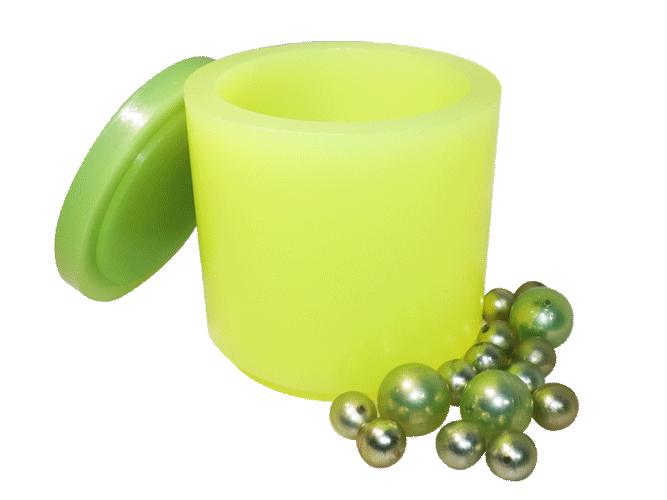
A polyurethane grinding bowl for a planetary mill is a replaceable working chamber into which the sample and grinding media are loaded. The glass itself does not create movement and does not replace the mill: grinding occurs due to the rotation of the planetary drive, and the chamber holds the material, balls and liquid phase in a given volume. In the catalog TENCAN presented polyurethane grinding bowl for planetary mill. It is considered for sample preparation when elasticity of the working surface, reduction of metal wear on the body and moderate noise are important. Specific volumes, dimensions, cover design and permissible modes require verification using the product card and confirmation by the manufacturer.
Function and structure of a glass in a planetary mill
In a planetary ball mill, the glasses are fixed to the carrier. When the carrier rotates and the glasses rotate in the opposite direction, the grinding bodies repeatedly collide with the walls and grind the material. The trajectories and impact energy depend on the mill geometry, gear ratio, speed, ball mass and chamber filling. Therefore, the same glass can behave differently on different drives, and transferring the mode from one model to another without checking is undesirable.
This glass belongs to planetary ball mills. It is not the grinding drum of a roller mill and does not replace the chamber of a bead mill: these devices have a different principle of movement and different fit requirements. The working unit of the cup includes a body, a lid and a seal; Some versions provide additional sealing or fastening elements. The glass must withstand cyclic loads, not deform, not allow dust and suspension to pass through, and also maintain a fit in the mill socket. For a polymer casing, the uniformity of wall thickness, the quality of the internal surface and the condition of the edge under the seal are especially important: this is where stress concentrators and places where powder sticks occur.
A polyurethane glass performs the same function as a steel, ceramic or agate glass, but differs in mechanical behavior. The polymer is less rigid, so it better absorbs some of the shock loads and can be useful when working with brittle or prone to splintering samples. However, it does not eliminate the wear of the grinding media and does not make the process “pollution-free”: the source of impurities remains the balls, the cover, the seal and the polymer itself.
Polyurethane version: properties and limitations
Polyurethane is not one chemically identical material, but a group of polymers with different properties. Hardness, elasticity, resistance to solvents and tendency to swell depend on the brand and composition. Therefore, the phrase "polyurethane cup" by itself does not describe chemical resistance. For a specific sample and environment, it is necessary to clarify what polyurethane is used, what solvents and temperatures are permissible, and how the seal will behave.
In laboratory practice, polyurethane is more often considered for soft and medium-hard materials, where maximum chamber rigidity is not required. It can reduce noise and shock loads, and also reduce metal transfer from the body. However, for abrasive powders, polymer wear may be noticeable; polyurethane does not become a universal replacement for steel, tungsten carbide or zirconia. The choice is made based on a combination of abrasiveness, analysis sensitivity, acceptable contamination and cleaning conditions.
Polymer dissipates heat worse than metal. During long or high-energy grinding, this may cause the contents to heat up; the temperature of the workspace cannot be automatically assumed to be equal to the temperature of the sample. The beaker material itself does not transform conventional grinding into cryogenic grinding: cooling is a separate function of the mill, and its presence must be confirmed for a specific installation. If the technique limits heating, the mode is selected taking into account the entire system, and not just the material of the glass.
Volume, dimensions and landing parameters
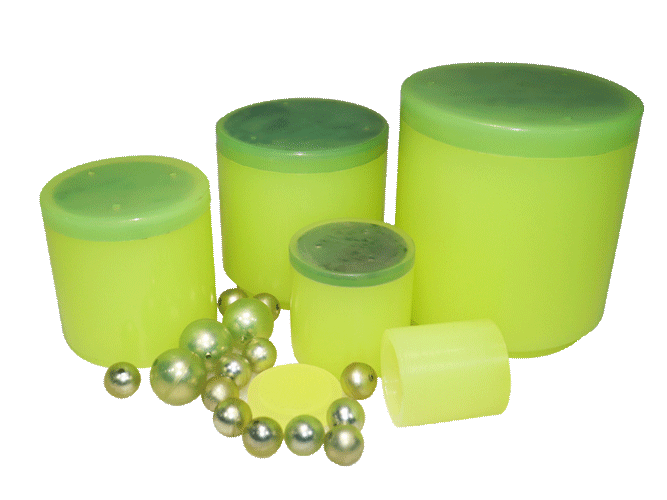
When selecting a glass, it is not enough to name the volume. A planetary mill requires the same landing dimensions, height, fixation method and permissible weight. In addition, the volume of one glass, the total volume of the set, the workload and the mass of the sample are different values. The table below lists questions that should be answered before ordering.
| Parameter | What to clarify |
|---|---|
| Nominal volume | Geometric capacity of the case, not sample mass |
| Workload | How much material and grinding media is permissible, taking into account the free space |
| External and internal dimensions | Diameter, height, bottom shape and fit into the mill nest |
| Cover and seal | Solvent compatibility, sealing and fixation method |
| Assembled weight | Balancing the kit and permissible load on the drive |
The nominal volume of the case shows how much it holds geometrically, but does not mean that this entire volume can be filled with sample and balls. The working load is less than nominal: part of the space is needed for the movement of grinding media. If the volume of one glass is indicated, you cannot automatically multiply it by the number of positions and obtain the productivity of the mill; the total volume of the kit and the payload are calculated separately.
For a planetary mill, mass is also important. A set of glasses of different weights can disrupt the balancing, so you should not mix versions on the same installation without the manufacturer’s permission. The outer diameter and height, bottom shape, cover position and seal must match the seat and clamping mechanism. If the specification only lists the volume, this is not enough to check compatibility.
Wear, contaminant transfer and cleaning
The wear of a polyurethane cup manifests itself differently than the wear of metal. The polymer can wear off, leave particles, change the color of the surface, and in places of scratches it can retain powder. This does not mean that polyurethane will necessarily contaminate every sample, but it does not guarantee zero carryover either. For trace analysis, it is useful to perform a blank experiment: run the beaker and grinding media through the same regime without the material being tested and evaluate the contribution of impurities.
Polymers may contain processing aids, stabilizers or colorants. Their influence depends on the sensitivity of the method and on what elements or compounds are determined. If the technique is critical to organic impurities, a polyurethane cup may not be the best choice; the alternative is selected based on chemical resistance and acceptable wear. You cannot transfer the properties of one brand of polyurethane to the entire range of glasses.
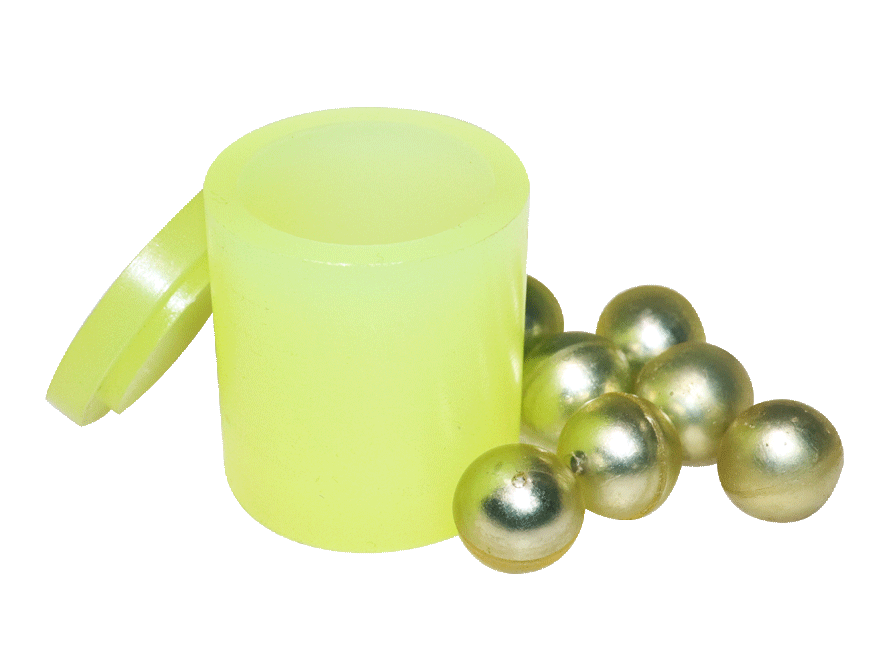
Cleaning should be fairly complete without damaging the surface. Typically, remove the lid, remove the grinding media, wash the chamber with a compatible solvent and a soft brush, then dry. Abrasive powders and hard scrapers leave scratches in which particles become trapped; an aggressive solvent can cause swelling or softening of the polymer. Before using a specific cleaning composition, you need to check its compatibility with the material of the cup and seal.
After wet grinding, liquid and a thin suspension remain in the chamber. They are removed before they are completely dry, otherwise agglomeration or transfer of residues is possible during the next use. If the glass has been used for different materials, one wash may not be enough; The cleaning sequence and cleanliness control should be in accordance with the laboratory's internal procedures.
Dry and wet grinding: compatibility and practical limitations
Dry grinding in a polyurethane cup is possible for materials that do not require intense abrasion and do not react with the polymer. Powder may adhere to elastic surfaces, especially if the material is wet or prone to aggregation. In this case, pre-drying helps, but its mode is set according to the properties of the sample, and not according to the material of the glass. You cannot promise the same dispersion for any powder just because the chamber is made of polymer.
Wet grinding introduces additional restrictions: the liquid must be compatible with the polyurethane and seal, and not cause swelling or dissolve components. After grinding, the suspension is separated from the grinding media; Ball type and size affect wear and contamination. A wet environment may reduce dust and heat, but does not eliminate chemical compatibility testing. Disagglomeration of particles in a liquid is also not the same as mechanical grinding.
The intensity of wear depends on the hardness and abrasiveness of the material, the size and density of the balls, the duration and speed of rotation. The parameters of one glass model do not become a characteristic of the entire assortment. If the card indicates a typical range or volume, this does not guarantee that the specified size will be achieved for a particular sample: the result is confirmed by measuring the particle size distribution.
Compatibility with the mill is checked by seating dimensions, mounting method, permissible weight and speed. Even a glass that is suitable in volume may not be suitable in height, bottom shape or seal. Equipment for other purposes, such as a sieving machine, does not automatically become compatible with the glass: these are different operations. Screening controls the size of the product, but does not confirm the mechanical compatibility of the chamber and drive.
Frequently asked questions about polyurethane grinding bowl
Can polyurethane cup be used for any material?
No. Suitability depends on the hardness and abrasiveness of the powder, chemical compatibility with the polymer and seal, temperature and contamination tolerance. Strong solvents, abrasive materials and sensitive trace analysis require separate confirmation of suitability; The name of the glass material alone is not enough for this.
How is polyurethane different from steel and ceramics?
It is less rigid, better absorbs some impacts and can reduce noise, but it wears out more and is not chemically universal. Steel gives metallic wear, ceramics - its own profile of impurities and fragility. There is no material that is simultaneously the best in all respects; The choice depends on the sample and method of analysis.
How to clean a glass so as not to accelerate wear?
Remove the lid and grinding media, remove the bulk of the powder, wash with a compatible solvent with a soft brush and dry. Do not use abrasive pastes or hard metal scrapers. Before new material, check that there are no residues and, if necessary, perform a dry run.
Is it enough to know the volume to order a glass?
No. You need external and internal dimensions, height, bottom shape, lid and seal design, assembled weight and method of fixation. Confirmation of compatibility with the specific planetary mill is also required. The volume of one glass is not equal to either the workload or the total volume of the set.