
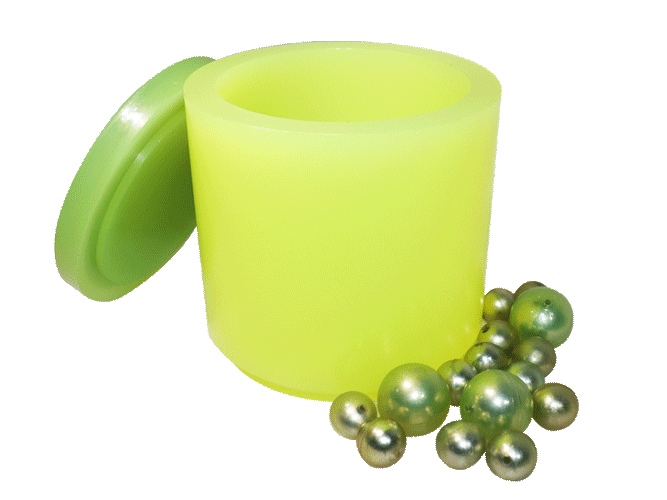
A polyurethane grinding bowl for a planetary mill is a replaceable working container in which the sample, together with the grinding media, is subjected to impact and abrasion. It does not replace the mill and does not set the rotation speed: the glass is installed in the sockets of the planetary drive, forms a closed grinding chamber and determines which surfaces the material comes into contact with. The geometry, fit, cap and internal surface condition affect sample loss, ease of cleaning and the risk of contamination transfer. In nomenclature TENCAN such affiliation is represented as polyurethane grinding bowl for planetary mill; Specific designs and standard sizes should be checked against the product card.
Function and place in the sample preparation process
In a planetary ball mill, the glass undergoes a complex movement: it rotates around its own axis and around the common axis of the carrier. The grinding bodies inside the chamber are accelerated, collide with the material and walls, crushing the sample and mixing it. The glass here is not a passive container, but the boundary of the work area. It holds the sample and balls, absorbs the load, participates in heat exchange and protects the surrounding area from dust or splashes.
To prepare the sample, it is important that the material is not lost in the corners, does not stick to the walls, and is not enriched with particles from the dishes. Therefore, the glass is selected not only by volume, but also by the material of the contact surface, the quality of the lid and ease of cleaning. The polyurethane version occupies its niche: it is useful where an elastic, impact-resistant surface and moderate abrasiveness are needed, but cannot be considered a universal solution for all powders.
Design and working principle
Body, cover and seal
The grinding bowl consists of a body, a lid and a sealing element; For a specific product, the presence, material and design of the seal must be checked according to the documentation. The housing absorbs the pressure of the balls and centrifugal loads, the lid closes the chamber, and the seal reduces the removal of dust and suspension. If the lid does not fit tightly, powder can get into the drive area and onto adjacent units, and with wet grinding, liquid loss is possible.
Before each use, check the fit of the glass in the socket, the condition of the edges, threaded elements and seals. Polyurethane is an elastomer, so it cannot be judged by its appearance in the same way as metal: slight deformation or darkening is not a death sentence, but deep risks, delamination and loss of geometry require replacement. Specific dimensions, wall thickness and acceptable modes for the model TENCAN should be taken from the current card and not transferred from another product.
Grinding media and energy transfer
The grinding media is a separate position, not part of the glass. Their material, diameter and quantity are chosen according to the sample and task; The polyurethane wall itself does not make the grind fine and does not replace the energy of the balls. An elastic surface can soften some impacts and reduce noise, but at the same time it is less capable of transmitting energy than hard ceramics or steel. Therefore, the result depends on the combination of mill, mode, balls, beaker and sample properties.
What does polyurethane provide as a material?
Polyurethane is a polymer material with elasticity and relatively high resistance to impact loads. In a grinding bowl, it is interesting as an alternative to fragile ceramics and heavy metal: the polymer surface is less susceptible to accidental impacts, does not rust, and can be convenient for soft or moderately hard samples. At the same time, polyurethane is not chemically inert for all environments and does not have an infinite resource.
Elasticity and shock loads
The elastomer wall absorbs some of the impact energy. This can be useful when working with materials that clump, are fibrous, or are sensitive to splintering, or where you want to reduce the risk of damage to the glass itself. However, damping does not always help grinding: very hard and brittle materials require a more rigid working surface and sufficient energy from the grinding media. Polyurethane does not convert a planetary mill into a different type of mill or compensate for incorrectly selected balls.
Wear and introduction of impurities
Polyurethane wears out, especially when in contact with abrasive powders, sharp crystals and large particles. Wear debris may be introduced into the sample, so the expression “zero contamination” does not apply here. For routine sample preparation this may not be significant, but for trace analysis of elements, organic impurities or subsequent spectroscopy, the blank sample and the possible contribution of the beaker material must be assessed. If the analysis is sensitive to polymer particles, it is better to choose a different glassware or a separate glass that is used only for this task.
Wear is affected by sample hardness, load size, grinding time, speed, ball weight and cleaning quality. You cannot judge suitability just by the name of the material: different brands of polyurethane may differ in hardness, elasticity and resistance to the environment. If the card does not indicate the brand, temperature range and chemical resistance, this information must be requested from the supplier.
What materials and tasks are suitable
Polyurethane cups are usually considered for soft to medium-hard materials that do not require maximum crushing energy: polymer granules, some organic and composite samples, and cases where the impact resistance of the glassware is important. It can be convenient for preliminary grinding and mixing, when the goal is not to obtain the minimum size at any cost. For ores, slags, carbides, hard ceramics and other abrasive materials, wear and the risk of impurities increase, so selection must be made with particular care.
The chemistry of the sample is taken into account separately. Polyurethane should not be considered resistant to any solvents, acids and oils. If wet grinding is intended, check whether the material swells, loses strength, and does not change color under the influence of the environment. For food, pharmaceutical or trace applications, not only durability is important, but also the ability to be validated for purification.
Temperature and chemical resistance limits
The temperature range of polyurethane depends on the brand and should not be inferred from the general properties of the polymers. Heating during grinding, hot drying, freezing and contact with aggressive liquids can affect elasticity, tightness and service life. If the mill has cooling, this does not mean that the glass itself is approved for cryogenic temperatures or liquid nitrogen; this possibility must be confirmed separately. The temperature of the working space of the installation is also not equal to the temperature of the sample inside the chamber.
Dry and wet grinding: what changes for a glass
In dry grinding, the main concerns are dust, sticking and electrostatics. Polyurethane can retain some small particles on the walls, so after unloading, thorough cleaning is necessary, and losses are taken into account when calculating the balance. The glass should not be filled “under the lid”: the balls and material must have room to move, otherwise the load on the lid and seal increases.
With wet grinding, requirements for tightness and chemical compatibility are added to the glass. Water, alcohols, oils and other media have different effects on the polymer; Some fluids may cause swelling or accelerate wear. Unless the environment is tested, the glass cannot be promised to withstand prolonged contact. After wet grinding, the glass is washed with a compatible solvent or detergent, dried and the seal checked. Wet grinding is not the same as deagglomeration: it can help destroy aggregates, but does not replace the correct selection of grinding media and mode.
How to read characteristics and select a glass
Volume, dimensions and workload
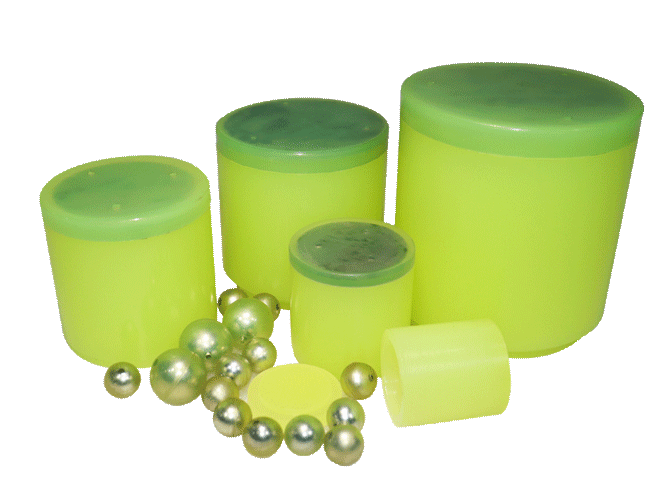
The nominal volume of the beaker is not yet the amount of sample that can be loaded. Part of the volume is occupied by grinding media, part is needed for the movement of material, so the working load is always less than the full volume. You cannot convert volume into mass without the bulk density of the sample, and you should not transfer numbers from one glass to another. If the volume is indicated on the card, specify whether it refers to one glass, a set, or a payload.
Geometry is more important than it seems: the outer diameter, height, bottom and lid shape must match the seat and clamp of the mill. Two glasses of the same volume may have different fits. Therefore, the selection is carried out according to the model of the mill and the article number of the glass, and not just according to the photograph.
Mill compatibility
The planetary cup is not a universal drum. It is not designed for a roller mill, bead mill or roller crusher - these are different operating principles and different mounting units. Even in a planetary mill, not every glass fits every nest: the diameter, height, method of fixation, permissible load and speed are checked. If the mill model is not specified, it is safer to ask for confirmation of compatibility rather than rely on superficial similarity.
Cover, sealing and cleaning
The cap and seal are consumable items that are the first to respond to wear. Before purchasing, check whether the seal is included in the kit, whether it can be replaced, and how the glass is sealed. For wet grinding, checking for leakage is especially important; for dry - to remove dust. Ease of cleaning affects productivity as much as volume: complex geometries and rough surfaces increase time between samples and the risk of carryover.
Wear, cleaning and contamination control
After grinding, the glass is inspected: there should be no deep marks, burrs, delaminations or sticky areas on the working surface. The lid edge and seal must not be cracked. If the glass does not fit well, the lid closes with force, and particles remain in the corners after cleaning, the product may require replacement or maintenance. Do not use metal scrapers or abrasive pastes if they can damage the polyurethane.
- Wash with a mild detergent and a soft brush, unless otherwise specified in the documentation.
- Do not use aggressive solvents without checking chemical compatibility.
- Dry under conditions acceptable for the material; do not overheat.
- Keep the beaker closed and protected from dust to avoid transferring particles to the next sample.
- For trace tasks, keep a separate glass and a blank control sample.
Polyurethane can accumulate dirt in micro-irregularities, so visual cleanliness is not enough. If the previous sample contained colored or oily components, a residue check is needed. In controversial cases, control grinding without a sample or with an inert sample helps.
Selection criteria
The choice begins not with the price of the glass, but with sampling and analysis. It is useful to record hardness, initial size, chemical composition, required size, dry or wet process, and sensitivity of the method to impurities. Then they check the mill: model, mounting dimensions, permissible load and mode. Only then do you select the material, volume, lid and seal.
- Sample material: soft, abrasive, chemically active, prone to sticking.
- Task: grinding, mixing, disagglomeration or preparation for analysis.
- Medium: dry grinding, water, organic solvent, protective atmosphere.
- Compatibility: mill model, socket, clamp, permissible speed and load.
- Maintenance: accessibility of covers and seals, ease of cleaning, service life.
If trace analysis is required, the polyurethane cup is assessed especially critically: even slight wear can make a significant contribution. For routine sample preparation, where some amount of impurities are tolerated, it can be convenient, but only after testing on a specific material. Current versions and product card TENCAN can be found in range of equipment, and check the parameters of a specific model using the passport.
Questions and answers
Is a polyurethane cup suitable for wet grinding?
Sometimes yes, but this is not a general property. It is necessary to check the resistance of the polyurethane to liquids, the tightness of the lid and the absence of swelling. Water and inorganic solutions do not automatically guarantee compatibility, and organic solvents require separate testing.
Can we assume that polyurethane does not contaminate the sample?
No. The polymer surface can wear away and leave particles, especially with abrasive powders. The risk depends on the material, mode and sensitivity of the assay. For trace tasks, supervision and, if necessary, other utensils are needed.
How is a polyurethane glass different from a ceramic or steel one?
The polymer is more elastic and withstands impact better, but is inferior in rigidity and heat resistance. Ceramics and metal give a different picture of wear and impurities. The choice is determined by the grade, acceptable contamination and grinding conditions, and not by the superiority of one material over all others.
Is it possible to put a glass in any planetary mill?
No. It is necessary to match the landing dimensions, method of fixation and permissible load. A glass from one model does not become universal just because it has a similar volume. Compatibility is confirmed by mill model and article number.
How do you know when it's time to replace the glass?
Signs include deep grooves, edge deformation, seal failure, poor fit, difficult-to-remove residues, and increased material contribution to the blank sample. If the geometry or tightness is broken, further use may spoil the sample.
A polyurethane grinding bowl is a small but important accessory. It does not make the planetary mill universal and does not remove the need to select a mode, but it allows you to obtain a working chamber with an elastic surface if its properties correspond to the sample. Checking for compatibility, wear and cleanliness is more important than promises of “absolute inertness.”