
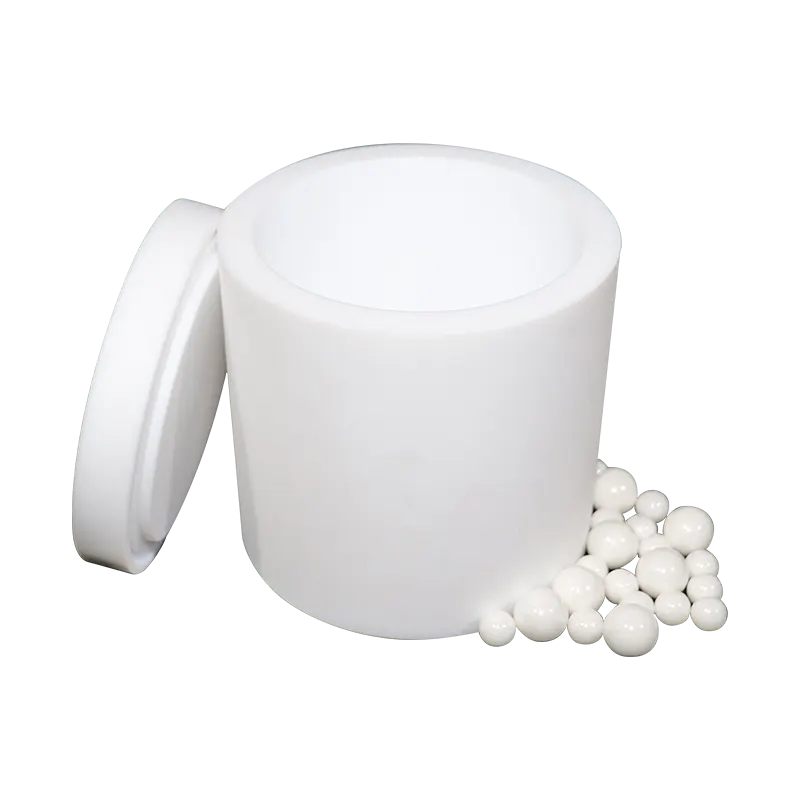
The PTFE grinding bowl is a replaceable working vessel for a planetary mill, in which the sample, together with the grinding media, is crushed, abraded and mixed. It is located between the mill drive and the material itself: the planetary mechanism sets the movement, and the glass determines the working space in contact with the sample, its volume, tightness and wall material. Specific execution TENCAN described in the card PTFE grinding bowl for planetary mill; The properties of polytetrafluoroethylene and their practical consequences for sample preparation are discussed below.
What is a PTFE cup and what is its role in sample preparation
Polytetrafluoroethylene, also known as PTFE-4, is a fluorine-containing polymer with long molecular chains shielded by fluorine atoms. This structure provides chemical inertness to most aggressive environments and low surface adhesion, but at the same time means low hardness and limited heat resistance. Therefore, a PTFE glass is not a “universal replacement” for a steel or corundum vessel, but a tool for a specific range of tasks.
Grinding equipment in general and planetary mills in particular solve different stages of one technological chain: first, the material is brought to a size suitable for loading, then it is crushed to analytical fineness. The glass belongs to the second stage. Its task is to provide a closed volume in which grinding media repeatedly act on the sample without losing material or contaminating it beyond the level acceptable for a particular analysis.
Glass structure and working principle
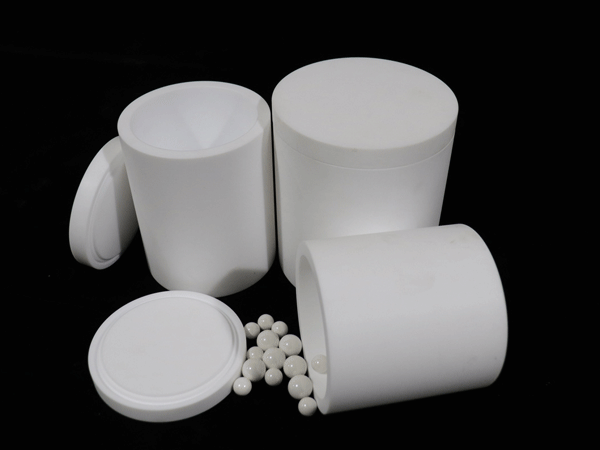
Structurally, the vessel repeats the logic of any grinding glass for a planetary mill: body, lid, sealing element and seating surfaces with which the glass is fixed in the mill seat. The difference is in the material of the body and the inner surface. The polymer is formed and processed differently than steel, zirconia or corundum, so the geometry of the internal cavity, wall thickness and edge precision are as important as the material itself.
In a planetary mill, the glasses rotate around a common axis and at the same time around their own axis. The resulting centrifugal forces are many times greater than the force of gravity, due to which the grinding bodies are pressed against the wall and the material with a force depending on the rotation speed, the diameter of the bowl, the mass and density of the bodies. There are two mechanisms at work: impact and abrasion. In a soft polymer vessel, the proportion of abrasion is higher, and part of the impact energy is absorbed by the wall, so one should not expect the same result as in a hard vessel, all other things being equal.
Cover, seal and sealing
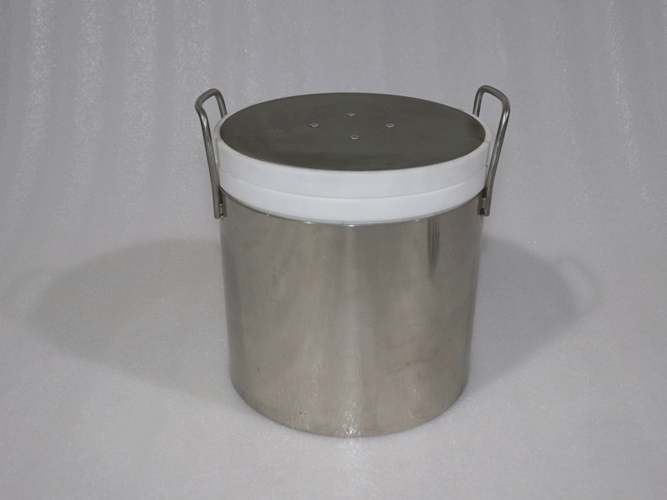
Tightness is the main practical criterion for a polymer vessel. With wet grinding, the vapor pressure of the solvent increases in a closed volume; with dry grinding, dust is formed, which should not come out. A lid with a seal holds the contents, but the polymer is more easily deformed, is more sensitive to temperature and requires careful tightening. A cap that is too tight, a dry or damaged seal, or particles trapped under the lip are typical causes of leakage. Before each cycle, it makes sense to check the condition of the sealing element and the cleanliness of the sealing surface. Refer to the product and mill documentation for the exact cover design and seal type for your specific model.
Dry and wet grinding in PTFE beaker
Dry grinding is used when the sample cannot or does not need to be mixed with liquid. In this mode, overloading the chamber is unacceptable: part of the volume must remain free for the movement of grinding media. The polymer easily accumulates a static charge, so the fine powder sticks to the walls and lid, and part of the sample remains on the surface after unloading. Wet grinding reduces dust formation and often reduces sticking, but adds the requirement of chemical resistance of the polymer to the selected liquid. In addition, in a soft vessel, it is necessary to distinguish between particle destruction and disagglomeration: agglomerates can break up faster than the primary particles are reduced, and these are different tasks assessed by different indicators.
Properties of PTFE and their practical consequences
Chemical resistance
PTFE is inert to most acids, alkalis, saline solutions and organic solvents, making it suitable for harsh environments and for samples that cannot be placed in a steel vessel. Resistance is not absolute: the polymer is not designed for contact with molten alkali metals, elemental fluorine and a number of strong oxidizing agents at elevated temperatures. In addition, the resistance of the vessel does not mean that the selected liquid is safe to use or compatible with the sample. Unconfirmed formulations and regimes for hazardous substances are not discussed in this article - they are determined by the manual for a specific installation.
Softness, wear and contamination
The hardness and elastic modulus of PTFE are significantly lower than those of steel, corundum, zirconium dioxide or tungsten carbide. This has two consequences. The grinding bodies wear less on the polymer than on the solid lining, so the contribution of the material of the bodies to sample contamination may be less. At the same time, the glass itself wears out: abrasive samples gradually wear down the walls and bottom, and polymer particles get into the sample. There is no “zero contamination” for any material—it’s just a matter of what elements are added and how that affects subsequent analysis. If the sample is being tested for fluorine, carbon, or polymer inclusions, a PTFE beaker is not the best choice.
Temperature, strain and static charge
The melting point of PTFE is about 327 °C, but long-term operation is limited to noticeably lower values: when heated, the polymer softens, loses its shape and is more easily deformed under load. The thermal conductivity of the polymer is low, so the heat generated by impact and friction is removed more slowly than through a metal or ceramic wall. This does not make the beaker a cryogenic device: grinding with liquid nitrogen is a separate operation with separate equipment and safety precautions, and cannot be attributed to conventional air-cooled milling. The temperature of the working space of the installation is also not equal to the measured temperature of the sample. The static charge is taken into account separately: during dry grinding, the powder sticks to the walls, which complicates quantitative unloading.
How to read the characteristics of a glass correctly
The parameters of the vessel are read in conjunction with the characteristics of the mill and the properties of the sample: no single indicator acts on its own.
Beaker volume, loading and sample weight
A distinction is made between the nominal volume of one glass, the total volume of all glasses in the set, the working load of grinding media and the mass of the sample. The nominal volume is a geometric characteristic of the vessel, and not the amount of material that can be loaded: free volume is necessary for the movement of bodies. Productivity over time is another independent value, depending on the mode and cycle duration. The choice of volume is based on the mass of the sample required for analysis and how much material is needed for a representative sample. If the volume of the glass is too large for the amount of sample available, grinding efficiency decreases: the bodies work mainly along the walls, and not along the material. Specific values of volumes and designs are indicated in the product card.
Coarseness, speed and grinding time
The final particle size depends on the initial particle size, the hardness of the material, the size and density of the grinding media, their ratio to the sample mass, rotation speed, time, medium (dry or wet process) and measurement method. The standard minimum from the catalog is not guaranteed for any sample: a polymer vessel absorbs part of the impact energy, so extremely fine grinding of solid materials in it is not always achievable. Increasing the rotation speed increases the impact energy, but at the same time increases heating and wear of the walls. If the source material is presented in large pieces, it is pre-crushed, for example into twin roll crusher; This is a separate operation for preparing the initial coarseness, which does not replace planetary grinding and is not part of the operation of the glass.
For what materials and tasks is a PTFE glass suitable?
Suitable samples and applications
Practical areas: samples sensitive to metal contamination; materials with aggressive components; soft and fibrous samples; tasks where it is important to reduce sticking and facilitate unloading. The polymer vessel is suitable for deagglomeration, mixing and gentle abrasion, including wet environments. It is useful where a steel cup is not acceptable due to corrosion or the contribution of iron, chromium and nickel to the analysis result.
Restrictions
For very hard, abrasive and brittle materials, PTFE is inferior to ceramics and metals: it wears out faster and transfers impact energy worse. The polymer cup is not intended for high-temperature operations - sintering, annealing and prolonged heating are performed in furnaces. The presence of a PTFE cup in the range also does not mean that it is automatically compatible with any mill: the seat size, method of fixation and permissible rotation speed are determined by the design of a particular planetary mill. Compatibility is confirmed by documentation or from the supplier, and not by the external similarity of parts.
Selection, compatibility, cleaning and wear monitoring
Selection criteria
- Material and abrasiveness of the sample: the harder the sample, the faster the polymer wall wears out.
- Component to be determined: a polymer vessel is not recommended for analysis of fluorine and carbon.
- Required sample weight and number of simultaneously processed samples.
- Process mode: dry or wet grinding, tightness requirements.
- Compatible with specific mill and selected grinding media.
A separate issue is grinding media. The density, hardness and material of the bodies affect both the grinding result and sample contamination; the combination of a specific glass and specific bodies is confirmed by the manufacturer, and is not selected by analogy with another set.
Cleaning
PTFE is washed off from many contaminants due to its low adhesion, but the surface cannot be scratched with abrasives and hard brushes: scratches retain the sample and accelerate wear. The usual sequence is mechanical removal of residues, washing with a suitable solvent, drying. When switching between different analytes, it is useful to assign beakers to specific tasks or perform blank control runs. Calcination of the polymer cup for cleaning is unacceptable: at high temperatures, PTFE decomposes with the release of aggressive fluorine-containing products. Remains of an aggressive environment should not be left in the vessel for a long time.
Wear and replacement
Signs of wear: changes in geometry and the appearance of irregularities, loosening of the lid, loss of tightness, change in color and the appearance of odor when heated, an increase in grinding time with the same result. A worn glass not only grinds worse, but also introduces more impurities. Planned monitoring of the condition of the walls and seal allows you to replace the vessel in a timely manner, rather than attributing the deterioration of results to the characteristics of the sample. Range of grinding equipment and accessories TENCAN presented on the website www.tencanballmills.com; полное название производителя — Changsha Tianchuang Powder Technology Co., Ltd.
Questions and answers
Does a PTFE cup introduce impurities into the sample?
Yes, like any material that comes into contact with the sample. The polymer is softer than steel and ceramics, so there is less wear on the grinding media, but under the influence of an abrasive sample the walls wear out, and PTFE particles can get into the material. The significance of this depends on the component being determined and the sensitivity of the method.
Is it possible to grind solid materials in such a glass?
Technically possible, but ineffective: the polymer absorbs some of the impact energy and wears out quickly. For hard and brittle samples, vessels made of zirconium dioxide, corundum, tungsten carbide or agate are more rational.
Which mode is preferable - dry or wet?
It depends on the material and subsequent analysis. Wet grinding reduces dust formation and sticking, which is important for PTFE due to static charge, but requires proven chemical resistance to liquids. Dry grinding is easier to prepare, but requires control of dust and complete unloading.
Can a PTFE beaker be used for cryogenic grinding?
Grinding with liquid nitrogen is a separate mode with appropriate equipment. Air cooling the mill and cooling the sample with liquid nitrogen are two different things; the ability to operate at low temperatures is determined by the documentation of the specific mill and vessel model, and not by the wall material itself.