
A grinding bowl made of PTFE (polytetrafluoroethylene, fluoroplastic) is the working vessel of a planetary ball mill, in which abrasion and impact grinding of the sample with grinding media occurs. Its task is to hold the sample and grinding medium, transmit rotation and ensure chemical inertness of the contact surface. Unlike grinding chambers made of steel, agate or zirconia, PTFE is chosen where low adhesion, resistance to aggressive media and minimal powder sticking are important. However, this material is not universal: it is softer than most inorganic materials and behaves differently during dry, wet and cryogenic grinding. Below are the functions of the cup, the properties of PTFE, proper reading of the characteristics, sample compatibility, and limitations to consider when selecting. For a specific model and size, please refer to the product card PTFE grinding bowl for planetary mill and technical documentation.
What is PTFE grinding bowl and where is it located in the grinding process
The planetary ball mill works due to the complex movement of the grinding bowls: they rotate around a common axis and at the same time around their own axis. Inside the glass, grinding bodies - usually balls - rise along the wall, fall and collide with the material, and also abrade it as they slide. The glass closes this system: it sets the volume of the chamber, holds the balls and sample, removes some of the heat and protects the mill mechanism from dust and contamination.
A grinding bowl is not just a container. Its geometry affects the trajectory of the balls, and the material of the walls and lid determines what impurities can get into the sample and how the sample will behave during prolonged contact. For a planetary mill, the landing dimensions, method of fixation, permissible rotation speed and balancing are important. Therefore, the glass is selected not only by volume, but also by compatibility with a specific mill model.
Role of PTFE in the grinding process
PTFE is a low friction, low surface energy fluoropolymer. Thanks to this, powders stick less to the walls, and the glass itself is easier to clean. In laboratory practice, such beakers are used for samples that are sensitive to metal contamination, for viscous or sticky materials, as well as for media to which some metals and ceramics are unstable. However, PTFE is not a “completely inert” material: its properties depend on the brand, fillers and operating conditions.
Limits of application
Fluoroplastic does not withstand the same mechanical stress as steel, tungsten carbide or zirconium dioxide. It is prone to deformation, creep and abrasive wear. If the sample consists of hard abrasive particles, the wall of the beaker will be abraded and PTFE particles may be introduced into the sample. Therefore, before choosing, it is important to evaluate the hardness of the material, the duration of grinding, the size and weight of the grinding media, as well as the permissible level of contamination.
PTFE design and properties: what is important to know before choosing
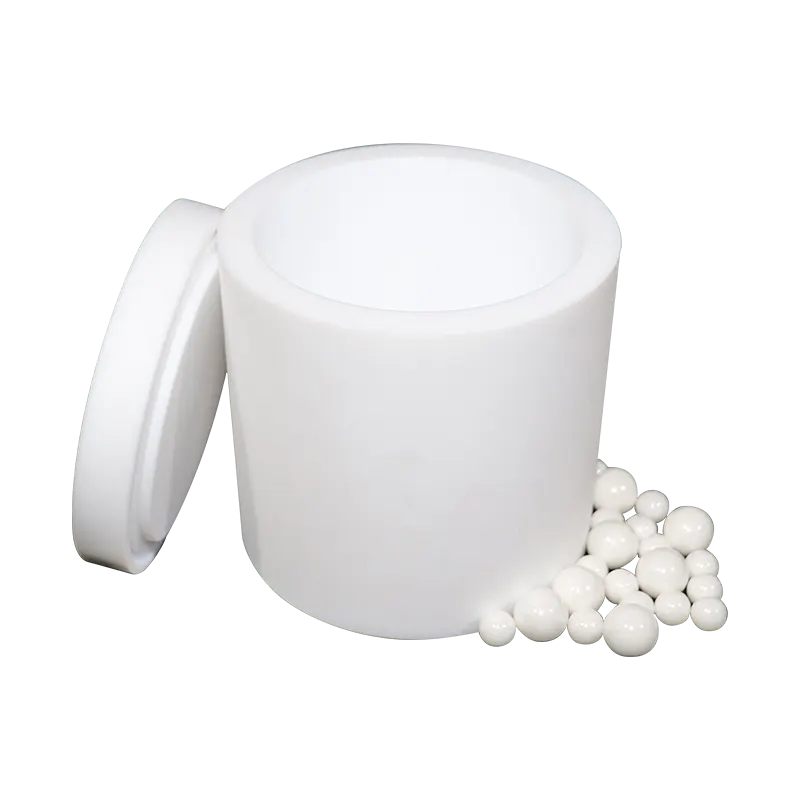
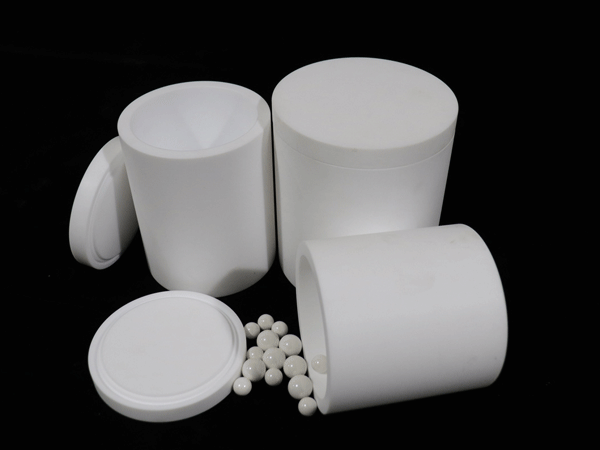
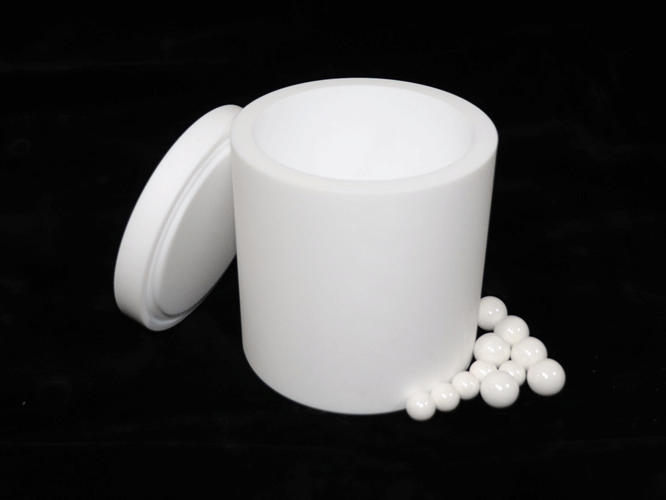
A PTFE grinding bowl usually consists of a body, a cover and a sealing element. The body may have a cylindrical or similar shape; The inner surface is made smooth to reduce sticking. The lid must provide a tight seal when rotating and not allow dust or liquid to pass through. Some versions provide additional elements for fixation and sealing.
Chemical resistance and low adhesion
PTFE is resistant to most acids, alkalis, solvents and oxidizing agents. This makes it suitable for wet grinding in aggressive environments and for samples that cannot come into contact with metal. Low adhesion helps reduce powder loss on walls and makes cleaning easier. However, resistance does not mean absence of interaction: individual reagents, especially at elevated temperatures, can affect the material. In addition, fillers, which are sometimes added to PTFE to increase strength, change its chemical and abrasive nature.
Mechanical limitations of fluoroplastic
The main limitation of PTFE is its low mechanical strength and hardness. With intense grinding, it can become deformed, and when in contact with abrasive, it can wear out. Wear accelerates with increasing rotation speed, mass of grinding media and processing time. Heating also affects mechanical properties: at elevated temperatures, fluoroplastic becomes softer and more prone to creep. Therefore, for long-term high-energy conditions, harder materials are sometimes chosen, and PTFE is left for applications where chemical inertness and low adhesion are more important than wear resistance.
Temperature
The operating temperature range depends on the grade of PTFE, the design of the cup, lid and seals. General reference values cannot be automatically transferred to a specific model. If the process is accompanied by heating, it must be taken into account that the temperature inside the glass may differ from the temperature of the mill body and from the ambient temperature. For cryogenic grinding with liquid nitrogen, the suitability of the glass must also be confirmed by the manufacturer: at low temperatures, fluoroplastic changes its mechanical properties and may become more brittle.
How to Read Grinding Bowl Specifications
The product card and technical documentation indicate different parameters that should not be mixed. The volume of one glass is the capacity of a separate chamber. The total volume refers to all glasses in the set. The working load is the amount of sample and grinding media that can be loaded into one beaker without loss of efficiency or excessive wear. The mass of the sample is only part of the load; it is not equal to volume and does not determine productivity over time.
Volume, loading and dimensions
When selecting a glass, you need to take into account that part of the volume is occupied by grinding media. Too much loading reduces the mobility of the balls and can lead to deformation of the walls. Too small - reduces the number of contacts and slows down the grinding. The optimal ratio depends on the material, ball size and mode. The dimensions of the glass must correspond to the seat of the mill: diameter, height, fastening elements and permissible rotation speed are checked according to the equipment passport, and not according to external similarity.
Speed, time and size
Rotation speed and grinding time affect impact energy and heating. The higher the speed, the more intense the grinding, but also the greater the load on the walls and lid. The final particle size depends not only on the glass, but also on the initial size, hardness of the material, density and size of the grinding media, medium and measurement method. The standard minimum from the catalog is not guaranteed for any sample: it must be verified experimentally for a specific sample.
Compatible with grinding media
Grinding bodies are the second source of contamination after the walls. For PTFE cups, it is important to select balls so that their material does not degrade faster than acceptable and does not introduce undesirable elements. Hard balls made of zirconia, corundum or tungsten carbide can wear out soft fluoroplastic, and soft polymer balls can wear out themselves. The compatibility of the “glass - grinding media - sample” pair is checked for chemical resistance, hardness, density and permissible level of impurities.
Sample Compatibility and Limitations of PTFE
PTFE is not suitable for all samples. Its benefits come in applications where sticking is to be avoided, chemical resistance is maintained and the risk of metal contamination is reduced. But for abrasive, hard and large materials, soft fluoroplastic may not be wear-resistant enough. Also, you should not automatically assume that a glass suitable for thread or diameter is compatible with any planetary mill: you need to check the mounting dimensions, balancing, permissible speed and method of fixation.
Suitable materials and applications
- soft and medium-hard powders prone to sticking;
- samples sensitive to metal contamination;
- wet grinding in aggressive or non-aqueous environments;
- materials for which low adhesion to walls is important;
- auxiliary operations where high impact energy is not required.
Abrasive ceramics, hard minerals, metal powders and coarse particles require harder grinding chambers, such as zirconia, corundum, tungsten carbide or steel. For particularly pure samples, the issue is resolved individually: not a single material gives absolute zero contamination.
Wear and transfer of impurities
PTFE wears out gradually. First, microscratches appear on the walls, then the geometry and smoothness of the surface may change. Wear products enter the sample along with the grinding media material. The degree of contamination depends on the hardness of the sample, abrasiveness, grinding time, speed and mass of the balls. If the analysis is sensitive to fluorine or polymer inclusions, PTFE should be used with caution and with mandatory control of the blank sample.
Cleaning
PTFE is easy to clean due to its low adhesion. Usually a soft brush, a suitable solvent and rinsing are sufficient. Do not use abrasive powders or hard metal brushes: they leave scratches that accelerate sticking and wear. If an ultrasonic bath is used, you need to make sure that the design of the lid and seals can withstand this. After wet grinding, the glass is dried; For drying, laboratory drying equipment can be used, for example vertical oven with forced convection, but this is a separate operation that does not confirm the compatibility of the glass with a specific mill and does not set the permissible heating temperature of PTFE.
Dry and wet grinding in PTFE beaker
Dry grinding is convenient when it is not desirable to introduce liquid. In a PTFE beaker, the powder adheres less to the walls than in a metal or ceramic chamber, so sample loss may be lower. However, dry powders are prone to agglomeration, and dust and electrostatic effects can make unloading difficult. The mode is selected so that the balls not only hit, but also abrade the material without overheating the fluoroplastic.
Wet grinding reduces dusting, improves particle distribution and often produces a narrower size distribution. PTFE is chemically resistant to many liquids, but cap seals and solvent compatibility must be checked separately. The liquid also affects the viscosity of the suspension and the mobility of the balls. Any solvent cannot be assumed to be safe for a particular cup just because it is safe for the PTFE lining.
Particle disruption and disagglomeration are not the same thing. If the task is to destroy agglomerates, and not to abrade primary particles, the mode and grinding media are chosen differently. For deagglomeration, a gentle action is often sufficient, whereas fine grinding requires higher energy. Understanding this difference helps you avoid overloading the PTFE cup and causing unnecessary wear.
Selection criteria and compatibility check
The choice begins with a sample: chemical composition, hardness, initial size, abrasiveness, sensitivity to contamination. Then the required final size and acceptable dispersion are determined. After this, the volume of the glass, the material of the grinding media, speed and time are selected. PTFE is chosen if its benefits—chemical resistance and low adhesion—outweigh the risk of wear.
What to check with the supplier
- compatibility of the glass with a specific model of planetary mill;
- permissible workload and sample volume;
- sealing material and acceptable solvents;
- temperature restrictions for long-term and short-term operation;
- recommendations for cleaning and wear monitoring;
- Possibility of use with selected grinding media.
You should not transfer the parameters of one model to the entire range. Even cups that look similar can differ in PTFE grade, wall thickness, lid, and load capacity. If the documentation states a range, it is important to understand whether it applies to short-term heating, long-term operation, dry or wet process.
Frequently asked questions about PTFE grinding bowls
Can a PTFE beaker be used for cryogenic grinding?
Cryogenic grinding with liquid nitrogen is a separate mode and the suitability of the beaker must be confirmed by the manufacturer. At low temperatures, fluoroplastic changes its mechanical properties, so normal operating conditions cannot be automatically applied to it. It is also important to distinguish between air cooling and liquid nitrogen cooling: the temperature of the working space of the installation is not equal to the temperature of the sample.
How is PTFE different from agate, corundum and zirconia?
PTFE is softer and chemically more inert to aggressive environments than most ceramics. Agate, corundum and zirconia are harder and better resistant to abrasion, but can introduce their own elements and require testing for chemical resistance. The choice depends on what is more important: minimal adhesion and chemical resistance or wear resistance and high grinding energy.
Is it possible to wash a glass in an ultrasonic bath?
The ability of ultrasonic cleaning depends on the cap design, seals and manufacturer's recommendations. The PTFE surface itself is usually stable, but intense cavitation and heat can damage seals or fasteners. If such cleaning is not confirmed, it is better to use a soft brush and a suitable solvent.
Does the glass fit any planetary mill?
No. Compatibility is determined by the mounting dimensions, fixation method, permissible rotation speed and balancing. Even if the glass is externally suitable, this does not guarantee safe operation. You need to check the documentation of the specific mill and glass.
Does PTFE leave particles in the sample?
When worn, PTFE particles may be introduced into the sample. This does not mean that the material is unsuitable, but requires an assessment of acceptable contamination. For trace analysis, it is useful to conduct a blank experiment and monitor the condition of the walls. No material is guaranteed to be “zero pollution”.
Brief summary
The PTFE grinding bowl is the working element of a planetary mill, which is chosen for its chemical resistance, low adhesion and reduced powder adhesion. Its limitations include softness, wear, and possible particle transfer. When selecting, it is important to check compatibility with the mill, volume and loading, material of grinding media, temperature conditions and cleaning method. For specific characteristics and standard sizes, please refer to the product card and the general catalog TENCAN.