
A precision forced convection oven is a laboratory apparatus for controlled removal of moisture and holding samples at a given temperature, in which the air in the working chamber is moved by a fan. Its place in the technological chain is the preparation of samples and materials before grinding, sieving, pressing or analysis, as well as the drying of powders, ceramics, granules and other samples, if the selected mode is compatible with the material. IN card TENCAN just such a device is presented; specific temperature ranges, chamber volume, accuracy and uniformity for a given design must be clarified on the card, since even cabinets that are similar in purpose may have different characteristics.
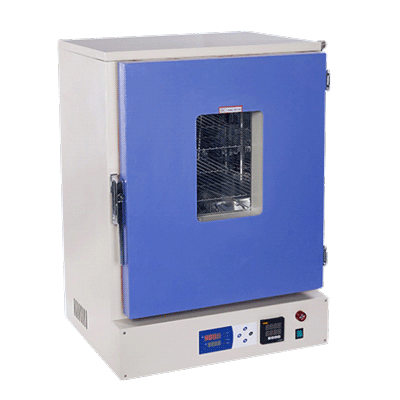
Where is the cabinet located in sample preparation
The drying cabinet does not crush, mix or sinter the material. Its task is to controllably supply heat to the sample and remove vapors without causing unwanted changes. In laboratory practice, such an operation often occurs before or after key stages: after synthesis, washing or filtration; before weighing, sifting, pressing or ball grinding; when preparing ceramic masses and powders for testing. In each case, it is not the “drying” itself that is important, but what moisture needs to be removed and what properties of the sample cannot be lost.
Moisture in the material is retained in different ways: on the surface of particles, in pores and capillaries, in interparticle gaps, sometimes in the form of chemically bound water in the structure. Surface water is removed more easily, pore water more slowly, and some hydrates require a temperature at which the material can already decompose or sinter. Therefore, the same regime cannot be mechanically transferred from one powder to another. Forced convection helps to supply heat faster and carry away vapors, but does not eliminate the limitations of the material itself.
Drying before grinding also has consequences. Too wet powder can stick to the grinding media and walls, clump and give an unstable result. Overdried material sometimes forms strong agglomerates, which then require a more stringent deagglomeration regime. For dry grinding, residual moisture is often undesirable, whereas in wet grinding the carrier liquid is part of the process; therefore, the same drying may be beneficial or redundant depending on the scheme. The goal of the cabinet is not to “keep it dry at all costs,” but to provide a reproducible sample condition that can then be tested and repeated.
How does forced convection work?
In a forced convection cabinet, a fan creates an air flow that passes through the heating element and the working chamber. The air transfers heat to shelves, trays and samples, picks up evaporating moisture and is discharged through a vent or damper. Compared to natural convection, such a flow usually makes heat transfer more intense and reduces local stagnation zones, but the resulting uniformity still depends on the geometry of the chamber, the location of the shelves, loading density and flow speed.
Forced convection does not mean vacuum drying. In a vacuum cabinet, heat is transferred differently, and the environment inside the chamber is depleted of air; This is a different class of equipment and a different set of restrictions. It does not make an ordinary drying cabinet cryogenic either: low-temperature treatment with liquid nitrogen is a separate task and a separate execution. Finally, the “precision” in the name refers primarily to the temperature maintenance system and workmanship, and not to a universal guarantee of perfect drying of any material.
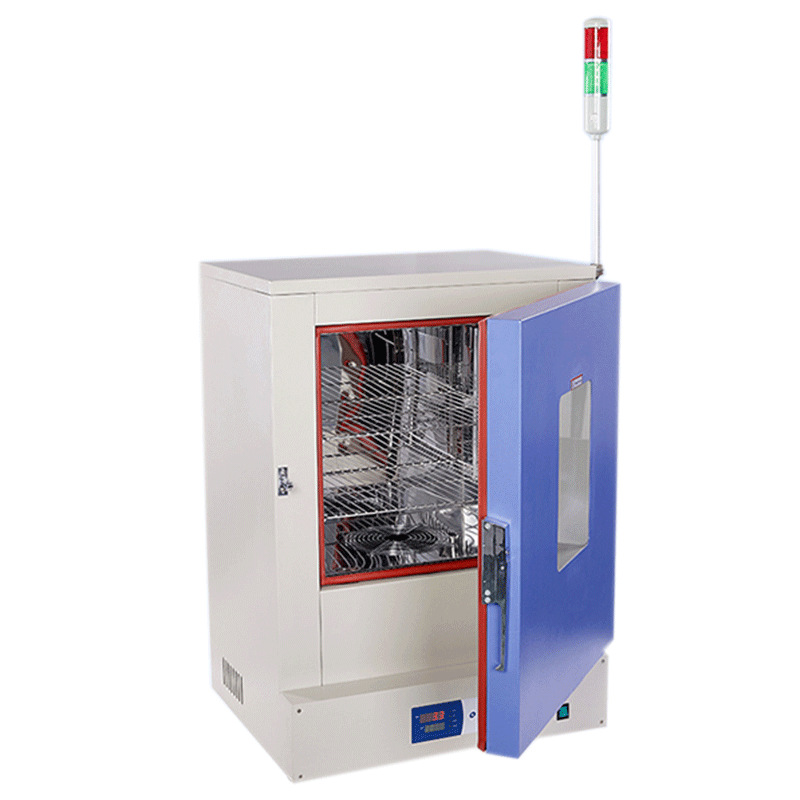
Main components of the device
- Working chamber with shelves or trays: samples are loaded into it; The payload is always less than the geometric volume.
- Heaters and fan: create a flow of heated air; their location affects the direction and uniformity of flow.
- Temperature sensor and controller: support the setting and control the heating; The display is used to judge the camera mode, not the temperature inside each particle.
- Door, seal and air damper: responsible for tightness and air exchange; vapors are removed through the damper.
- Security and alarm systems: may include overheating limitation, timer and audible indication; their availability depends on the execution.
In the card TENCAN a precision forced convection oven is presented; This is a specific version, not the entire range. Therefore, the parameters of another model are not transferred here, and values that are missing in the card cannot be guessed. The following discusses the general principles of reading characteristics; specific numbers for a given cabinet should be taken from its current card and accompanying documentation.
How to Read Cabinet Specifications
In the specification of the drying cabinet there are several different values next to each other, which are easy to confuse. Some describe heating, others describe temperature distribution, and others describe useful volume or air exchange. If you read them as one “main number”, you can choose a device that is formally suitable for temperature, but does not work well with a specific load.
Temperature: setpoint, maintenance and maximum value
The set point is the temperature set by the operator. Maintenance accuracy shows how stably the controller maintains the mode near the target. The maximum operating temperature is an upper limit, but it is not a recommendation to constantly work at it. The time it takes to reach the mode and the behavior of the camera after loading cold samples is also worth mentioning. The number on the display refers to the sensor in the camera; The temperature of the sample itself may vary due to heat capacity, moisture evaporation, and limited heat transfer within the powder.
Therefore, the phrase “cabinet to such and such temperature” in itself says little about suitability for the task. You need to understand what temperature is needed on the sample, how long exposure is allowed, and how sensitive the material is to overheating. If the card indicates a range, but does not indicate the measurement conditions, this is a reason to clarify the data, and not to invent it.
Uniformity and loading
Temperature uniformity throughout the chamber is an important but conditional indicator. It depends on whether the chamber is empty or filled, where the shelves are located, what the mass of the samples is and whether the air flow is blocked. A densely packed chamber with large pallets may behave completely differently than an empty one. Therefore, when choosing, you should look not only at the passport uniformity, but also at the organization of flow, the distance between shelves and the ability to evenly place the load.
Thermal inertia also affects the result. The metal tray, ceramic cup and thick layer of powder heat up at different rates. If the sample lies in a dense layer, moisture from the lower layers takes longer to reach the surface, and the upper layer may dry out. A thin, even layer will usually dry differently than a clump or thick layer; This is a question of technique, not just cabinet power.
Chamber volume and payload
The geometric volume of the chamber is not equal to the mass of the sample that can be dried at one time. Payload is limited by shelf area, bed height, thermal load capacity, and circulation requirements. A small chamber with a large load may lose its uniformity; A chamber that is too large with a small sample is inefficient in terms of time and energy. For the technique, reproducibility is more important: the same placement, the same weight and the same layer give more comparable results than simply “loading more.”
Management, logging and security
The controller may have a timer, programmable steps, deviation alarm and communication interface. The presence of these features is implementation dependent and should not be assumed by default. For laboratory work, clear indications, overheating protection, door locking and the ability to check the actual operating mode are useful. If you plan to work with powders, it is important to provide dust protection and consider cleaning so that residues from the previous sample are not transferred to the next one.
Materials, objectives and limitations
The drying oven is used for powders, granules, ceramic masses, precipitates, samples after synthesis and materials that need to remove surface or pore moisture. In analytical practice, drying can be a step in preparation for weighing or measurement, but then it is especially important that the regime does not change the composition of the sample. For polymers, organic substances, hydrates and mixtures with highly volatile components, temperature and time must be confirmed separately; general recommendations are inappropriate here.
Limitations begin where simple water removal ends. The oven does not sinter ceramics, does not melt metal, and does not replace a muffle or tube furnace with a controlled atmosphere. It does not provide a vacuum environment unless specified in the design, and does not become explosion-proof just because it is called laboratory. Flammable solvents, toxic vapors and dusts capable of forming hazardous concentrations require special solutions and risk assessment; a conventional drying cabinet is not suitable for such tasks without a confirmed set.
A separate issue is cleanliness. Contaminants can be transferred through shelves, trays, seals, air flow and dust. The material of the shelves and equipment in itself does not provide “zero pollution”; this applies to any laboratory operation. For trace analyses, it is useful to provide a blank run, clean the chamber, and store samples without re-wetting. You should not promise complete sterility or absence of contamination unless this is confirmed by methodology and testing.
How to choose the right version
The choice begins not with the name of the model, but with the description of the problem. It is necessary to understand what exactly is being removed: free water, pore moisture or moisture associated with the material; what temperature is acceptable for the sample; how quickly it should dry; what properties cannot be lost. Then the requirements for the chamber are formulated: payload, number of shelves, permissible layer height, ability to place trays and sensors, ease of cleaning.
- Material and its limitations: thermal sensitivity, tendency to oxidation, agglomeration, dusting and chemical decomposition.
- Temperature regime: not only the upper limit, but also the operating point, accuracy of maintenance, time to reach the mode and behavior during loading.
- Uniformity and flow: position of fan, shelves and damper; the ability not to block circulation.
- Volume and loading: useful volume, shelf area, sample weight and layer thickness.
- Safety: protection against overheating, alarm, interlocks, compatibility with expected vapors and dust.
- Documentation and reproducibility: clear instructions, measurement conditions, ability to record and repeat the mode.
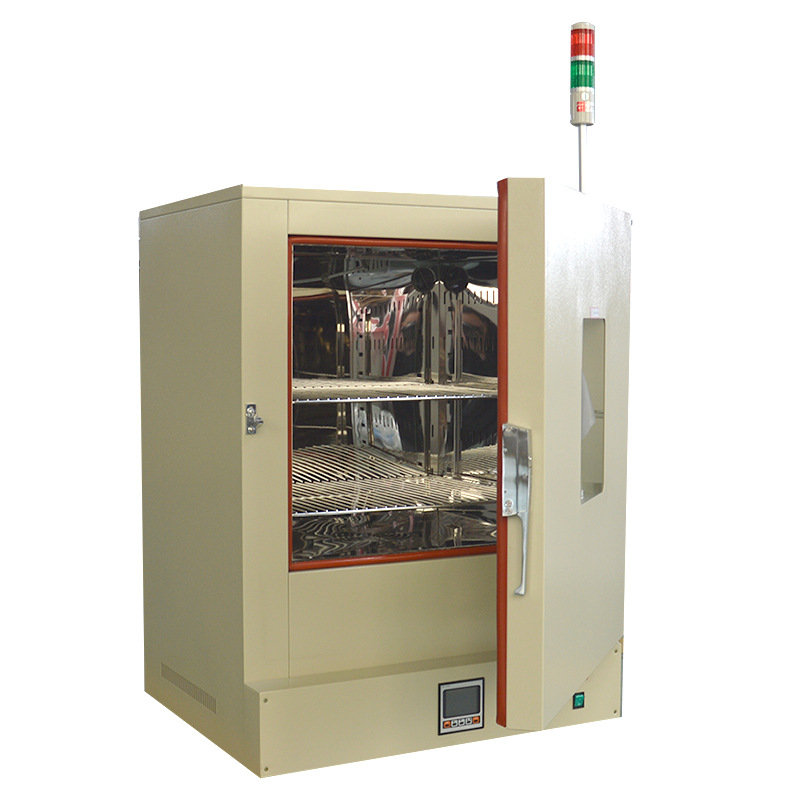
It is useful to check in advance how the device behaves with a real load, and not just with an empty camera. If the product card does not contain the necessary information, this is not a reason to assume it by analogy with another model. IN catalog TENCAN the equipment is grouped by area, and the card for the precision forced convection drying cabinet contains a description of the specific design; Before choosing, you should check exactly its parameters with the task.
Short answers to frequently asked questions
How does a precision oven differ from a conventional drying oven?
First of all, the control system and the declared stability characteristics, and not just the presence of a fan. Forced convection improves heat transfer, but suitability is determined by a combination of accuracy, uniformity, volume, safety and material compatibility.
Is it possible to dry the powder before ball grinding?
In many drying techniques, drying does reduce sticking and clumping, but the specific method depends on the material. Over-drying sometimes increases agglomeration, and residual moisture can interfere. It is necessary to check the condition of the sample after drying, and not to assume that any powder requires the same preparation.
Why is the temperature on the display not equal to the sample temperature?
The sensor measures the temperature in a chamber or at a specific point while the sample is heated gradually. The evaporation of moisture cools the surface, the thick layer of powder is heated unevenly, and the pan has its own heat capacity. Therefore, the regime is confirmed according to the method and, if necessary, additional measurements.
Can such a cabinet be used for sintering?
No, the oven is designed for drying and temperature control, not sintering. Sintering requires furnaces with the appropriate range, atmosphere and equipment; The oven functions cannot be transferred to the cabinet.
How is forced convection different from vacuum drying?
In a forced convection cabinet, heat is transferred by air flow at close to atmospheric pressure. In a vacuum cabinet, the environment and heat transfer are different, so these are different classes of equipment with different limitations and techniques.
This article helps formulate equipment requirements and questions for the supplier, but does not replace the user manual for a specific cabinet. The decision on the drying mode is made based on the properties of the sample, documentation and internal safety procedures.