
A precision forced convection oven is a laboratory equipment for the controlled removal of moisture from samples before weighing, analysis, storage or further heat treatment. In the sample preparation chain, it is located between stages where the material is already obtained or formed, and stages where stable mass, absence of free moisture and reproducible surface condition are important. After wet grinding, washing, filtering or storage, the powder often contains varying amounts of liquid; Drying allows samples to be brought to a comparable state, but does not replace chemical analysis and does not guarantee the same result for all materials.
In line TENCAN this class of equipment corresponds precision forced convection oven. TENCAN — brand of Changsha Tianchuang Powder Technology Co., Ltd.; The link leads to the product card, where you can check the specific parameters of the selected design. The cabinet is not a mill, press or sintering furnace: its function is controlled moisture removal, not grinding, compaction or high-temperature sintering.
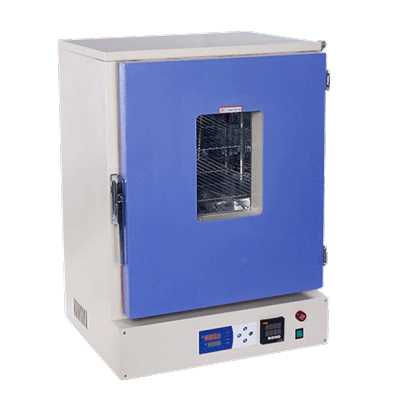
What is this equipment and where is it used?
A forced convection drying cabinet is a chamber with a heater, fan and air distribution system. The fan creates a directed flow that passes through the heating element, transfers heat to the samples and removes evaporated moisture. Unlike natural convection, where air moves mainly due to temperature differences, here circulation is forced. This allows you to quickly reach a given mode and reduce stagnant zones, although uniformity still depends on the design of the chamber, the location of the shelves and the loading density.
In laboratory practice, the cabinet is used for the preparation of powders, granules, ceramic blanks, glass containers, filters and other samples when it is necessary to remove free moisture before weighing, sifting, packaging, analysis or subsequent heat treatment. In materials science and sample preparation areas, such an operation often occurs before measuring moisture, bulk density, particle size distribution, or before molding. At the same time, drying does not replace calcination, annealing or sintering: these are different temperature and physicochemical processes, and they should not be confused.
For tasks where not only the drying itself is important, but also the reproducibility of the mode, temperature control, air flow organization and the ability to repeat conditions from batch to batch are important. This is what the word “precision” in the name indicates. It does not mean that any sample will be dried to an ideal state: the result depends on the material, initial humidity, layer thickness, liquid properties and permissible temperature. Therefore, equipment is chosen together with the drying technique, and not instead of it.
How does forced convection work?
In a cabinet with forced convection, air usually passes through a closed or partially renewed circuit: a fan takes air from the chamber, directs it through the heater, distributes it throughout the volume and returns it back. The heater maintains the temperature and the flow transfers heat to the samples and helps remove moisture from the workspace. The better the flow pattern is organized, the less likely there are local overheats and cold spots, but only with proper loading. An empty chamber and a chamber tightly filled with baking sheets behave differently.
Forced convection does not “blow through” the sample and does not replace the diffusion of moisture from the depths of the material. If the piece is dense or the layer of powder is thick, the surface may dry out before the moisture leaves the inner layers. As a result, a crust forms, which slows down further drying and can distort the result. Therefore, for dense and sensitive materials, a softer setting is often needed rather than the maximum flow rate.
The temperature of the working space and the temperature of the sample itself are distinguished separately. The cabinet sensor measures the temperature at a specific point in the chamber or in the flow, but not necessarily inside the powder. Massive loads, damp material and dense laying may take longer to warm up. This is important when selecting a mode for temperature-sensitive substances: the controller reading is not the same as the measured sample temperature.
| Criterion | Natural convection | Forced convection |
|---|---|---|
| Air movement | Due to the temperature difference and the rise of heated layers | Organized by fan and air ducts |
| Entering the mode | Usually slower | Usually faster |
| Uniformity | Depends more on volume and load | Depends on flow pattern, shelves and load |
| Risk of surface drying | Yes with uneven heating | May increase if flow is too intense |
| Typical choice | Simple tasks without high repeatability requirements | Applications where control and reproducibility are important |
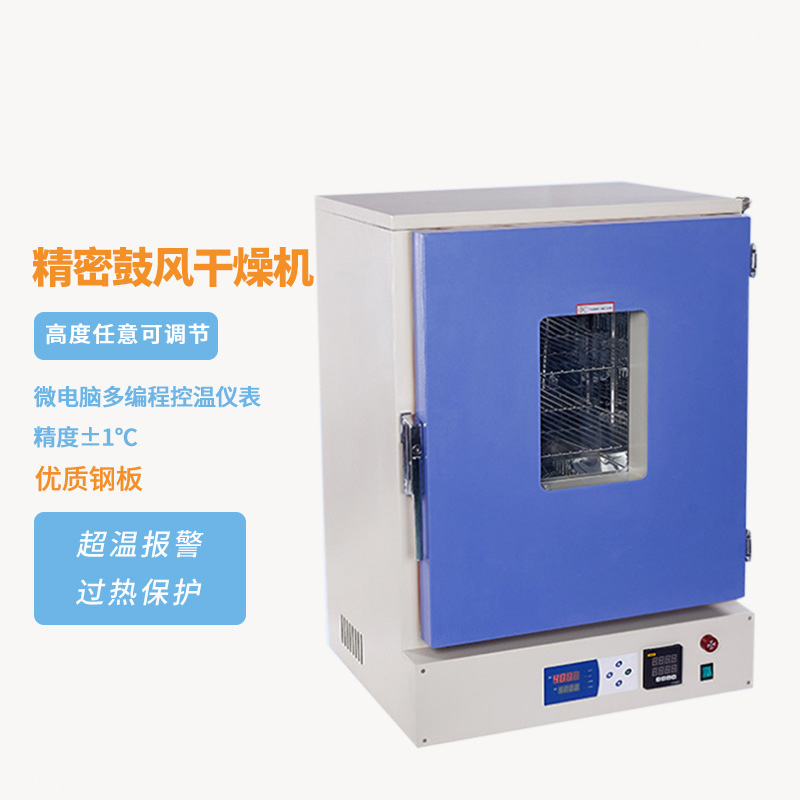
What does “precision” mean and what parameters to read
The word “precision” in the name of the equipment indicates an emphasis on accuracy of maintaining the regime and repeatability of conditions, and not on a single formal accuracy class. Specific tolerances, temperature ranges, errors and chamber uniformity should be found in the documentation of the selected model. You cannot transfer the parameters of one design to the entire range: even externally similar cabinets may differ in controller, airflow circuit, chamber material and set of protections.
Operating and maximum temperature
In the product data sheet, it is useful to distinguish between the maximum temperature that the equipment is capable of reaching and the long-term operating temperature acceptable for everyday use. It's not always the same thing. In addition, the upper limit of the chamber does not mean that any material can be dried at that temperature: the limit may be related to the sample, container, seals or safety requirements. If the meaning in the description is ambiguous, it is better to clarify it rather than insert it into the methodology based on a guess.
Stability and uniformity
Temperature stability describes how close the actual value is to the set point at a specific control point. Uniformity describes the difference between points in a chamber. Both indicators are important for drying, but they manifest themselves in different ways: even a cabinet with a stable controller can have a noticeable gradient if loaded incorrectly. Check uniformity correctly in a certain mode and with a certain load; an empty chamber does not show how a densely filled one will behave. Therefore, the technique records not only the temperature, but also the location of the samples, the type of tray and the drying duration.
Air exchange and flow rate
Intense flow accelerates heat transfer and moisture removal, but with light powders it can cause dusting and uneven laying. If the equipment allows you to adjust the fan speed, this is useful for sensitive materials. If there is no adjustment, the mode is selected based on the load, the type of baking sheet and the permissible temperature. The documentation sometimes gives the air exchange rate or flow rate; These parameters are useful for comparison, but they cannot be assessed in isolation from the chamber volume and air distribution pattern.
Management, control and security
Precision is associated not only with the heater, but also with the controller: temperature setting, timer, deviation alarm, overheat protection and calibration capabilities. The presence of a function on a card does not mean that it is included in a specific package; this needs to be checked against the description and passport. Safety is assessed separately: not every laboratory cabinet is designed to work with flammable vapors or aggressive substances. If the sample contains an organic solvent, the conventional design may not be suitable; requires a specially evaluated solution and compliance with laboratory regulations.
Materials, downloads and restrictions
A forced convection oven is suitable for many sample preparation tasks, but is not a universal tool for all substances. Powders after wet grinding, granulates, ceramic masses, sediments, filters and containers may require different regimes. For one material, gentle drying at a low temperature is important, for another it is the removal of free moisture with a more intense exchange. The decision is made based on the properties of the sample, and not just on the capabilities of the camera.
Loading affects the results more than it seems. A thick layer of powder dries unevenly: the lower layers may remain wet when the upper ones are already dry. Tightly placed baking sheets block the flow, and a high load increases the heating inertia. For reproducibility, record the sample weight, layer thickness, tray type, position in the chamber and drying time. If the procedure requires drying to constant weight, the samples are weighed after cooling under suitable conditions, since the hygroscopic powder may reacquire moisture from the air.
The materials of the shelves, trays and inner chamber must be compatible with the sample. Acidic, alkaline or abrasive powders may interact with the surface and dust may be transferred to subsequent batches. Therefore, cleaning, recycling containers, and controlling cross-contamination are important. It should not be assumed that forced convection in itself prevents the transfer of impurities: the air flow can carry fine dust throughout the chamber.
Restrictions are also related to security. Flammable liquids, the vapors of which may accumulate in the chamber, require separate assessment; An ordinary drying cabinet should not be considered as explosion-proof equipment without confirmation. Heat-sensitive materials should not be dried at temperatures that change their phase composition or properties. Finally, the oven is not intended for sintering, melting or high-temperature processing: ovens of the appropriate class are used for such tasks.
How to choose a cabinet and check compatibility
The choice begins with a description of the task, not with the name of the equipment. You need to understand exactly what moisture is being removed, what temperature is acceptable for the sample, how many samples are processed at the same time, and what the repeatability requirements are. After this, it is useful to compare several designs in terms of chamber volume, blowing pattern, control and materials. General range and directions of equipment TENCAN are given on main page of the site; The specific parameters of the selected model can be found in its card.
- Problem and sample. Determine what is removed - free moisture, surface liquid after washing or residues after wet grinding. The permissible temperature, sensitivity of the material and tendency to oxidation are taken into account.
- Useful download. Camera volume and payload are not the same thing. The size of the trays, the distance from the heater and the ability to evenly place the samples without blocking the flow are important.
- Material compatibility. Check what the shelves, trays and chamber are made of and how they withstand cleaning and contact with the sample. For aggressive substances, use suitable secondary containers if the procedure allows this.
- Control and reproducibility. They look at what functions are actually included in the package: temperature setting, timer, alarm, overheat protection, calibration capability. You should not attribute functions to the equipment that are not included in the description.
- Safety. Flammable vapors, toxic substances and dust require separate assessment. A general purpose laboratory cabinet does not replace a fume hood or specialized system.
After choosing a model, the mode is checked on a real sample. They start with gentle conditions, monitor the condition of the surface, the absence of crust and uniform drying. If the result is unstable, the cause is often not the controller, but a too dense load, an unsuitable tray or the wrong temperature. The product card helps narrow down your choice, but does not replace the methodology and instruction manual.
Questions and answers
How is a precision oven different from a conventional oven?
With a primary focus on control and repeatability, temperature control, flow management, and mode protection matter more than just the presence of heat. However, the specific benefits are determined by the performance, so you need to compare parameters and functions, and not just the name.
Is it possible to dry the powder after wet grinding?
Yes, if the material and liquid allow such an operation. It is important to consider what the powder was moistened with, the permissible temperature and the tendency to form a crust. For flammable or toxic liquids, a conventional cabinet may not be suitable; a separate safety assessment is required.
Why might the sample temperature differ from the cabinet reading?
The sensor measures the temperature in the working area or flow, and the sample is heated depending on mass, humidity, layer thickness and placement. Dense loads and large pieces require more time. Therefore, the mode is checked on a real sample, and not just based on the controller’s set value.
Is a drying oven a substitute for a sintering oven?
No. Drying removes moisture, while sintering is associated with high-temperature transformations and strengthening of the material. These are different processes and different equipment; substituting one for the other is unacceptable.
How to choose the camera volume?
They are based on the number and size of samples, the required distance between them and the ability not to block the flow. A larger chamber is not always better: with a small load it may work less efficiently. It is useful to choose a version based on the actual load, and not on the maximum figure in the description.