
The precision forced convection oven is a laboratory apparatus for controlled heating and drying. It removes moisture and residual solvent from powders, granules, compact and fibrous samples, and dries laboratory glassware, equipment and containers. In the sample preparation chain, such a cabinet occupies a place between “wet” operations (wet grinding, washing, impregnation, filtration) and “dry” operations (sifting, weighing, sample reduction, pressing). Its task is to set the temperature in the working volume and create a directed air flow, which carries away vapors from the surface of the material and equalizes the temperature field throughout the chamber.
The name of the model reflects two design features. “Precision” indicates an emphasis on precision and consistency in maintaining temperature, “forced convection” refers to a fan that moves air within the cooking chamber, as opposed to cabinets where heat is transferred only by natural convection and radiation. Specific values of temperature, accuracy and working volume relate to a specific model and are checked according to its documentation. In the catalog TENCAN The device is presented in the heat treatment equipment section: precision forced convection oven.
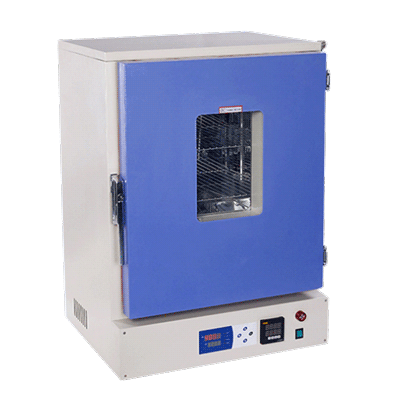
How does a forced convection drying cabinet work?
The design of such a device consists of several functional units, and each of them determines which tasks the device solves reliably, and which require reservations and additional verification.
Working chamber and air circuit
The working chamber is an isolated volume, inside of which shelves, trays or pallets with material are placed. The walls, door and seal form a thermal barrier: the better the insulation, the less heat escapes through the walls and the more stable the temperature when loading and briefly opening the door. The material of the chamber and shelves is important because when drying aggressive or abrasive powders, interaction with the surface is possible, as well as the adhesion and transfer of contaminants. An air circuit is a fan, a system of channels and openings for air intake and exhaust. The direction of the flow (horizontal or vertical airflow) determines which zones of the chamber warm up faster and where “shadow” areas are formed, where the flow reaches weaker.
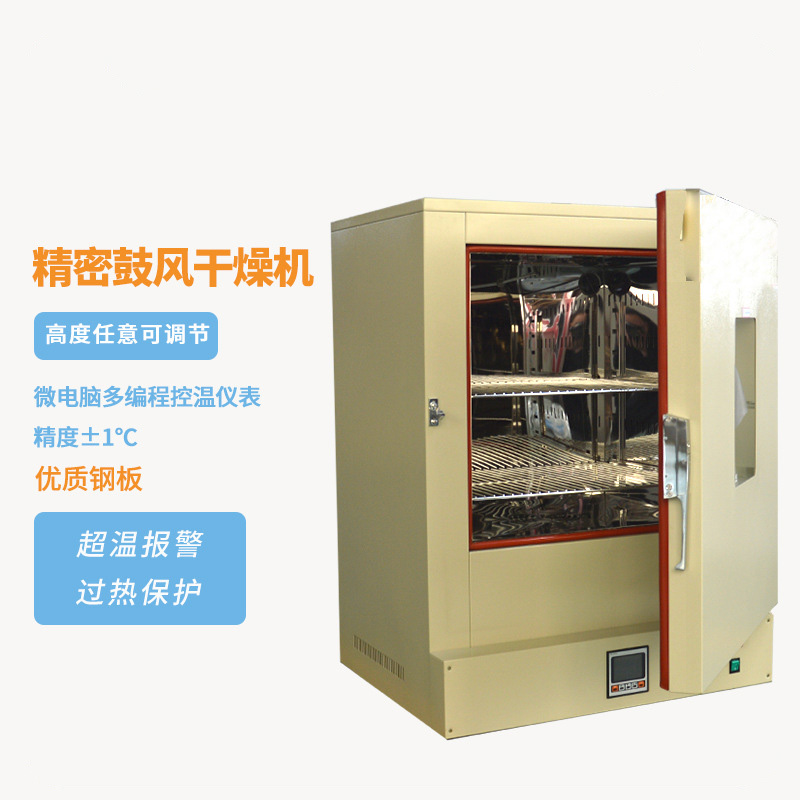
Heater, sensor and regulator
The heating element transfers heat to the passing air, the temperature sensor measures it at the installation point, and the controller compares the reading with the target and controls the heating power. Precision consists of several factors: the class of the sensor, the control algorithm, the location of the sensor in the flow, the stability of the supply voltage and the quality of air mixing. It is important to distinguish between the air temperature in the working volume and the temperature of the sample itself: the sensor measures the first, not the second. A sample with moisture warms up more slowly due to evaporative cooling, and a massive load takes longer to reach the operating mode. That is why large and wet samples are dried in stages, and not immediately at the maximum temperature.
What does forced convection provide and what does it not replace?
Forced convection solves two problems. The first is heat transfer: moving air transfers heat to the surface of the material more intensely than stationary air, so heating occurs faster and more evenly. The second is vapor removal: the flow continuously removes moisture from the chamber, preventing it from accumulating at the surface and slowing down drying. As a result, the temperature distribution throughout the volume becomes smoother, and the difference between the shelves decreases.
However, convection does not cancel physical restrictions. If the material is prone to forming a surface crust, removing moisture from the surface too quickly will result in moisture remaining inside and a dense layer forming on the outside. If the powder is light and dusty, the air flow can carry it away - then you need trays, limiters or a reduction in the blowing speed. If the sample is thermally sensitive, increasing the temperature to speed up the process leads to decomposition, sintering, or a change in phase composition. Finally, forced convection is not vacuum drying or controlled atmosphere drying; such tasks require a different type of apparatus.
How to read cabinet specifications correctly
The model specification is read not as a list of numbers, but as a set of interrelated conditions. Below are the main parameters and what exactly needs to be clarified.
| Parameter | What does it describe? | What to clarify in the documentation |
|---|---|---|
| Temperature range | Task boundaries and sustainable operation boundaries | Maximum and long-term operating temperatures are different values |
| Precision and stability | Deviation from the task and its fluctuations over time | Is the deviation specified for the working volume or only for the sensor point? |
| Working volume | Usable camera space | How much is left after installing shelves and pallets, what is the permissible load by weight |
| Chamber and shelf material | Resistant to corrosion, adhesion and abrasion | Compatibility with specific powder and solvent |
| Air exchange | Intensity of vapor removal and air renewal | Is the flow regulated, is there an outlet for ventilation of the room? |
| Control and protection | Program setting, overheating limitation, alarm | Availability of independent temperature limiter and behavior in case of sensor failure |
Separately, it is worth mentioning the terminology. Equipment of this class is often placed in catalogs next to furnaces, but drying is not sintering. Drying removes moisture and volatile components at temperatures generally well below the sintering threshold; sintering involves heat treatment, during which the particles are combined into a strong frame. A laboratory oven is not designed for sintering, and conversely, the oven is not optimal for gently drying heat-sensitive powders.
Materials, objectives and limitations
Typical applications of the cabinet are drying samples after wet grinding, washing and filtration, preparing powders for sifting and dividing, drying laboratory glassware and equipment. In materials science laboratories, it is also used to remove adsorbed moisture before weighing: the mass of a wet powder is unstable, so it is more convenient to carry out the results of granulometric analysis and calculations on the charge on a dry basis.
Limitations are related to the nature of the sample. Heat-sensitive organic materials, polymers and some salts require low temperatures and exposure, at which moisture removal occurs slowly. After drying, hygroscopic powders quickly absorb moisture from the air, so the hot sample is cooled in a desiccator rather than on an open table. Working with flammable solvents requires special attention to ventilation, the absence of ignition sources and compliance of the device with the conditions of use; in doubtful cases, the mode and admissibility of drying are coordinated with the documentation and safety rules of the laboratory. Discussion of instrument selection does not replace the operating instructions for a specific installation.
Connection with grinding and grinding equipment
Drying and grinding are technologically related. Wet grinding in a planetary mill produces a suspension, which often needs to be dried before further operations: the residual liquid changes the flowability, tendency to agglomerate and the result of sieving. It is important here to distinguish between particle destruction and disagglomeration: gentle drying should not destroy what was obtained in the mill, but it does not always completely eliminate the agglomerates formed during drying of the suspension. If agglomerates are critical, dry regrinding or gentle disagglomeration is used after drying.
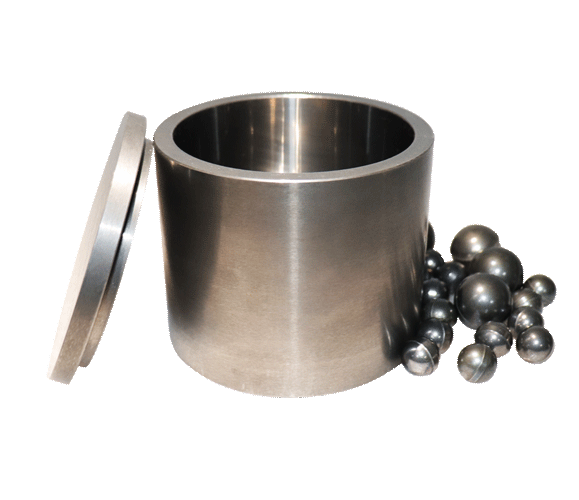
Grinding equipment affects the purity of the sample. For example, tungsten carbide grinding bowl for planetary mill are chosen where high density and wear resistance of the material under intense abrasion are needed. Such a glass is a part of a planetary mill, and not a drying container: it is designed for mechanical load during the grinding process, and not for work in a drying cabinet. The compatibility of equipment and apparatus is determined by their own parameters, and not by their general purpose: the random proximity of two products in the catalog does not prove their joint operation. The transfer of tooling material into the sample depends on the hardness of the sample, grinding time, mode and surface condition - tungsten carbide, ceramic or zirconium dioxide only mean a different wear profile, but not the absence of impurities.
Selection criteria and compatibility
It is convenient to select a drying cabinet based on the task, and not on a list of numbers. A useful sequence looks like this:
- Define your goal. Removing free moisture, removing solvent, drying dishes or preparing for weighing have different requirements for temperature and air exchange.
- Assess the sample's thermal sensitivity. It sets the upper temperature limit and the need for step mode.
- Calculate the one-time download. The mass and volume of the sample are more important than a “large chamber”: an overloaded chamber dries unevenly.
- Check material compatibility. The material of the chamber, shelves and trays must not react with the sample.
- Check your air exchange requirements. Both the drying speed and safety when working with volatile components depend on it.
- Allow for temperature and accuracy margins — not for advertising figures, but for reproducibility between series of experiments.
It is useful to determine in advance how the final moisture content will be controlled: by constant mass during repeated weighing or by another method accepted in the laboratory. Without such a criterion, seemingly identical modes give different results. It is convenient to start an overview of directions and types of equipment with home page TENCAN, which contains sections for the preparation, grinding and heat treatment of materials; The full name of the manufacturer is Changsha Tianchuang Powder Technology Co., Ltd.
Frequently asked questions
How does a convection drying cabinet differ from a vacuum drying cabinet?
In a regular cabinet, drying occurs at atmospheric pressure, air circulates and carries away vapors. In a vacuum apparatus, reduced pressure lowers the boiling point of moisture and reduces oxidation, but requires a different chamber, pumping unit and seals. The devices are not interchangeable one to one: the choice is determined by the thermal sensitivity of the material and the requirements for the environment.
Is it possible to dry the powder directly in the grinding bowl?
The grinding glass is a working part of the mill, not a drying utensil. After wet grinding, the suspension is transferred to a suitable container and dried in a cabinet, and the glass is washed and dried separately so as not to leave sample residues on its surface and not to mix batches.
How to distinguish drying from sintering?
Drying removes moisture and volatiles at relatively moderate temperatures. Sintering is a heat treatment in which particles are combined into a durable material; it requires an oven, not an oven. An attempt to “speed up” drying by using a temperature higher than permissible for the sample does not replace sintering.
What should I check before ordering?
Type and properties of the sample, permissible temperature, single loading, air exchange requirements, material compatibility, and the expected method of controlling residual moisture. This information allows you to compare the task with the parameters of a specific model given in its documentation.