
A plastic crusher is equipment for preliminary reduction in the size of plastic blanks, sprues, defective products and other polymer fractions. In the technological chain, it usually takes place before finer grinding, mixing or pressing: after crushing, the material becomes more convenient for dosing, transportation and further processing. In the provided card TENCAN such a machine is presented as plastic crusher; This is not a planetary ball mill or a bead mill, but equipment for a different purpose.
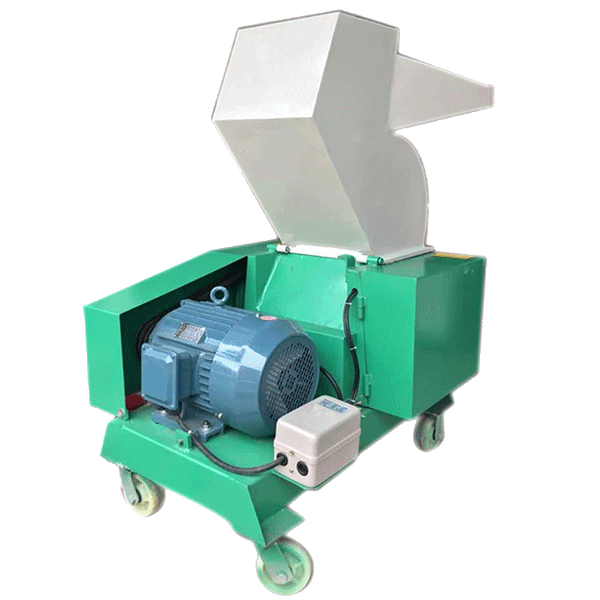
What is a plastic crusher and where is it located in the process
The main task of the crusher is to reduce the size and weight of individual plastic fragments in order to obtain a fraction more convenient for further operations. Crushing is not the same as fine grinding: the output is usually lumps, flakes or granules, rather than a powder with a narrow particle size distribution. Therefore, the crusher should not be considered as a replacement for a ball, planetary or bead mill if the end goal is fine material.
Plastics vary greatly in their behavior under mechanical stress: some readily crack, others crumple, stretch, or soften when heated. The result is influenced by the wall thickness, the shape of the workpiece, the presence of reinforcing additives, dirt and moisture. Because of this, the same machine can behave differently on sprues, sheet material, film, or bulk defective products. Correct comparison is possible only for a specific material and a given mode.
In laboratory and industrial practice, the crusher often serves as the first stage of preparation. It reduces the size of the pieces before weighing, mixing, pressing or re-grinding. However, it does not guarantee a certain particle shape, no dust, or constant performance on any plastic. These indicators are checked against documentation and tests for a specific product.
How does a plastic crusher work: mechanism and main elements
The working principle is based on the mechanical destruction of the material in the grinding chamber. In knife designs, a combination of cutting, impact and abrasion predominates; in other designs the ratio may be different. The specific geometry of the working body, the profile of the knives and the unloading part depend on the design, so one name cannot judge all the parameters of the machine.
Loading and picking up material
The loading window limits the permissible dimensions of the workpiece. A piece that is too large or incorrectly oriented may hang up, require refeeding, or create uneven load on the drive. Hollow parts, thin-walled parts and film behave differently than solid sprues: they take up a lot of volume with little weight and may not grip properly.
For stable operation, uniform feeding and the absence of foreign inclusions are important. Metal parts, stones, glass and abrasive contaminants should not get into the chamber: they increase wear and can damage the working elements. The method of supply and safety precautions should be taken according to the specific installation manual, and not according to a general article.
Grinding and unloading
In the chamber, the material is repeatedly subjected to loading until it passes through the unloading section or is removed from the working area. If a grid or replaceable sieve is provided, it is their geometry that largely determines the upper limit of product size. However, this does not mean that the entire fraction will be the same: the shape of the pieces, the fragility of the plastic and the feeding mode give rise to scatter.
When used intensively, the plastic may become hot. Heating promotes softening, sticking and changes in the nature of crushing, so for heat-sensitive materials it is necessary to separately check the admissibility of the mode. The surface temperature of the equipment or the specified process parameter is not equal to the measured temperature of the sample.
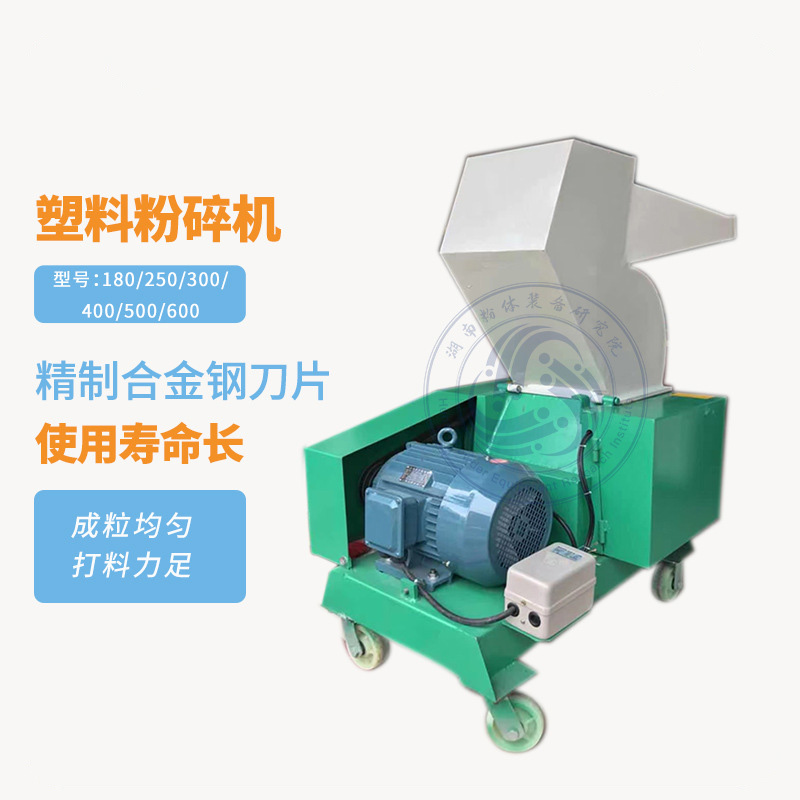
What performances are found and what is important to distinguish
One product card describes a specific design, and not the entire possible range of machines for plastics. Practical differences usually relate to loading area size, drive type, unloading arrangement, contact materials and ease of cleaning. You cannot transfer parameters from one execution to another without confirmation.
- The size of the loading window and the permissible dimensions of the workpiece.
- Type of drive and organization of the working body.
- Materials in contact with the product and their wear resistance.
- Access for cleaning, inspection and replacement of wear parts.
It is useful to distinguish between a crusher, a mill and a mixer. The crusher reduces the size of the pieces, the mill provides finer grinding, and the mixer redistributes the components without necessarily breaking down the particles. In different industries, similar machines may be called differently, so they focus on the task, the size of the source material and the required product, and not just on the word in the name.
Crusher parameters and their correct reading
The performance of a plastic crusher cannot be assessed by one number in isolation from the material. It depends on the shape and thickness of the workpieces, bulk density, permissible piece size, output fraction and feeding mode. Drive power is also not equal to productivity: part of the energy is spent on heating, friction and repeated crushing.
Load size and output fraction
The loading window shows which pieces can be fed into the machine, but does not guarantee easy grip for any shape. The output fraction is determined by the joint action of the working body and the unloading section. If a description specifies a typical size, it should be taken as a guide for specific conditions and not as a promise for any plastic.
Performance and Mode
Performance on heavy gates and lightweight film varies even with the same equipment. For film and hollow products, volumetric feeding and freezing are important; for rigid parts - sufficient fracture energy and durability of working elements. Therefore, when choosing, they ask for a mode for a specific sample, and do not compare machines according to the passport line without conditions.
Contact materials and wear
Knives, lining and other parts of the working area are subject to wear. Fiberglass, mineral fillers and contaminants accelerate abrasive wear; soft and sticky plastics may require more frequent cleaning. Even robust contact materials do not mean “zero contamination”: transfer of wear particles is always possible, and for sensitive samples this must be assessed separately.
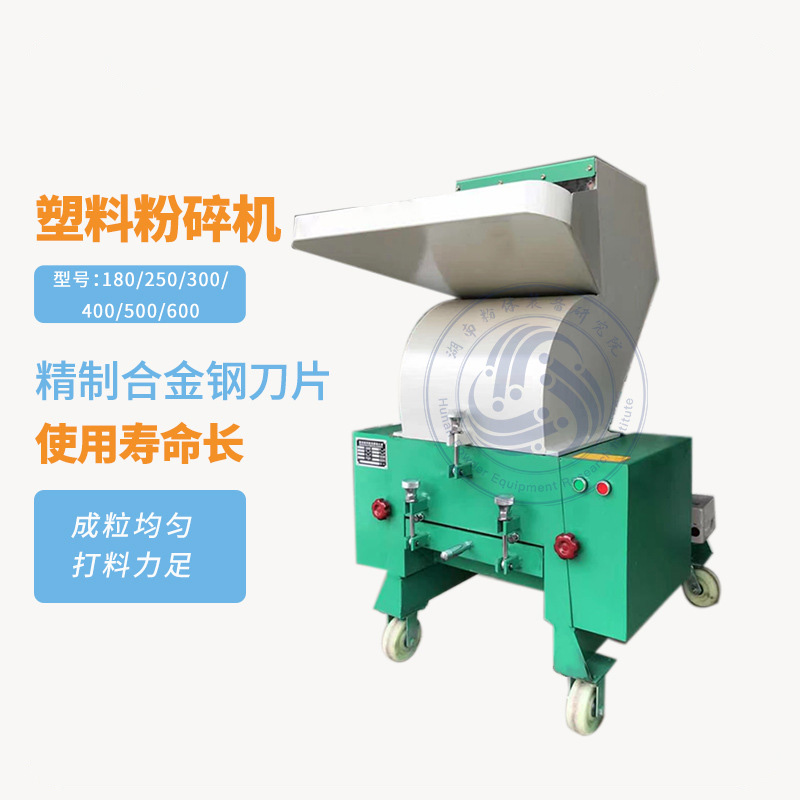
Materials and restrictions
The name “plastic crusher” does not mean permissiveness regarding raw materials. Rigid engineering plastics, reinforced composites, foams, films and mixed waste require different conditions. For some, the shape of the load is important, for others - resistance to abrasive, for others - prevention of heating and sticking.
Do not load the machine with materials whose suitability has not been confirmed: this applies to unknown mixtures, hazardous substances, materials with metallic inclusions and compositions that release aggressive products when heated. Discussion of selection does not replace the safety data sheet, operating instructions or local requirements. For heat-sensitive plastics, heating and cleanability are checked separately.
How to choose a crusher for plastic
The selection begins with a description of the pattern and purpose, not with a search for maximum power. First, the material, shape and dimensions of the workpieces, the required output fraction, unit mass or productivity, as well as permissible heating and cleaning requirements are recorded.
- Determine what exactly you need to get: pieces for further processing, a convenient sample or preparation before another grinding.
- Check the permissible dimensions and loading shape for the intended products.
- Specify the required fraction and how to control it.
- Assess wear and compatibility of contact materials with the sample.
- Provide cleaning between batches and safety precautions.
- Check the real performance for a specific plastic, and not just the drive power.
After this it is useful to reopen plastic crusher card TENCAN and check whether the selected execution relates to the desired task. A general overview of equipment areas is available at website TENCAN. If a fine powder is required rather than pre-crushing, a mill of the appropriate operating principle should be considered.
Questions and answers
How is a plastic crusher different from a mill?
The crusher first reduces the pieces to a convenient intermediate fraction. The mill is designed for finer grinding and usually requires different controls for size, heat and contamination. These are different machines and should not be replaced without checking the problem.
Is it possible to get powder from a crusher?
As a rule, no: for plastic, the result of crushing is pieces, flakes or granules. If fine powder is required, different equipment and separate testing of material suitability is required. Product appearance is not a substitute for measuring particle distribution.
Is one crusher suitable for all plastics?
No. The hardness, thickness, tendency to heat, abrasiveness of fillers and the shape of the workpieces differ. Even if the load size is suitable, the mode and wear of the specific material must be checked.
What's more important: power or performance?
Both parameters are important, but separately they do not prove anything. Power is related to overcoming resistance, and productivity depends on the material, feed and output fraction. You can only compare cars under the same conditions.
How to check compatibility?
It is necessary to compare the passport restrictions of a specific design with the sample: dimensions, shape, material, permissible heating, cleaning and safety requirements. If in doubt, it is better to check the information in the documentation rather than transfer the properties of another model.