
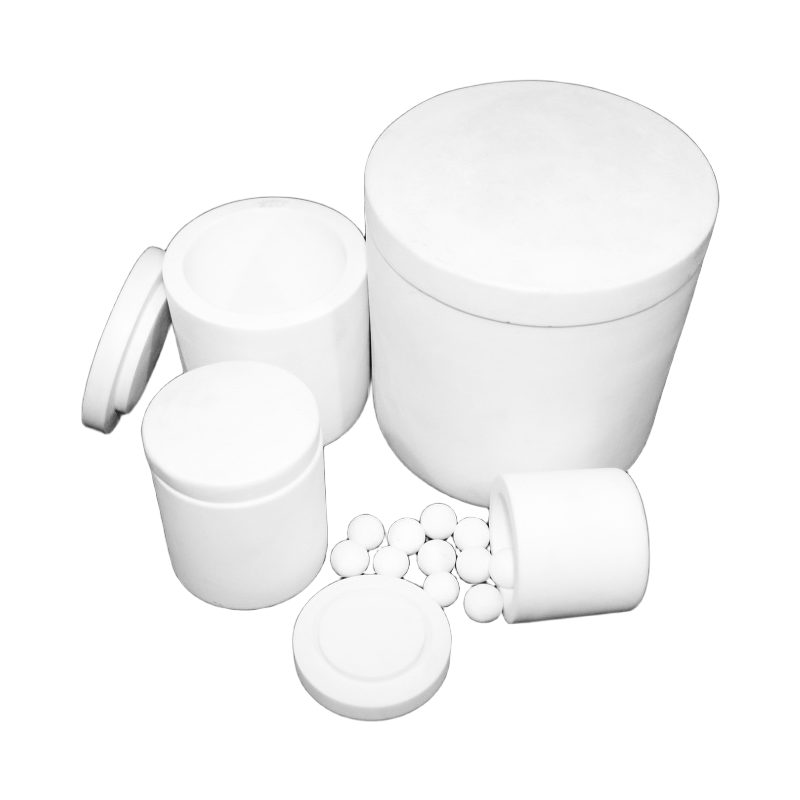
The Class A corundum grinding bowl for planetary mill is a replaceable working chamber in which the sample is kept together with the grinding media during grinding. The glass is installed in the socket of the planetary mill and together with it creates a shock and abrasion effect on the material. Its purpose is to provide a closed volume compatible with the specific mill, withstand contact with the sample and grinding media, and reduce unwanted introduction of impurities to a reasonable minimum. In the catalog TENCAN the product is presented as a separate item "Class A Corundum Grinding Bowl for Planetary Mill". Below is a practical explanation of how to read the properties of such a glass, what restrictions to consider and what to check before purchasing.
What is a corundum grinding bowl and how does it work?
The grinding bowl is not a grinder in its own right. By itself, it only holds the sample and the grinding media; grinding occurs when the planetary disk moves, the glass rotates around its own axis, and the balls interact with the material. Therefore, the properties of the glass cannot be considered in isolation from the mill, the mode, the size of the original sample and the selected grinding media. The same glass under different conditions will give different results.
In a planetary mill, the glass is fixed in a seat and must withstand alternating loads. If the geometry, weight or method of fixation does not match the mill, vibration, imbalance, increased wear of components and non-reproducible grinding are possible. Therefore, the first check when choosing is not the color of the ceramic or the photograph, but compatibility with a specific mill model.
A typical grinding bowl has a body, a lid and a seal, as well as seating surfaces that secure it into the mill. In a specific product TENCAN The cover design, seals and packaging must be checked against the product card and manual. It should not be assumed that any corundum glass is constructed in the same way: different series have different wall thickness, bottom profile, closing method and permissible modes.
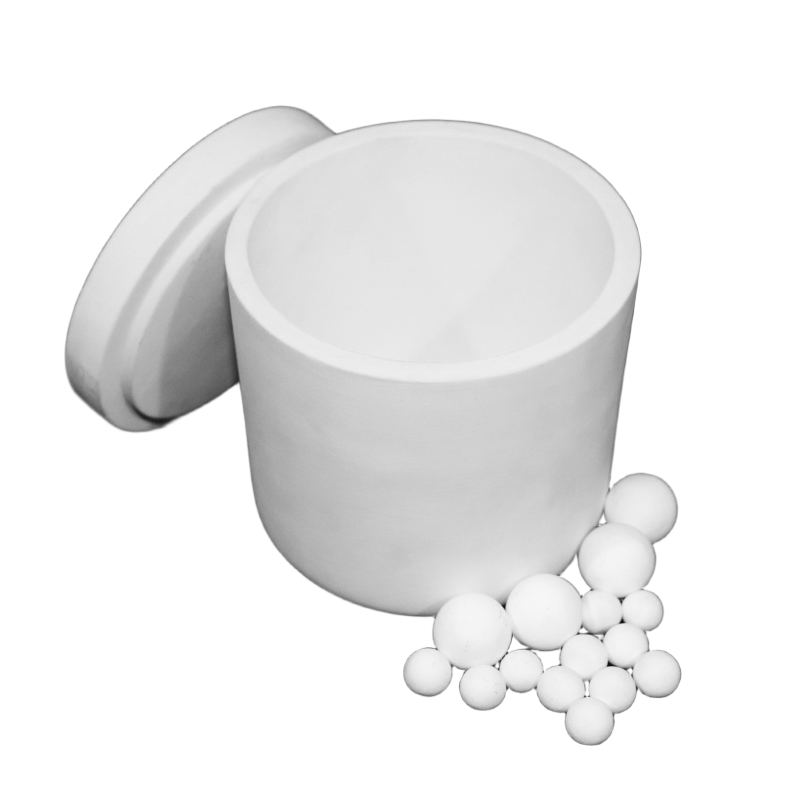
The glass works in tandem with grinding media. Their material, diameter, and number affect impact energy, abrasion, and what contaminants can be introduced into the sample. The corundum cup does not “improve” the grind by itself; it specifies the working chamber material and compatibility restrictions.
Material, wear and contamination
Corundum is a mineral based on aluminum oxide Al2O3. In technical ceramics, corundum products are valued for their high hardness, wear resistance and the ability to work in contact with abrasive powders. Corundum has a hardness of close to 9 on the Mohs scale, so it resists abrasion better than many metals and soft ceramics. But high hardness does not mean chemical inertness, and certainly does not mean a complete absence of contamination.
When grinding, the material of the glass gradually wears out. Corundum particles may enter the sample, especially if we are talking about long-term or high-energy operation, hard abrasive material, large initial fraction or insufficient loading. For analyzes where aluminum or trace amounts of elements are determined, this must be taken into account in advance. For applications where aluminum is not an analytically important component, corundum ceramics are often a reasonable compromise between wear resistance and cost, but the final choice depends on the specific sample.
The degree of wear depends not only on the material of the glass. It is influenced by the hardness and shape of the particles, the size of the grinding media, their density, the ratio of sample to balls, rotation speed, grinding duration, dry or wet mode, as well as the presence of an aggressive liquid medium. Dry grinding often produces a more pronounced abrasive effect, while wet grinding can increase chemical interaction with the fluid and compaction. You cannot transfer the results of one mode to all others.
Class A designation in the product name TENCAN refers to the supplier's nomenclature. It is useful for position identification, but does not replace the analysis of specific properties: ceramic composition, porosity, acceptable media and dimensions. Don't automatically assume that "A" means "completely inert" or "no wear." If impurities are important to the application, request confirmed data from the supplier for the specific batch and application conditions.
Corundum ceramics can be sensitive to strong reagents, especially at elevated temperatures. Therefore, the phrases “acid resistant” or “chemical resistant” without specifying the environment and conditions are insufficient. For unusual solvents, acids, alkalis and hot liquids, a separate check of compatibility with the cup and seal material is required.
Parameters, modes and restrictions
When choosing a corundum glass, it is important to read the parameters correctly. The product card may indicate the nominal volume, internal and external dimensions, weight, type of lid and other data. But even with numbers, you need to understand what they refer to.
Volume, dimensions and loading
The volume of one beaker is not the total volume of all beakers in the mill or the mass of the sample that can be loaded. The working load is always less than the geometric volume, because part of the space is occupied by the grinding media, and the materials need room to move. You cannot determine the load only by photograph or by volume “by eye”. Specific limits depend on the mill, bowl, grinding media and sample properties; they should be taken from the manual or checked with the manufacturer.
They also distinguish between inner diameter, outer diameter, height, wall thickness and weight. External dimensions are important for fit into the mill, internal dimensions are important for the useful volume and movement of the balls, and mass is important for balancing and load on the drive. If the card does not indicate the required value, it needs to be clarified, and not calculated from a perspective photograph. Particular care should be taken when recalculating the volume between glasses of different geometries: the same nominal volume does not mean the same workload.
Dry and wet grinding
Dry grinding is useful when the liquid interferes with subsequent analysis or reacts with the sample. In dry mode, dusting, sticking to walls, electrostatic charge and uneven material supply are more likely to occur. The glass should allow you to close it tightly enough, and cleaning after such grinding requires attention to the edges and corners.
Wet grinding is introduced to improve dispersion, reduce dust and more uniform particle distribution, but it imposes additional requirements for tightness and chemical compatibility. The liquid must not destroy the seal, cause corrosion of fasteners, or react with the sample. After wet grinding, the suspension is removed, the glass is washed with a suitable solvent and dried. It cannot be assumed that since corundum is hard, it will withstand any solvent.
What not to assume
It should not be assumed that a corundum beaker is suitable for any planetary mill, that it does not introduce impurities, that it can be filled “to the top”, or that the parameters of one size are automatically transferred to the entire range. Also, do not confuse grinding with disagglomeration: in the first case, the particles themselves are destroyed, in the second, only the connections between the aggregates. Other equipment principles may be used for disagglomeration and mixing and the grinding bowl does not automatically replace them.
Compatible with mill and grinding media
Planetary mill compatibility is a critical point. The glass must correspond to the seat, fixation method, height, diameter, weight and permissible rotation speed. The planetary mill creates high centrifugal loads; An incorrect cup may cause unbalance, vibration, overheating, or damage to the mounting. Therefore, you cannot choose a glass only by volume: first check that it is generally intended for the desired mill model.
Check the lid and seal separately. They must ensure closure in the selected mode, not interfere with installation, and not be destroyed by contact with the sample or solvent. If the card indicates compatibility with certain series of mills, this is more important than the external similarity of the glasses.
The grinding bodies are picked up together with the glass. For a corundum glass, corundum grinding media can be considered, but this is not the only and not always the best option. Zirconium dioxide balls have a different density and can increase grinding energy, but at the same time increase wall wear and impurity introduction. Steel balls produce metallic contamination, which is unacceptable for some analyses. Agate bodies are softer and are not suitable for all hard specimens. The choice depends on what sample material, what result is needed and what contamination is acceptable.
The number and diameter of grinding media also influence the process. Too large a load leaves little free space, increases temperature and wear; too small may not provide effective grinding. Specific ratios are not universal. They are selected according to the mill manual and tested experimentally, starting with safe modes. General directions of equipment TENCAN you can look at manufacturer's website, but specific compatibility must be confirmed using the product card.
Cleaning, maintenance and selection criteria
Cleaning
After each sample, the beaker is cleaned to prevent particle transfer. Remaining powder is removed with a soft brush or a suitable tool that does not scratch the ceramics. The beaker is then rinsed with a solvent compatible with the beaker material, seal, and sample. Avoid using wire brushes or coarse abrasives as they can damage the surface and increase particle retention. After washing, the glass is rinsed and dried; keep it closed and clean.
For aggressive reagents, separate testing is required. Even if corundum ceramics are resistant to a certain environment, the seal and other elements may be less resistant. Do not mix unknown chemicals in a closed glass or heat it without instructions. Cleaning should not become an experiment with hazardous substances.
Signs of wear
Inspect the body, lip, bottom and seal. Chips, cracks, deep scratches, discoloration, looseness of the surface and loose closure are a reason to replace the glass or contact the supplier. A cracked glass cannot be used: it may break under load. A worn surface is less easy to clean and can increase the transfer of impurities between samples.
Selection criteria
- Analytical task: what elements are determined and whether the addition of aluminum or other ceramic components is permissible.
- Sample properties: hardness, coarseness, abrasiveness, tendency to stick, sensitivity to moisture.
- Required volume and workload: do not confuse the volume of the beaker with the mass of the sample.
- Compatibility with the mill: fit, fixation, weight, permissible speed.
- Grinding media: material, diameter, quantity, permissible contamination.
- Mode: dry or wet, type of liquid, tightness requirements.
- Cleaning and maintenance: surface accessibility, seal resistance, ease of drying.
- Documentation: verified dimensions, materials and limitations, not just the "Class A" title.
It makes sense to compare corundum glass with other materials only based on specific data. It cannot be stated that one material is “better” without specifying the sample, mode and permissible level of contamination.
Frequently asked questions
Can a corundum glass be considered chemically inert?
No. Corundum ceramics are chemically stable in many environments, but are not universal. Resistance is influenced by ceramic composition, porosity, temperature, contact time and medium. Strong reagents and unusual solvents require compatibility testing.
Is it suitable for wet grinding with organic solvent?
This depends on the specific solvent, seal and conditions. An organic solvent may not dissolve ceramics, but seals or contaminants; in addition, vapor pressure and temperature are important. It is impossible to give a general recommendation without a glass passport and mill manual.
Is it possible to place a glass on any planetary mill?
No. You need to check the geometry, weight, fixation method and permissible speed. A glass that looks similar may not fit a particular planetary mill. Compatibility is confirmed by the product card and manual, not by photograph.
How do you know when it's time to replace the glass?
Upon inspection after cleaning: cracks, chips, deep gouges, surface changes, poor closure. If the glass is in doubt, it is better to take it out of service. For critical analyses, the increase in background impurities is also taken into account.
Are grinding media made of the same material required?
Not necessarily. The same material reduces heterogeneity but does not eliminate wear. Sometimes a different grinding media material is chosen if it provides the required grinding energy and acceptable contamination. The decision is made based on the sample, analytical problem and compatibility.
A class A corundum grinding bowl for a planetary mill is an accessory that only works in the correct mill-glass-grinding media-sample system. Its strengths lie in hard ceramics and wear resistance, but its limitations lie in possible contamination, chemical compatibility, and the need for precision fit. The choice begins with an analytical task and a compatibility check, rather than with the promise of complete inertia.