
Semicircular Model Planetary Ball Mill - Laboratory Equipment TENCAN for grinding and preparing powder samples. Its task is not just to reduce pieces of material, but to obtain a representative sample with a controlled particle size distribution for further analysis, mixing or synthesis. In the technological chain, such a mill usually comes after selection and preliminary crushing, but before sifting, pressing, heat treatment or measurements. Other equipment areas TENCAN presented in catalog TENCAN.
The name “semicircular model” refers to the design of a specific device. It does not replace studying the card: the layout, contents of delivery, available grinding bowls and operating conditions must be checked against semicircular model planetary ball mill card, and not deduced from the name. This is especially important because planetary grinding is sensitive to the type of bowl, the mass and size of the grinding media, load and rotation mode.
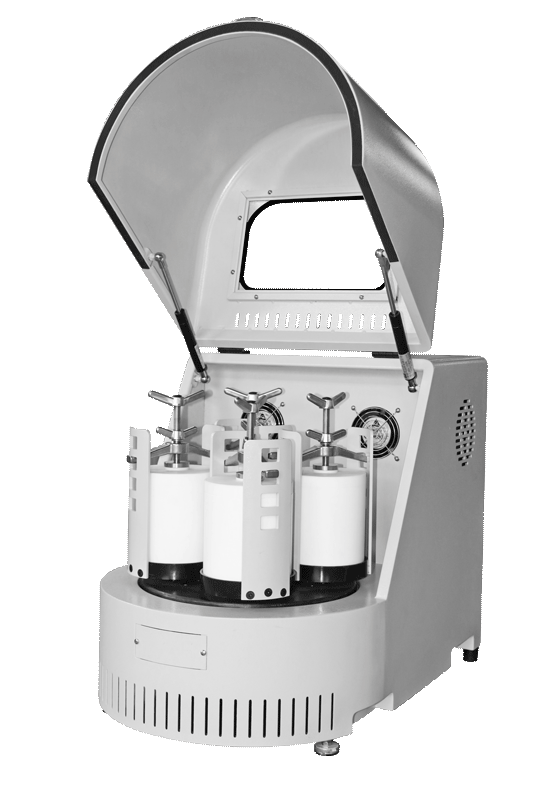
The place of a planetary mill in sample preparation
Preparation of a powder sample rarely consists of a single step. First, the material is selected, dried or stabilized, then the size is reduced, the sample is reduced and brought to a state suitable for analysis. The planetary ball mill occupies the niche of fine laboratory grinding: it allows you to work with small batches of material and quickly switch from one mode to another. However, this is not a universal replacement for an industrial mill and does not automatically guarantee a given size.
In laboratory practice, planetary grinding is used when it is necessary to obtain a fine powder from brittle, moderately hard or pre-ground materials, and also when reproducibility of preparation is important. For ores, minerals, ceramics, glasses, slags, catalysts and composites, the choice of mode will be different. There is no one “laboratory mode” that is equally suitable for all samples: even materials with the same name can differ in hardness, moisture content and tendency to agglomerate.
A planetary mill should not be confused with a bead mill, roller drum mill or roller crusher. They all reduce particle size, but use different mechanisms, different working bodies and different applications. The bead mill is more often associated with liquid dispersions and small grinding media, the roller mill is associated with a rotating drum, and the roller crusher is associated with the destruction of material between the rolls. Planetary grinding differs in the trajectory of movement of the glasses and grinding bodies, therefore the selection criteria here are different.
Working principle: what happens inside the planetary mill
In a planetary ball mill, the grinding glasses are fixed in a holder and rotate in two movements at once: around its own axis and around the common axis of the apparatus. Due to this, the grinding bodies inside the glass move along a complex trajectory, collide with the walls and with each other, abrade and destroy the material. Depending on the mode, impact or abrasion predominates, but in practice both mechanisms are usually present.
Energy is transferred to the sample through the grinding media and the walls of the beaker. Therefore, the result is determined not only by the rotation speed. What matters are the diameter and density of the balls, their number, the ratio of the mass of the balls and the sample, the volume of the glass, the degree of filling, the properties of the material and the grinding time. If you change one parameter, not only the size may change, but also the shape of the particles, the degree of agglomeration and the possible introduction of impurities.
Planetary grinding can be dry or wet. During dry grinding, the material is in an air environment; when wet, a suitable liquid is added, which affects the dispersion, temperature and behavior of the particles. Wet grinding is not always better than dry grinding: the choice depends on subsequent operations, chemical compatibility of the liquid with the sample, and drying requirements. Also, chopping and mixing are not the same thing. The mill can mix the components, but the uniformity of the mixture must be confirmed separately, and not assumed based on the fact of grinding together.
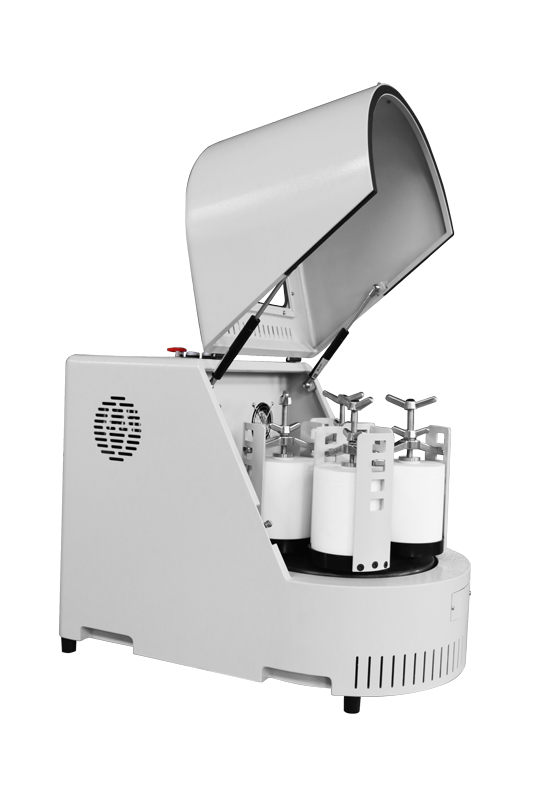
Device and components that are important when choosing
The planetary mill consists of a housing, a drive, a cup holder, a control system and protective elements. For the user, not only the declared functions are important, but also the convenience of daily work: access to glasses, fixation, tightness, cleaning, noise, vibration and stability of the device. Laboratory equipment operates in repetitive cycles, so ease of maintenance is often as important as a single feature.
Grinding glasses are a replaceable element that is in contact with the sample. Their material, volume, geometry and condition of the seals influence the process. You cannot transfer the characteristics of one glass to the entire mill or assume that any glass fits any model. Compatibility is determined by mount design, dimensions, load capacity and manufacturer documentation. If the product card does not contain confirmation of compatibility, it must be requested separately.
Grinding media are also part of the working system. Balls of different diameters have different effects on the material: larger ones produce a greater impact component, smaller ones produce more abrasion and contact. The density of the ball material affects the transmitted energy, and wear affects the possible introduction of impurities. Therefore, the selection of balls does not come down to the phrase “the more, the better.” It is necessary to take into account the hardness of the sample, acceptable contamination, the volume of the glass and the grinding task.
How to read specifications correctly
Glass volume, total volume and loading
In descriptions of planetary mills, different volumes are often found: the volume of one glass, the total volume of several glasses, the recommended loading and the mass of the sample. These are not interchangeable quantities. The volume of the glass is a geometric capacity; the working load is usually less than this, because part of the space is occupied by grinding media and there must be free volume for movement. The mass of the sample depends on the density of the material, so the same volume of different powders gives different masses.
Productivity over time is another separate dimension. It depends on the cycle duration, the number of glasses, the load weight and the permissible mode. If the card does not indicate the workload for a specific configuration, you cannot substitute the value “by analogy” with another model. For calculations, it is better to request confirmed data from the manufacturer and take into account that the actual load may be less than the catalog capacity.
Rotation speed and speed ratio
For a planetary mill, not only the absolute rotation speed is important, but also the ratio of the speeds of the carrier and glasses. It affects the trajectory of the grinding media and the intensity of the impact. However, the number itself doesn't say much without specifying the material, glass, balls and time. A regime that is effective for one powder may lead to overheating, agglomeration or wear for another.
Increasing the speed does not guarantee a finer grind. Beyond a certain point, heating, fouling, and particle aggregation may increase rather than beneficial grinding. Therefore, in laboratory practice, modes are selected stepwise and all conditions are recorded: load, type of glass, balls, time, environment. Reproducibility is more important than a single result.
Time, temperature and cooling
The duration of grinding depends on the task and the properties of the material. There is no universal time that can be recommended for all samples. During the process, the mill and sample heat up; If the documentation does not state special cooling, the process should not be called cryogenic. Conventional air cooling and liquid nitrogen cooling are different solutions. The temperature of the working space of the installation is not equal to the measured temperature of the sample, and the temperature of the beaker wall does not necessarily coincide with the temperature of the powder.
If the material is sensitive to heat or oxidation, this should be discussed separately. In some tasks, shortening cycles, pausing between cycles, or otherwise organizing the process helps, but specific measures must comply with the operating instructions and the properties of the substance. The regime found for one material cannot be transferred to a reactive or toxic sample without a risk assessment.
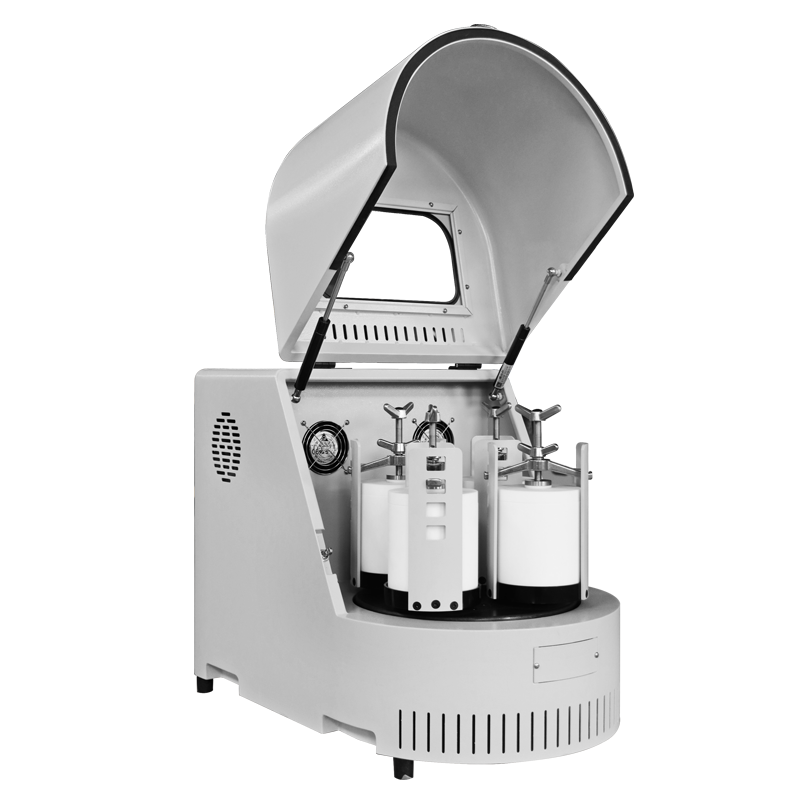
Materials, environment and limitations
The choice of glass material and grinding media is a compromise between wear resistance, chemical inertness, cost and acceptable contamination. Stainless steel is strong and technologically advanced, but can introduce iron and other elements; Zirconium dioxide, corundum, agate, tungsten carbide, polymers and other materials have their limitations. None of them provide “zero pollution.” Even inert material wears out, and wear products end up in the sample.
For soft materials, sometimes it is not the abrasion ability that is more important, but the preservation of the nature of the sample. For abrasive powders, wear of the cup and balls comes to the fore. For materials prone to sticking, cleaning and media selection. For samples sensitive to moisture or oxygen - tightness and organization of work. These factors are discussed before choosing a model, otherwise the equipment may be technically sound, but unsuitable for a particular task.
It is worth separating grinding bowls for planetary mills and drums for roller mills. In the catalog TENCAN presented, for example, stainless steel grinding drum for roller mill. This is not the same as a beaker for a planetary mill. Even if both products are made of stainless steel, the fastening design, geometry and loading conditions may differ. It is not possible to automatically transfer the drum to the planetary model; compatibility must be confirmed by documentation.
Disagglomeration should not be confused with grinding of primary particles. If the powder consists of aggregates, gentle action may destroy the bonds between them, but not reduce the crystallites themselves. In this case, the result of the size measurement depends on the method of dispersion before analysis. Therefore, discussions of “final size” should always include the measurement method and preparation conditions.
Selection criteria and compatibility
Selecting a planetary mill starts with the task, not with a list of functions. It is necessary to understand what material will be crushed, what the initial particle size is, what sample mass is required, whether contamination is acceptable, whether the process will be dry or wet, and what operations will follow next. Then check which configurations and accessories are confirmed for a specific model. The product card is a starting point, but for non-standard materials and modes, consultation with the manufacturer is required.
Compatibility includes several levels: mechanical fastening of the cup, permissible volume and weight, seal material, resistance to the environment used and operational safety. You cannot choose a glass only by volume or only by material. Also, one cannot assume that a more powerful mill will automatically produce a finer powder. The result is determined by the entire system “apparatus - glass - grinding media - sample - mode”.
For the laboratory, repeatability, ease of cleanup, and the ability to keep records of each run are important. If the equipment will be used by different employees, it is worth determining in advance how the parameters are recorded and how the condition of the glasses and balls is checked. Wear and tear is a normal part of the job, but must be controlled. Cracks, chips, deformed seals and discoloration of the material may be signs that the process needs to be revised.
Before ordering, it is useful to clarify: what bowls and grinding media are available for the selected model, what volumes are considered working, what materials are confirmed, what temperature and environmental restrictions apply, how cleaning is organized and what safety measures are provided. If the answer to a question is not on an open card, this is not a reason to come up with a description. It is better to record the condition that needs to be confirmed.
Questions and answers
Is this a cryogenic mill?
Only if the documentation specifically states liquid nitrogen cooling or a corresponding cryogenic design. Conventional air cooling does not make the process cryogenic, even if the case heats up less. For sensitive materials, it is necessary to separately check the sample temperature and the permissible mode.
Is it possible to put a drum from a roller mill on a planetary mill?
Not automatically. The drum for the roller mill and the bowl for the planetary mill are different accessories. Compatibility is determined by mounting, dimensions, load capacity and manufacturer's instructions. The title of the material in itself does not confirm this.
How much sample should I load?
Depends on bowl volume, grinding media and confirmed workload. The total volume of the glass cannot be equated with the mass of the sample. For a specific configuration, you need to use the manual or check the permissible load with the manufacturer.
Why can’t the final size be announced in advance?
It depends on the material, initial size, medium, time, grinding media and measuring method. Catalog minimums, if stated, apply to specific conditions and do not guarantee the same result for any sample. Size is confirmed by measurement, not by promise.
What is important to remember
Semicircular Model Planetary Ball Mill TENCAN — a laboratory instrument for fine grinding and preparation of powders, and not a universal device with a predetermined result for any material. Its operation is described through the mechanism of movement of the glasses, grinding media, loading, medium and mode. The semicircular design is a characteristic of the model, and not a replacement for technical documentation. Before choosing, you need to check the product card, confirm the compatibility of the bowls and grinding media, evaluate the permissible contamination and operating conditions.
A wise choice begins with a sample and a task. If the material, mode or affiliation is in doubt, it is better not to transfer the controversial meaning from another description, but to clarify it. This approach reduces the risk of sample preparation errors and makes laboratory results comparable between runs.