
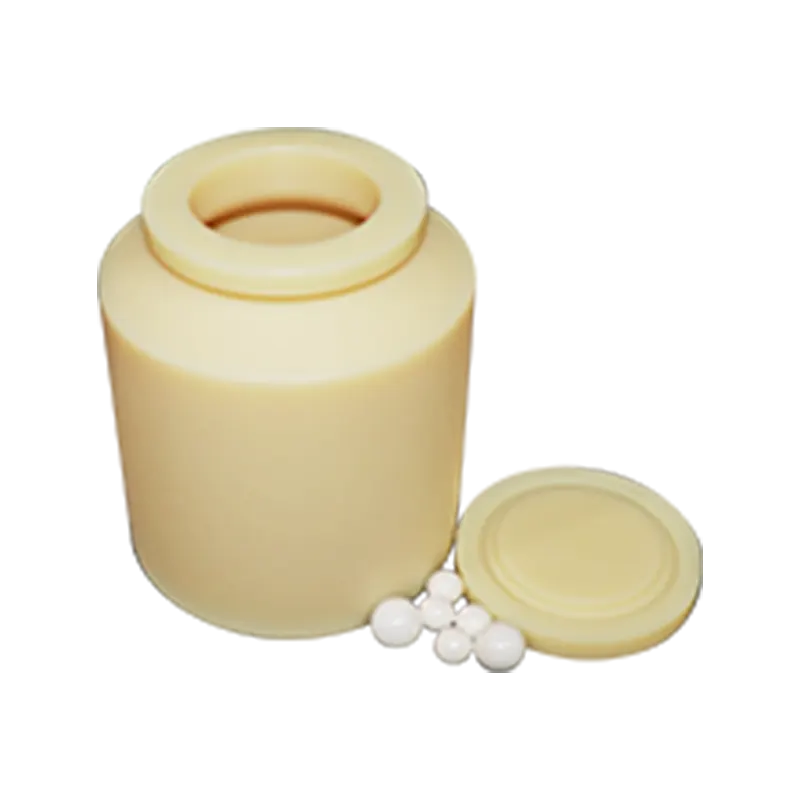
The nylon grinding drum is a replacement grinding vessel for the roller ball mill. In such a mill, the drum lies on drive rollers and rotates around its axis, and the grinding bodies inside roll and fall, crushing the sample and mixing it. Nylon drum TENCAN, presented in product card, are classified as polymer grinding equipment: it is considered where it is necessary to reduce the contact of the sample with the metal and where the properties of nylon are compatible with the sample, medium and grinding mode. This is not a universal replacement for a steel or ceramic drum and does not guarantee the absence of contamination: the polymer also wears out and requires condition monitoring.
Function and place in the grinding process
In a roller mill, the drum is a passive part: the movement is transmitted to it by the rollers, and not by its own drive. Inside the cavity there is a sample and grinding media. When the body rotates, they rise and fall off; grinding occurs due to impact and abrasion. Therefore, the result depends not only on the drum material, but also on the diameter and mass of the grinding media, degree of filling, grinding time and sample properties. The drum in this scheme sets the boundaries of the working chamber, affects the nature of the movement of the load and the contact of the sample with the wall material.
The roller drum should not be confused with the grinding bowl of a planetary mill. The planetary cup is fixed in the socket and set into complex planetary motion; it has a different geometry, mounting and loading conditions. Also, mixing equipment cannot be considered a substitute for a mill: mixing is not the same as grinding, and compatibility with a drum does not follow from the mere presence of both products in the catalog.
Dry and wet grinding have different requirements. In the dry process, dusting, clumping, electrostatic charge and complete discharge are important. When wet, liquid appears: it can change the viscosity of the suspension, interact with the polymer and affect cleaning. The possibility of wet grinding in a nylon drum is determined by the specific sample and medium; Without checking chemical resistance and compatibility, this mode should not be considered standard.
Design and working principle
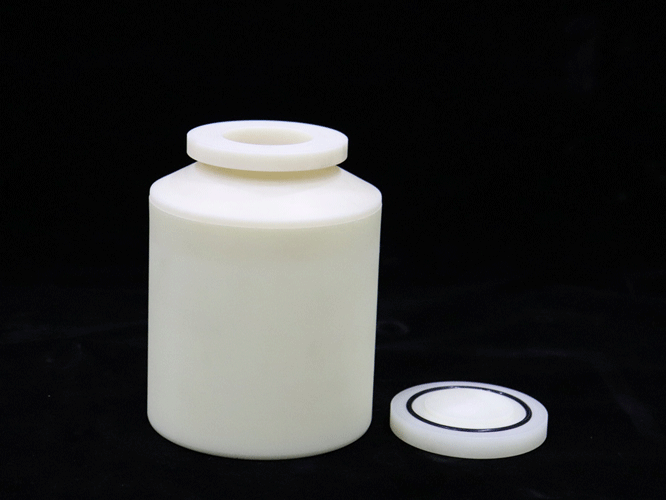
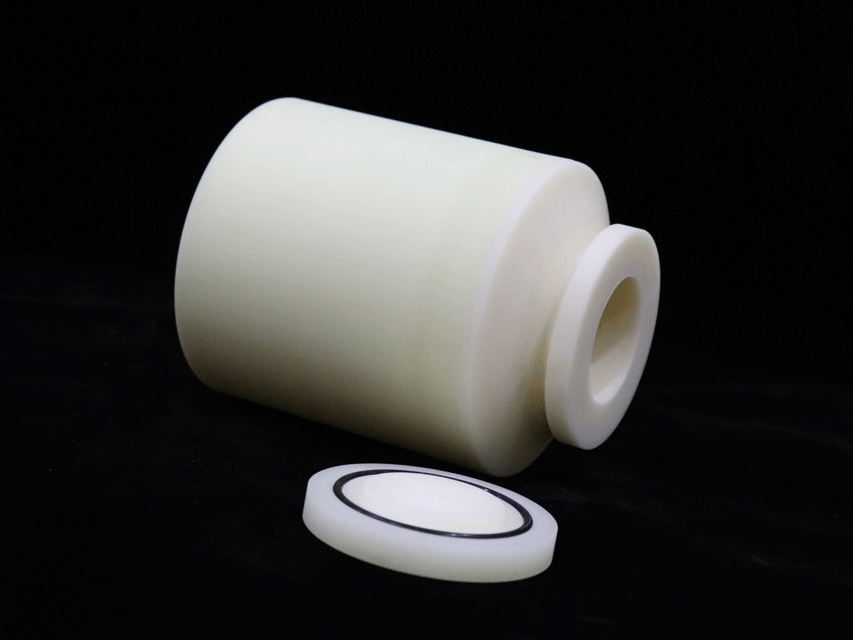
In general, a grinding drum consists of a body with an internal cavity, a cover and a seal that limits the spillage of sample and grinding media. For roller mills, the outer geometric surface on which the drum contacts the rollers, the weight of the loaded drum, and the reliability of the lid fixation are important. Specific configuration of nylon drum TENCAN is given in the current card; you should not attribute to it a lining, a cooling jacket or other components that are not there.
The working principle is simple: the mill rotates the drum, the loading inside moves from the lower position to the upper and back. The higher the speed and the greater the mass of the load, the more intense the impact, but the higher the heating and wear. This is especially important for a polymer drum: excessive loading with large and heavy balls increases the load on the wall and lid. The mode is selected so as to ensure the movement of the grinding media, but not to turn the test into accelerated wear of the equipment.
Cover and seal
The lid is not a minor detail. It is this that holds the sample and grinding media, absorbs part of the load and determines the ease of cleaning. Before each use, check the fit of the lid, the condition of the seal, and the absence of distortion and contamination on the edges. If the seal has lost elasticity, is damaged or does not provide a tight seal, further work requires replacement of the part or consultation with the supplier; Leaks cannot be compensated for by increasing tightening without the manufacturer's instructions.
Material, wear and contamination
Nylon is a polyamide material that is valued in grinding equipment for its combination of relatively low density, elasticity and resistance to a number of media. Compared to steel, tungsten carbide or oxide ceramics, it is softer; this can reduce the abrasive effect on the grinding media, but does not eliminate the wear of the drum itself. The polymer wall is capable of abrasion, scratching and accumulation of contaminants in micro-irregularities. Therefore, the expression “nylon does not introduce impurities” is inaccurate: it can introduce wear particles, as well as carry over contaminants from a previous sample if not properly cleaned.
How does wear appear?
- discoloration or appearance of matte areas on the inner surface;
- risks, scratches, dents and traces of grinding media;
- loss of geometry, ovalization or deformation of the edge;
- wear of the seal, cover and seating surfaces;
- the appearance of cracks, delaminations or stuck particles.
Wear can be easily monitored in good light after cleaning and drying. If the condition of the surface is in doubt, it is better to remove the drum from critical experiments. A small scratch may be safe for coarse grinding, but is unacceptable where particle size distribution or impurities are controlled. The decision is made based on the requirements of the methodology, and not just on appearance.
Sample contamination: what to consider
The drum's contribution to contamination depends on the hardness and abrasiveness of the sample, the duration of grinding, the mass and material of the grinding media, as well as the cleanliness of the equipment. Soft polymers are usually considered for samples where severe metallic wear cannot be tolerated, but they are not always suitable for hard abrasive powders. A separate issue is chemical compatibility: nylon can absorb moisture and some substances, and aggressive solvents can change its properties. Without documentation for a specific material, it is impossible to assign temperature, medium and contact time “by analogy”.
Volume, loading and reading characteristics
When describing grinding equipment, it is important to distinguish between the geometric volume of the drum, the useful workload, the mass of the sample and the mass of the grinding media. The geometric volume is the capacity of the cavity; it does not equal the amount of material that can be effectively crushed. The working load is usually smaller and depends on the bulk density of the sample, the size of the balls and the allowable filling. It is impossible to transfer the volume figure to the mass of the sample without taking into account the density: 100 ml of powder of different bulk densities will give different masses.
If the card indicates a volume, check whether it refers to a single drum or a set, whether it is nominal or actual. Diameter, length, wall thickness, weight and type of seal are read together: the name “nylon drum” alone cannot determine whether it will fit a particular mill. Also, you should not deduce the final size only from the volume. The particle size distribution depends on the initial size, material, medium, grinding media, time and method of measurement; the typical catalog minimum is not guaranteed for any sample.
Compatible with roller mill and grinding media
Compatibility starts with a mechanical fit. The drum must match the roller mill in terms of outer diameter and length, weight, distance between the rollers and method of fixation. A drum that is too heavy or incorrectly centered increases the load on the drive and rollers; too light may behave unstable. The cover must ensure tightness in the working position, and the outer surface must ensure reliable contact with the rollers. These parameters are checked against current cards on website TENCAN and confirmed with the manufacturer, and not selected from a photograph.
Grinding media are selected not only by diameter, but also by material, density, hardness and chemical compatibility with the sample. In a nylon drum, heavy and large balls increase the load on the wall and the risk of wear; Small balls give more contacts, but transmit the impact worse. The material of the balls makes its own contribution to contamination: steel, ceramic, zirconium dioxide, agate or tungsten carbide behave differently. It is impossible to automatically transfer grinding parameters worked out in a steel drum to a polymer drum: separate selection is required.
The nylon drum for a roller mill is not a universal bowl for a planetary mill. Landing dimensions, loading dynamics and strength requirements vary. Just because a mixer is listed in a catalog does not mean it is suitable for grinding or that it can be used with that drum. Mixing, crushing and grinding are different operations with different mechanisms of action.
Cleaning, selection and restrictions
Cleaning affects the result as much as the material. After work, the drum is freed from grinding media and samples, then the residue is removed with a soft brush or sponge, washed with a suitable detergent and dried thoroughly. Aggressive solvents, abrasive powders and high drying temperatures are only permissible if they are approved for the specific material. Do not dry the nylon drum with an open flame or uncontrolled heating equipment. It is helpful to keep separate labeling or cleaning logs for different samples to avoid transferring contamination.
When choosing, look at several practical points. First, the sample is assessed: hardness, abrasiveness, tendency to stick, moisture, chemical activity and permissible level of impurities. Then check the mode: dry or wet grinding, required fineness, type and size of grinding media. Mechanical compatibility with the mill and cleanability are then confirmed. For critical analyses, it is determined in advance how wear will be monitored and when the drum will be replaced. Nylon drum TENCAN V product card should be considered as a specific tool and not as a one-size-fits-all solution for all powders.
Brief questions and answers
When is a nylon drum appropriate?
It is considered for applications where a polymer container is needed and where the softness of the wall material does not conflict with the sample. It may be suitable for samples sensitive to metal contamination, but only after checking for wear and chemical compatibility. For hard abrasive materials and high temperatures, it is not an automatic choice.
Can it be used for wet grinding?
Only if compatibility with the liquid and cleaning conditions have been confirmed. The liquid changes the load, viscosity and behavior of the sample; the polymer can swell or absorb components. Without manufacturer's data, wet mode cannot be considered standard.
How is it different from the planetary mill glass?
First of all, the installation location and the nature of the movement. The drum for the roller mill rotates on rollers, and the planetary cup is fixed in the socket and set into planetary motion. Their geometry, cover and strength requirements are different; interchangeability is not intended.
How to reduce the risk of contamination?
Use clean equipment, monitor wear, do not share drums with incompatible samples without proper cleaning, and check seal condition. The polymer wall does not provide “zero” contamination, so separate control is required for trace analysis.
Is it enough to select a drum by volume?
No. It is necessary to check the external dimensions, weight, fit on the rollers, cover, seal, permissible loading and compatibility with grinding media. Volume is only one parameter, and the geometric volume is not equal to the working mass of the sample.