
The nylon grinding bowl for a planetary mill is a replaceable working chamber in which the sample and grinding media are subjected to shock and abrasion during the complex rotation of the planetary disk. It is located in the sample preparation chain between the mill drive and the powder itself: the geometry, material and condition of the beaker determine how reproducibly grinding, disagglomeration or mixing will take place. Such a glass is used in laboratory practice when working with small portions, monitoring the material of contacting surfaces and taking into account the possible transfer of impurities.
What is a nylon grinding bowl and where does it work?
In a planetary mill, the glass is fixed on a rotating disk, and the glass itself receives additional rotation in the opposite direction. Inside the chamber, the grinding media repeatedly collides with the material and abrades it. The glass separates the sample from the drive, holds the grinding media and sets the boundaries of the working area. Therefore, it cannot be considered as a secondary container: fit, tightness, wear and wall material affect the grinding mode and the purity of the sample.
In the catalog TENCAN presented precisely nylon grinding bowl for planetary mill. Before using a specific design, you need to check it with the mill model and the conditions of the task, and not transfer the properties of one glass to the entire assortment.
The nylon grinding bowl should not be confused with the grinding drum of a roller mill, the chamber of a bead mill, or the working body of a crusher. These are different devices with different dynamics, mounting and type of grinding medium. Even if the containers are similar in appearance, interchangeability does not occur automatically.
Design and working principle
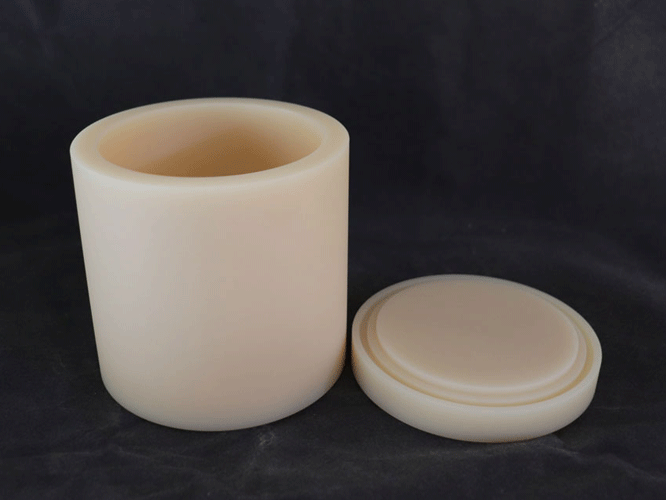
A typical grinding bowl includes a body, a cover, a seal and fastening elements. For planetary mills, not only the internal volume and shape are important, but also the external mounting dimensions, the method of fixation, the ability to install the required number of glasses and the compatibility of the lid with the selected mode. If the lid or seal is chosen incorrectly, liquid loss may occur during wet grinding, and dust and contamination of the working chamber may occur during dry grinding.
The grinding bodies inside the glass receive energy from the movement of the walls. As a result, impacts and friction are combined: the former has a stronger effect on coarse grinding, the latter on regrinding and deagglomeration. The nylon glass does not create this energy itself; it must withstand dynamics, maintain geometry and not introduce unwanted changes into the sample. Therefore, the choice of bowl material and grinding media is considered together and not separately.
When dry grinding, it is important to consider dust, buildup and heat. With wet grinding, the compatibility of the liquid with the glass material, tightness and subsequent cleaning come to the fore. Wet grinding is not always better than dry grinding: it can change the aggregation of particles, introduce a liquid phase and require additional drying. Mixing is also not the same as grinding: in one case it is enough to distribute the components evenly, in the other it is necessary to change the particle size distribution.
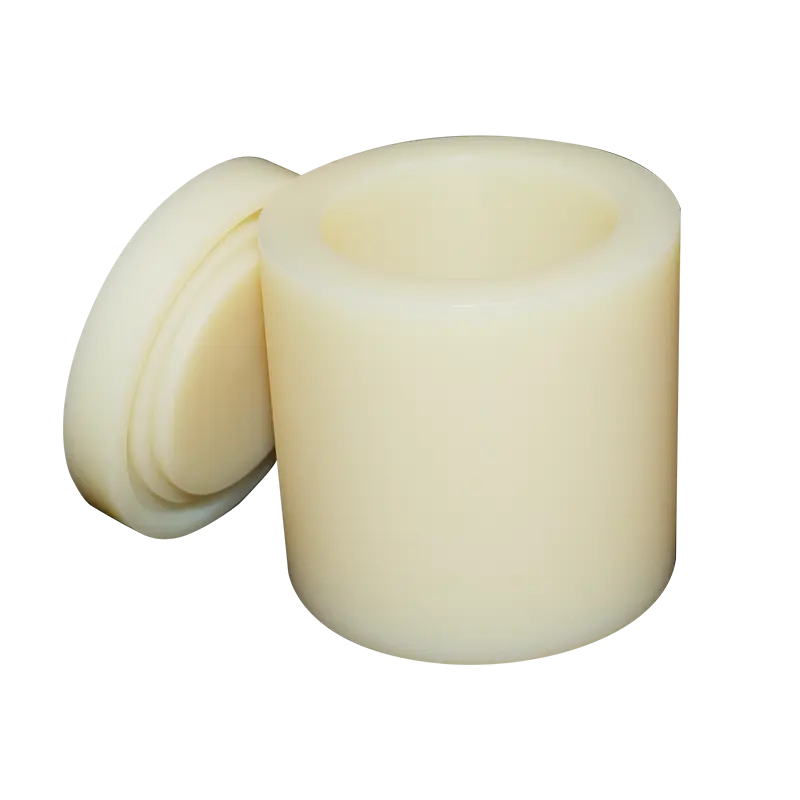
Nylon as a material: possibilities and limitations
Nylon is a polyamide. In grinding bowls, the polymer material is not considered as a universal replacement for steel, ceramics or tungsten carbide, but as one of the options for tasks where moderate abrasiveness of the contact, the mass of the unit and the nature of the interaction with the sample are important. Specific properties depend on the brand of polymer, the design of the glass and operating conditions, so general ideas about nylon cannot be converted into a guarantee for any sample.
The practical advantage of a polymer cup is due to the fact that it can be convenient when working with materials that are sensitive to more severe grinding media. However, this does not mean there is no wear. The polymer is capable of scratching, swelling, absorbing moisture and gradually losing its geometry. Abrasive powder, long grinding and high-energy operation accelerate wear. As a result, particles of the glass material may be introduced into the sample - this risk must be assessed separately for each sample.
There is no “zero pollution” just because a glass is called polymer. Complete chemical inertness and suitability for all solvents cannot be promised without testing. Nylon products may behave differently in contact with acids, alkalis, alcohols and other media; Some effects do not appear immediately, but after swelling or changes in size. The temperature range is also not universal: it is specified for a specific design, and is not derived from the word “nylon”.
- The material of the cup is assessed along with the hardness and abrasiveness of the sample.
- For moisture-sensitive samples, moisture sorption and tightness are considered separately.
- For wet grinding, check the compatibility of the liquid with the body, lid and seal.
- For long or intensive grinding, wear and possible introduction of impurities are controlled.
If the product card does not contain the required parameter - for example, the exact volume, size or medium recommendation - the value should not be guessed. It is more correct to formulate the condition that needs to be clarified with the manufacturer, and not turn the assumption into a characteristic.
Compatible with planetary mill and sample
Compatibility starts with mechanical testing. You need to make sure that the glass is suitable for the specific planetary mill model in terms of seating dimensions, fastening, number of positions and permissible loading. Even the correct material does not compensate for an incorrect fit: misalignment, insufficient fixation or an unsuitable cover pose the risk of damage to the assembly and loss of the sample.
- Check the mill model and the design of the glass against the documentation.
- Check the external dimensions, method of fixation and compatibility of the cover.
- Separate the volume of one glass, the total volume and the workload.
- Do not exceed the reasonable weight of the sample and grinding media unless directed by the manufacturer.
- Assess whether the sample material will react with the polymer or liquid.
- Consider cleaning between samples and monitoring for carryover of contaminants.
A nylon planetary mill cup should not be automatically considered compatible with a heavy duty vibratory ball mill. Vibrating equipment has different dynamics, different mountings and different requirements for the working chamber. The similarity of the names “ball mill” does not prove interchangeability. For the same reason, it is impossible to transfer the parameters of one glass to drums for roller mills or to chambers of bead mills.
Pattern compatibility is a separate issue. For abrasive powder, wall wear and possible material transfer are important; for wet material - sealing and cleaning; for a mixture of components - the absence of an undesirable reaction with the polymer. If the sample is hazardous, toxic or requires special conditions, general selection recommendations do not replace the operating instructions for a specific installation.
How to read characteristics and choose a glass
The characteristics of the glass must be read in the context of the entire system. The volume of one glass is not equal to the total loading volume of the mill. The workload includes grinding media and sample, not just free space. The mass of the sample and the productivity over time are different quantities. Finally, the final particle size depends on the initial particle size, material, grinding medium, mode and method of measurement; the typical catalog minimum is not guaranteed for any sample.
When choosing a glass material, it is useful to go from limitations, not from habit. If the main risk is metal contamination, consider ceramic or polymer, but each option has its own wear and tear. If abrasion resistance is important, harder materials are evaluated, but they may be less easy to clean and more expensive. If the sample is sensitive to moisture, the polymer cup requires separate testing for sorption and tightness. There is no universal “best” material: there is material suitable for a specific sample and mode.
Grinding media are selected compatible with the glass and sample. Too large or heavy bodies increase the load on the walls and fastenings; too small may not be effective for coarse material. The material of the grinding media also contributes to possible impurities. It cannot be said that a particular glass will withstand any regime just because it is intended for a planetary mill.
- Formulate the task: grinding, disagglomeration or mixing; dry or wet process.
- Check the compatibility of the glass with the mill model and mounting.
- Match the beaker material with the sample, liquid and acceptable level of impurities.
- Select grinding media based on material, size and load.
- Assess cleaning, drying, and risk of contamination transfer between samples.
- Plan periodic inspection and replacement of worn elements.
General directions of equipment TENCAN are given on manufacturer's website. For a specific task, what is more important is not the title of the section, but the confirmed compatibility of components and materials.
Wear, cleaning and common issues
The polymer cup wears out gradually, so its condition is checked before and after work. Signs of deep scratches, discoloration, loss of shape, damage to the seal, or a difficult-to-seat lid may indicate the need for replacement. Small changes are not always dangerous, but when working with sensitive samples, it is better not to accumulate uncertainty.
Condition monitoring and cleaning
After the sample, the beaker is cleaned in a manner compatible with the body and seal material. Usually start with dry removal of residues with a soft instrument, then apply a suitable solvent and dry if necessary. Abrasive powders, metal brushes and hard scrapers can damage the surface, so they are used only if they are approved. You cannot dry the glass at any high temperature: the heat resistance of a specific design must be specified by the manufacturer.
- Inspect the housing, cover and seal before each load.
- Do not use incompatible solvents or aggressive media without checking.
- Do not use metal scrapers to remove stuck powder.
- Keep the glass protected from deformation and contamination.
- Maintain a record of samples if cross-contamination control is important.
Questions and answers
Can I use a nylon cup for wet grinding?
This depends on the compatibility of the fluid with the specific polymer, bonnet and seal, and the tightness of the assembly. Without confirmation for the selected medium and mode, wet grinding should not be considered a standard application.
How is a nylon glass different from a ceramic or metal one?
Wear, weight, resistance to abrasive and the nature of possible transfer of impurities differ. The polymer is not necessarily “cleaner”: it can be scratched and absorb substances. Ceramics and metal also have their limitations, so the choice is made according to the sample and conditions.
Is this glass suitable for a vibration or drum mill?
Only with direct confirmation from the manufacturer. Planetary, vibration and roller mills have different mountings and dynamics. External similarity of the container does not prove compatibility.
How do you know when it's time to replace the glass?
The basis is inspection and stability of operation: damage to the surface, poor fit of the lid, wear of the seal, signs of deformation or doubts about the purity of the sample. If the condition interferes with reproducibility, the beaker is taken out of service.
The nylon grinding bowl is a part that links the mill mode, the properties of the sample and the purity of the sample preparation. It is chosen not by one big word in the name, but by compatibility with the device, material, wear and cleaning conditions. This approach allows us to maintain the reproducibility of laboratory work and not attribute properties to the glass that it does not have.