
A muffle furnace (chamber furnace) is equipment for the heat treatment of materials in a closed chamber separated from the heating elements. The chamber, or muffle, defines the working space in which the sample receives heat primarily from the hot walls, and not from direct contact with the coil or heating element. In the technological chain of material preparation, the oven takes place after grinding, mixing and, if necessary, pressing, but before cooling, weighing and analyzing the sample. Typical tasks include sintering, annealing, calcination, ashing and drying at controlled temperatures. In the catalog TENCAN the furnace belongs to a series of sintering equipment; her card is available here: muffle furnace (chamber furnace).
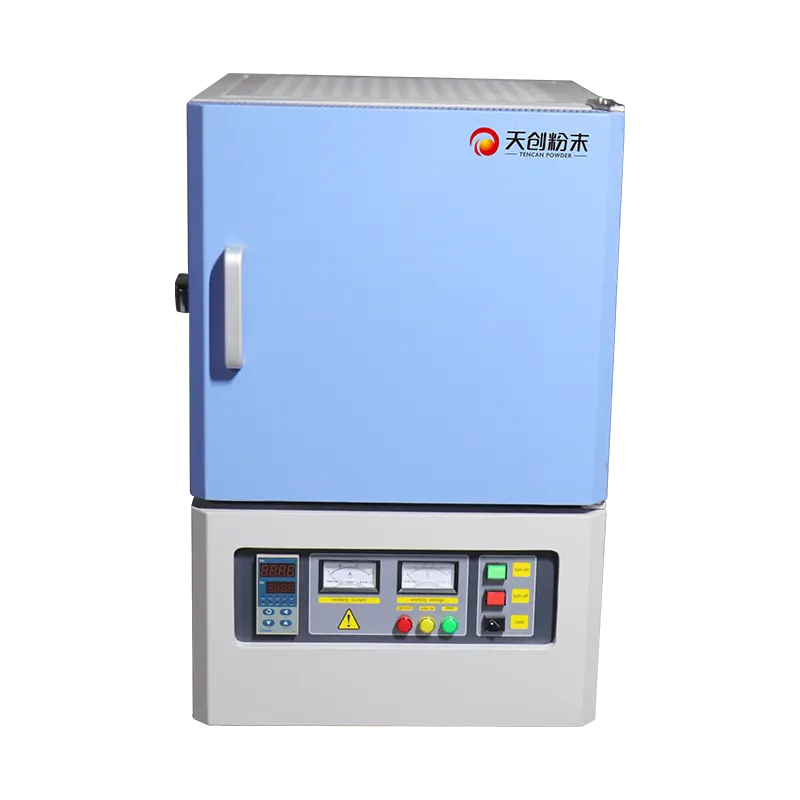
What is a muffle furnace and where is it located in the technological chain
Heat treatment is only one stage of working with a material, and its result depends on what happened before. The usual sequence is: sampling, crushing and grinding, homogenization, sometimes molding, then heating in an oven, controlled cooling and finally measuring properties. The chamber furnace covers tasks related to heating: removal of moisture and technological binders, phase transformations, sintering and compaction of powder blanks, changing the crystal structure, simulating high-temperature operation.
When selecting equipment, it is useful to immediately separate similar categories. An air-atmosphere chamber furnace is not a tube furnace, where the sample is contained in a tube and can be purged with gas, nor is it a vacuum furnace. It also does not replace a forced convection drying oven, which is designed for moderate temperatures and uniform airflow. Before comparing models, the main question is formulated: is a controlled atmosphere or vacuum needed, or is heating in air sufficient?
Within the heat treatment series, equipment is distinguished by chamber design, temperature range, workspace volume and control system. Numerical values refer to a specific model and are indicated on its card; It is impossible to transfer the parameters of one furnace to the entire line, just as it is impossible to derive them from general considerations.
Design and principle of operation of a chamber furnace
Structurally, a muffle furnace consists of several functional groups: an outer casing, a layer of thermal insulation, a working chamber with lining, heating elements, a temperature sensor, a control unit with a regulator and a door with a seal. Some versions provide a channel for the removal of gases formed when the sample is heated. Each node affects which modes are allowed and how long the equipment maintains its performance.
Chamber, lining and thermal insulation
The material of the working chamber determines the temperature limit, resistance to cyclic heating and the likelihood of interaction with the sample. Fiber ceramics and other refractory materials provide thermal insulation, but remain consumable: over time, they lose their properties, especially with sudden temperature changes. A practical conclusion is that the working chamber should not serve as a stand. The sample is placed on a tray, crucible, or support material compatible with the sample and the process temperature.
Heating elements and heat transfer
Heating elements are located along the walls of the chamber, sometimes also on the roof and floor. Heat is transferred by radiation and convection, so the temperature at the walls and in the center, at the door and in the depths of the chamber may vary. Hence two rules of thumb: do not fill the chamber entirely and do not place the sample close to the heaters. Dense loading impairs the uniformity of heating and increases the time it takes to reach the operating mode.
Thermal control and heating program
The regulator, together with a thermocouple, supports a given program: raising the temperature at a certain speed, holding and cooling. Programs differ in the number of segments, accuracy of maintenance and the ability to limit the heating rate. Speed is important not only as a convenience: too fast a rise creates thermal stresses in the sample and in the lining, and for some materials determines the final structure. The ability of an oven to reach temperature in a short time does not mean that this mode is suitable for a particular sample.
Characteristics and their correct reading
Catalog data is only useful if it is clear what each number means. Below are the most common sources of error when comparing stoves.
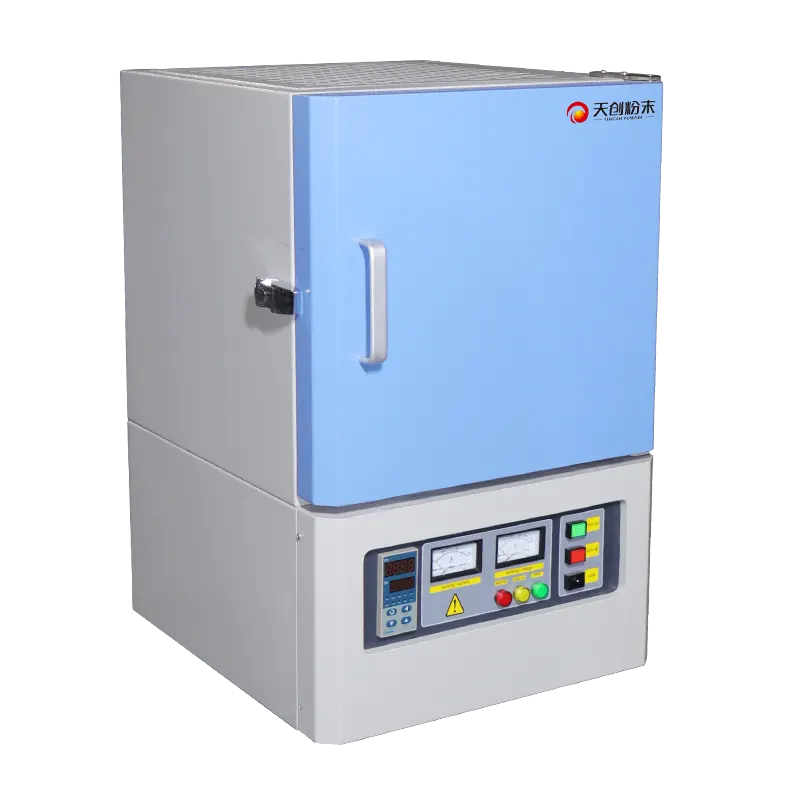
Maximum and continuous operating temperature
The maximum temperature is usually the short-term limit to which the oven can be heated without causing immediate damage. Long-term operating temperature is a mode in which the equipment is constantly operated with an acceptable life of the heaters and lining. The process should be planned based on long-term operating temperatures and leave a margin, rather than focusing on the maximum value. It is impossible to arithmetically deduce one value from another: the relationship is specified by the design of a particular model and is indicated in its documentation.
Chamber volume, loading weight and productivity
The volume of the working chamber, the volume of an individual crucible, the mass of the sample, the number of samples per cycle and productivity per hour are different values, and they should not be confused. A large chamber does not mean a proportionally larger load: limitations are related to the heat capacity of the material, heat transfer conditions and requirements for uniform heating. If the task is to process many small samples, it is not the volume that is important, but the reproducibility of the regime from cycle to cycle.
Atmosphere, cooling and heating rate
An air atmosphere chamber furnace is not a controlled atmosphere or vacuum furnace. If the material oxidizes when heated, a different category of equipment is needed, and the ability to work in a protective environment must be confirmed by the model documentation. Separately, it is worth distinguishing between the cooling of the installation itself after shutdown and cryogenic processes: cooling the housing or working space with air is not cryogenic processing, and cryogenic devices belong to other groups of equipment. Finally, the temperature of the working space is not equal to the temperature of the sample: after switching off, the sample cools down more slowly than the chamber.
Materials and Objectives: Applications and Limitations
Typical applications of chamber furnaces include sintering ceramics and oxide powders, annealing metals and alloys, calcining catalysts and sorbents, ashing organic samples, debinding before sintering, heat treating glass, phosphors and pigments, and testing materials at elevated temperatures. In all cases, the furnace works with an already prepared sample, and its task is to provide the specified temperature conditions, and not to change the chemical composition of the material.
Limitations follow from the same principle. In air, some materials oxidize or interact with the substrate material; some components evaporate and contaminate the chamber; organic decomposition products require gas removal. The temperature field inside the chamber is not perfectly uniform, which means that the position of the sample affects the result. The material of the crucible or baking tray can become a source of impurities - this is especially important for samples intended for subsequent elemental analysis.
Before ordering, specify: maximum and long-term operating temperature, chamber material, type of thermocouple and control system, volume of working space, the need for a controlled atmosphere, as well as compatibility with dishes and substrates that are intended to be used. The listed parameters relate to a specific model, so it is correct to compare stoves only using their own cards.
Grinding before sintering: how the grinding equipment is connected to the furnace
The result of heat treatment depends on the state of the powder before heating: on the particle size, particle size distribution, mixture homogeneity and the presence of agglomerates. Grinding is usually carried out in a planetary ball mill, where the sample is contained in a grinding bowl along with the grinding media. Agate glasses are used for some materials: agate grinding bowl for planetary mill.
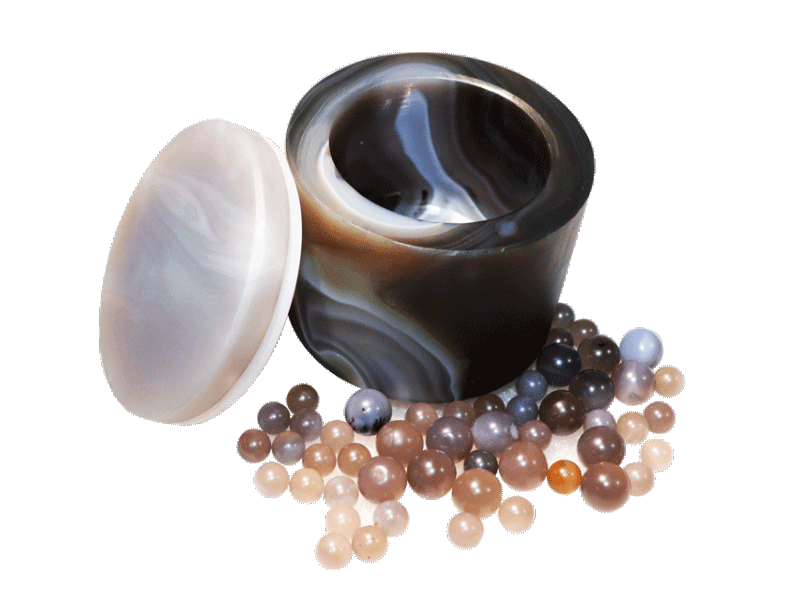
It is important here not to confuse the roles of devices. The grinding bowl is a part of a planetary mill, not a muffle furnace, and the connection between them is technological, not structural: the furnace heats the powder prepared at the previous stage. Agate is chosen for its low level of impurities, but “low” does not mean “zero”: wear of the glass and grinding media still occurs, and its intensity depends on the hardness of the sample, grinding time and mode. For very hard materials and large loads, agate is usually not the optimal choice.
The compatibility of the beaker is determined by the mill model, volume, permissible rotation speed and sample properties. This information is checked against the documentation for the mill and the glass, and not by analogy with another set. Dry and wet grinding differ not only in the medium: they give a different particle size distribution and have different effects on subsequent sintering, so it is reasonable to fix the grinding mode together with the heat treatment mode.
How to choose a muffle furnace: criteria and compatibility
The practical selection procedure looks like this:
- Determine the operating temperature of the process and the required holding time, then select a model based on the long-term operating temperature with a margin.
- Assess the size and weight of the samples, the type of crucible or substrate and, based on this, the required volume of working space.
- Decide whether an air atmosphere is sufficient or whether a controlled environment and appropriate oven design is required.
- Formulate a heating and cooling program: rate of rise, number of steps, duration of exposure.
- Specify the type of thermocouple, the accuracy of temperature maintenance and the method of control.
- Consider gas exhaust, installation placement and power requirements.
- Coordinate the furnace with adjacent stages: powder size after grinding, cooling conditions and requirements for sample purity.
Separately, you should avoid transferring parameters between different types of equipment. The pressing force and pressure in the hydraulic system of the press, the rotation speed of the planetary mill, the productivity of the crusher and the temperature of the furnace are the characteristics of different machines, and they do not replace each other when selecting. Each position is selected according to its card and its purpose.
Frequently asked questions
How does a chamber furnace differ from a tube furnace?
In a chamber furnace, the sample is in a closed volume with an air atmosphere, and in a tubular furnace, the sample is in a pipe through which gas can be blown. Tube furnaces are used when a controlled environment or sample drawing is important; chamber - when heating in air and convenient loading of several samples is sufficient.
Can materials that are sensitive to oxygen be heated in a muffle furnace?
In air, such materials tend to oxidize. The ability to operate in a protective environment or in a vacuum must be expressly stated for a specific model; if this is not the case, other equipment is selected for oxidizing samples, rather than compensating for the risk by increasing the temperature or increasing the holding time.
How to read the maximum temperature if the process lasts several hours?
You should focus on long-term operating temperature, and consider the maximum value as a short-term limit. Prolonged exposure at the maximum temperature accelerates the wear of heaters and linings, so the margin between the operating mode and the limit is a resource of the equipment, and not a formality.
Does powder preparation affect the result of heat treatment?
Yes. The coarseness, particle size distribution and mixture homogeneity determine the density of the workpiece, the sintering rate and the structure of the material. Therefore, the grinding mode and the heating mode are usually described together rather than separately.
Do I need to place the sample directly under the cameras?
No. The sample is placed in a crucible or tray made of material compatible with the sample and process temperature. Direct contact with linings and heaters makes sample retrieval difficult, increases the risk of contamination, and accelerates chamber wear.
The muffle furnace is responsible for the temperature regime in the material preparation chain, and its choice is determined by the task: temperature range, loading volume, atmosphere and required reproducibility. Equipment TENCAN for grinding, mixing, pressing and heat treatment are described in the sections of the site www.tencanballmills.com; Specific parameters should be checked in the card of the selected model.