
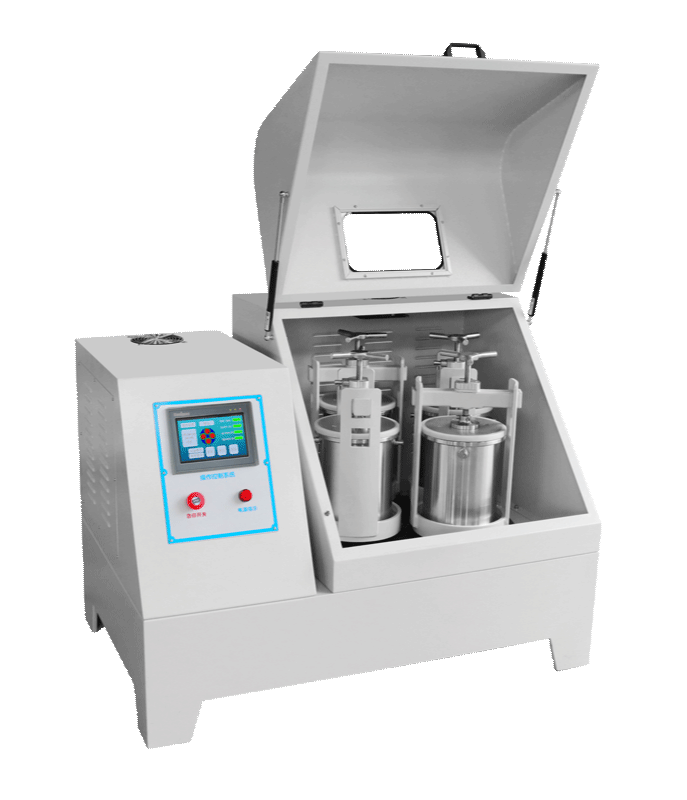
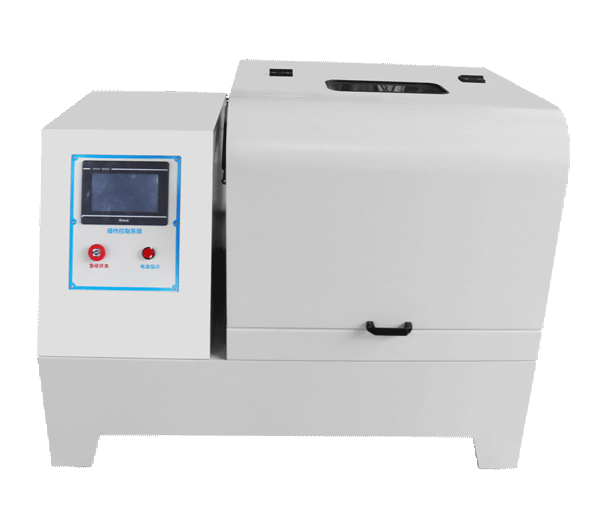
The microcomputer planetary ball mill with touch screen is a laboratory unit for fine grinding and homogenization of small samples. The grinding bowls in it rotate simultaneously around their own axis and around the common axis of the carrier, so the grinding bodies acquire high accelerations, repeatedly hit the material and wear it out. A microcontroller with a touch panel sets the rotation speed, the duration of the operating cycle and pauses between cycles, due to which the selected mode is repeated from sample to sample. In the sample preparation chain, such a device occupies a place between preliminary crushing and analytical operations - X-ray phase analysis, spectroscopy, measurement of particle size distribution, preparation of the charge for sintering. Below we explain how planetary grinding works, what the installation parameters mean and how to select glasses and grinding media for a specific material.
The place of a planetary mill in sample preparation
The planetary ball mill does not replace the entire grinding fleet of the laboratory. A jaw or roller crusher reduces pieces to the millimeter range, a drum mill on rollers is designed for larger drums and longer processes, a bead mill works with liquid systems and pastes, and an attritor works with suspensions during stirring grinding. The planetary scheme is in demand where it is necessary to quickly obtain a fine powder from a small sample and where it is important to maintain the ratio of components when grinding the mixture together. The microcomputer planetary ball mill with a touch screen fills exactly this niche: a compact device, one or several samples, gram and tenth samples, high specific grinding energy. Since the processing is carried out in closed glasses, the loss of material during transfer is small, and the sample is protected from the external environment within the limits determined by the specific design.
Working principle: rotation of bowls and movement of grinding media
In a drum mill, the beaker rotates around one axis, and the ball load rises and rolls under the influence of gravity. In a planetary mill, the carrier with fixed glasses rotates around the central axis, and each glass simultaneously rotates around its axis - in the same direction or towards. The resulting centrifugal force noticeably exceeds the force of gravity: the balls are pressed against the wall of the glass, break away from it in the upper part of the trajectory, fall onto the material and slide along the wall. The energy transferred to the sample depends on the ratio of rotational speeds of the carrier and bowls, the geometry of the bowl, the mass and size of the grinding media, as well as the degree of filling. It is the combination of these factors, and not just the rotation speed, that determines the grinding result.
Impact and abrasion
Particles are destroyed by two mechanisms. Impact is effective for brittle materials and at rough stages when large grains need to be cracked. Abrasion makes a major contribution in the fine range, as well as in the processing of viscous, layered and fibrous materials. The ratio of impact and abrasion is regulated by the size of the balls and the mode: large grinding bodies and high speed shift the process towards impact, small balls and moderate speed towards shear abrasion. Therefore, the same installation is used for both pre-grinding and fine processing, changing the equipment and program.
Grinding and disagglomeration are different tasks
It is not always necessary to reduce the crystallite size. Sometimes the goal is to break up agglomerates and obtain a homogeneous powder or suspension. In this case, excess energy is harmful: the material sticks to the balls and walls, dense aggregates are formed, the result becomes worse in a formally “more intense” mode. Control of particle size distribution before and after treatment is more informative than visual assessment. Planetary grinding speeds up both deagglomeration and grinding, but requires an understanding of which of the two tasks is solved in each specific case.
Microcomputer control and touch screen
The touch panel and microcontroller are responsible for making the unit work repeatably. The operator sets the rotation speed, grinding time, pause duration, and, if necessary, alternating the direction of rotation and the sequence of cycles. Smooth acceleration and braking reduce shock loads on the drive and reduce the risk of cups moving during startup. Saved programs allow you to return to a proven mode, which is important for serial measurements and when comparing samples prepared at different times. Digital control in itself does not change the physics of grinding, but makes it predictable and documentable.
Reproducibility is more important than maximum speed
In analytical preparation, the value is not the highest available speed, but the consistency of the result. If the regime is repeated, the differences between samples reflect the properties of the material and not the variation in preparation. Therefore, it makes sense to record not only the rotation speed and time, but also the type of bowl, material and number of grinding media, sample weight and filling. It is useful to keep this information in a laboratory journal along with the instrument parameters: they are needed when interpreting data and when transferring the technique to another installation.
What to clarify for a specific version
Specifications refer to a specific model and not to the entire range of planetary mills. The number of seats, volume of cups, rotation speed range, power consumption, weight of the device, type of cooling and available accessories are indicated in the product card and manual. If the translated value is ambiguous or missing, it is clarified with the supplier, and not substituted by analogy with another model. The parameters of one version do not become a characteristic of the entire assortment. Current versions and equipment can be conveniently checked against the catalog TENCAN.
Grinding bowls and grinding media: materials and compatibility
The glass and grinding media are the working parts of the mill, and they are the ones in contact with the sample. The material of the tooling determines wear, durability and the possible introduction of impurities. For planetary mills, shells made of agate, zirconium dioxide, corundum, tungsten carbide, stainless steel, nylon, polyurethane and PTFE are used, as well as lining options. Grinding media are produced from the same groups of materials and are selected in accordance with the glass. The harder the sample and the higher the required purity, the more carefully the hardness of the equipment material, chemical resistance and the permissible level of contamination are compared. Compatibility is confirmed for a specific sample-to-equipment pair and is not derived from a general rule.
Agate grinding glass
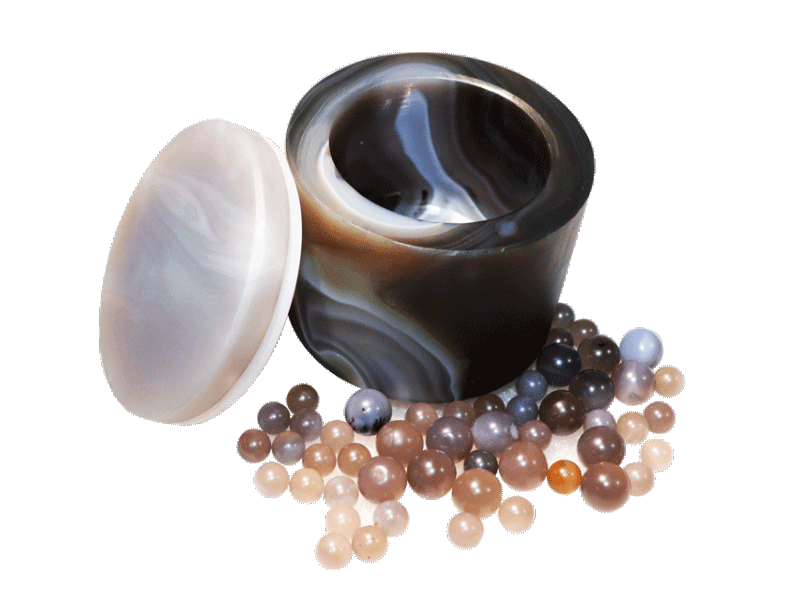
Agate is a dense, fine-grained material based on chalcedony, hard and chemically resistant, with a relatively low density compared to metal equipment. Agate grinding bowl for planetary mill are chosen when it is necessary to grind samples with minimal metal contamination - for example, when preparing samples for spectral or X-ray phase analysis. At the same time, agate is fragile: it is sensitive to shock loads, chips and sudden temperature changes, and therefore is poorly suited for large and very hard pieces, for working with large balls and for forced modes. Agate tooling is designed for processes that are moderate in energy and for materials that do not require forceful destruction.
Wear, cleaning and introduction of impurities
Any equipment wears out. Metal glasses provide a noticeable contribution of iron and alloying elements, ceramics and oxide materials - traces of their components, polymers - traces of organics and wear products. The formulation “zero contamination” is incorrect: it is correct to talk about reducing the contribution of impurities and whether this contribution is critical for the chosen analysis method. Wear increases with grinding time, speed, sample hardness and ball size. Between samples, glasses and balls are cleaned so as not to transfer material or damage the surface: abrasive cleaning and aggressive reagents for soft materials are unacceptable. Cleaning rules are determined by the material of the equipment and the nature of the sample.
Dry and wet grinding
Dry grinding is simpler: there is no need to select liquid, and after processing there is no need for drying. However, fine dry powders are prone to aggregation, sticking to walls and balls, and dust formation during unloading. Wet grinding introduces a liquid medium that removes heat, reduces sticking and often produces a narrower particle size distribution. The media used are water, alcohols, acetone and other solvents, the choice of which is determined by the chemistry of the sample and subsequent operations. The liquid must be compatible with the material of the beaker and grinding media and not react with the sample. After wet grinding, the suspension is separated and dried, and the solvent is disposed of according to current regulations. Grinding in a liquid medium does not turn the installation into a bead mill: it is still planetary grinding in beakers.
How to choose a configuration for a task
The selection begins not with the device, but with the statement of the problem. It is useful to answer several questions: what material is processed, what is its initial size, what result is considered sufficient, are impurities from the equipment acceptable, is the sample sensitive to heat, how many samples are prepared per day. The answers determine the glass, grinding media, mode and number of cycles.
Sample material and purity requirements
Hardness, brittleness, and stickiness determine which failure mechanism will work. For hard and large materials, where metal impurities do not interfere, more durable equipment is appropriate. For iron-sensitive analytical samples, ceramics, agate or polymers are chosen if they can withstand the energy of the process. For soft and fibrous materials, cutting and abrasion is often sufficient, and then the excess impact energy only compacts the sample.
Sample quantity, beaker volume and filling
Distinguish between the volume of the beaker, the total volume of the equipment, the workload and the mass of the sample. The glass is not filled to the top: the balls need a path to move. The mass of the sample and the mass of the grinding media are related: too small a sample leads to equipment wear and poor statistics, too large a sample leads to incomplete grinding and overload of the drive. The proportions found for one glass size do not automatically transfer to another size. Specific load values are taken from the installation manual.
Thermal conditions and processing time
Grinding generates heat, and heating can change the sample: causing polymorphs, decomposition, oxidation or loss of volatile components. Pauses between cycles, moderate speed, smaller loads and a wet process help. Air cooling of the housing is not equal to cryogenic grinding: the temperature of the working space of the installation is not equal to the measured temperature of the sample, and working with liquid nitrogen requires performance confirmed by documentation. If the card does not contain information about cryogenic treatment, the installation cannot be considered cryogenic.
Applications and Limitations
Such mills are used in geology and mineralogy, ceramics and glass, metallurgy and powder metallurgy, in the development of materials for chemical power sources, in pharmaceuticals, soil science and in the preparation of waste samples. The main limitation is scale: this is a small batch laboratory instrument, not a continuous production plant, and is not a replacement for an industrial mill or crusher. Noise and vibration occur during operation, so a stable base and correct fastening are important. The result depends on the material, initial size, medium, mode and method of measurement: the typical minimum size from the catalog is not guaranteed for any sample.
Questions and answers
Can wet and viscous materials be shredded?
Viscous and soft materials are processed in wet mode or in polymer cups, if the manual allows this. Excess liquid reduces the impact efficiency, so the medium is selected based on volume and viscosity.
How is an agate glass different from a zirconia glass?
Both materials are used for metal-sensitive samples. Zirconium dioxide is generally stronger and denser, agate is more fragile, but is suitable for moderate conditions and delicate analytical samples. The choice is determined by the hardness of the sample and acceptable wear.
Is a planetary mill a replacement for a crusher?
No. Crushing equipment reduces large pieces, and a planetary mill works with an already prepared sample. Joint grinding of materials of different hardness also requires preliminary approval of the size.
How hot does the sample get when grinding?
Heating depends on the mode, duration, load and material. You cannot focus on the temperature of the case or working space: the temperature of the sample itself is important, and if necessary, it is measured separately.
How to understand that the mode is selected correctly?
Signs: reproducible particle size distribution, absence of adhesion and aggregates, acceptable wear of equipment. The test is carried out by comparing several modes, and not by one test.