
A large roller ball mill is a drum-type grinding installation in which a sealed grinding drum with grinding media rotates due to friction against the drive rollers, and not on its own axis. This arrangement allows the use of large-volume drums and the processing of large batches of material: the drum is removed from the rollers, loaded and returned to its place without disassembling the drive. In the process chain, the installation occupies a place between preliminary crushing and final preparation of the powder - where representative weighing, uniformity and reproducible particle size distribution are required.
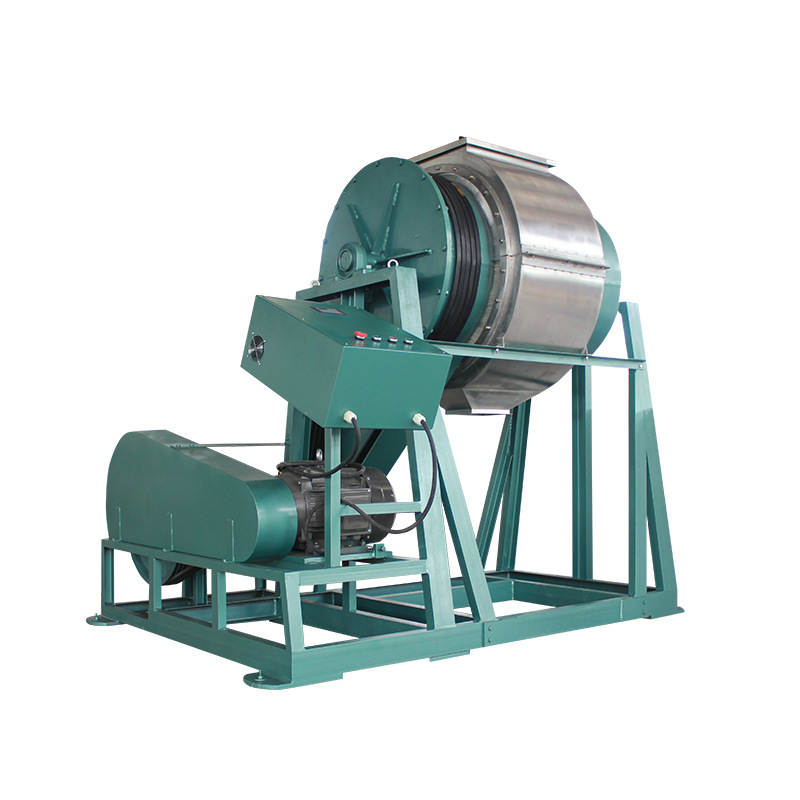
The design, grinding mechanism and selection criteria for a large roller mill are discussed below. Technical data of a specific version should be checked in the card large roller ball mill on the manufacturer’s website, since the parameters of one model are not automatically transferred to the entire range of grinding equipment.
What is a large roller ball mill and where is it used?
The roller ball mill is a representative of drum grinding. Inside the rotating drum there are grinding bodies (usually balls), which, when lifting and rolling the load, crush and abrade the material. The drive here is moved outside: the drum is not fixed to the shaft, but lies on rollers, and it is due to this that it can be made large and quickly replaceable. Hence the name - a large roller mill, that is, an installation designed for drums of significant volume and, accordingly, for an increased sample mass.
This equipment is intended for sample preparation and for small production batches. Typical areas include powder metallurgy, ceramics and refractories, glass and minerals, pigments and fillers, chemical power supply materials, and geological and analytical laboratories where the sample must be reduced to a homogeneous powder before further analysis or sintering.
It is important to distinguish between devices that are similar in name. A planetary ball mill operates with fixed bowls rotating around a common axis and at the same time around its own, and provides high grinding energy with small quantities. The bead mill grinds with a small diameter medium in a chamber with a mixing rotor and is more often used for suspensions and fine dispersion. A roller crusher crushes material between two rotating rollers and is a crushing operation rather than a grinding operation. A large roller mill is precisely a drum grinding with a roller drive, and it cannot be replaced with another type of machine in the description.
Construction of a large roller ball mill
The design of the installation includes several functional units, each of which affects the grinding result and the ease of working with the sample.
Drive and support rollers
The drum rests on two pairs of rollers. One pair is connected to the drive and transmits rotation through frictional contact, the second serves as a support and sets the position of the drum. The center distance of the rollers determines what diameter drums can be installed on a given machine, so when choosing equipment, the first step is to compare the diameter and length of the existing drums with the range indicated in the product card. Friction transmission places demands on the condition of the surface of the drum and rollers: contamination, oil marks or deformation of the shell impair grip and can lead to slippage and uneven rotation speed.
Grinding drum and grinding media
Grinding drum - the working volume of the installation. It is closed with a lid with a seal so that the powder does not become dusty or lost, and during wet grinding the medium does not leak out. The material of the drum and the material of the grinding media are chosen together with the sample material: it is this pair that determines what impurities can get into the sample and how quickly the equipment will wear out. The cover must be securely fixed, and its outer surface must not interfere with rolling on the rollers.
Frame, guard and control system
The frame takes the weight of the drum with loading and vibration; The guard protects the operator from the rotating drum and from the possible displacement of heavy equipment. The control system sets the rotation speed and grinding time, and also ensures that the installation is stopped. Please note that the settings available in the interface are machine specific; they do not replace the requirements for sample preparation and the amount of material in the drum.
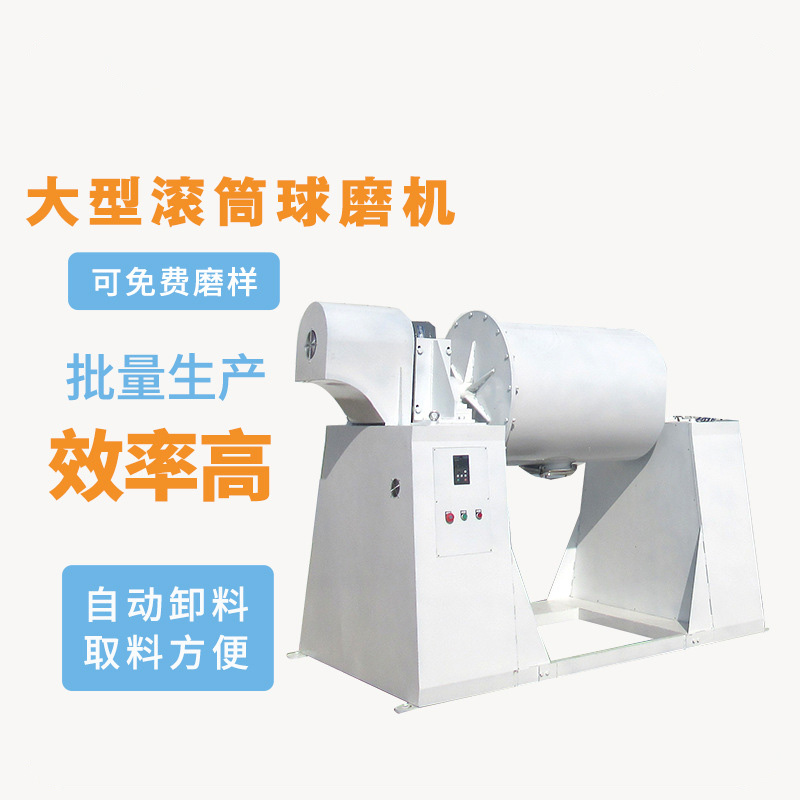
Working principle: how drum rotation turns into grinding
Grinding in a drum mill is not the result of simply rolling the contents. The material is destroyed under the influence of a complex of loads, and understanding this mechanism helps to select the correct mode.
Lifting, falling and rolling loads
When the drum rotates, the grinding media are carried upward by the wall, and then, depending on the rotation speed and fill factor, they either roll down the inclined loading surface or break off and fall. In the first case, the abrasive effect predominates, in the second - the impact effect. The general physical reference point for drum mills is the critical rotation speed, at which the centrifugal force holds the bodies against the wall and grinding practically stops; in engineering estimates, it is sometimes expressed by a relationship of the form n ≈ 42.3 / √D, where D is the internal diameter of the drum in meters, and n is the rotation speed in revolutions per minute. This is a general assessment, and not a characteristic of a specific machine: the manufacturer sets the operating speed for its model and its range of drums.
Dry and wet grinding
During dry grinding, the crushed powder remains free-flowing, but is prone to sticking to walls and agglomeration, especially in soft and plastic materials. In wet grinding, liquid is added to the drum; this reduces dust generation, reduces sticking and often speeds up the achievement of fine particle size, but adds liquid separation and drying steps and the risk of chemical interaction between the medium and the sample material. The choice between dry and wet mode is determined not by convenience, but by the properties of the sample and the requirements for the final product.
Grinding and disagglomeration are not the same thing
The drum mill is capable of both reducing the size of primary particles and destroying aggregates formed by weak bonds. If the task is disagglomeration, long-term intensive grinding may be excessive: it leads to additional rubbing of the material, an increase in the proportion of fine fractions and increased contamination due to equipment wear. Therefore, the regime is formulated in terms of the goal - the desired particle size distribution, and not the maximum possible processing time.
Characteristics and their correct reading
Catalog values must be read with an understanding of what exactly they describe. The same figure can relate to equipment, to a machine or to a process, and mixing these levels is unacceptable.
Drum volume, workload and sample weight
The full (geometric) volume of the drum is not yet the working load. Part of the volume is occupied by grinding media, and part must remain free for loading movement. The weight of sample that can be reasonably loaded into a particular drum depends on the density of the material, the size and number of grinding media, and the required fineness. These are three different quantities: the volume of the equipment, the total load of the drum and the mass of the sample. As the batch increases, the weight of the equipment and the load on the rollers increase proportionally, which is taken into account when choosing the size of the installation.
Speed, grinding time and cooling
The rotation frequency determines what mode of movement of the load is implemented, and the grinding time determines how many loading cycles the material will receive. Increasing both parameters does not always improve the result: sticking increases for plastic materials, and heating increases for heat-sensitive materials. It is important here to distinguish between types of cooling. Air cooling removes heat from the working area of the installation and does not turn the process into a cryogenic one. Processing with liquid nitrogen is a separate case in which the sample itself is cooled; Without confirmation in the documentation, it is impossible to call conventional cooling cryogenic. In addition, the temperature of the working space of the installation is not equal to the measured temperature of the sample inside the drum.
Product size
The achievable fineness depends on the material, the initial particle size, the medium, the mode and method of measurement. The standard minimum given in the catalog is a guideline for certain conditions and is not a guarantee for any sample. For soft materials, agglomeration becomes a limitation, for hard and abrasive materials - wear of equipment and associated contamination, for fibrous materials - insufficient impact efficiency. In reports, it is correct to indicate not only the size, but also the method for determining it.
Grinding drums and grinding media: compatibility and wear
The roller mill tooling is not a one-size-fits-all part. The drum must match the machine in terms of fit and weight, and in terms of material - the sample and process conditions. A coincidence of category names does not prove compatibility: check the type of mill, the diameter and length of the drum, and the method of fixing the lid.
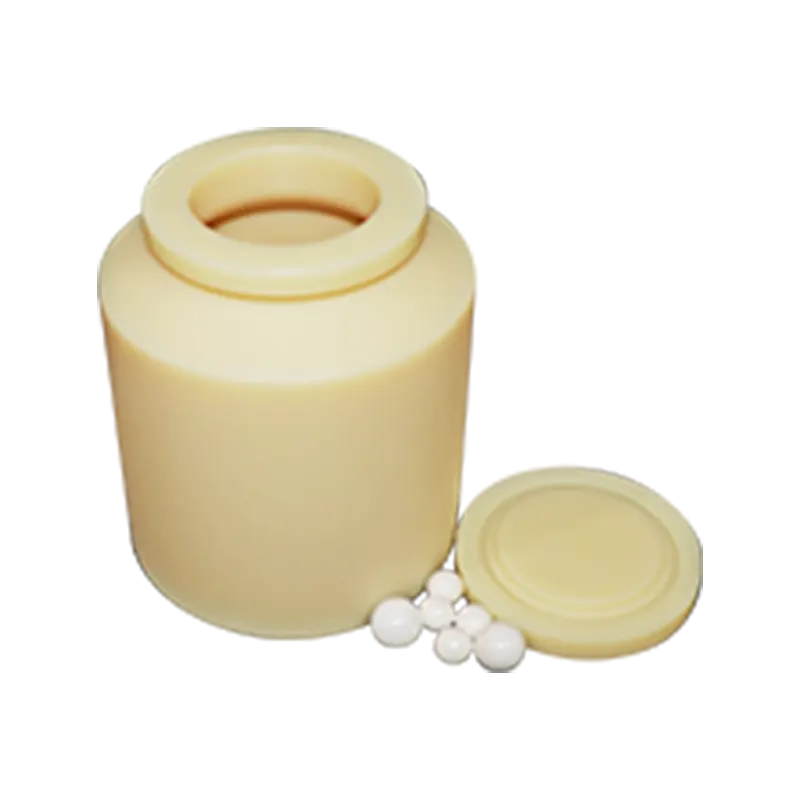
Nylon grinding drum
Drums made of polymeric materials are produced for roller mills, in particular nylon grinding drum. Nylon is a relatively soft and lightweight material: it reduces impact noise and weight of equipment, does not rust and is convenient when working with materials that are sensitive to metal contamination. The downside is limited resistance to abrasive and hard powders, a tendency to wear and to the accumulation of polymer particles in the sample, as well as sensitivity to temperature. A nylon drum cannot be considered as equipment with zero addition of impurities: with prolonged grinding of the abrasive material, its walls wear out.
Addition of impurities and cleaning
Any equipment introduces its own material into the sample; the only question is the quantity and whether it is critical for subsequent analysis. Hard tooling materials (for example, tungsten carbide) wear out more slowly, but are themselves strong pollutants for a number of elements. Ceramics based on oxides and zirconium dioxide reduce the risk of metal contamination, but they do not provide absolute cleanliness. Steel drums and balls are practical for durable samples, but require consideration of possible iron and chromium contamination. Between different samples, the equipment is cleaned so as not to damage the surface and not leave traces of the previous material; When working with traceable series, separate kits are often used.
For which tasks is a large roller mill suitable and for which not?
The installation solves problems well where significant weight and homogeneity are needed: averaging and grinding of mineral raw materials, ceramic charges, glass, pigments, sample preparation before analysis. A large-volume drum makes it possible to work with material that does not fit into the laboratory beaker of a planetary mill.
There are also limitations. If extremely fine grinding of small quantities in a short time is required, a planetary or vibratory mill is more appropriate. If the material is to be dispersed in a liquid with a high degree of grinding, we are talking about a bead mill. Large pieces of rock are usually crushed before drum grinding - a roller mill does not replace a crusher. Drum grinding is also not suitable for materials that degrade, melt or chemically react with the environment and equipment during prolonged processing.
Selection criteria and compatibility
The choice begins with the statement of the problem: what material, what the initial and target size, what mass of the sample is needed for representativeness, a dry or wet process is assumed. Then the standard size of the installation is selected - first of all, according to the range of diameters and lengths of the drums, according to the permissible loading weight and according to the available rotation speed ranges.
Next, the equipment will be agreed upon. The material of the drum and grinding media is selected according to the hardness and abrasiveness of the sample, as well as what impurities are acceptable in the final product. They separately check the compatibility of a specific drum with a specific mill model: seating dimensions, method of fixing the cover, sealing requirements. It is useful to check with the supplier in advance which drums and bodies are recommended for the selected machine, how wear is regulated and how cleaning is carried out. An overview of the areas of equipment and accessories is given at website TENCAN.
Questions and answers
How does a large roller mill differ from a planetary mill?
Method of energy transfer and scale. The planetary mill rotates fixed bowls at a high relative speed and works with small quantities; The roller type uses a free-standing, large-volume drum on a friction drive and is designed for larger batches with lower specific grinding energy.
How to choose grinding drum material?
Based on the sample and acceptable contamination. For metal-sensitive materials, polymer and ceramic options are suitable, for durable abrasive ones - harder materials that have higher wear resistance. In any case, the equipment contributes to the composition of the sample, so the material is selected along with the subsequent analysis method.
Is it possible to grind without liquid?
Yes, dry grinding is a common mode for many bulk materials. The limitation is sticking and agglomeration, especially in soft and plastic samples. Addition of liquid reduces these effects but requires subsequent media separation and drying, as well as chemical compatibility testing.
What should I check before ordering equipment?
Mill model, permissible diameter and length of the drum, material of the drum and grinding media, type of seal, as well as operating conditions - dry or wet process, operating temperature and requirements for sample purity. This information allows you to select a compatible kit and avoid a situation where the equipment formally fits by name, but not by fit dimensions.