
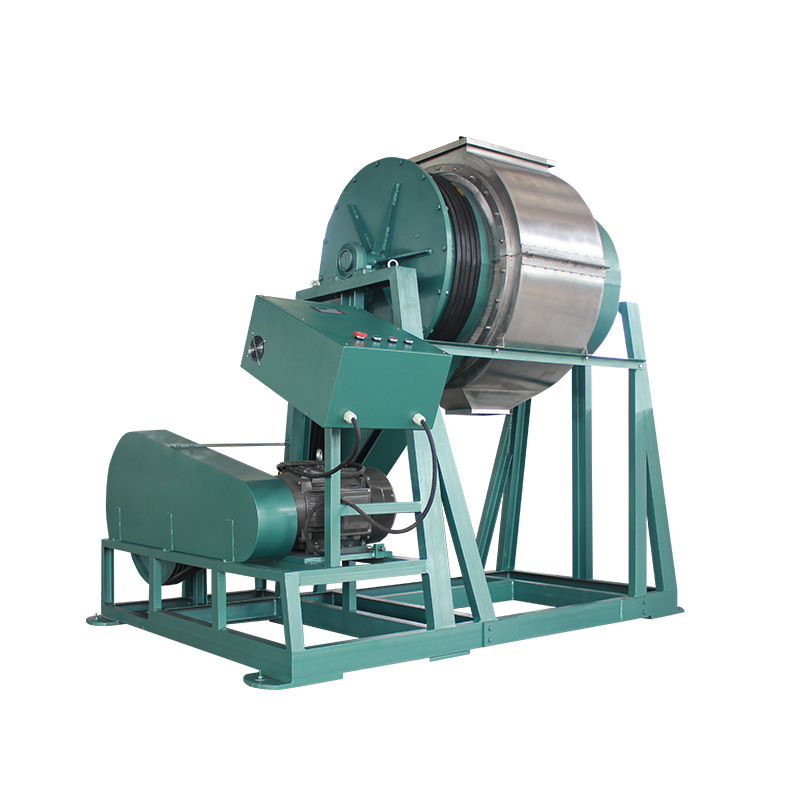
A large roller ball mill is a drum grinding unit in which a cylindrical drum with grinding media rotates on support rollers. In the catalog TENCAN such equipment is presented in a separate version large roller ball mill. It is designed for grinding and homogenizing powders and suspensions when it is necessary to process a batch of material in a closed drum and obtain a narrower particle size distribution than after coarse crushing. The word “large” in the name indicates the standard size in the line, and not the universal performance: the actual drum volume, permissible load, dimensions and drive must be checked against the card of a specific design.
What is this equipment and where does it fit in the process?
In the process chain, a roller ball mill usually comes after crushing, sieving or pre-mixing and before analyzing, pressing, sintering or further processing of the powder. Its task is to reduce the particle size, open up aggregates and homogenize the material. This is not a primary crusher or a pure mixer: mixing occurs in the drum, but the main result is a change in the particle size distribution under a controlled regime.
The roller design is convenient in that the drum is not fixed to the high-speed shaft, but rests on rollers. This arrangement allows the drum to be replaceable and serviced separately from the drive. However, it does not mean permissiveness in terms of loading weight: support rollers, bearings, drive and the drum itself are designed for a certain operating range. If the product card does not contain the required parameter, it cannot be restored by analogy with another model.
For a laboratory, a large roller mill can be a transition link between benchtop equipment and a more productive installation. For the production site, it is no longer just the size of the drum that is important, but also the method of loading, unloading, cleaning, time control and safety. Therefore, the same name “large roller ball mill” does not describe a specific configuration.
Design and principle of operation
Drum, rollers and drive
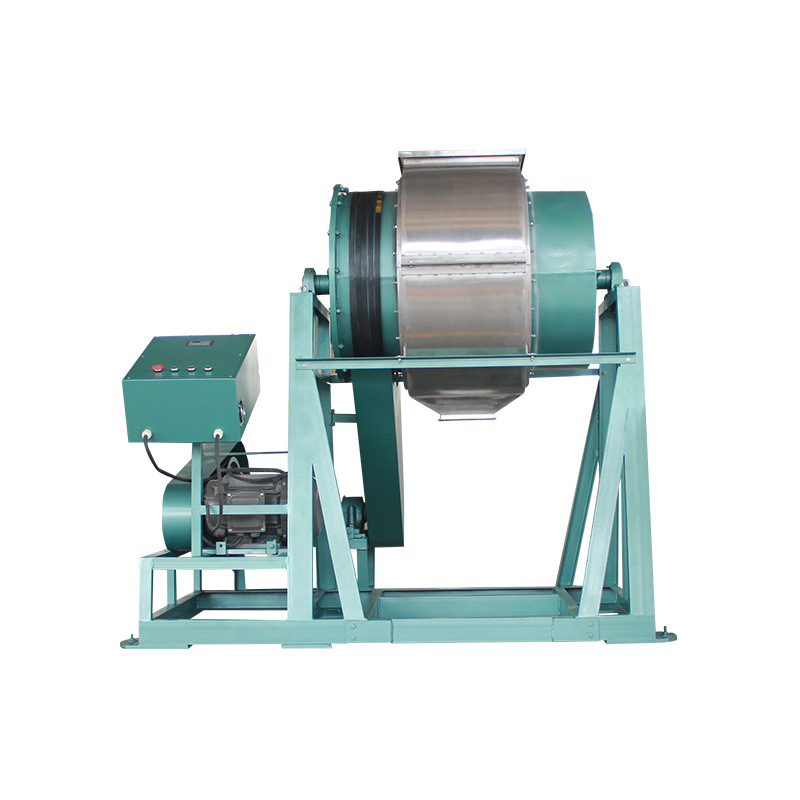
The main elements of such a machine are a drum, support rollers, frame, drive and control system. The drum is mounted on rollers and rotates around its axis. Inside there are grinding media and the processed material. The drive transmits rotation through a corresponding mechanism; The specific design of the drive, the availability of frequency control and the type of fencing depend on the model. Don't assume that every large roller mill has the same set of options.
The drum can be equipped with a loading and unloading opening, a seal and a lining. The material of these assemblies is important: it comes into contact with the sample and affects wear, cleaning and possible introduction of impurities. If the card does not indicate the lining material, it cannot be stated that it is ceramic, polyurethane or steel. This needs to be clarified for a specific delivery.
Movement of grinding media
When the drum rotates, the grinding media rise along the inner wall, then break off and fall down. Depending on the speed and filling, either impact or abrasion between the balls and the wall predominates. For brittle materials, impact is important; for soft materials prone to aggregation, abrasion and grinding are important. Rotation that is too slow does not raise the load to the desired height, and rotation that is too fast can cause the bodies to be pressed against the wall and reduce efficiency. Therefore, the speed is selected together with the drum diameter, the type of grinding media and the degree of filling.
Several processes simultaneously occur inside the drum: particle size reduction, deagglomeration, mixing and sometimes mechanochemical changes in the surface. Not each of them is needed for a specific task. If it is only necessary to destroy soft agglomerates, an aggressive mode with large balls may be redundant. If durable material needs to be crushed, disagglomeration alone is not enough.
What determines the grinding result?
The result depends on the initial size, hardness and brittleness of the material, its tendency to stick, humidity and temperature. The diameter and density of the grinding media, their number, the ratio of the mass of the balls and the sample, the volume of the drum, the rotation speed and the processing time are affected. For wet grinding, a medium is added: its viscosity, chemical compatibility with the material and ability to hold particles in suspension. For dry grinding, dusting, clumping and complete discharge are important.
The catalog minimum size is not a guarantee for any sample. It refers to a specific material and test conditions. If the description states “up to such and such coarseness,” this is a guideline for selection, and not a promise of results using other raw materials. Testing on a real sample remains mandatory.
How is a roller mill different from others?
A planetary ball mill uses grinding bowls that rotate around its own axis and around a central axis. Due to this, the energy per unit mass can be higher, and the samples are usually smaller. A roller mill works differently: a large drum rotates on supports, and the scale of loading is determined by its geometry. This doesn't mean that one car is always better than another; The comparison should be based on the task, sample weight and purity requirements.
A vibration mill imparts energy to the grinding media through vibration of the housing, while a bead mill uses fine grinding media and a mixing rotor. A roller crusher crushes material between rollers and is not a ball mill, even if it has the word “roller” in its name. The roller ball mill occupies a separate place: in it, it is the drum with the balls that rotates on roller supports, and does not crush between two rolls.
For the user, the practical difference is in loading, cleaning and impact. A planetary mill is often chosen for small samples and intensive grinding, a vibratory mill for applications that require vibrational energy, and a bead mill for suspensions and fine dispersion. A large roller mill is appropriate where you need drum grinding of a batch and the ability to work with a larger load, but specific limits must be looked at in the passport.
How to read coarse mill parameters
The first and most common source of error is mixing the drum volume, the usable volume and the mass of the sample. The geometric volume of the drum is the entire internal volume. The workload is smaller: part of the space is occupied by the grinding media, and the material does not have to completely fill the drum. The mass of the sample depends on the bulk density and permissible filling. If the description says volume, you need to understand whether it refers to a full volume or a working volume. It is impossible to convert volume into mass without density and without taking into account grinding media.
The second parameter is the rotation speed. It can be indicated in revolutions per minute or as a percentage of some calculated value. It is impossible to compare mills only by the number of revolutions: the diameter of the drum is important. The same angular velocity at different diameters gives different linear velocity of the wall and different impact energy. If the speed is adjustable, this expands the selection possibilities, but does not eliminate loading restrictions.
The third parameter is grinding media. Their diameter, material, density and quantity affect efficiency and wear. Large balls give a stronger blow, small ones give more contact area and abrasion. The filling with grinding media is selected so that there is room for the material and loading movement. There is no universal recommendation without taking into account the sample.
The fourth parameter is drive and power. Engine power characterizes the ability to rotate the load, but does not guarantee the specified size. Consumption is influenced by the mass of the balls, filling, material properties and mode. The fifth parameter is size. If a typical range is specified, check for what material and measurement method it was obtained. Sixth - operating conditions: available voltage, noise, dust, foundation and maintenance requirements. All this data must be consistent for a specific model.
Dry and wet grinding, grinding media and compatibility
Dry grinding is used when the material should not come into contact with liquid or when powder is needed after processing. It is easier for subsequent drying, but may be accompanied by dust, sticking to the walls and incomplete unloading. Wet grinding uses a carrier liquid; it reduces dust and can improve particle distribution, but requires fluid compatibility with the drum and seal material and subsequent fluid separation. The wet mode is not automatically finer: the result depends on the viscosity, stability of the suspension and the energy of the grinding media.
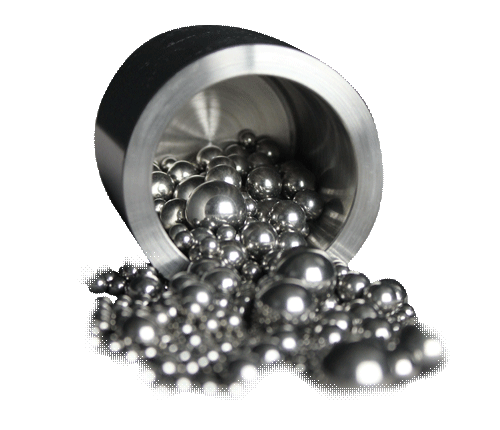
Grinding media are a consumable element that is in direct contact with the sample. In the catalog TENCAN presented 304 stainless steel grinding balls. This is a separate item and does not indicate compatibility with any major roller mill. Before use, check the diameter of the balls, the permissible loading of the drum, the lining material, cleanliness requirements and the possibility of wear. 304 stainless steel is resistant to a range of environments, but is not “wear free” and does not guarantee zero transfer of impurities. Abrasive materials may introduce iron, chromium and nickel into the sample.
For applications with stringent contamination requirements, other grinding media and lining materials are considered, but their suitability must be confirmed for a specific material-apparatus pair. Ceramic, zirconia or tungsten carbide do not mean no wear at all: they have a different contamination profile, different fragility and different costs. You cannot transfer the properties of one material to the entire range.
Cleaning between samples is as important as choosing your balls. Residues from the previous sample in the corners of the drum, on the lining and between the balls may distort the following result. The cleaning method depends on the material and design; aggressive solvents and abrasive cleaning can damage the surface. If the manual does not contain an approved method, it must be requested from the equipment supplier.
How to choose a large roller mill for the task
The choice begins not with the name “large”, but with the requirements for the sample and process. It is useful to record what exactly should happen: the average size, the upper limit of the distribution, preservation of the particle structure, the absence of unacceptable impurities, or simply averaging. After this, they check which model provides the required working volume and permissible load.
- Determine the mass of one sample and the number of samples per shift. This allows you to separate the working volume from the total volume of the drum.
- Check the original size and hardness of the material. For larger pieces, pre-crushing may be necessary rather than just ball milling.
- Match the material of the drum, lining and grinding media with the permissible level of impurities. Each pair of materials requires a separate wear rating.
- Select dry or wet mode and check the compatibility of the fluid with the seals, coating and sample material.
- Determine whether speed control, a timer, a safety guard, a loading and unloading system are required, and what cleaning is acceptable.
- Request from TENCAN data for a specific model: dimensions, weight, volume, permissible load, drive and operating conditions. Do not substitute parameters of a neighboring model.
- Conduct trial grinding on real material. Only it will show whether the desired size is achieved and whether an undesirable change in properties occurs.
If the task requires high purity, low temperature, or operation in an inert environment, this should be discussed separately. A large roller mill itself does not become cryogenic or vacuum just because it has a closed drum. Air cooling and liquid nitrogen cooling are different solutions; the temperature of the working space is not equal to the temperature of the sample. You should not attribute functions to an installation that are not included in its description.
Briefly about frequently asked questions
Can 304 stainless steel balls be used in this mill?
Only after checking the diameter, load capacity, drum material and cleanliness requirements. The ball card confirms the ball material and type, but does not confirm compatibility with any model. For abrasive samples, wear and possible transfer of elements into the sample are taken into account.
How does a large roller mill differ from a planetary mill?
In a planetary mill, the beakers undergo a complex rotation and usually work with small samples. In a roller mill, the drum rotates on support rollers, and the scale is determined by its geometry. The choice depends on the sample weight, energy required and acceptable contamination.
Can you grind wet?
Wet grinding is possible if the design and materials allow contact with liquid and the seals are resistant to the selected environment. Subsequent filtration or drying, purification, and compatibility of the liquid with the sample must be taken into account. There is no universal permission for any solvents.
Does the mill guarantee the specified size?
No. The fineness depends on the material, initial size, grinding media, time, speed and method of measurement. Catalog guidelines are useful for selection, but are checked on a real sample. If a parameter is not confirmed for a specific model, it should not be considered guaranteed.