
A laboratory jaw crusher is a machine for preliminary crushing of sample pieces by compression between two jaws. In the sample preparation chain, it comes before the mill and reduces the size of the material to a state at which the sample can be divided, reduced, sent for abrasion or prepared for analysis. In the catalog TENCAN this position is classified as crushing equipment; The current version and its parameters are given in laboratory jaw crusher card.
Jaw crushing is not a substitute for fine grinding. Its task is to obtain material from a large piece of a suitable size for the next operation, without overloading the mill and without creating an excess of fines ahead of time. Therefore, choosing a crusher does not begin with a search for maximum power, but with an understanding of the initial size, sample weight, required size after crushing and contamination restrictions.
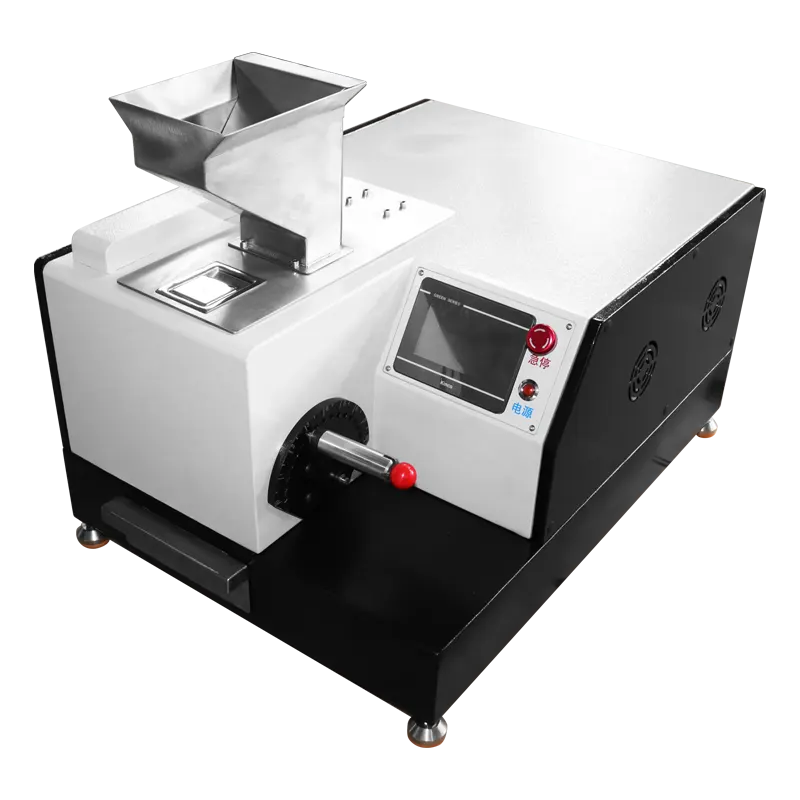
Place of the crusher in the sample preparation chain
Sample preparation typically involves sampling, cutting, crushing, reducing, grinding, and sieving. The jaw crusher takes place in the crushing stage. If the material comes in pieces that do not fit into the grinding bowl or are not suitable for the mill, you must first reduce the size of the piece. Crushing equipment is used for this operation.
Crushing and grinding differ in purpose and mechanism. Crushing produces a larger product, while grinding tends to produce a fine powder and often a narrow particle size distribution. These operations cannot be mixed in the description: a jaw crusher is not a ball, planetary or bead mill. It is also not intended to produce a finished powder with a given micron size.
For the representativeness of the sample, it is important not only to grind all the material, but also not to lose its composition. Over-crushing can produce a lot of fines, which are then more difficult to properly reduce. A practical approach is to select the minimum size reduction required and control the product size at each stage.
How does a laboratory jaw crusher work?
In a jaw crusher, material enters a chamber between the fixed and movable jaws. The drive imparts periodic movement to the movable cheek. When the cheek approaches immobility, the piece shrinks and collapses; when the cheek moves away, the crushed material falls towards the discharge slot. The main mechanism is compression and splitting, and not impact destruction, as in hammer machines.
The result is influenced by the geometry of the chamber, the stroke of the movable jaw, the frequency of movement, the profile of the crushing surfaces and the size of the discharge gap. These parameters are interconnected. You cannot evaluate the work by only one figure, for example, by the width of the gap: the size of the product also depends on the properties of the material, the shape of the pieces, humidity and loading mode.
The jaw crusher operates intermittently or in small batches in a laboratory setting. The operator loads the material into the receiving device, after crushing, unloads the product and cleans the chamber. For reproducibility, it is important to have the same approach to batch weight, feed size, and discharge slot setting.
Dust, noise and vibration are particularly noticeable in the laboratory. These are not minor issues, but part of the choice of equipment and organization of the workplace. If the material is dusty, dust control and personal protective equipment are required; if the sample is hazardous, a conventional laboratory crusher is not automatically suitable without a risk assessment.
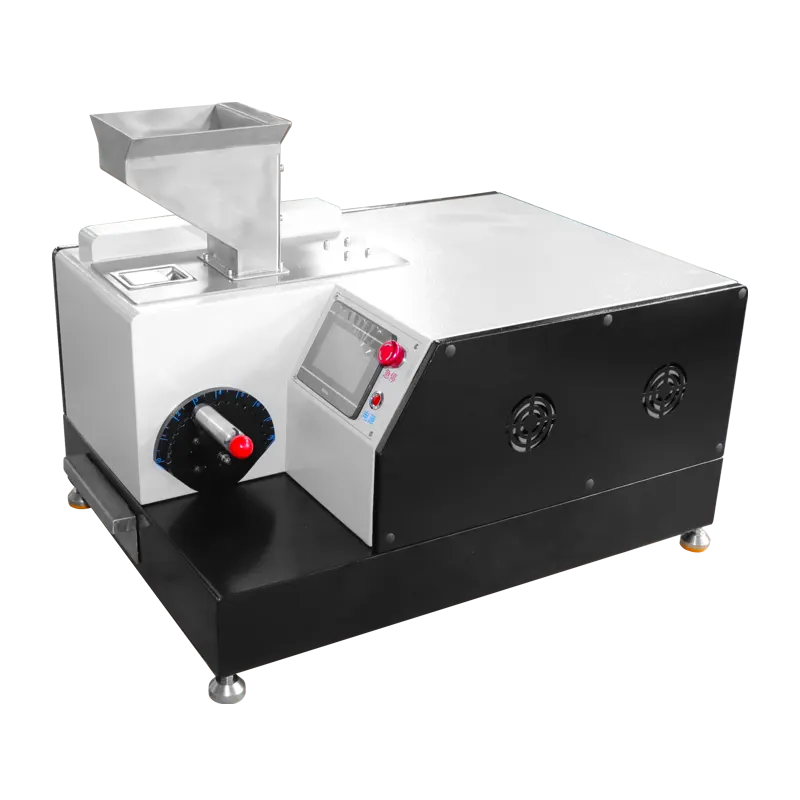
Main nodes and what they define
A jaw crusher has several functional units. Their purpose is related to material supply, force generation, unloading and work safety. The specific design depends on the design, so the parameters of the components should be checked with the product card and not transferred from another machine.
Loading hopper and receiving opening
The feed hopper directs the material into the crushing chamber. The receiving opening limits the maximum piece that can be fed into the machine. A piece that is too large may become stuck, causing overload or uneven wear. In practice, it is important not only to know the size of the hole, but also to evaluate the shape of the pieces: an elongated piece may behave differently than a compact one.
Crushing jaws and their material
The crushing jaws transmit force to the material and at the same time are subject to wear. The material of the jaws influences durability, wear patterns and possible transfer of impurities into the sample. If a specific material is indicated on the card, it is evaluated along with the task: for some samples, durability is more important, for others, minimal change in composition. There is no universal material that is suitable for all samples and does not make any changes.
Drive and adjustment of the discharge gap
The drive creates the movement of the movable cheek. Adjusting the discharge gap allows you to change the setting to the desired product size, but does not guarantee the same particle size distribution for all materials. After changing the setting, it is useful to check the actual fineness on a reference sample rather than relying solely on the position of the mechanism.
Housing, base and dust control
The body and base provide stability under cyclic loads. In a laboratory room, access to the chamber for cleaning, ease of unloading, and the ability to connect to a dust removal system, if provided for, are also important. You should not attribute functions to a machine that are not in its description: for example, a normal laboratory design does not become a controlled atmosphere cabinet just because dust is generated during operation.
What parameters to read in the card
When choosing a laboratory jaw crusher, they look at several groups of parameters. The first group describes the permissible load: the size of the receiving opening and the maximum size of the piece. The second is the result of crushing: the adjustment range of the discharge slot and the approximate size of the product. The third is performance and operating conditions. The fourth is the material of the working surfaces, dimensions, weight, power supply and maintenance requirements.
The receiving opening and the maximum size of the loaded piece are not the same thing. The hole can be quite large geometrically, but the instructions limit the size of the piece due to shape, material strength and risk of jamming. You cannot select a crusher based only on the opening width if the card contains a separate loading limitation.
The discharge slot determines the machine setting, not the single particle size. The crushed product always has a distribution by size: some particles will be smaller than the setting, some will be larger due to the shape and exit conditions. Therefore, the phrase “the output is exactly the same number of millimeters” should be taken critically. It is more correct to talk about the range and the actual measurement on a specific material.
Throughput in laboratory equipment depends on feed size, density, flowability, slit setting and how the operator loads the sample. The value from the card cannot be automatically converted to any sample. For a small laboratory, what is more important is not the maximum rated productivity, but the reproducibility and ease of working with the required sample mass.
Drive power alone does not indicate the quality of crushing. A more powerful machine may be needed for large pieces or dense material, but it will not compensate for incorrect settings, overloading the chamber or inappropriate load size. The parameters of one model do not become a characteristic of the entire range TENCAN: Each performance is checked against its own card.
Materials and limitations
Jaw crushers in the laboratory are usually used for brittle materials that break under compression. These can be minerals, ores, ceramics, slags and other solid samples, if their size and behavior correspond to the selected design. However, the general principle does not replace testing of a specific sample: strength, viscosity, moisture and the presence of inclusions can change the result.
Plastic, viscous, fibrous and very wet materials are crushed worse: they can smear the chamber, form lumps and make unloading difficult. Such samples sometimes require a different grinding principle or preliminary preparation. A good result cannot be promised just because the material is formally placed in the receiving hole.
A separate issue is sample contamination. Wear on cheeks and other working surfaces may introduce trace amounts of material. If the sample is intended for elemental analysis, the risk must be assessed in advance. Phrases about “total absence of pollution” are incorrect for any mechanical crusher: we can only talk about reducing risk and controlling blanks.
Cleaning between samples is as important as machine selection. Residues from the previous sample in the chamber, on the cheeks and in the discharge area may distort the following result. Different cleaning techniques are used for different tasks, but they should not damage the work surfaces. If the cleaning procedure is not described, it should be confirmed with the supplier and reflected in the laboratory procedure.
How to choose a laboratory jaw crusher
It is convenient to choose based on the task, and not on the name of the model. First, they describe the sample and the purpose, then check which executions allow such work. For TENCAN The starting point is the laboratory jaw crusher card, but the final decision is made after comparing the parameters with a specific sample.
- Determine the initial size and maximum piece. The machine must accept material with reserve, and not work at the limit of its capabilities.
- Set the required size after crushing. You should not crush smaller than the next stage needs: this increases the amount of fine fraction and the cleaning load.
- Estimate the mass of the sample and the number of samples. Ease of use, speed of purification and reproducibility are different for single samples and for batches.
- Check the cheek material and the risk of impurities. If the composition of the sample is critical, working surfaces cannot be selected based solely on service life.
- Consider dust, noise and safety. Loading, unloading and cleaning should be described in a procedure and not performed impromptu.
- Match the crusher with the mill and sieve. A product that is too large will overload the mill, and a product that is too small can affect the reduction performance.
- Check all values with the current card. If a parameter is not specified or the units are in doubt, it is clarified rather than guessed at.
How does a jaw crusher differ from other equipment?
From roll crusher
A roller crusher crushes the material between rotating rollers. The cheek machine uses compression between the cheeks. Both devices are crushing devices, but the chamber geometry, load patterns and suitability for different materials differ. You cannot replace one equipment with another only for similar product sizes.
From ball or planetary mill
A ball mill crushes material by impact and abrasion of grinding media. The planetary mill uses a complex movement of grinding bowls. A jaw crusher prepares the material for such grinding, but does not perform it. The grinding bowl for the planetary mill is also not part of the jaw crusher: it is a different type of equipment with different compatibility requirements.
From the bead mill
The bead mill is designed for fine dispersion and wet grinding with fine grinding media. It does not solve the problem of preliminary crushing of large pieces. Confusing these concepts leads to incorrect equipment selection and dangerous attempts to load the wrong size material.
Frequently asked questions
Can a jaw crusher produce fine powder?
No, this is a pre-crushing operation. For fine grinding you need a mill, and the coarseness after crushing must correspond to its permissible load. The specific limit depends on the design of the crusher and the properties of the sample.
Why can’t you judge the size only by the discharge gap?
The slot sets the machine setting, but the product has a particle size distribution. The result is influenced by the shape of the pieces, the strength of the material, humidity and loading mode. It is more correct to measure the product size using a representative sample.
Which cheek material should you choose?
This depends on the abrasiveness of the sample and the permissible change in its composition. If data on available materials is not given on the card, they need to be clarified. Any hard cheek material should not be assumed to guarantee the absence of impurities.
Can wet material be crushed?
Wet and sticky samples often make crushing and unloading difficult. The ability to work with a specific humidity is determined by the design and must be checked according to the documentation. If necessary, the sample is prepared differently, but hazardous or unstable materials are not arbitrarily processed without a risk assessment.
Is one crusher sufficient for sample preparation?
Usually not. After crushing, reduction, attrition, screening and size control may be necessary. The jaw crusher is one stage, not a universal preparation system. Stage compatibility is more important than a single maximum stat.
Practical conclusion
Laboratory Jaw Crusher TENCAN — equipment for the first reduction of sample size before subsequent grinding. When choosing, it is useful to go from the maximum piece, required size, sample weight and acceptable contamination, and then check the receiving opening, slot setting, productivity and operating conditions according to the current card. If the value is not confirmed, it is better to clarify it than to transfer it from other equipment. An overview of other areas and brand positions is given at website TENCAN.