
Laboratory horizontal bead mill with pin rotor is a machine for fine and ultra-fine wet grinding and deagglomeration of powders in a liquid medium. The grinding chamber is a horizontal cylindrical body, inside of which a rotor with radial pins rotates, and the working space is filled with a fine grinding medium. In the technological chain, such a machine usually stands after preliminary wetting and dispersing and before operations where a narrow particle size distribution and suspension stability are important: coating, printing, ceramic casting, sample preparation for analytical measurements. The purpose, device, meaning of the passport parameters and selection criteria are discussed below; Specific values for this model are given in laboratory bead mill card TENCAN.
Purpose and place in the technological chain
The bead mill solves two related, but not identical problems. The first is the destruction of primary particles, that is, the actual grinding. The second is disagglomeration: breaking up loose conglomerates that formed during drying, storing or mixing the powder and which are not destroyed by ordinary mixing. For pigments, oxide ceramics, phosphors, battery materials and many fillers, the second task is often more important than the first, because it is the aggregates, and not the primary particles, that determine turbidity, sedimentation and coating defects.
Difference from planetary and drum mill
A planetary ball mill operates periodically: a grinding bowl with a sample and balls rotates along a complex trajectory, and the material is crushed in portions. The roller drum mill uses the slow rotation of a large drum and is suitable for larger loads and longer grinding times. A horizontal bead mill is designed differently: grinding occurs in a flow-through or circulating suspension, and energy is transferred through a fine medium under high shear loads. Hence its strengths - quick access to fine grinding, reproducibility from batch to batch and the ability to work with viscous pastes - and limitations: the mandatory presence of liquid, increased heating and more complex cleaning.
Why is the process always wet?
In this type of chamber, dry grinding is not possible: the powder must be moistened and turned into a stable suspension or paste, otherwise the grinding medium will not be able to transmit shear, and the material will settle in stagnant zones. Therefore, sample preparation includes the selection of a dispersion medium, surfactant additives, and the order of adding components. The error at this stage is not compensated by the mill mode: poorly wetted powder produces large inclusions even with prolonged stirring.
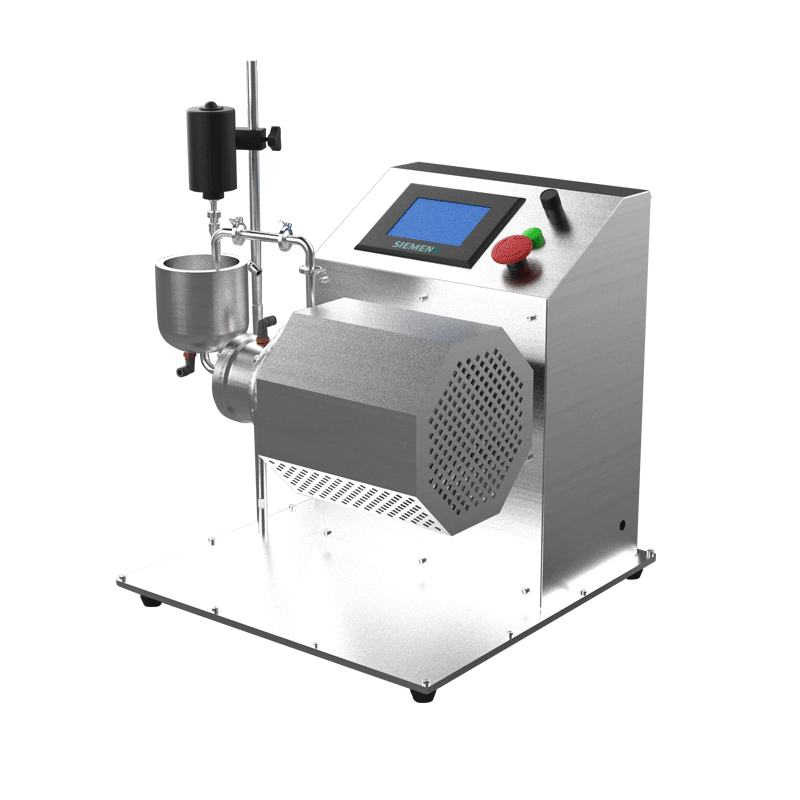
Design and working principle
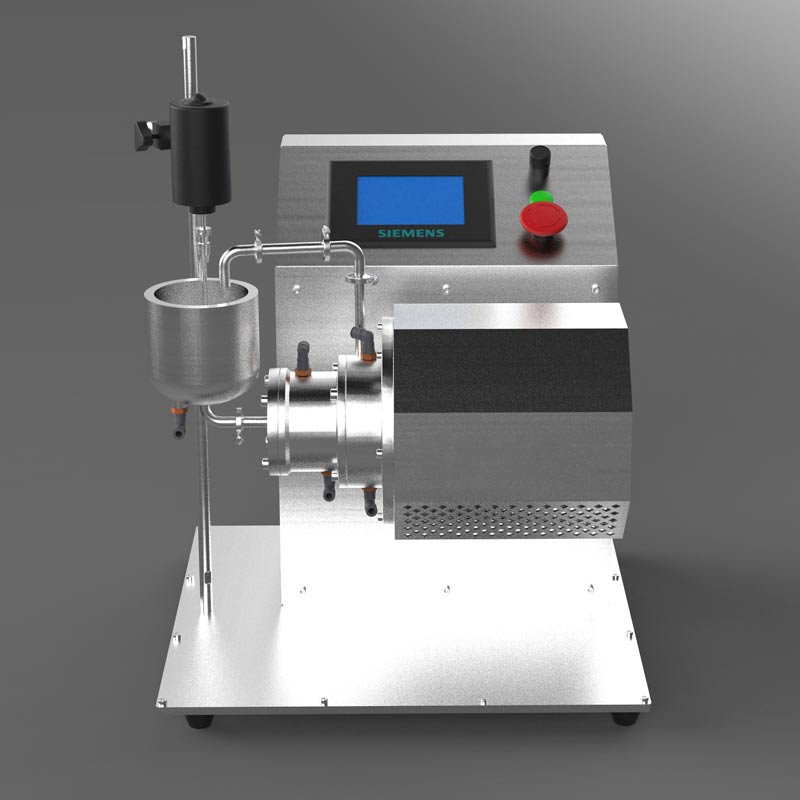
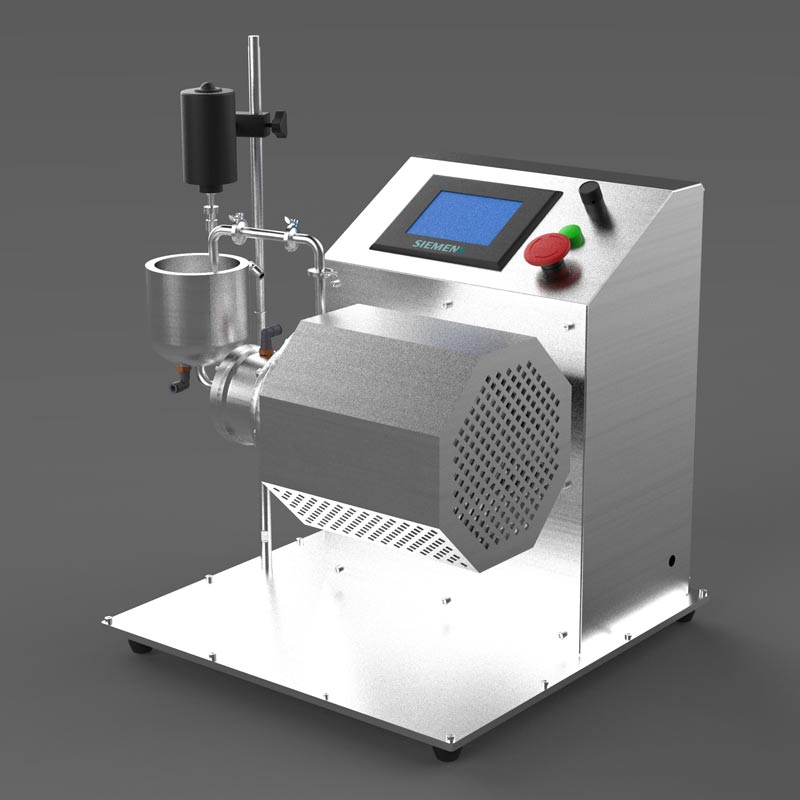
Structurally, the machine consists of a frame, a horizontal grinding chamber with a jacket or other heat dissipation circuit, a rotor with pins, a variable speed drive, a suspension input and output unit, and a separation system that holds the grinding media inside the chamber. Each of these nodes affects the result, and it makes no sense to consider them separately.
Grinding chamber and pin rotor
The pins on the rotor are radial pins arranged in several rows. When rotating, they impart intense motion to the grinding bodies and suspension, creating high shear zones and local vortices. Unlike a smooth disc, a pin rotor “grabs” the medium better, so for fine grinding it transfers energy more efficiently, but at the same time increases wear and heat. The gap between the pins and the inner wall of the chamber is an important design parameter: it must be consistent with the diameter of the grinding media, otherwise the medium either jams or bypasses the grinding zone. You need to check this according to the manufacturer's documentation, and not by appearance.
Grinding media and their retention
Bead mills use balls of small diameter - usually fractions of a millimeter. The smaller the ball, the more contacts per unit volume and the thinner the result can be, but also the higher the requirements for the separating device and the purity of the initial suspension: large particles and foreign inclusions clog the separator slots. The grinding bodies wear out, and their material gets into the product - this is a normal process, not an accident, so the pair “ball material - sample material” is selected consciously. The diameter, density and material of the balls must correspond to both the viscosity of the suspension and the permissible level of impurities.
Circulation, temperature and cleaning
The suspension can pass through the chamber once or return repeatedly to the intermediate container; The circulation mode gives a more uniform result and allows you to control the temperature in the circuit. Heating in a bead mill is not an afterthought: the viscosity, stability of additives and even the phase composition of sensitive materials depend on temperature. Air or water jacket cooling removes heat from the housing, but the measured outlet slurry temperature is not the same as the wall temperature or cooling loop setpoint. Temperature-sensitive systems require separate confirmation of process suitability rather than assuming that cooling solves all issues.
How to read specifications correctly
In descriptions of bead mills, it is easy to confuse values that are similar in meaning, and both the load and the size expectations depend on this. It is useful to separate camera geometry, kinematics and output.
Chamber volume and workload
The total volume of the grinding chamber is not equal to either the volume of the loaded suspension or the mass of the dry powder. Part of the volume is occupied by grinding bodies, part must remain free for the movement of the medium. Therefore, the documentation separately includes the useful volume, the recommended degree of filling and the permissible weight of the sample. When planning an experiment, proceed from the mass of the solid phase that needs to be processed and from the content of dry substances in the suspension, and not from the chamber volume figure.
Rotational speed and peripheral speed
The rotor rotation frequency in itself says little: with different chamber diameters, the same revolutions give different linear speeds at the periphery. To compare modes, it is more correct to use the peripheral speed and the associated energy density. Increasing the speed speeds up grinding, but increases heat, wear and the risk of grinding particles and changing their shape; in addition, there is a limit beyond which the increase in fineness becomes insignificant.
Size: what the result really means
The fineness values given in catalogs are usually obtained using a specific model material and a specific measurement method. They do not constitute a guarantee for any sample. The final particle size depends on the initial particle size, hardness, nature of the material, type and size of grinding media, material-medium ratio, processing time and control method (sedimentation, laser diffraction, microscopy give different numbers). The correct formulation of the problem is not “you need X nanometers”, but “you need a stable distribution with such and such a median size and such and such an upper limit, measured by such and such a method.”
Materials, media and limitations
Where the method works well
The horizontal bead mill is suitable for medium to high viscosity suspensions: pigment pastes, ceramic slips, lithium power supply materials, inks, coatings, pharmaceutical and cosmetic dispersions. It is also often the fastest way to get a pilot batch up to a condition suitable for application and testing when the planetary mill distributes too widely or overheats the material.
Where restrictions begin
Highly abrasive powders accelerate wear of the rotor, chamber and grinding media, and therefore increase the risk of introducing impurities; For such problems, the choice of component materials becomes the main, rather than a secondary, decision. Viscous and thixotropic systems require matching of the pump and the circulation circuit. Shear- or temperature-sensitive materials may change particle morphology or degrade. Finally, the bead mill is not designed for coarse crushing: pieces and granules above a certain size must be pre-crushed by other equipment.
Selection criteria and node compatibility
The selection begins not with a model, but with a description of the task: the mass of the solid phase in one cycle, the target particle distribution, permissible heating, cleanliness requirements and further operation (application, drying, sintering, analysis). These requirements are then translated into chamber volume, drive type, part material, cooling circuit and circulation method.
Coordination of materials and grinding media
The material of the chamber, rotor and balls is selected according to the hardness of the sample and acceptable contamination. Ceramics based on zirconium dioxide and corundum are chemically more inert than steel, but they also wear out; Polymer coatings reduce metal grinding, but they dissipate heat worse and wear out faster due to abrasives. The formulation “free of contamination” is incorrect in principle: we are always talking about a controlled and acceptable level of impurities, which is confirmed by analysis of the product, and not by a promise.
What cannot be transferred between types of equipment
The grinding bowl of a planetary mill is an independent replaceable container designed for a specific planetary installation. For example, corundum grinding glass It is used in planetary mills and is not installed in a horizontal bead mill, where the grinding chamber is the machine body, and not a removable glass. A similar logic applies to grinding media: balls selected for planetary grinding do not automatically become suitable for the bead chamber - they have a different diameter, a different separator and different speeds. Compatibility is confirmed by the manufacturer's documentation, and not by the external similarity of the parts.
Scalability and reproducibility
The laboratory installation is valuable because it allows you to fix the recipe and regime, and then transfer them to more productive equipment. For such transfer, not only geometry and speed are important, but also specific energy per unit mass, process temperature and residence time of the suspension in the chamber. If these values are not recorded in the protocol, comparison of results between batches becomes meaningless. It is convenient to start an overview of directions and types of equipment with site TENCAN, and specific operating conditions and equipment can be specified in the product data sheet.
Frequently asked questions
Is it possible to work without grinding media, just with a rotor?
A rotor without a medium performs dispersion and mixing, but not fine grinding: without balls there are not enough contacts to transfer energy to the particles. The mode without grinding media is suitable for wetting and breaking up loose agglomerates, but submicron results should not be expected from it.
Is the mill suitable for dry powder?
No. The horizontal bead mill is designed for liquid phase: suspension or paste. Dry grinding requires a different operating principle and different equipment, and an attempt to work with “almost dry” material leads to overheating, settling and clogging of the separator.
What determines the processing time?
From the hardness and initial size of the material, the viscosity of the suspension, the size and density of the grinding media, peripheral speed and circulation mode. The time is selected experimentally according to the “size-time” curve, and not according to a universal recommendation: after a certain point, the increase in fineness slows down, and wear and grinding increase.
How to understand that the regime is too strict?
Signs are an increase in temperature under constant conditions, the appearance in the distribution of particles of a fraction that was not in the original material, a change in color or rheological properties of the suspension, accelerated wear of components. In such cases, reduce the speed, reduce the cycle time, or switch to a different material for the lining and grinding media.
Bottom line
The Laboratory Pin Rotor Horizontal Bead Mill is a wet fine grinding and deagglomeration tool, not a general purpose machine for all powders. Its result is determined by the jointly selected suspension, grinding media, chamber geometry and thermal conditions, and the passport size values remain a guideline that is checked on a specific material. This approach saves time at the sample preparation stage and makes the results comparable between experimental series.