
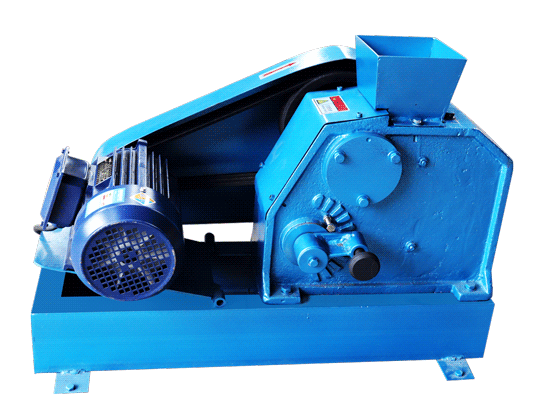
A laboratory jaw crusher is equipment for the primary destruction of sample pieces by compression between fixed and movable jaws. In the sample preparation system, it takes place before fine grinding: after crushing, the material can be fed into a ball, vibrating or bead mill for sample reduction or further analysis. In the catalog TENCAN this is a separate type of equipment; The exact parameters of a specific version are given in laboratory jaw crusher card.
What is a laboratory jaw crusher and where does it fit in the sample preparation chain?
The jaw crusher does not reduce the material into a fine powder. Its job is to reduce large pieces to a size that can be safely and reproducibly fed to the next stage. Destruction occurs primarily due to compression: the piece falls into the chamber between the cheeks, is pinched as the movable cheek approaches, and is destroyed along cracks and weak sections.
Unlike a ball, vibratory or bead mill, where impact, abrasion and repeated collisions of grinding media are important, a jaw crusher operates as a primary crushing machine. Therefore, it cannot be judged by its minimum grind size, like a mill. The correct question when choosing is different: what is the maximum piece that needs to be accepted, what size should it be brought to, and what is the next operation awaiting the material.
The representativeness of the sample is important for the laboratory. If only a few large pieces are crushed and the rest of the sample is discarded, the result may not reflect the composition of the batch. It is common to think ahead about reduction, averaging, and chamber cleaning procedures between samples. The jaw crusher here is part of the sample preparation circuit, and not an isolated device.
A jaw crusher should not be confused with a roller crusher, disc crusher or mill. They have different failure principles, different product profiles and different material limitations. Even if two devices look compact and laboratory, this does not make them interchangeable.
Design and operating principle: from the receiving hopper to the discharge slot
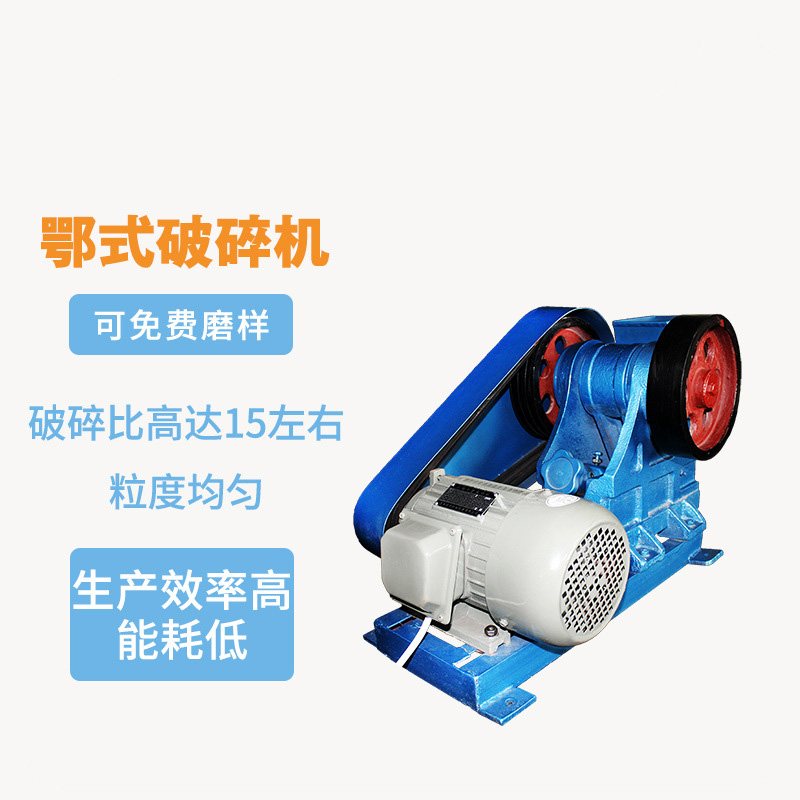
A typical laboratory jaw crusher includes a frame, a crushing chamber, fixed and movable jaws, an eccentric shaft drive, a flywheel, a discharge slot adjustment mechanism, and a receiving hopper. The specific layout depends on the model, so when working, refer to the manufacturer's manual, and not to general descriptions.
Crushing chamber and jaw movement
The material is fed from above into the space between the cheeks. The fixed cheek is fixed on the frame, the movable one makes a reciprocating movement. When the cheeks come together, the piece is pinched and destroyed; when the movable cheek moves away, the crushed material falls down and gradually exits through the unloading slot.
The profile of the cheeks and the condition of their working surface affect the grip of the piece and the nature of the product. Worn or damaged jaws can reduce feed, increase unwanted particles and create a risk of jamming. The condition of wear elements is checked according to the documentation of the specific model.
Drive, eccentric shaft and overload protection
The electric motor transmits motion through a belt drive, flywheel and eccentric shaft. The flywheel smoothes out uneven loads, and the eccentric shaft sets the working stroke of the movable cheek. Many designs include a spacer plate or other protective element that takes part of the load during an overload.
Protection does not mean that any piece or foreign object can be fed into the crusher. Metal inclusions, tools and random solids can damage working parts. Limit operating conditions and the procedure for action in the event of jamming should be described in the manual.
Adjusting the unloading gap
The discharge slot determines the minimum distance between the cheeks at the bottom of the chamber. Its position is regulated by a mechanism provided for by the design: wedge, spacer or other. After changing the setting, it is important to ensure that the mechanism is locked and that the chamber is clear of material.
The nominal gap is not equal to a single exit particle size. The actual product has a particle size distribution, and its shape depends on the material and mode. Some of the particles may be elongated, and small fractions are formed not only due to adjustment, but also due to the destruction of pieces in the chamber.
Feeding and unloading
The receiving hopper directs material into the chamber and reduces the risk of chunks being thrown out. The feed is carried out evenly, without filling the chamber above the permissible level. Pushing the material with hands or foreign objects is unacceptable: for this, use the techniques and protective equipment provided by the manufacturer.
The unloading area must provide free exit of the product. If the hopper is overfilled or material builds up, performance will decrease and the chamber may become clogged. This is especially noticeable for wet and sticky samples, so the possibility of crushing them is checked separately.
Characteristics and their correct reading
In the product card, it is important to distinguish between parameters that describe the permissible feed, setting and estimated performance. The same number may refer to different conditions, unless it is indicated for which material and mode it was obtained.
Receiving hole and maximum piece
The receiving opening characterizes the size of the chamber inlet section. The maximum piece the manufacturer will allow may be less than this size and usually depends on the shape of the piece and the condition of the cheeks. A flat, elongated or wedge-shaped piece behaves differently than one that is close to a cube.
In practice, you should not focus on the maximum piece without a margin. Feeds that are too large or incorrectly oriented increase the risk of jamming and overloading. If the sample contains many large fractions, first evaluate the need for preliminary separation or reduction of the pieces in another way.
Discharge slot and product size
The discharge gap is a setting option, not a promise of a specific size for any material. Brittle materials break down more easily, ductile materials produce more elongated particles, and heterogeneous rock produces a wider distribution. For the next stage, not only the average value is important, but also the upper limit of the size.
If the card indicates an adjustment range, it is read along with a description of the mechanism and measurement conditions. The range of one model cannot be transferred to the entire range of jaw crushers. Also, do not assume that reducing the gap automatically provides fine grinding: for micron tasks you need a mill, not just a crusher.
Performance and operating mode
The productivity of a laboratory jaw crusher depends on the size of the feed material, its strength, bulk density, moisture content, gap setting, feed uniformity and permissible load. The table value is therefore a guide to agreed conditions and not a guarantee for any sample.
It is incorrect to compare models only based on maximum performance. For the laboratory, it is more important whether the required piece fits, whether the required size can be obtained, whether the chamber is easy to clean, and whether the drive can withstand repeated cycles. Sometimes a small batch requires more careful serving than advertised.
Power, power, weight and noise
The drive power, voltage, weight and dimensions must correspond to the capabilities of the laboratory. A heavy model may require stable support and a separate electrical line. The noise level and dust formation depend not only on the machine, but also on the material, feeding method and workplace organization.
If an important parameter is missing from the description, it is clarified with the supplier along with the measurement conditions. You should not restore a missing value by analogy with another model or by appearance. For the selection of equipment, documents for a specific design are important, and not general assumptions.
Materials, Applications and Limitations
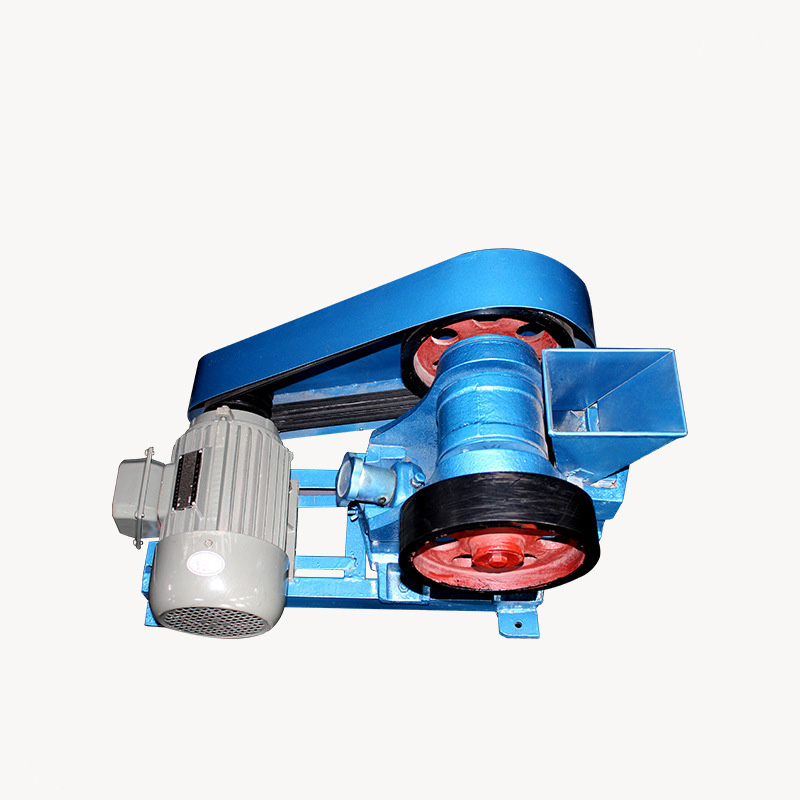
The jaw crusher is typically used for brittle and relatively hard materials that can be broken by compression. These are mineral raw materials, ores, ceramics, glass, slag and building materials. Specific suitability depends on the strength, abrasiveness, moisture content and acceptable contamination of the sample.
Suitable tasks
The crusher is convenient where you need to reduce the particle size before subsequent grinding, obtain a representative sample, or prepare the material for chemical analysis. It can also be part of a small line if downstream operations are consistent in size and weight.
For brittle materials with moderate viscosity, the process is usually stable. If the sample contains inclusions of different hardness, the feeding mode is selected so as not to overload the chamber and not lose representativeness. This is especially important for heterogeneous geological samples.
Restrictions
Plastic, viscous, fibrous and very wet materials may have poor grip, stick to the cheeks and clog the chamber. The jaw crusher is not designed for final fine comminution, deagglomeration or narrow particle distribution. For such tasks, other grinding principles are used.
A crusher cannot be considered a substitute for a mill if the description of the next stage requires micron-sized powder. It should also not be used for materials that, when compressed, deform, melt, or release hazardous substances without specially provided conditions.
Wear, impurities and cleaning
The cheeks and other working surfaces come into contact with the material and gradually wear out. Wear product can get into the sample, so for trace analysis it is especially important to know the material of the working elements and the permissible level of impurities. The transfer of impurities cannot be completely excluded; you can only reduce it and control it.
Cleaning the chamber between samples requires access to work surfaces and removal of trapped particles. If cleaning is difficult, the risk of cross-contamination increases. Cleaning procedures and acceptable products must be in accordance with the manual to avoid damage to the jaws and adjustment mechanism.
How to choose a laboratory jaw crusher TENCAN
In the catalog TENCAN equipment for sample preparation is represented by different classes, so the choice begins not with the name of the model, but with the description of the task. First, the properties of the sample and the requirements of the next operation are recorded, then they check which parameters are confirmed for a specific execution.
Selection sequence
- Determine the sample material: strength, fragility, abrasiveness, moisture and tendency to stick.
- Set the maximum size of the initial piece and the mass of the batch that needs to be processed in one cycle.
- Formulate the requirements for the product: the upper fineness, the permissible proportion of fine fractions and the requirements of the next mill or analysis.
- Check the receiving opening, the range of the discharge slot and the approximate performance of the selected model.
- Assess the material of working elements, wear, accessibility to cleaning and the risk of introducing impurities.
- Check power supply, dimensions, weight, noise and room requirements with laboratory conditions.
Compatible with neighboring operations
The jaw crusher must be compatible not only with the sample, but also with the subsequent mill or reduction system. If fine grinding is required after crushing, check that the product fits in the grinding bowl or drum and that its fineness meets the requirements of the particular mill. Grinding bowls, drums and grinding media are other machines and cannot be considered compatible with a jaw crusher based on brand alone.
For the sample preparation line, it is useful to determine in advance where averaging will take place, how the material will be stored, and which samples should not be mixed. An error at the operational boundary is often more noticeable than a small deviation in a single machine's parameter.
Common mistakes
- Select a crusher only by the size of the receiving hole, without taking into account the shape of the pieces and the permissible load.
- Consider the nominal discharge gap as a guarantee of a certain product size.
- Transfer performance from the description to any material without checking the conditions.
- Use a jaw crusher for fine grinding or deagglomeration.
- Do not take into account wear of working parts and the need for cleaning between samples.
It is useful to check before ordering jaw crusher card with the technical specifications and clarify the missing information. This is more reliable than choosing by appearance or by one advertising parameter.
Short answers to frequently asked questions
How is a jaw crusher different from a ball mill?
A jaw crusher breaks down pieces by compression and serves for primary crushing. A ball mill crushes material by impact and abrasion of grinding media and is designed for finer grinding. These devices solve different problems and do not directly replace each other.
Is it possible to obtain micron-sized powder using a jaw crusher?
As a rule, no. A jaw crusher produces a crushed product rather than a fine powder. Micron sizes usually require a subsequent mill; the ability to achieve a specific fineness depends on the material, initial size and mode.
Why is the stated performance not equal to the actual performance?
Because productivity depends on material strength, bulk density, moisture content, feed coarseness, slot setting and loading uniformity. The table value is a guideline for specific conditions and is not a guarantee for any sample.
How to reduce the transfer of impurities?
The material of the cheeks and other working surfaces must be taken into account, the chamber must be cleaned between samples and, if possible, the sample must be checked for contamination. Wear cannot be completely eliminated, so control and the correct choice of design are especially important for trace elements.
Is the crusher suitable for wet material?
Wet and sticky materials can clog the chamber and impair feeding. The possibility of their processing is checked according to the manual and the results of trial crushing; It cannot be assumed that a laboratory jaw crusher is suitable for any wet sample.
To make the correct choice, it is enough to consistently describe the sample, the required size and the next operation, and then compare this data with the confirmed characteristics of a particular model TENCAN.