
A hydraulic twin-shaft dissolver is a mixing and dispersing equipment for working with liquid and pasty products in a working vessel. Its place in the technological chain is between dosing components and obtaining a finished suspension, paste or slip. The device ensures wetting of the powder, involving the entire volume in circulation and destruction of agglomerates, but does not replace grinding in a ball or bead mill. The specific design and contents of the delivery are given in hydraulic twin-shaft dissolver card.
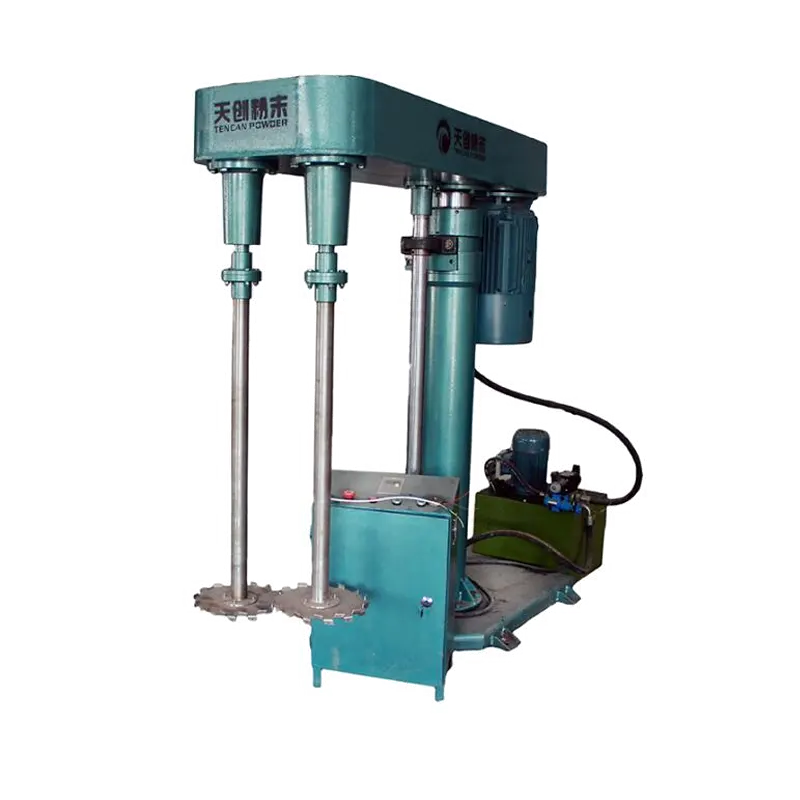
What is hydraulic twin shaft dissolver and where is it located in the process
In Russian technical practice, similar devices are called dissolvers or dissolvers; in the title TENCAN the "dissolver" form is used. This does not change the essence: this is a machine for introducing powder components into a liquid medium and obtaining a more uniform dispersed system. It works with suspensions, pastes, polymer solutions, pigment concentrates and other similar media, if the materials and mode are compatible with the specific design.
A dissolver is not a reactor, dryer or mill. Its task is to create controlled product movement and an intense shear zone. As a result, the powder is wetted, lumps are destroyed, and the distribution of components becomes more uniform. In this case, the primary particles can remain the same size: dispersing agglomerates and grinding solid material are not the same thing. Therefore, the promise of “any given size” only due to the dissolver is technically unfounded.
The twin-shaft arrangement allows the two functions to be separated. One working body is usually responsible for the general flow and involvement of the entire volume, the second is responsible for the local high-shear effect. This separation is useful for viscous media, when one mixing element is not enough for uniform circulation. However, the specific shaft geometry, direction of rotation, diameters and drives are determined by the design. They cannot be guessed by name.
The word "hydraulic" indicates the presence of a hydraulic circuit, but does not reveal its function. In different machines, hydraulics can serve the raising and lowering of the working element, fixing the traverse, moving the unit or drive. For selection, it is not the word itself that is important, but what operations are mechanized, what lifting height is needed, how the service is arranged and what requirements are placed on the hydraulic system. This information should be in the documentation for your specific model.
General directions of equipment TENCAN can be checked on main page of the site. For the task of preparing a suspension, it is important to compare exactly the mixing and dispersing equipment, and not to transfer the characteristics of mills or presses to the dissolver.
How a twin-shaft unit works: mixing and dispersing
Two impact zones
In a two-shaft dissolver, one can roughly distinguish a general mixing zone and a dispersion zone. The first supports the movement of the entire volume, prevents stagnation at the walls and bottom, and helps draw the powder into the liquid. The second creates a higher shear near the working body: there the agglomerates are destroyed more intensively, and the liquid phase penetrates better into the pores of the powder.
The result depends not only on the number of revolutions. What matters is the diameter of the working body, its shape, position in the vessel, the ratio of the diameters of the vessel and the stirrer, the viscosity of the medium, the solid phase content and processing time. A fast shaft with a small disk and a large slow shaft solve different problems; they cannot be compared only by the signature “dissolver”.
Hydraulic circuit: what does it change in practice?
Hydraulics are important for operation, but their parameters are not equal to dispersion parameters. The pressure in the hydraulic system does not characterize the shift in the product and does not allow one to judge the quality of the dispersion. If the specification indicates hydraulic pressure, it refers to the drive or movement assembly, not the suspension shear stress. Such quantities must be read in the context of their purpose.
When choosing, it is worth clarifying what movements the hydraulics perform, how the working position is fixed, what happens during an emergency shutdown, how seals and filters are maintained. For a large installation, access to components, stability of the traverse, safety during lifting and a clear locking procedure are important. These are not “additional amenities”, but part of normal operation.
What a dissolver does not replace
The dissolver does not replace a ball, planetary, vibration or bead mill. In a mill, grinding occurs due to grinding bodies and repeated impacts or abrasion; in the dissolver, the working medium is mixed and dispersed without such a grinding load. If the task is to reduce the size of strong primary particles, a different type of equipment and a separate test mode is needed.
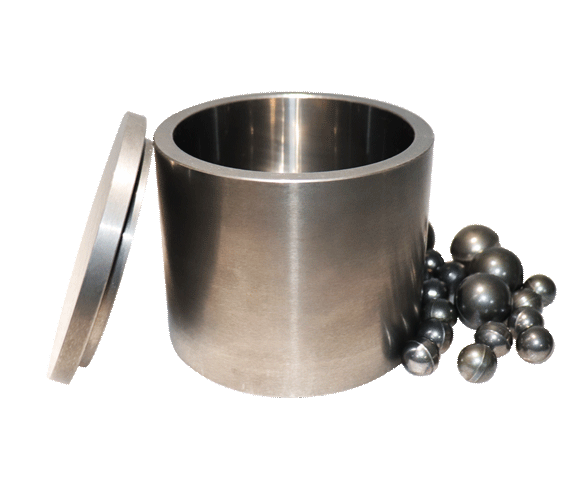
The tungsten carbide grinding bowl is designed for planetary mill. This is a different class of equipment; the image does not confirm its compatibility with the dissolver.
It is also useful to distinguish between mixing and dispersing. Mixing equalizes the composition by volume, but does not necessarily destroy agglomerates. Dispersion is aimed at wetting and deagglomeration, however, it does not guarantee a certain particle size distribution. The end result is always verified on the actual product and not derived from the name of the machine.
Device and parameters: what to check on the card
In a typical dissolver, several groups of elements can be distinguished. Their composition depends on the version, so the list below is not a statement about the configuration of a specific model, but a guideline for checking the documentation.
- Working vessel: geometry, volume, material, presence of jacket, lid, drain and sensors.
- Shafts and working bodies: type, diameter, location, direction of rotation, possibility of replacement.
- Drive: power, torque, control range, starting and protection.
- Hydraulic unit: purpose, stroke, fixation, maintenance, fluid requirements.
- Seals and Atmosphere: Normal operation, vacuum or inert atmosphere only if specified.
- Control and safety: interlocks, emergency stop, access to moving parts, grounding.
Not all of the nodes listed are required. For example, a vacuum design or cooling jacket may be an option rather than standard. You cannot turn an option into a basic characteristic without confirmation. Also, you should not transfer the parameters of one model to the entire range: volume, power and speed vary from machine to machine.
How to read basic parameters
| Parameter | What does it mean | What to clarify |
|---|---|---|
| Vessel volume | Geometric capacity of the working chamber | Useful volume, permissible working load, free side |
| Workload | The amount of product that maintains normal circulation | Minimum and maximum, dependence on density and viscosity |
| Drive power | Installed engine power | Torque, drive type, permissible viscosity |
| Rotational speed | Shaft revolutions in selected mode | Range, working body diameter, regulation |
| Peripheral speed | Estimated speed of a point on the edge of the working element | For what diameter and mode is the value given? |
| Medium viscosity | Rheological characteristics of the product | Measurement method, shear rate, temperature |
| Contact material | Material of parts in contact with the product | Brand, coating, resistance to media and abrasive |
| Temperature | Possibility of heating or cooling, if available | Jacket type, coolant, product temperature control |
The volume of the vessel and the mass of the load are different quantities. Liters describe the capacity, kilograms describe the amount of product; conversion depends on density and rheology. It cannot be said that a vessel with a volume of X always produces a batch of mass Y. It is also unacceptable to mix the total volume, payload and productivity per shift: the latter depends on the operation time, downtime and quality requirements.
Rotation speed without the diameter of the working body says little about the shift. For comparison, peripheral speed is used, but it is not the only criterion: the shape of the disk, the gap, circulation and the properties of the medium are important. Drive power alone also does not guarantee fine dispersion. A more powerful motor may be needed for a viscous product, but the quality is determined by the combination of geometry and mode.
Materials, media and limitations
The material of the contact parts is selected according to chemical compatibility with the liquid phase, abrasiveness of the powder, temperature and cleaning method. Stainless steel, polymer coatings and ceramic elements have different limitations. Neither option means "zero contamination": wear, solvents and abrasive particles can carry contaminants. For sensitive materials, it is important to evaluate not only the original material, but also wear debris and cleanability.
A dissolver usually works with a liquid medium. Dry mixing of powders is a different task and requires different equipment. When introducing a powder into a liquid, loading order, feed rate, wettability and tendency to clump are important. These issues are resolved during a trial batch; There is no universal recipe or “correct” time for all materials.
High solids content increases viscosity and shaft load. At some point, circulation may deteriorate, stagnant zones or drive overheating will appear. The limit is determined by the specific model, geometry and product, so it cannot be assigned by analogy. For thixotropic and non-Newtonian media, it is especially important to check the behavior at different shear rates.
Flammable solvents, dust and toxic components require a separate safety assessment. If a design does not provide explosion protection, ventilation and grounding, it cannot be considered suitable for such environments. The presence of the words “laboratory” or “industrial” in the title also does not replace a hazard analysis. The article describes selection principles, but is not a guide to working with hazardous substances.
Cleaning affects the transfer of impurities between batches. It is necessary to check access to the walls, bottom, shafts and seals, the possibility of disassembly and the compatibility of detergents with materials. If a product is prone to crusting, not only the smoothness of the surface is important, but also the geometry and the absence of hard-to-reach pockets. It is better to find out these details before purchasing, and not after the first cycle.
How to choose a hydraulic twin-shaft dissolver
The choice begins with the operation, not with the equipment list. You need to understand what exactly is required: to dissolve the polymer, moisten and deagglomerate the powder, obtain a paste, maintain the suspension in suspension, or combine several stages. Different tasks require different working parts and modes, even if the machines are similar in appearance.
- Formulate the purpose of the operation and readiness criteria: absence of lumps, sample uniformity, suspension stability, permissible temperature, processing time.
- Determine the batch range and working volume. Do not confuse the volume of the vessel with the payload and do not choose a car only based on its maximum displacement.
- Assess rheology: viscosity, yield stress, thixotropy, solids content. For complex media it is useful to carry out a trial dispersion.
- Check chemical compatibility and wear. The contact material must withstand the environment, temperature and cleaning.
- Compare shaft configuration and drive. Power, diameter and speed are read together, not separately.
- Take into account the infrastructure: room height, electrical, hydraulics, ventilation, grounding, access for maintenance.
- Record the contents of the supply and operating limits in the documentation. Options must be listed explicitly.
Tool compatibility
The dissolver works with the working vessel and working bodies provided for by its design. Grinding bowls of planetary mills, grinding media and drums of roller mills belong to another class of equipment. A coincidence of material or size does not prove compatibility. Without confirmation from the manufacturer, such a combination cannot be considered standard, especially when it comes to fastening, compaction, speed and load.
In particular, the tungsten carbide glass is designed for planetary mill. It must not be described as a dissolver container or used in place of a working vessel without written confirmation. For a dissolver, not only the material and volume are important, but also the geometry, fastening, cover, clearances and permissible speed.
What to request from the supplier
- The current specification of the specific design and the contents of the delivery.
- Working load range, permissible viscosity and temperature limits.
- Type of working body, diameter, speed and recommendations for modes.
- Contact materials, seals, ability to clean and replace components.
- Requirements for hydraulics, electrical, ventilation and maintenance.
- Documentation on safety, interlocks and emergency stop.
It is useful to agree on a trial batch and acceptance criteria. This reduces the risk that the machine is formally suitable in volume, but does not provide the required circulation on the actual product. In this case, the test results relate to a specific material and mode; they cannot be automatically transferred to another composition.
Brief answers to frequently asked questions
How is a dissolver different from a ball mill?
The ball mill grinds the material with grinding media, and the dissolver mixes and disperses the medium without such a grinding load. A dissolver can destroy agglomerates, but is not required to reduce the size of strong primary particles. Therefore, you cannot replace the mill with a dissolver.
Can the planetary grinding bowl be used as a work vessel?
No confirmed compatibility. The planetary cup is designed for a different type of fastening and load. For the dissolver, a vessel provided by the design is used; Without confirmation from the manufacturer, the replacement is not considered standard.
What does the "hydraulic" in the name mean?
This indicates the hydraulic circuit, but does not reveal its function. Hydraulics can serve lifting, fixing or driving; The specific purpose is checked according to the documentation. The pressure in the hydraulic system is not equal to the shear stress in the product.
Is the drive power sufficient for evaluation?
No. Power is important for viscous media and large batches, but the result depends on the shaft geometry, diameter, speed, vessel shape and product properties. It is impossible to compare installations only by kilowatts.
Can I work with flammable solvents?
Only if the design and documentation allow such an environment, and the necessary measures are provided: grounding, ventilation, control and protection. The general article does not replace the safety assessment and operating instructions.