
What is a high-speed simple dispersant and where does it stand in the process chain?
A high-speed simple disperser is a device that introduces a powder or paste into a liquid medium and distributes it throughout the volume using a rapidly rotating working element. The material is in a container: the shaft with the disk is immersed in the suspension, creating intense circulation and local high shear zones, due to which lumps and agglomerates are destroyed, the particles are wetted, and the concentration is leveled throughout the entire working volume.
In the technological chain, such a device occupies an intermediate position between dosing components and fine grinding. Its task is not to reduce the primary particles, but to obtain a homogeneous, separation-resistant system with a reproducible particle size distribution. Therefore, the dispersant cannot be considered either a “reverse mill” or a reinforced mixer: it has different mechanics, different parameters and different selection criteria.
A product card with a description and updated technical data is posted on the website TENCAN: High Speed Simple Disperser.
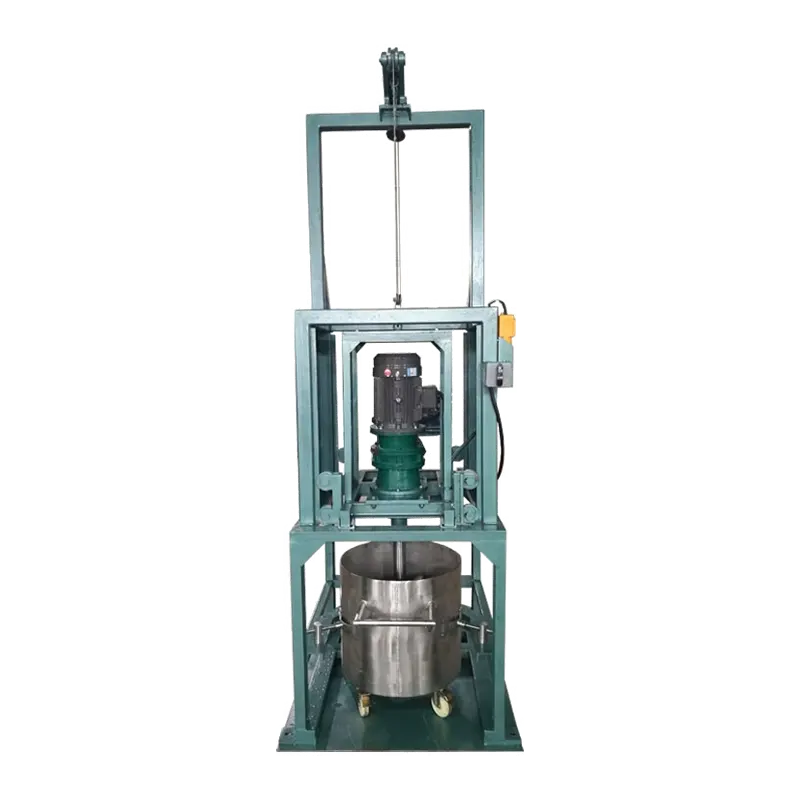
Design and working principle
A typical installation of this class includes a frame or stand, a drive with an electric motor, a vertical shaft, a working element in the form of a gear or bladed disk, a unit for attaching and moving the shaft in height, as well as a container - its own or replaceable. The control panel sets the rotation speed and, as a rule, allows you to change it during processing. A specific set of components, the material of the contact parts and the method of fixing the container for the model TENCAN you need to check it on its card: the name “simple” indicates the basic version, but does not describe the entire package.
The working body rotates at high frequency; At the periphery of the disk, the linear speed is maximum, and it is there that the greatest shear stresses arise. Several zones are formed in the volume: an area of intense shear at the edges of the disk, a circulation zone where the material rises and falls along the walls of the container, and a relatively calm central area. The quality of dispersion depends on how often each particle passes through the shear zone, not just on the maximum rotational speed.
What happens to particles during dispersion
Dispersion involves several sequential phenomena. First, the liquid must wet the surface of the powder: if wetting is poor, the powder remains in the form of films and lumps even after prolonged mixing. Then agglomerates—secondary formations held by interparticle forces and capillary bridges—are destroyed. In this case, the primary particles, as a rule, are not crushed: the dispersant separates what has already stuck together, and does not crush the crystals. The final stage is stabilization: the particles must remain in a distributed state after the shaft stops.
Hence the practical conclusion. If the suspension separates, the reason is not always the speed: it may be insufficient wetting, the wrong stabilizer, the viscosity of the medium is too high, or the fact that the powder was introduced outside the zone of maximum turbulence. Changing the load order often does more than increase the RPM.
Disperser, mixer and mill are different machines
A paddle or V-shaped mixer mixes the ingredients, but creates almost no local shear. The dispersant works with a liquid or paste medium and creates a shear sufficient for deagglomeration. The bead mill adds grinding media to the chamber and, due to their movement, ensures fine grinding. A planetary, drum or vibrating ball mill grinds material in grinding bowls or drums with grinding media and solves the problem of particle size reduction, not just homogenization. Replacing one apparatus with another in order to save a stage almost always leads to the wrong result: either the system remains inhomogeneous, or the sample receives excessive wear and impurities.
Key parameters and how to read them correctly
A dispersant specification reads not as a list of maximums, but as a set of interrelated constraints. Not a single indicator is automatically transferred from one model to the entire range, therefore, when selecting, they compare exactly the design that is offered for a specific task.
Rotational speed and peripheral speed
The catalog usually indicates the shaft speed range in revolutions per minute. For the physics of the process, the peripheral speed of the working body is more important: it is proportional to the product of the rotation speed and the diameter of the disk. A large diameter disc at moderate rpm can create the same amount of shear as a small disc at high rpm. Therefore, it is incorrect to compare installations only by the number of revolutions, and even more so to transfer the mode from one device to another without taking into account the geometry of the working element and the volume of the container.
Tank volume and workload
The total volume of the container and the working load are different values. The working load is always less than the geometric volume: part of the container remains free for circulation and for the wave of material that the disk raises. In addition, it is necessary to distinguish between batch volume and productivity over time: a batch apparatus processes one volume per batch, and calculation by kilograms per hour requires taking into account the time of dispersion, loading and unloading. The values for a specific model are indicated in its card - they should not be guessed based on the appearance of the installation.
The viscosity and density of the medium are checked separately: thick pastes require not only power, but also a suitable disk geometry, otherwise the material simply rotates with the shaft, and the volume shift remains low. Temperature is also a mode parameter: during prolonged operation, viscous systems heat up, and this affects the stability of the suspension.
Materials, applications and limitations
Where a High Speed Dispersant is Appropriate
Such devices are used where it is necessary to quickly introduce powder into a liquid and obtain a homogeneous suspension or paste: in the production of paints and varnishes and pigment pastes, ceramic slips, suspensions for chemical current sources, magnetic and optical compositions, adhesives, sealants, cosmetics and food products, as well as in laboratory sample preparation, when a reproducible sample is required to analyze the particle size distribution.
In laboratory practice, a dispersant is often used as a preparatory step: it brings the sample to a homogeneous state before measurement or before further processing in a mill. This does not replace grinding, but it does noticeably reduce the variation between parallel samples.
Limitations to consider in advance
The first limitation is the environment. The high-speed dispersant is designed to work with liquid or paste; Dry mixing of powders is accomplished using other equipment. The second is abrasiveness: solid fillers accelerate wear of the working body and the walls of the container, and wear products enter the material. Third, volatile solvents and dusting: working with them requires taking into account ventilation and safety rules, which are determined not by the catalog, but by the regulations of a specific production. The fourth is foaming: excess air in the suspension distorts the density and distribution of particles, and sometimes the result of subsequent operations.
Finally, the dispersant should not be expected to bring the system to any given particle size. The achievable particle size depends on the initial powder size, the properties of the medium, the mode and method of measurement; The typical catalog value is not a guarantee for each sample.
Selection criteria, compatibility and location of grinding media
The selection begins with three questions: what batch size is needed, what is the viscosity of the medium and what result is considered acceptable. Next, the requirements for cleanliness are clarified: is it permissible for material from the working element to get into the product, how is the device cleaned between different compositions, and is there a risk of cross-contamination. Then they check whether the container of the required size fits, whether the type of drive matches the available power supply, and whether the speed range is sufficient for the planned modes. All this data is taken from the card of a specific product, and not from general considerations.
Corundum grinding balls: another class of accessories
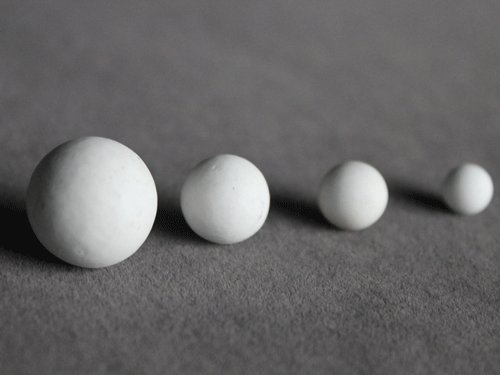
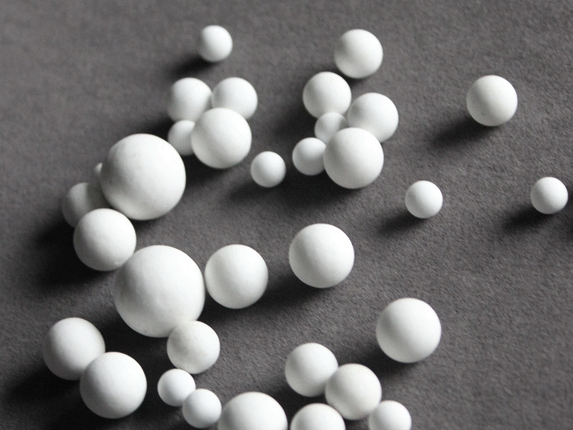
A separate group consists of grinding media. Corundum grinding balls made on the basis of aluminum oxide (Al2O3) - a material with high hardness and wear resistance. Their purpose is to serve as a grinding medium in ball mills: planetary, drum on rollers, vibration, where the material is processed together with a grinding bowl or drum and where abrasion-resistant material is needed.
It is important not to transfer the properties of the grinding media to the dispersant. In a high-speed apparatus with a toothed disk, grinding media are usually not used: the working element itself creates shear, and free balls do not add the necessary deagglomeration, but create an impact load on the shaft, walls and bottom of the container. This is not an “increase” of dispersion, but a different process - the abrasion and impact characteristic of mills. If both homogenization and grinding are required, the operations are divided into stages or a bead mill is used, where grinding media are a standard design element.
When working with corundum balls, take into account compatibility with a specific device: size, drum material, load weight, as well as wear and cleaning. Neither corundum nor other ceramic materials provide “zero contamination”: the only question is how critical the introduced impurities are for the product and how long the treatment lasts.
Frequently asked questions
Can a high speed dispersant be used for dry mixing of powders?
As a rule, no. The device is designed for liquid or paste-like media: when dry, the disk does not create a stable shear, but it generates dust and becomes clogged. For dry mixtures, drum, V-shaped and spatial mixers are used. Features of a specific design are specified in the product card.
How is a dispersant different from a bead mill?
Presence of grinding medium. In a disperser, shear is created by a rotating disk, and in a bead mill, it is created by the movement of grinding media in the chamber. The first separates agglomerates, the second is capable of reducing particle size. These are different tasks and different selection criteria.
Does increasing the rotation speed result in a thinner product?
Not directly. An increase in rotation speed increases shear and accelerates disagglomeration, but the primary particles are usually not crushed during dispersion. The final size distribution depends on the initial powder, medium, mode and measurement method; the limit value for one material cannot be extended to another.
Is it permissible to load corundum balls into a dispersant?
This is not the normal mode. Grinding media are designed for mills, where they move along a given trajectory. In a disperser, loose balls produce shock loads on the shaft and container, so it is impossible to mix the two principles in one device without confirmation from the manufacturer.
How to approach the choice of performance?
Go from the task: batch volume, viscosity, required degree of homogeneity, restrictions on impurities, purification conditions. Then compare these requirements with the parameters of specific models. TENCAN — Changsha Tianchuang Powder Technology Co., Ltd. — develops and supplies grinding, mixing and laboratory equipment; An overview of the directions is given on the website www.tencanballmills.com.