
A high-speed dispersant-homogenizer is equipment for intensive mixing, dispersing and homogenizing liquid, paste and suspension systems. In the process chain, it is usually located between the preparation of components and subsequent processing: molding, coating, analysis or packaging. Its purpose is to obtain a stable, homogeneous environment, and not to replace grinding equipment. In the catalog TENCAN the product is presented in the mixing equipment section; Specific parameters, equipment and operating limitations are specified in high-speed dispersant-homogenizer card TENCAN.
What is a high-speed dispersant-homogenizer and where does it work?
The name combines two close, but not completely identical operations. Dispersion means the distribution of a solid or liquid phase in a medium and the destruction of agglomerates that are held together by weak bonds. Homogenization involves obtaining a homogeneous system, often an emulsion, with as uniform a distribution of droplets or particles as possible. In a real problem, these processes often go together: first, the powder is wetted and distributed in the liquid, then large agglomerates are broken up, and the medium is stabilized.
A high-speed dispersant-homogenizer is used where a conventional paddle mixer is not enough: in the preparation of suspensions with a high proportion of solid phase, pastes, emulsions, polymer solutions and composite compositions. For a laboratory, this may include preparing samples before analysis or molding; for production - preparing a batch of product with a given homogeneity. However, the equipment is not a universal “grinder of everything”: if it is necessary to reduce the size of strong primary particles, a ball, bead or other mill is usually needed, and not just a mixer-homogenizer.
It is important to distinguish between a dispersant-homogenizer and grinding equipment. In a ball mill, the material is processed by grinding media, and the main mechanism is impact and abrasion. In a high-speed homogenizer, energy is transferred through the working element and the fluid flow: shear deformations, turbulence, edge impacts and cavitation effects occur. This mode destroys soft agglomerates and drops well, but does not guarantee fine grinding of hard crystals or abrasive powders.
Working principle and main elements
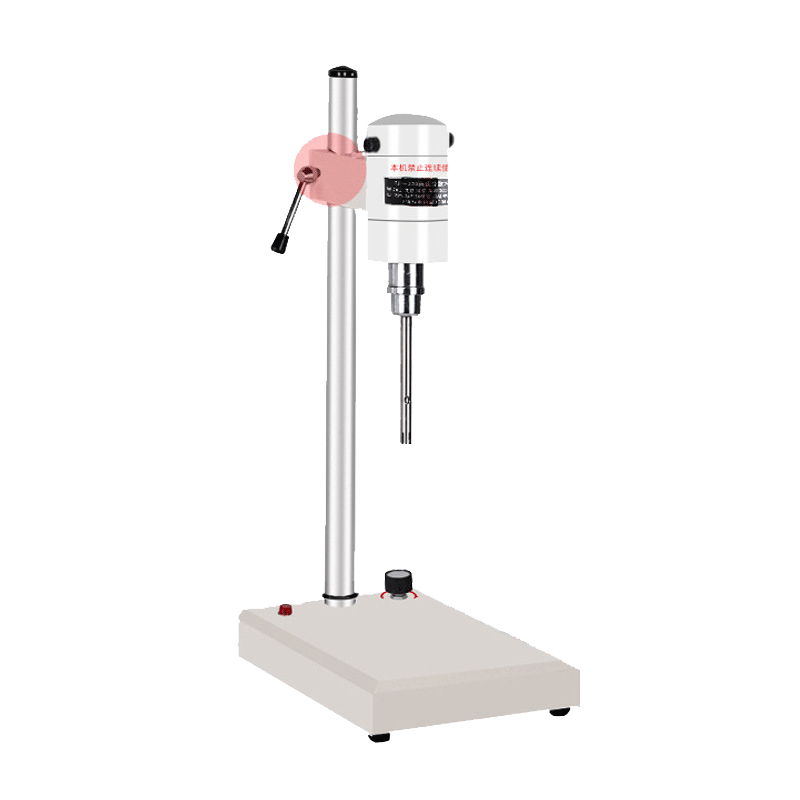
A typical arrangement includes a drive, a shaft, an end-effector, a work container, a frame or mounting system, and a control unit. The drive rotates the working element; the material is drawn into the processing zone, passes through it and returns to the volume of the container. The more intense the circulation and the higher the local shear rate, the faster the wetting and destruction of agglomerates occurs, however, excess energy can cause heating, foaming and air entrapment.
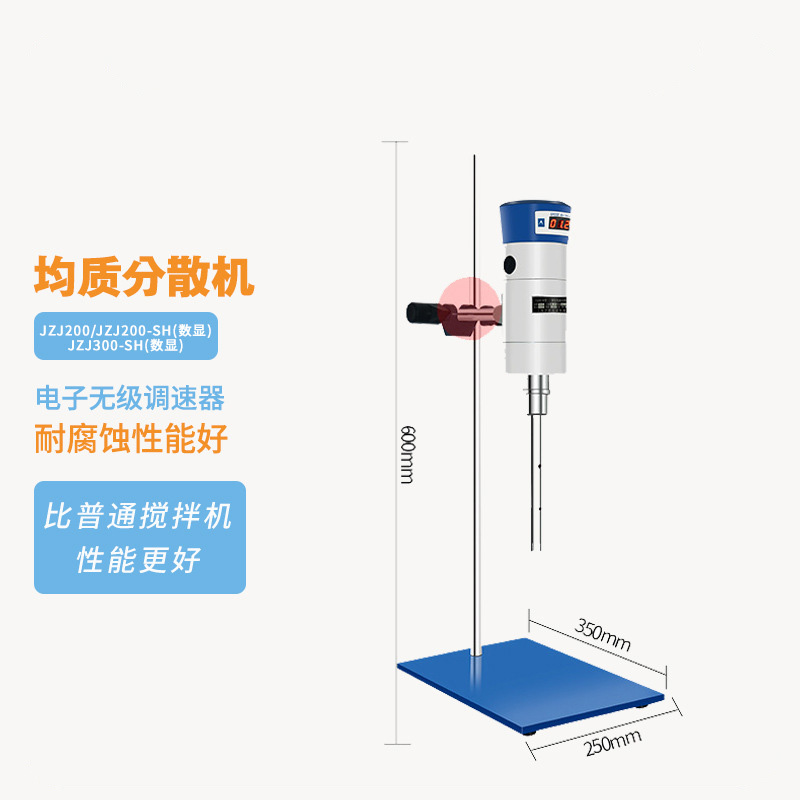
For specific execution TENCAN you need to check: the type of working element, its diameter and material, the permissible loading volume, the method of fastening the container, the presence of speed control, overload protection and the possibility of thermostatting. The characteristics of one option should not be transferred to the entire model range: even machines with similar names may differ in drive, seals and working body.
What happens to the material
First, the liquid must wet the surface of the powder and displace the air. Then the agglomerates enter a zone of high shear load: some of the bonds between the particles are destroyed, and they are distributed throughout the volume. In emulsions, droplets are simultaneously crushed and stabilized by surfactants or other components. If stabilization is not sufficient, droplets or particles may become larger again after the machine is stopped.
Therefore, the result depends not only on the number of revolutions. The viscosity of the medium, the density and hardness of the particles, their initial size, phase ratio, temperature, loading order and processing time are important. The same device on different materials gives a different effect; It is impossible to transfer the results of one sample to another without verification.
Key components and layout
When choosing, it is useful to think of a machine not as a single name, but as a collection of components, each of which affects suitability for the task.
- Drive. Determines the available torque and control range. Power in itself does not indicate the quality of dispersion: the working element and how the energy is transferred to the environment are important.
- Working body. Its geometry determines the nature of the shear and circulation. Different formulations may require different executions; The material of the implement is important in terms of wear and product contact.
- Working capacity. It is necessary to distinguish between the nominal volume of the vessel and the payload. Too full a container will result in blowout, foaming and poor circulation; Loading too lightly can also impair performance.
- Fastening and moving. The stand, lifting or fixing of the container affect the ease of maintenance and cleaning, but do not replace checking the technological regime.
- Management and protection. Speed regulation, load control and emergency shutdown are practical functions that should be checked for a specific version.
In the product card, you need to look specifically at the performance, and not at the general words “high-speed” or “homogenizer”. If there is not enough data, it is better to formulate a question to the seller: what load is permissible, what viscosity is the working element intended for, what materials come into contact with the product and how the machine is cleaned.
Characteristics and their correct reading
Dispersant-homogenizer parameters are often misread when comparing machines based on just one number. Below is the practical meaning of the main characteristics.
Speed, power and peripheral speed
RPM indicates how fast the shaft rotates, but does not fully describe the conditions in the processing area. The peripheral speed of the working body is more informative: it depends on the diameter and number of revolutions. Two devices with the same speed but different diameters can create different shears. Drive power is important for handling viscous media and maintaining speed under load, but more power does not guarantee proper particle distribution.
Volume, loading and viscosity
The nominal volume of the container is not equal to the useful volume of the batch. It is necessary to take into account the space for circulation, possible foaming and margin to the edge. The viscosity of the medium affects the flow: thick paste may not be drawn into the working area in the same way as water, and requires a different working element or mode. If the maximum viscosity is indicated on the card, this is a guideline for specific conditions, and not a promise of the same result for any composition.
Performance and results
For a batch machine, productivity is usually expressed in terms of batch size and processing time, rather than in terms of "liters per hour" without explanation. The time depends on the required homogeneity: sometimes a short cycle is enough, sometimes a long circulation is needed. You should not take the minimum particle size from the description as guaranteed for any powder: the result is influenced by the initial size, hardness, wettability and stability of the suspension.
Materials and applications
A high-speed dispersant-homogenizer is in demand in the preparation of ceramic suspensions, pigment pastes, polymer solutions, composite compositions and emulsions. In laboratory practice, it is used for sample preparation and development of formulations, when it is necessary to quickly obtain a representative sample of a homogeneous suspension. In production, such machines may be included in the product preparation area before forming, applying or further mixing.
For powder materials, it is important to determine in advance what exactly is required: to moisten and distribute the powder, to destroy soft agglomerates, to obtain an emulsion, or to grind durable particles. If the task is fine grinding, a dispersant-homogenizer can only be an auxiliary step and not the main equipment.
Limitations and common mistakes
The apparatus should not be used for dry grinding or crushing without the appropriate design and confirmation from the manufacturer. High speeds in a vessel with powder without a liquid phase create dust, heating and uneven loading. It also cannot be assumed that a “homogenizer” is automatically suitable for aggressive solvents, abrasive particles or food and pharmaceutical applications: the material of the working element, seals and container must be compatible with the product and cleaning method.
Heating should also be taken into account. Mechanical energy is converted into heat, so with prolonged processing the temperature can rise noticeably. If this is critical, you need to check the possibility of cooling or thermostating; normal operation at room temperature does not mean that the sample will not heat up. Foaming and air entrapment also need to be assessed: foam changes effective volume and can impair uniformity.
How to choose and check compatibility
The choice begins with a description of the task, not with the name of the machine. A practical checklist looks like this:
- Define the operation: mixing, dispersing, emulsifying, or a combination of tasks.
- Set the properties of the medium: viscosity, density, solid phase fraction, presence of abrasive particles, tendency to foam.
- Specify the batch size and payload, and not just the total volume of the vessel.
- Check the temperature conditions and allowable processing time.
- Match contact materials to product and cleaning requirements.
- Assess safety: solvents, dust, overload, access to rotating parts.
For a specific product TENCAN it is convenient to check these points with high-speed dispersant-homogenizer card. You can see the general structure of equipment areas on the main page TENCAN. If the parameters are not specified or are formulated ambiguously, it is more correct to request clarification than to substitute values by analogy with another model.
A trial run on a real train is more useful than a comparison based only on nameplate numbers. It shows how the material is drawn into the work area, whether the medium is overheated, whether homogeneity is maintained after stopping and how easy cleaning is. For multicomponent formulations, the order of loading is also important: first the dispersion medium, then the powder in small portions, if necessary, with temperature and foam control.
Frequently asked questions
How is a dispersant-homogenizer different from a ball mill?
A ball mill grinds material using grinding media and is intended primarily for particle size reduction. The dispersant-homogenizer creates intense flow and shear, helping to mix phases, wet the powder and break up soft agglomerates. For robust particles, dispersion alone may not be sufficient.
Is the machine suitable for dry powder grinding?
As a rule, no. High speed dry powder processing requires a different design, dust protection and loading system. For dry materials, you need to check the design separately and not transfer operating modes with suspension to it.
What is more important: the number of revolutions or the peripheral speed?
To evaluate shear, peripheral speed is more important because it depends on the diameter of the working element. But it is not the only criterion: geometry, viscosity of the medium, loading volume and processing time are important.
Is it possible to guarantee the same result for different materials?
No. The result depends on the initial particle size, wettability, viscosity, system stability and mode. The selection should be carried out according to specific composition and conditions, and not according to one general promise from the description.