
Fast Ball Mill TENCAN — This is a grinding equipment designed for mechanical grinding and homogenization of bulk materials using grinding bodies. In sample preparation tasks, it is between sampling and dividing the sample, on the one hand, and analysis or further processing of the powder, on the other. In line TENCAN This is an independent position among grinding equipment; it should not be automatically identified with a planetary, drum or bead mill. The current configuration and parameters of a specific version are given in fast ball mill card TENCAN.
What does “fast” mean in the name of the mill?
The name reflects the emphasis on the pace of sample preparation and intense mechanical action. This is not a unit of measurement and does not guarantee a certain size: for the same equipment, the result depends on the initial particle size, material hardness, load mass, type and size of grinding media, medium, time and selected mode.
An increase in grinding intensity is usually associated with an increase in transferred energy, but at the same time it increases heating, wear of working elements, noise and vibration. Therefore, the fast cycle cannot be assessed only by the rotation speed or the processing time. In practice, reproducibility, the absence of overheating of the sample, and maintaining the representativeness of the sample after grinding are important.
A fast ball mill should not be confused with a planetary one. In a planetary mill, the grinding bowls perform a complex movement around the common and own axes; In a fast ball mill, the kinematics and layout may be different. Similarity of names does not imply equal energy, size, or compatibility of accessories.
Design and working principle
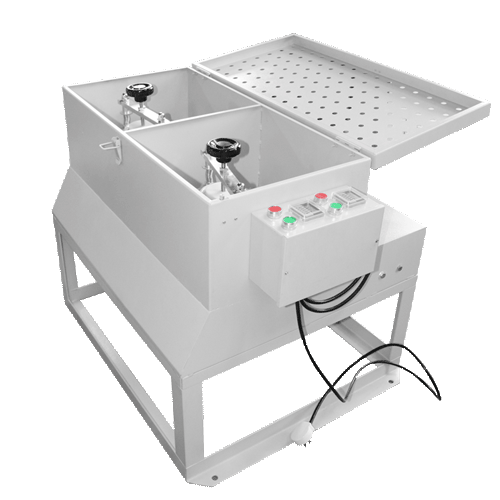
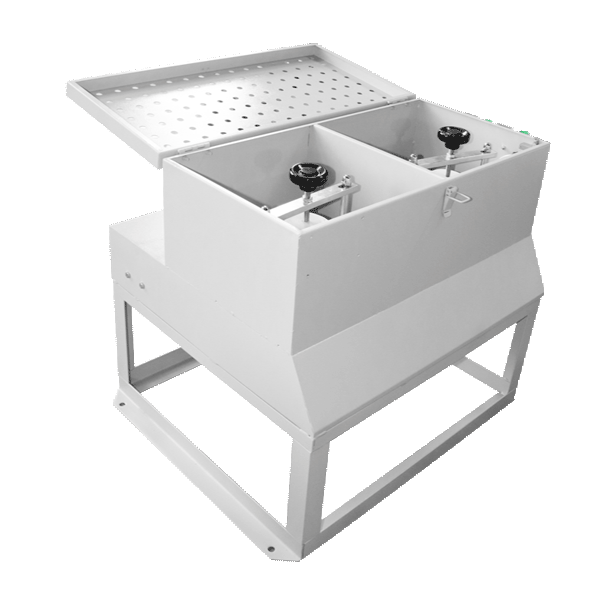
The standard design includes a supporting frame, a drive, a mounting unit for the grinding container, controls and safety interlocks. The specific composition of the components depends on the model, so when selecting, they check not only the name, but also the design of the drive, the method of fixing the container, and access to unloading and cleaning.
- The bed absorbs loads and reduces the transmission of vibration to the supporting surface.
- The drive sets the movement of the working body; its characteristics are more important than the overall impression of the dimensions of the installation.
- The fastening unit must ensure reliable fixation of the grinding container without distortion.
- Guards and interlocks are related to operational safety and not to minor additions.
- The control system sets the mode, but does not replace checking the actual size and condition of the sample.
Working medium - grinding media. When a container or working element moves, it transfers energy to the material through impact, abrasion and shear. The ratio of these mechanisms depends on the design, size and density of the balls, degree of filling and properties of the sample. Therefore, the same grinding time does not guarantee the same particle size distribution for different materials.
Dry grinding is convenient for bulk samples that do not require a liquid medium and are easily unloaded from the container. Wet grinding can improve dispersion and reduce dusting, but adds the steps of slurry preparation, liquid separation, and drying. In addition, the solvent must be compatible with the material of the container, grinding media and seals. Wet grinding is not just a “stronger” mode, but a different technological option with its own limitations.
Characteristics that are important to read correctly
When reviewing the equipment sheet, it is useful to distinguish between installation parameters, grinding vessel parameters and process parameters. Mixing these levels leads to selection errors and inflated expectations.
- Grinding container volume and workload. The nominal volume of the container is not equal to the mass of the sample that can be loaded. They always clarify whether we are talking about one vessel, total volume, workload or productivity over time.
- Speed and driving mode. The speed or other drive parameter must be considered in conjunction with the type of grinding media and the permissible load. High speed does not compensate for inappropriate ball size.
- Drive power. This is a characteristic of energy consumption and load reserve, and not a direct indicator of grind size.
- Grinding bodies. The diameter, density, material and number of balls affect impact energy, wear and contamination of the product. This data should not be transferred from another model.
- Processing time. It is selected experimentally; Grinding too long can lead to overheating, agglomeration or excessive wear.
- Size. The initial and final particle sizes are indicated along with the measurement conditions. The typical minimum stated in the description is not guaranteed for any material.
- Cooling. Air cooling is not cryogenic. Liquid nitrogen cooling is only discussed if there is appropriate confirmation for a specific design.
Particularly carefully read the sections on thermal conditions. The air temperature in the working area or the housing temperature is not equal to the temperature of the sample inside the grinding container. If the material is sensitive to heat, a separate check is required: short-term grinding with pauses, temperature control after the cycle, or another solution provided for by the design. Conventional air cooling cannot be called a cryogenic process without explicit indication in the documentation.
To clarify specific values, use fast ball mill page TENCAN, rather than general tables from neighboring categories. A parameter of one model does not become a characteristic of the entire range.
Materials, environment and limitations
Ball grinding is not equally suitable for all materials. Brittle powders tend to grind more predictably than plastic powders, which can flatten, stick to walls, and form agglomerates. Fibrous and elastic samples require separate testing: grinding media may not cut the fibers, but only deform them. Wet and greasy materials can change the movement pattern of the balls and make unloading difficult.
For heat-sensitive substances, the main risk is heating due to mechanical energy. Even if the installation is cooled, this does not negate measuring the temperature of the sample and checking the safety of its properties. For abrasive materials, wear of the container and grinding media, as well as the possible transfer of elements into the product, are important.
The material of the grinding container and balls is selected based on a combination of factors: sample hardness, acceptable contamination, tendency to stick, cleaning requirements and compatibility with the machine. Stainless steel, zirconia, corundum, agate, tungsten carbide and polymer materials behave differently. None of them provide “zero contamination”: wear, abrasion and residue from the previous sample require monitoring.
Cleaning is part of the choice, not an afterthought. If the container is difficult to disassemble or the material tends to clog the corners, the risk of cross-contamination between samples increases. For trace analyses, checking the blank sample and the washing procedure are especially important. A laboratory ball mill should not be described as a machine that guarantees sterility or complete absence of impurities.
How to choose a fast ball mill and check compatibility
- Formulate the task: analysis, homogenization, size reduction or preparation for further surgery is needed. The permissible heating and capacity requirements depend on this.
- Assess the material: hardness, ductility, moisture, abrasiveness and sensitivity to contamination.
- Determine a reasonable amount of sample and the desired size without mixing the volume of the container with the work load.
- Check which grinding containers and grinding media are truly compatible with the selected design: mounting, volume, lid, seal, permissible load.
- Check the thermal conditions and the possibility of cooling; for cryogenic applications, separate confirmation is required rather than an assumption.
- Carry out a test grinding with control of the coarseness, temperature and condition of the container. Repeatability is more important than one successful result.
Compatibility of accessories is confirmed by documentation and the actual fastening unit. A similar name, the same material, or a similar diameter does not prove that a container from a different type of mill will fit a fast ball mill. You cannot transfer parameters from a roller, planetary or bead machine just because they also use balls.
For a general acquaintance with the areas of equipment TENCAN can be used manufacturer's website, but the final choice is made based on the specific machine’s card, passport and test grinding results. If the value in the description is unclear, the units appear inconsistent, or there is no measurement condition, it is better not to use the dubious value for calculation. Clarification from the manufacturer is required, and not an independent “correction” of the specification.
Frequently asked questions
How does a fast ball mill differ from a planetary mill?
Different kinematics and layout. A planetary mill uses a complex movement of cups, while a fast ball mill may have a different drive and container mounting design. You need to compare specific models based on confirmed parameters, and not just by name.
Can particle size be guaranteed?
No. The achievable fineness depends on the material, initial size, grinding media, medium, time, energy and measurement method. Even with intensive mode, some particles may remain larger, and the fine fraction may agglomerate.
When is wet grinding needed?
When you need to better disperse the material, reduce dust, or work with a suspension. However, wet grinding adds liquid preparation, separation and drying steps, and requires solvent compatibility with the container and seals.
How to check the compatibility of the grinding container and grinding media?
According to the passport of a specific machine, the type of fastening, the permissible volume and weight of the load, as well as the material of the container. You cannot rely only on external similarity or on the fact that the affiliation relates to ball mills of a different type.
Is air cooling cryogenic?
No. Air cooling removes heat but does not create cryogenic conditions. A process with a confirmed use of liquid nitrogen or a special low-temperature system is considered cryogenic if this is expressly specified for a specific design.