
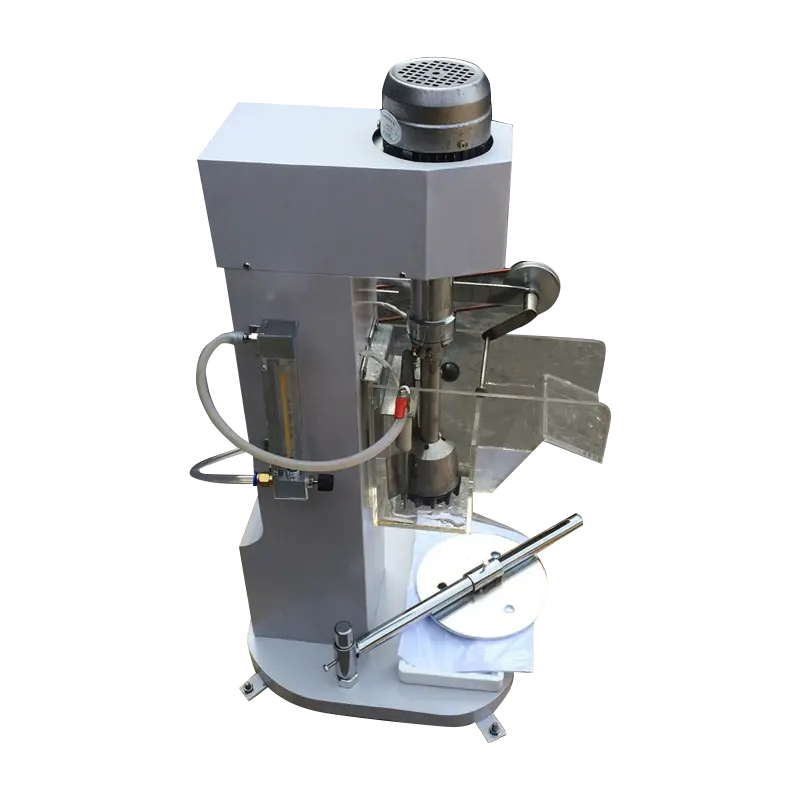
A laboratory flotation machine is a small-sized installation for flotation experiments on samples of ore, concentrates, industrial products and technogenic raw materials. In the sample preparation chain, it comes after crushing, grinding and sifting: the material at this point has been reduced to the required size, and the machine shows how the pulp behaves under a given reagent regime and aeration and what kind of foam product can be obtained. In the catalog TENCAN the installation is classified as research equipment: it is a laboratory instrument for methodological and technological tests, and not an industrial flotation machine.
Function and place in the technological chain
Flotation separates particles based on their surface wettability. Hydrophobic grains stick to air bubbles and are carried into the foam layer, hydrophilic grains remain in the pulp and go into the chamber product. A laboratory machine reproduces this mechanism on the scale of a small sample, so its main function is not to obtain a commercial concentrate, but to obtain comparable experimental results, by which reagent modes, grinding coarseness and processing schemes can be compared.
A typical sequence of work looks like this: crushing the initial sample, grinding to a given size, controlling the particle size distribution by sifting, preparing a pulp of the required density, conditioning with reagents, flotation itself, removing the foam product, dehydration and analysis of the resulting products. Each step affects the result: insufficiently crushed material does not open the grains, over-grinded material produces sludge and reduces selectivity. Therefore, a flotation experiment makes sense only when the sample preparation conditions are reproducible from experiment to experiment.
The result of the experiment is the material balance: the yield of concentrate and tailings, the content of the target component in each product and the calculated recovery. The machine is responsible only for separation; weighing, drying and chemical or mineralogical analysis are carried out separately, and without them the flotation result remains a qualitative observation.
Design and working principle
Main nodes
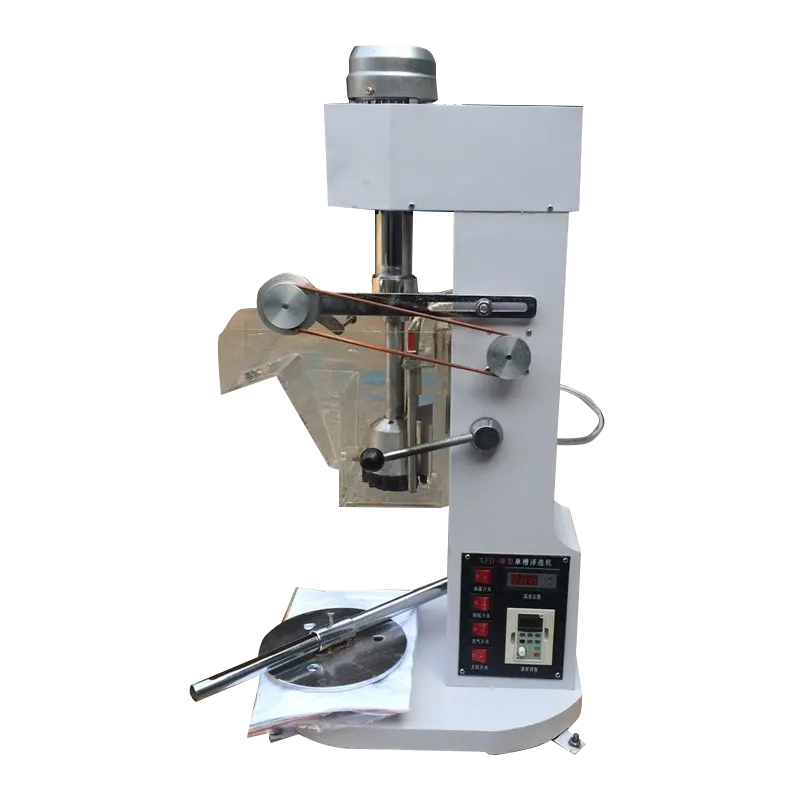
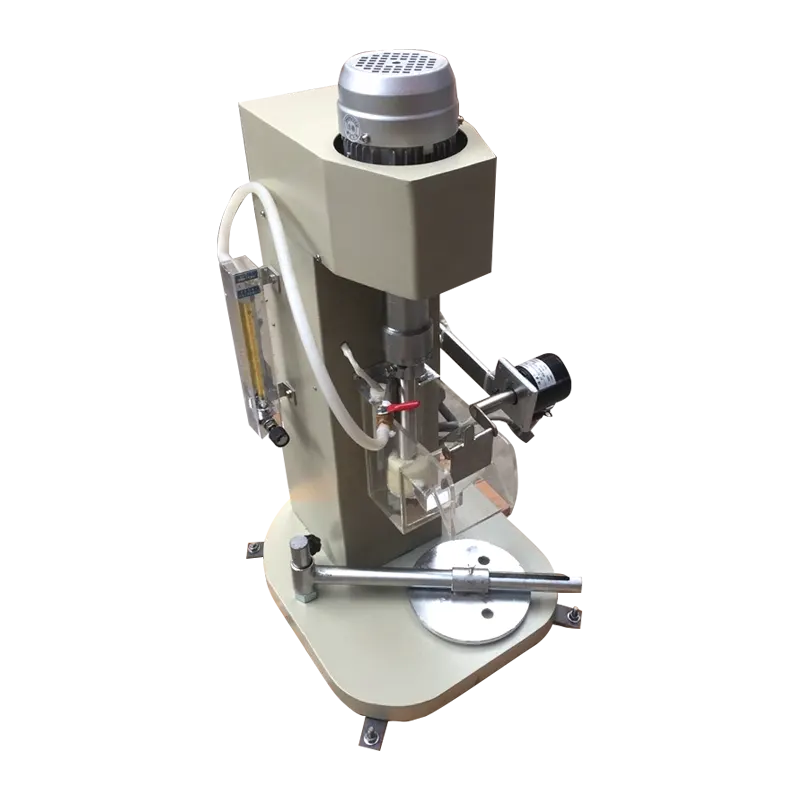
In a typical laboratory design, several functional elements can be distinguished. The working chamber holds the pulp and sets the height of the foam layer; It also contains a mixing unit - an impeller on a vertical shaft. The drive provides rotation; often such installations have speed control. A stationary stator or guide vane around the impeller forms the flow and participates in air dispersion. For machines with forced aeration, an air supply system with flow control is added. The foam product is removed with a scraper - mechanically driven or manually. A separate unit is the control panel, on which start-up, adjustments and indication are concentrated. The specific equipment, materials of the chamber and impeller, the presence of certain adjustments are indicated in the product card, and they cannot be transferred from another model.
What happens in the chamber
Three processes are going on simultaneously in the chamber. The first is maintaining particles in suspension; without it, large and dense grains settle to the bottom and fall out of the process. The second is to disperse the air into bubbles of suitable size and contact them with the particles. The third is the formation of a stable foam layer into which mineralized bubbles pass, and the removal of this layer without excessive pulp capture.
The separation is determined not by the design of the machine itself, but by the state of the particle surface, which is set by the reagents: the collector increases the hydrophobicity of the target grains, the foaming agent stabilizes the foam, depressants and activators control selectivity, pH regulators create the desired environment. The machine merely provides the conditions under which this separation can occur reproducibly.
Stirring, aeration and skimming
Mixing intensity is a compromise. If the flow is too weak, some of the material settles, and the result of the experiment depends on chance. When too strong, the turbulence disrupts the flocs, increases the entrapment of fine particles into the foam layer and makes the foam unstable. In practice, the mode is selected so that all the material is in suspension, and the foam layer remains controllable.
Aeration can be spontaneous, when air is sucked in by a rotating impeller, or forced, with supply from a separate unit and flow control. These are different principles, and they cannot be mixed in the description. Foam removal also affects the result: at a high removal rate, more pulp goes into the concentrate, water-mechanical removal increases, and the content of the target component decreases.
Versions of laboratory flotation machines
Laboratory machines differ primarily in the method of aeration, operating mode and number of chambers. These signs are more important than appearance, because they determine what problems the installation solves.
Aeration method
Mechanical, or self-aerating, machines receive air due to the operation of an impeller in the chamber. They are simpler in design, but the air flow depends on the rotation speed and pulp level, so the aeration parameters are related to hydrodynamics. Machines with forced air supply allow you to set the flow rate independently of mixing, which is convenient for methodological experiments where you need to separately evaluate the influence of aeration and hydrodynamics. None of the options is universally best: the choice is determined by the methodology.
Batch and continuous mode
In periodic mode, a portion of the pulp is processed in a chamber and the concentrate is removed until a specified time or until the foam is depleted. This experiment is convenient for comparing reagents and sizes. In continuous mode, the pulp passes through the chamber at a certain flow rate, and the result depends on the residence time. The continuous circuit is closer to the factory circuit, but requires a stable supply and a more complex organization of experience. For the same sample, these modes give different results and cannot be compared directly.
Number of cameras
The single-chamber design is suitable for main and control flotation in one run. Multiple sequential chambers allow simulation of cleaning and inspection operations, but increase sample consumption and requirements for feed stability. The presence of a second chamber in itself does not guarantee better separation: what is more important is whether the volumes and operating modes are consistent.
Parameters and their correct reading
The characteristics of a flotation machine are read not as an advertising list, but as a set of conditions under which the result was obtained. Below is what is most often misunderstood.
Chamber volume, sample weight and pulp density
The geometric volume of the chamber and the working load are two different things: part of the volume is occupied by the foam layer, part by the mixing unit, so the useful volume is always less than the full one. The mass of the sample is determined not by the volume of the chamber, but by the selected pulp density. Density is usually expressed as percent solid by weight; Conversion to volume percentages requires the density of the material and is not done “by eye.” An experiment carried out at one pulp density cannot be automatically transferred to another: the residence time, aeration and water-mechanical removal change.
Rotational speed and peripheral speed
The shaft rotation frequency itself says little about hydrodynamics: with different impeller diameters, the same revolutions give different peripheral speeds at the periphery. If the mixing organ is replaced, the mode is recalculated, otherwise the comparability of the experiments is lost. The product card should specify the adjustment range and impeller diameter.
Air consumption, time and size
Air flow affects bubble size and flotation speed. Excess air produces coarse foam, sludge entrapment and reduced selectivity; the disadvantage is the low speed of the process and loss of the target component in the tailings. Flotation time determines the completeness of extraction: the kinetics is different for different size classes, so the same mode works differently for fine and coarse grains.
What makes sense to find out before starting work: chamber volume and recommended loading, rotation speed range, presence of adjustable aeration and its range, chamber and impeller material, drive power, dimensions, kit composition. If the value is not specified in the specification or appears contradictory, it is not thought up, but clarified with the supplier.
Materials, applications and limitations
Laboratory flotation is used for ores of non-ferrous and precious metals, polymetallic ores, coal, non-metallic mineral raw materials, as well as for man-made products and waste, where it is necessary to evaluate the possibility of extracting a useful component. In each case, the reagent regime is different: sulfide minerals are floated by some collectors, oxidized minerals by others, coal requires a different foam-forming system. There is no universal recipe, and it should be selected in a specific laboratory for a specific sample.
Limitations are related to the scale and physics of the process. Large classes float poorly regardless of the vehicle; thin slurries increase capture and reduce selectivity; oxidized surfaces require special preparation. The results of the laboratory experiment are not directly transferred to the factory: a large-scale transition requires pilot testing and residence time calculations. Finally, flotation reagents can be aggressive and toxic, so the work requires exhaust ventilation, personal protective equipment and correct waste disposal; Specific operating conditions are determined by the installation manual, not the review article.
Selection criteria and compatibility
The choice begins with the task, not with the characteristics. First, they formulate what exactly needs to be measured: compare collectors, evaluate the grinding size, check the cleaning scheme, obtain a concentrate for further research. Then the mass of the sample and the number of parallel experiments are determined, from which the required volume of the chamber follows.
Next, check whether the installation parameters are consistent with each other: chamber volume and pulp density, impeller diameter and rotation speed range, aeration method and technique. Materials are assessed separately - the chamber and mixing unit must be able to withstand abrasive material and contact with reagents, and also allow for cleaning between runs so as not to transfer residual reagents from sample to sample.
Practical conditions are also important: dimensions and weight of the installation, power requirements, availability of consumables, availability of ventilation in the room. If you plan to work with different types of samples, it is useful to clarify in advance which chambers and mixing elements are available and whether they can be changed without modification. Technical details of a specific version are given in laboratory flotation machine card; general composition of equipment areas TENCAN you can look at main page of the site.
Questions that arise most often
How does a laboratory flotation machine differ from an industrial one?
Scale and purpose. The laboratory installation operates with a sample and is used for comparing modes, while the industrial installation is used for continuous enrichment of the flow. Direct recalculation of results without pilot tests is incorrect.
Is it possible to float a sample without grinding?
It is possible, but the result will be determined by the size of the source material. If the grains are not opened, the target component will remain in splices and go into the tails. The grind size is one of the main factors in the experiment and is recorded and controlled.
Is forced aeration necessary?
Depends on the technique. Forced supply allows you to set the air flow regardless of mixing, which is convenient for methodological experiments. Self-aerating machines are simpler, but they link aeration to the hydrodynamics of the chamber.
How to evaluate the reproducibility of an experiment?
Repeating under the same conditions: one sample, one size, one reagent mode, the same time and rate of foam removal. The discrepancy in yield and content between parallel experiments shows how stable the regime is.