
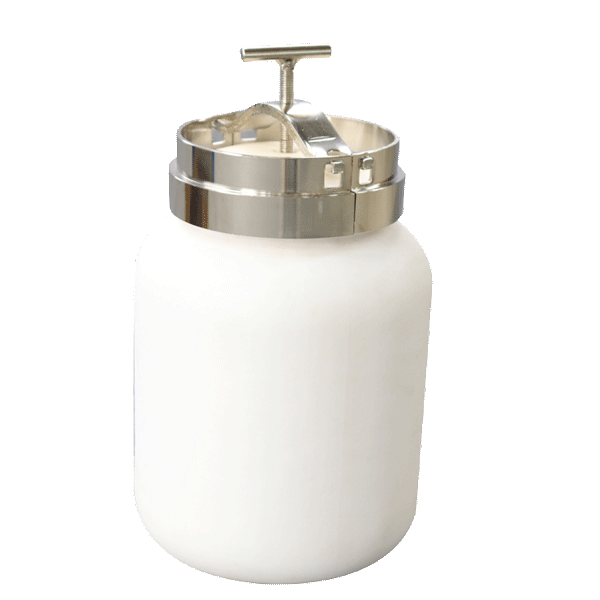
The corundum grinding drum is a cylindrical grinding chamber made of sintered corundum (aluminum oxide, Al2O3). It is installed on a roller ball mill and serves for grinding, mixing and homogenizing powder samples. The sample and grinding media are loaded inside the drum; When the drum rotates on support rollers, the material is subjected to abrasion and shock loads, which leads to a decrease in particle size. In stock TENCAN presented corundum grinding drum for roller mills.
The corundum grinding drum belongs to the class of grinding equipment - replaceable chambers in which grinding directly occurs. Its main purpose is to work as part of roller ball mills. Such mills consist of a frame with rotating rollers on which a drum is mounted. When the drum rotates, the grinding bodies (balls or cylinders) roll inside, breaking and abrading the material. The corundum drum in this system serves as a working chamber, which must withstand mechanical loads, be chemically inert and minimize sample contamination.
The use of corundum (aluminum oxide) is due to its high hardness and wear resistance. Unlike metal drums, corundum does not introduce metal impurities, which is critical for trace element analysis. However, like any material, it is not completely inert: with intense wear, Al2O3 particles may enter the sample. Therefore, choosing a corundum drum is a compromise between low fouling, cost and abrasion resistance.
Corundum drums are used in laboratory practice for preparing samples of ores, minerals, ceramics, glass, cement, soils and other materials. They are suitable for both dry and wet grinding. In the latter case, liquid (water, alcohol, acetone, etc.) is added to the drum, which reduces dust formation and improves dispersion. However, it should be borne in mind that corundum can interact with some aggressive environments, especially at elevated temperatures, therefore the chemical resistance of a particular brand of corundum must be confirmed.
Material and design features
The basis of the corundum drum is sintered aluminum oxide. Depending on the technology and purpose, the Al2O3 content can range from 85% to 99.7%. The higher the purity, the fewer impurities (SiO2, Fe2O3, Na2O, etc.) and the higher the cost. High-density corundum (e.g. 99.5% Al2O3) has a Vickers hardness of about 1500–1700 HV and good wear resistance. However, it is fragile: under shock loads or sudden temperature changes, chips and cracks are possible.
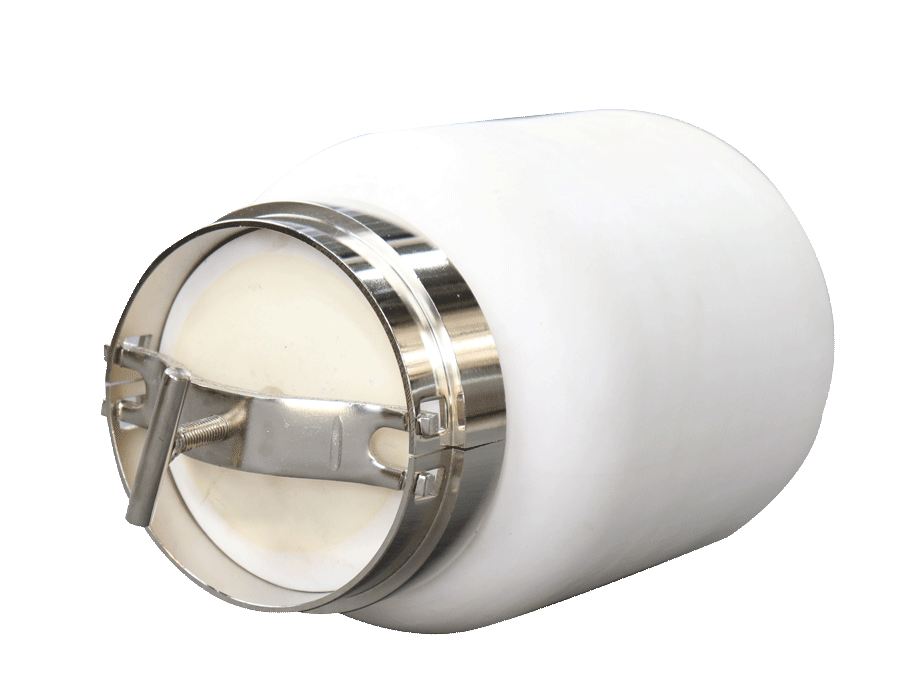
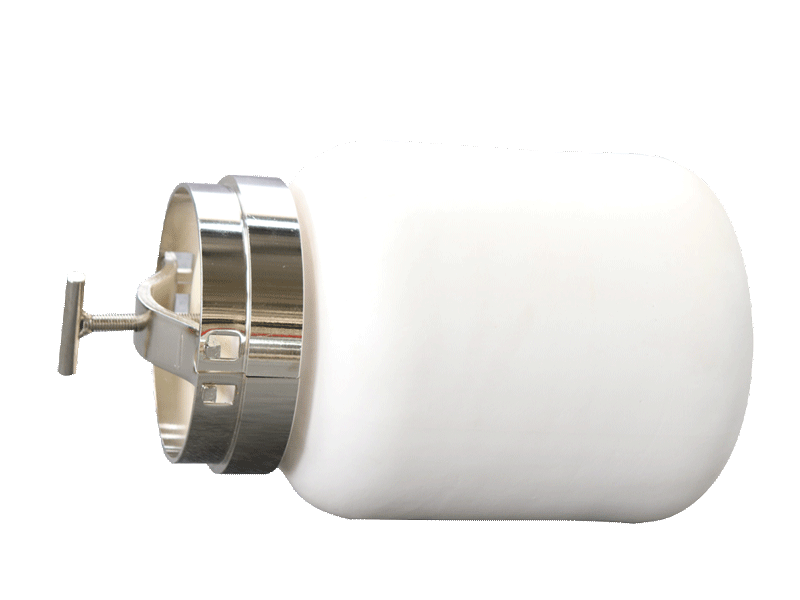
Structurally, the drum is usually a cylinder with a solid bottom and a removable lid. The cover can be flat or with a collar and is secured with screws, clamps or a threaded connection. For tightness, a gasket made of silicone, PTFE, fluorine rubber or other elastomer is used. It is important that the gasket material is compatible with the sample and solvent, otherwise leakage or contamination may occur.
The inner surface of the drum can be smooth or have ribs (lifters) that improve mixing and prevent slipping of the grinding media. Some models are equipped with a cooling jacket or the ability to connect to a gas supply system, but this is rather an exception for special tasks. A standard corundum roller mill drum is not a cryogenic device: it is not designed to be cooled with liquid nitrogen without additional equipment.
The dimensions and volume of the drum are selected for a specific roller mill model. Typical volumes of laboratory drums range from 0.5 to 10 liters or more. In this case, the geometric volume of the drum is always greater than the working volume: part of the space is occupied by grinding bodies and the free space necessary for movement. Do not fill the drum completely - this reduces grinding efficiency and increases the load on the drive.
How to correctly read the characteristics of a corundum drum
When choosing a corundum drum, it is important to distinguish between several parameters that are often confused.
- Geometric volume — full internal volume of the drum. It is indicated in liters or milliliters.
- Working volume — volume available for loading sample and grinding media. Typically 30–50% of the geometric value.
- Sample weight — the amount of material that can be effectively crushed in one cycle. Depends on the density of the sample, the size of the grinding media and the desired grinding fineness.
- Dimensions — outer diameter and length of the drum. They must match the distance between the mill rollers and the fixation system.
- Wall thickness — affects mechanical strength and heat dissipation. A wall that is too thin can crack; a wall that is too thick increases mass and inertia.
- Maximum rotation speed — determined by the design of the mill and the strength of the drum. Exceeding the speed may result in drum destruction or increased wear.
- Temperature restrictions — For corundum, sudden cooling or heating is usually not recommended; The typical operating range is from room temperature to several hundred degrees, but the exact values need to be clarified.
Not all of these parameters may be indicated on the product card. If there is no data, you should not invent it yourself. It is better to ask the manufacturer or supplier for technical specifications for a specific model. For example, for corundum grinding drum TENCAN It is recommended to clarify the volume, dimensions and permissible operating conditions.
Wear, soiling and cleaning
Corundum drum wear is a natural process, the speed of which depends on several factors:
- sample hardness and abrasiveness;
- material, size and density of grinding media;
- rotation speed and grinding duration;
- the presence of liquid and its chemical activity;
- the quality of the corundum itself (porosity, purity, granularity).
Corundum is hard but brittle. Under impact loads (for example, when using large heavy balls), microchips may appear on the inner surface. Over time, this leads to increased roughness, material buildup, and resulting cross-contamination between samples. In addition, wear particles of corundum enter the sample. For most applications this is acceptable as long as the Al2O3 content does not interfere with the analysis. If extremely low contamination is required, other materials (such as zirconia or tungsten carbide) should be considered.
Cleaning the drum must be thorough. After each use, remove any remaining sample and grinding media. The drum is then washed with a suitable solvent (water, ethanol, acetone) using a soft brush. Do not use metal brushes or abrasive powders as they will leave scratches. If the material reacts with water, use alcohol or another inert solvent. After washing, the drum is dried at room temperature or in a drying cabinet at low temperature, avoiding sudden changes.
To monitor wear, it is recommended to periodically inspect the interior surface under bright light. Deep grooves, chips, or discoloration may indicate the need for replacement. It is also worth checking the condition of the sealing gasket: loss of elasticity or damage leads to leaks.
Compatible with mills and grinding media
The corundum grinding drum is designed for roller ball mills. It is not universal and does not automatically fit other types of equipment. For example, planetary ball mills use grinding bowls that are mounted in a planetary disk and experience significantly higher centrifugal loads. Vibratory mills such as lightweight vibration ball mill, also have their own design of grinding chambers. Corundum drum for roller mill should not be considered interchangeable with them without confirmation from the manufacturer.
When selecting a drum for a roller mill, you need to check:
- outer diameter and length of the drum - they must correspond to the distance between the rollers and the length of the working area;
- fixation method - some mills require special flanges or grooves;
- maximum weight of the drum with loading - exceeding it may lead to engine overload;
- rotation speed - it must be consistent with the strength of the drum.
Grinding media also play an important role. For corundum drums, corundum balls (cylinders) of the same or similar composition are often used to reduce the contrast of contamination. However, corundum grinding media have a high density (about 3.6–3.9 g/cm³) and can be quite heavy. Alternatives: zirconia balls (density ~6 g/cm³, high wear resistance), agate balls (density ~2.6 g/cm³, low contamination), steel balls (high density but risk of metal contamination). The choice depends on the hardness of the sample and the acceptable level of impurities.
It is important to maintain the mass ratio: usually the mass of the grinding media is 3–10 times the mass of the sample. The size of the balls is selected so that they do not get stuck and are effectively crushed. Balls that are too small may not break up large particles, while balls that are too large may damage the drum. The optimal mode is selected experimentally.
Criteria for selecting a corundum drum
The choice of corundum drum is justified when required:
- grind material of medium and high hardness (up to 9 on the Mohs scale);
- minimize metal contamination;
- work in chemically active environments (corundum is resistant to most acids and alkalis, except hydrofluoric acid and hot concentrated alkalis);
- use both dry and wet grinding;
- provide reasonable cost compared to zirconium or tungsten carbide drums.
Restrictions:
- fragility - not suitable for very intense impact modes and large heavy balls;
- possible wear with Al2O3 entering the sample;
- not recommended for materials sensitive to aluminum contamination;
- Requires careful cleaning and storage.
When choosing, it is worth considering the available mill model, the required sample volume, the desired final particle size and budget. If a corundum drum is not suitable for some parameters, you can consider drums made of stainless steel, polyurethane, PTFE, zirconium dioxide or tungsten carbide. Each material has its own advantages and limitations.
For precise information on a specific product, please contact website TENCAN or to the current product card. Do not use outdated publications or third party sources as specifications may change.
Frequently Asked Questions
Can a corundum drum be used for a planetary mill?
No, these are different types of equipment. Planetary mills require grinding bowls that are mounted in the planetary disk and are designed to withstand high centrifugal loads. The corundum drum for the roller mill is not designed for such conditions.
Which grinding media material is best for a corundum drum?
Most often, corundum balls or cylinders of the same material are used to reduce the risk of contrast contamination. However, if higher density and wear resistance are required, zirconia balls can be used. The final choice depends on the sample and acceptable impurities.
How do you know if the drum is worn out and needs to be replaced?
Signs of wear: deep scratches, chips, changes in geometry, the appearance of cracks, as well as an increase in grinding time under the same conditions. Regular visual inspection helps to notice degradation in time.
Can the corundum drum be washed in the dishwasher?
Not recommended. Sudden temperature changes and aggressive detergents can damage corundum and sealing materials. It is better to wash by hand with mild detergents and dry at room temperature.
Does the corundum drum affect the purity of the sample?
Corundum is one of the most inert materials, but not completely inert. When worn, Al2O3 particles may enter the sample. If the assay is sensitive to aluminum, other materials (agate, zirconium, tungsten carbide) should be considered.