
A vertical drying cabinet with forced convection is an apparatus for drying, heating and thermal exposure of samples in an air environment at a given temperature, in which a fan drives air in an organized manner through the heater and working chamber. In the preparation of powder materials, it occupies a place between wet operations - wet grinding, washing, granulation - and subsequent stages: sifting, pressing, sintering, measuring properties. The purpose of such a cabinet is not to “heat more,” but to remove moisture or hold the sample at a temperature with a reproducible result.
Below is about the design of the device, which parameters in its description are really important, where the border between drying and heat treatment is, and what restrictions should be taken into account before purchasing. Specific values of temperature, chamber volume and accuracy for the selected version are given in vertical forced convection oven card; in the review they are not replaced by guesswork.
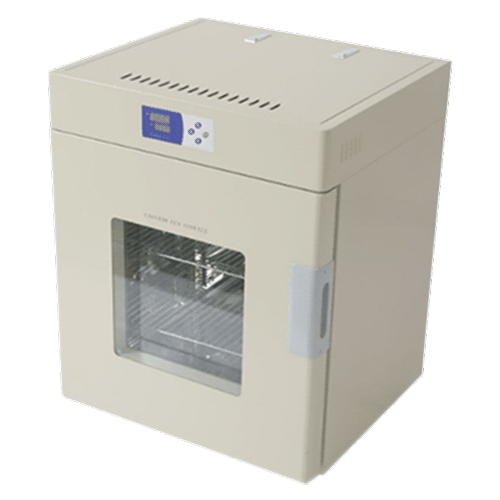
Purpose: where the cabinet is located in the technological chain
Drying is the removal of liquid from a sample without chemically transforming it. This is precisely why it differs from sintering, annealing and burning out the binder: the structure of the material changes, and not just the moisture content. Therefore, the drying cabinet does not replace a muffle or tube furnace, although it may look similar to them. Its operating range lies in the region of moderate temperatures, where the material remains the same powder, granule or workpiece, but becomes dry.
Typical applications in the laboratory and small production area:
- drying the powder after wet grinding or washing before sifting and pressing;
- removing moisture from ceramic, oxide and composite powders before weighing and analysis;
- drying glassware, grinding bowls, drums, trays and sieves;
- heating the samples before testing to eliminate the influence of adsorbed moisture;
- thermal exposure at a moderate temperature - hardening of the binder, stabilization, relief of internal stresses;
- preparing samples for granulometric analysis, where humidity distorts the result.
In all these cases, not only the temperature is important, but also how quickly and evenly moisture is removed from the chamber. This is precisely the problem that forced convection solves.
How does forced convection work?
The air in the chamber is heated by a heating element and moved by a fan along an organized circuit: it is usually taken from the chamber, passes through the heater, fed back and distributed throughout the volume through a system of channels or perforations. Some of the air is removed outside through the vent, and fresh air comes in to replace it - this way the chamber is freed from moisture evaporating from the sample.
Main nodes
Working chamber with shelves or trays, thermal insulation, heater, fan with motor, air ducts, temperature sensor, control unit and door with seal. Each node affects the result: insulation determines heat loss and stability of the mode, the fan determines the uniformity of the temperature field, the air duct layout determines the absence of stagnant zones, the door seal determines reproducibility during repeated cycles. The material of the chamber and shelves, as well as the maximum permissible loading weight, are specified in the documentation of the specific design, and are not transferred from another model.
What does blowing do and what does it not solve?
Forced convection reduces the temperature difference between chamber zones and accelerates the transfer of moisture from the sample to the air. Without airflow, a moisture-saturated boundary layer forms above the flat layer of powder, and drying slows down, leaving the top and bottom shelves exposed to different conditions. The fan evens out these conditions, but does not cancel physics: the drying speed is still limited by the speed of moisture diffusion inside the particle and the thickness of the layer.
The downside is that air currents can carry away fine dust. If the powder is very dispersed or light, it is placed in shallow baking trays with sides, covered with a perforated lid, or the blowing intensity is reduced if the design allows this. The cabinet is not designed for drying bulk materials “in the light” with a powerful flow: this leads to both sample loss and contamination of the chamber.
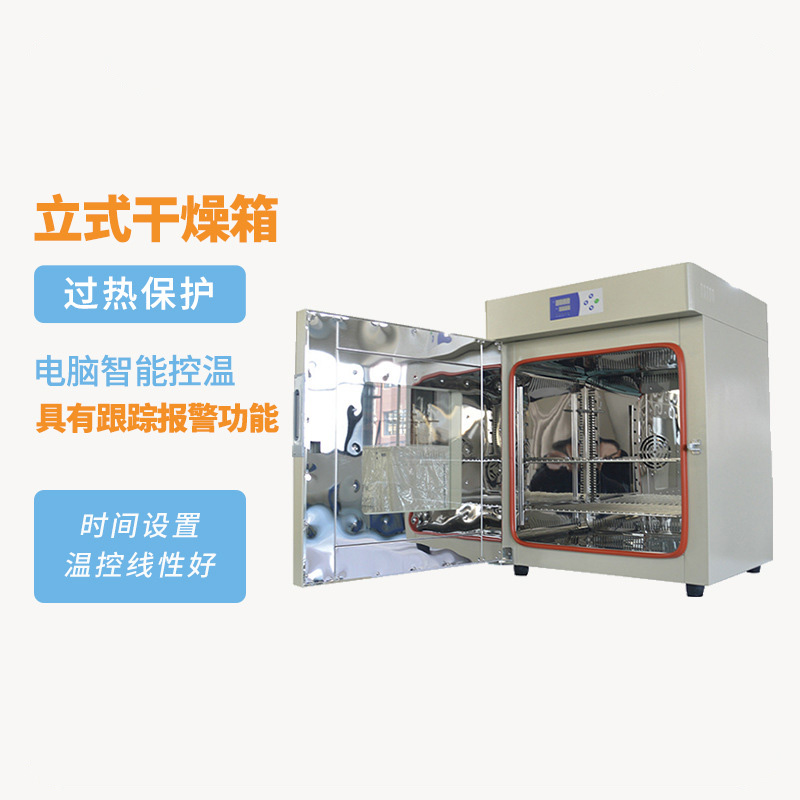
How to read cabinet specifications correctly
The description of a drying cabinet often looks like a short list of numbers, but some of them refer to different things. Below is what exactly each parameter means.
Maximum and continuous operating temperature
The maximum temperature is the limit that the structure can withstand for a short time; Long-term operating temperature is lower and determines normal operation. These values cannot be mixed: operating at the limit constantly reduces the life of the heater, seals and insulation. In addition, the temperature of the workspace is not the temperature of the sample. While the moisture evaporates, the sample remains cooler than the air in the chamber, and the massive load warms up more slowly. If a procedure requires a specific material temperature, it should be measured or justified by the holding time, and not assumed to be equal to the set point.
Stability and uniformity
The accuracy of maintaining the temperature on the sensor and the temperature distribution throughout the chamber volume are different indicators. The first talks about the operation of the regulator, the second talks about how conditions differ on different shelves. For drying this difference is usually not critical, but for thermal holding and calibration work it is important. It is correct to check uniformity on an empty and loaded chamber: the result depends on the mass of the samples and their location.
Chamber volume and payload
The total volume of the chamber is a geometric quantity. The payload is smaller: part of the volume is occupied by shelves, baking trays and gaps for air circulation. If you fill the chamber tightly, the airflow will be disrupted, and the uniformity declared for the free volume will not be achieved. As a rule of thumb, the combined volume of samples and glassware should leave air passages clear, especially at the inlet and outlet of the flow.
Vertical layout
Vertical design means that the camera is elongated in height. This saves bench or lab space and allows samples to be placed on multiple levels. It must be remembered that the lower and upper shelves are located at different points in the air circuit, and heavy baking sheets on the upper levels are inconvenient to place and remove. The load is distributed so that the flow is not blocked, and the most critical samples are placed in an area with the most predictable conditions.
Materials, objectives and limitations
A cabinet with forced convection operates in an air environment. This determines both its strengths and the limits of applicability.
Where is it appropriate?
Oxide and ceramic powders, clays, mineral raw materials, glass, dried sediments, soil and geological samples, as well as dishes and equipment are typical drying objects. In these cases, moderate heating in an oxidizing environment does not change the phase composition of the material.
Dry and wet grinding: connection with drying
After wet grinding, the suspension is separated from the grinding media, washed if necessary and sent for drying. It is important not to confuse disagglomeration with comminution: drying only removes liquid, but it can “cement” small particles into agglomerates due to residual dissolved substances. Therefore, the drying regime and subsequent sieving influence what particle size distribution will be measured. A soft mode with a gradual increase in temperature usually produces less dense agglomerates than rapid heating.
Restrictions
- The air environment is oxidizing. Metal powders, especially thin ones, oxidize when heated in air; they require other solutions than a conventional drying cabinet.
- Flammable solvents and vapors must not be dried in a cabinet not designed for this purpose: the standard design is not explosion-proof, and the ventilation is not designed to remove flammable vapors.
- Thermolabile materials are destroyed when heated - the temperature is selected according to the properties of the sample, and not according to the capabilities of the cabinet.
- The cabinet does not replace a vacuum drying cabinet, muffle furnace or controlled atmosphere furnace: these are different classes of equipment with different media and ranges.
- Dusting powders require closed trays, otherwise sample loss and chamber contamination may occur.
- Cooling after drying must be thoughtful: a hot sample taken out into the air may absorb moisture back or crack.
Selection criteria and compatibility
The choice begins not with a list of functions, but with a sample. What kind of material is it, how much moisture needs to be removed, at what temperature does it degrade, is it sensitive to oxygen, how many samples need to be dried at the same time - these answers immediately cut off inappropriate options.
- Temperature regime. We need an operating temperature with a margin relative to the planned cycles, and not a limiting one. Check that long-term operation is below the maximum.
- Volume and loading. They count not “how many will fit,” but how many samples are needed in one cycle, taking into account the free passage of air. An overloaded chamber loses uniformity.
- Uniformity and control. For routine drying, a stable regulator is sufficient; Reproducible techniques require clear guidelines for temperature field testing and sample placement.
- Sample material versus environment. Oxidizing powders, substances with organic solvents and heat-sensitive samples require a different class of equipment or special design.
- Terms of Use. Electrical power, room ventilation requirements, installation area and ease of loading influence no less than temperature.
- Equipment compatibility. Baking trays, trays and stands must withstand operating temperatures, not deform or release volatile substances. Equipment made of polymers, including polyurethane grinding drums, is a part of the grinding equipment, not the drying chamber, and its heating is permissible only within the limits specified for the material itself.
After choosing a mode, it is useful to carry out a trial cycle with a control sample: weigh before and after, evaluate agglomeration and appearance. It's cheaper than finding a problem on a series. General line of thermal and auxiliary equipment TENCAN presented in catalog on the main website, and the parameters of a specific cabinet are specified according to product page.
Briefly about frequently asked questions
How is forced convection different from natural?
A fan that creates an organized air flow. There is heating itself in both cases, but with natural convection, moisture transfer is slower, and the difference between the chamber zones is greater.
Is it possible to dry the powder after wet grinding?
Yes, this is one of the main tasks. But first, the grinding media and excess liquid are separated, and the temperature is chosen so as not to destroy the material and form dense agglomerates. The mode is selected experimentally.
Does such a cabinet replace a vacuum cabinet or a muffle furnace?
No. A vacuum oven operates at reduced pressure and allows drying at a lower temperature, while an oven operates at high temperatures and in a specified atmosphere. Only the appearance and the presence of a heating chamber are the same.
Why should samples not be dried with flammable solvents?
Because hot air circulates in the chamber, and the standard design is not designed for flammable vapors: they can accumulate and ignite. There are separate versions for such tasks, and their suitability must be confirmed by documentation.
What chamber volume should I choose?
One that leaves room for circulation when actually loaded. A cabinet with extra volume is more convenient, but a chamber that is too large for one sample will hold the mode worse when the door is opened frequently.
The forced convection drying oven is a tool with a narrow but important role: it brings the sample to a dry state without changing its nature, and does so repeatably. Carefully reading the characteristics, understanding the difference between air temperature and material temperature, taking into account environmental and loading restrictions do more than any additional function. The exact performance parameters are always taken from the product passport and card, and the drying mode is checked on a control sample.