
A vertical drying cabinet with forced convection is a chamber-type equipment for drying and temperature holding samples, in which the air inside the working volume does not remain stationary, but is continuously mixed by a fan. This scheme more actively removes moisture from the surface of the material than natural convection and reduces the temperature difference between chamber zones. In the laboratory chain, the cabinet stands between sample preparation and the following operations: after wet grinding, washing, granulation or storage, the sample must be brought to a stable mass before sieving, pressing or sintering.
Specification values - temperature range, chamber volume, maintenance accuracy - depend on the specific design, so the operating principle, device and selection criteria are discussed below. Actual parameters are given in the product card: vertical oven with forced convection. General information about equipment areas TENCAN collected at main page of the site.
What kind of equipment is this and where is it located in the sample preparation process?
For its intended purpose, this is an apparatus for drying and temperature holding at atmospheric pressure. The material is placed on shelves or baking sheets, the temperature is set and, if the controller allows it, the holding time; the further process takes place without the constant participation of the operator. Typical tasks include removing moisture after wet grinding or washing, drying granules before pressing, preparing powder for screening, holding samples at a fixed temperature for testing or aging.
Three problems that a closet solves
The first is the removal of free moisture from the surface of the particles and from the spaces between them. The second is the removal of moisture retained by pores and surface films, bringing the sample to a constant mass; It is this operation that is most often needed before weighing and calculating the charge. The third is thermal exposure without changing the phase composition: drying, degassing at moderate temperatures, testing the stability of the material. All three tasks are united by the requirement for temperature stability over time, and not for its maximum value.
What the closet is not
An oven does not replace a muffle furnace: sintering requires different temperature levels, different heaters and linings, and often a programmable profile. It does not replace a vacuum cabinet, where moisture removal occurs at reduced pressure and heat transfer is organized differently. It is not a freeze dryer and does not become a controlled atmosphere chamber just because it has an air exchange damper. These differences are important when selecting: equipment is selected by operation, not by name.
How does forced convection work?
The fan forces air through the heating block and the working chamber, after which the flow returns to the heater. Such a closed loop with recirculation provides two things: constant heat removal from the heater, due to which the temperature in the volume equalizes faster, and intense mass transfer at the surface of the sample, that is, moisture removal. Part of the air, as a rule, is discharged outside, and fresh air enters in its place through an adjustable damper - without this, the chamber quickly becomes saturated with vapors and drying slows down. The degree of opening of the damper and the frequency of air exchange are parameters that should be clarified in the documentation of a specific model.
Vertical layout and flow organization
The definition “vertical” in the name indicates the layout: the working chamber is elongated in height, and the air flow is organized primarily vertically. The practical consequence is that the shelves must allow air to pass through, and dense trays and baking sheets that cover the cross-section of the chamber act as a heat insulator and spoil uniformity. It is forbidden to load material close to the heaters, the flow outlet or the temperature sensor: local overheating and distorted readings are the most common reasons for unsuccessful drying. The exact circulation diagram for a specific design is given in the operating instructions.
Differences from natural convection, vacuum drying and oven
During natural convection, air moves only due to the difference in density: the process is slower, more dependent on the loading and location of the samples, and a noticeable gradient is possible across the volume of the chamber. Vacuum drying reduces the boiling point of moisture, but heat transfer in a rarefied environment occurs mainly through contact with the shelf, so the substrate material and layer thickness are important; This is a different class of devices and a different loading method. The oven differs in operating temperatures and task - changing the structure of the material, and not removing moisture. It is impossible to mix these operations in one device without confirmed characteristics.
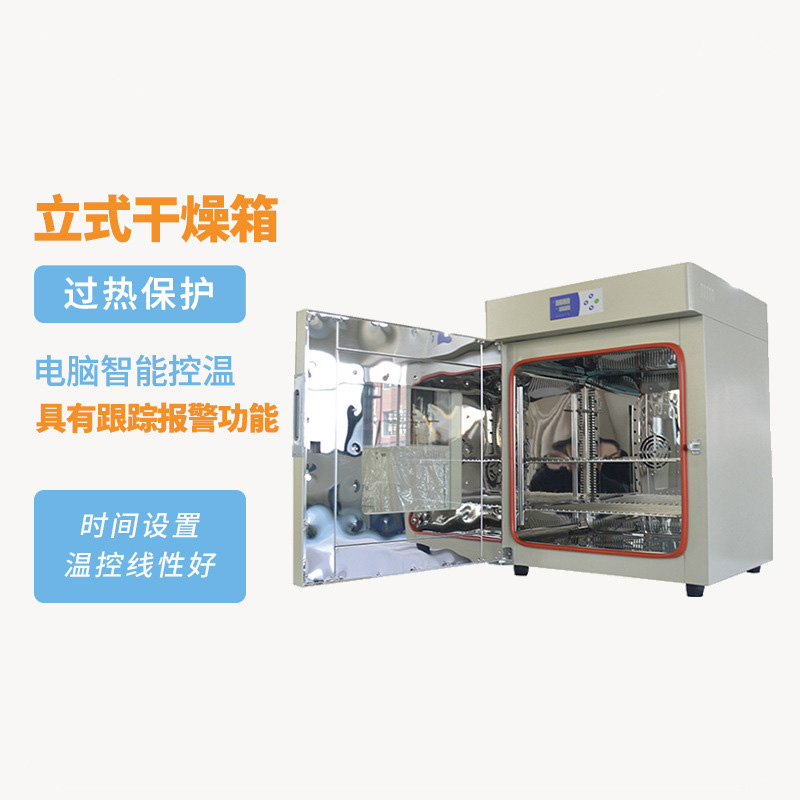
Device: nodes that determine the behavior of the camera
The design of the cabinet has several components, each of which affects the drying result. When choosing, it is useful to understand what each of them is responsible for, and not just look at the declared temperature.
- Working chamber — volume in which samples are placed; The material of the walls, the quality of the welds and the absence of hard-to-reach cavities where dust accumulates are important.
- Heating block — determines the speed of reaching the regime and heat distribution; in the forced scheme it is placed in the stream.
- Fan — creates a flow and ensures uniformity; the level of noise and vibration depends on its execution.
- Temperature sensor — the location of its installation determines what temperature the controller displays: air in the flow or another point.
- Controller — supports a task, can have a timer, a programmable profile and an independent overheat limiter.
- Door, seal and damper — heat loss, air leaks and regime stability depend on their condition.
Separately, it is worth evaluating the shelves: their number, material, permissible load and installation pitch. A shelf with a large weight reserve allows air to pass through less well, and a thin one can become deformed when heated. If the chamber is supposed to work with powders, you need trays with sides and a well-thought-out cleaning procedure - any remaining material on the walls becomes a source of contamination during the next cycle.
How to read the characteristics and not be mistaken in expectations
The main difficulty is that similar-sounding parameters describe different properties. Below is a breakdown of what exactly each group of characteristics means and what questions you should ask before purchasing.
Maximum and continuous operating temperature
The maximum temperature is usually specified as a short-term limit, and long-term operation is calculated at a lower value; In addition, the limit depends on the loading material and the permissible load on the shelves. For polymers, organic and hygroscopic materials, it is not the upper limit of the cabinet that is critical, but the lower one: whether the controller is able to stably keep the temperature just above room temperature. If the card indicates only one value without explaining the mode, this is a reason to clarify the conditions, and not to think of them yourself.
Accuracy of maintenance, uniformity and time to reach the regime
Maintenance accuracy describes how stable the temperature at the sensor point is during operation. Uniformity describes the temperature spread throughout the chamber volume at steady state and at a certain load. These are different indicators, and good accuracy does not guarantee the absence of a gradient at the walls and bottom. The time it takes to reach the mode depends on the mass of the load: an empty chamber and a chamber filled with trays with powder behave differently, and a large load requires a longer exposure to warm up the center of the sample.
Chamber volume and payload
The total volume of the chamber is a geometric quantity; the payload is always smaller, since part of the cross-section is occupied by shelves, baking trays and gaps for air passage. You should focus on the total mass and thickness of the layer of material that a particular model allows, and not on the displacement. For a thin layer of powder, the baking tray area is important; for massive products, the heating time is important. Exceeding the load does not appear immediately: first, the uniformity drops and the output to the mode is extended, and only then the limiter is triggered.
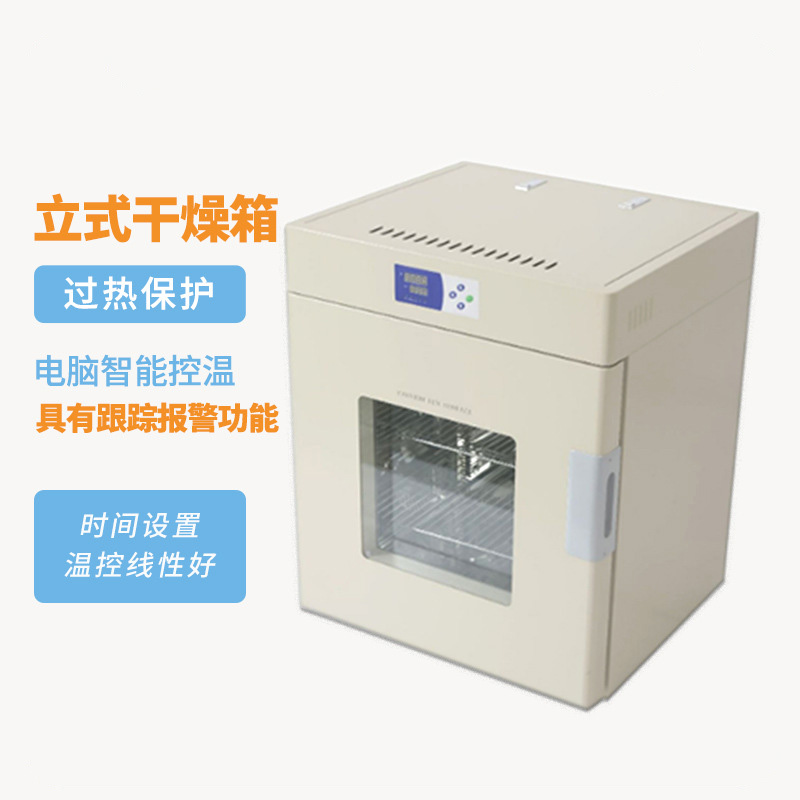
Materials, Applications and Limitations
The cabinet is suitable for drying ceramic powders, oxides, granulates, mineral raw materials, many fillers and compositions. For metal powders, the key is not only the removal of moisture, but also the behavior of the surface: when heated in air, fine particles oxidize, and the subsequent operation produces a different material. If the technology requires an inert environment or a reducing atmosphere, a conventional drying cabinet does not solve this problem - a chamber with a controlled atmosphere is needed, and this is a separate class of equipment.
For heat-sensitive materials - polymers, organic additives, materials with low-melting components - the upper limit of the operating temperature is determined not only by the cabinet, but also by the sample itself. Softening, foaming and aggregation of particles occur before the material begins to deteriorate, and outwardly this looks like “uneven drying.” You should focus on the properties of a particular substance and the supplier’s data, and not on the maximum temperature of the device.
Samples containing flammable solvents after wet grinding or washing require special attention. The evaporation of such liquids in a confined space with heaters creates a risk that requires specially designed systems; There can be no confirmation of such a possibility for a specific model without documentation. Such operations are not carried out in a conventional drying cabinet. Also, you should not combine materials that emit aggressive or foul-smelling products in one cycle: the chamber is not an exhaust device, and contamination of the walls is transferred to subsequent samples.
Selection criteria and compatibility check
It is convenient to select based on the operation, and not on the list of characteristics. The check sequence looks like this.
- Formulate the problem: removing free moisture, bringing to constant mass or holding at temperature.
- Determine the permissible temperature range on the sample side, including the lower limit and permissible heating rate.
- Estimate the mass and thickness of the loading layer, as well as the number of baking trays processed simultaneously.
- Check whether controlled air exchange or an inert environment is required; if necessary, look for the appropriate device class.
- Specify the material of the chamber and shelves, permissible load and cleaning procedure.
- Check which parameters relate to the selected model and which are taken from the general description of the series.
Compatibility with a specific model is checked according to the manufacturer's documentation and material properties, and not by analogy with another model from the same manufacturer. If the meaning on a card is ambiguous or inaccurately translated, it is wise to leave it in doubt and ask for clarification: a guess is more expensive than a missing line. You can check the current configuration in vertical forced convection oven card.
Frequently asked questions
Is it possible to use a cabinet instead of a muffle furnace?
No. Drying removes moisture and does not involve a change in the phase composition, while sintering requires temperatures, chamber materials and heaters of a different class. Even if the range partially overlaps, the purpose and life of the devices differ.
Why does the sample dry unevenly?
Most often, the cause is not the cabinet, but the load: a dense layer of powder, a baking sheet without a side, a shelf blocking the flow, or material placed too close to the heater. The second reason is insufficient exposure: the center of the sample warms up later than the surface.
How does maintenance accuracy differ from uniformity?
Accuracy shows the stability of the temperature at the measurement point over time, uniformity shows the spread throughout the chamber volume. The device can confidently hold the task and at the same time have a noticeable gradient at the walls when fully loaded.
Is it possible to dry the powder after wet grinding in alcohol?
It depends on the device and safety regulations. Evaporation of a flammable liquid in a chamber with heaters requires specially designed equipment; for a conventional drying cabinet, this possibility must be confirmed by documentation, otherwise the operation is not carried out.
Is it necessary to stir the material during drying?
For thin layers, a properly organized flow is usually sufficient. If the layer is thick, mixing or pouring improves the result, but it is more convenient to reduce the thickness of the layer and increase the area of the baking sheet. Specific techniques are determined in the instruction manual.
A vertical forced convection oven is a device whose value is determined not by the top digit of the temperature range, but by the stability of the mode, reasonable loading and proper handling of the sample. Understanding the design of the chamber and the differences between drying, dewatering and sintering allows you to select equipment for the task and avoid operations for which it is not intended.