
A basket bead mill is a grinding apparatus for wet dispersion and fine grinding, in which the working chamber is made in the form of a perforated basket filled with grinding media and immersed directly into the vessel with the product. The slurry or paste passes repeatedly through a layer of grinding media inside the basket and is returned to the same vessel, so no external piping or intermediate vessel is required. In terms of purpose, the device occupies an intermediate position between a dissolver, which mixes and wets, and a flow-through bead mill, where the product is continuously pumped through a separate grinding chamber.
TENCAN (Changsha Tianchuang Powder Technology Co., Ltd.) supplies such equipment as part of its grinding equipment line. The specific model is described in the card “Basket Bead Mill", and the general composition of directions is on manufacturer's website. Below we will explain how this type of device works, what parameters are really important when choosing and where its capabilities end.
What is a basket bead mill and what problem does it solve?
The practical problem is formulated as the transfer of a pigment or powder component from the state of agglomerates into a stable thin suspension. Three operations are combined inside one apparatus: wetting of particles with the liquid phase, deagglomeration - destruction of aggregates held by weak bonds, and grinding itself, that is, reducing the size of primary particles. The first two operations require a relatively small specific power, the third requires significantly more, and it is this that determines whether a bead stage is needed in the technological scheme.
Typical applications include pigment pastes and enamels, printing inks, suspension agrochemicals, ceramic slips and glazes, suspensions for chemical power sources, cosmetic and pharmaceutical compositions. The common feature of these products is that the liquid phase is already present, the solid phase is suspended in it, and the required coarseness lies in the fine grinding area. The key difference between a single-vessel and a flow-through circuit is working with one container: changing the product and washing are faster, there is less product loss to the “seed”, but the volume of the processed batch is limited by the geometry of the vessel and the drive power.
Design and working principle
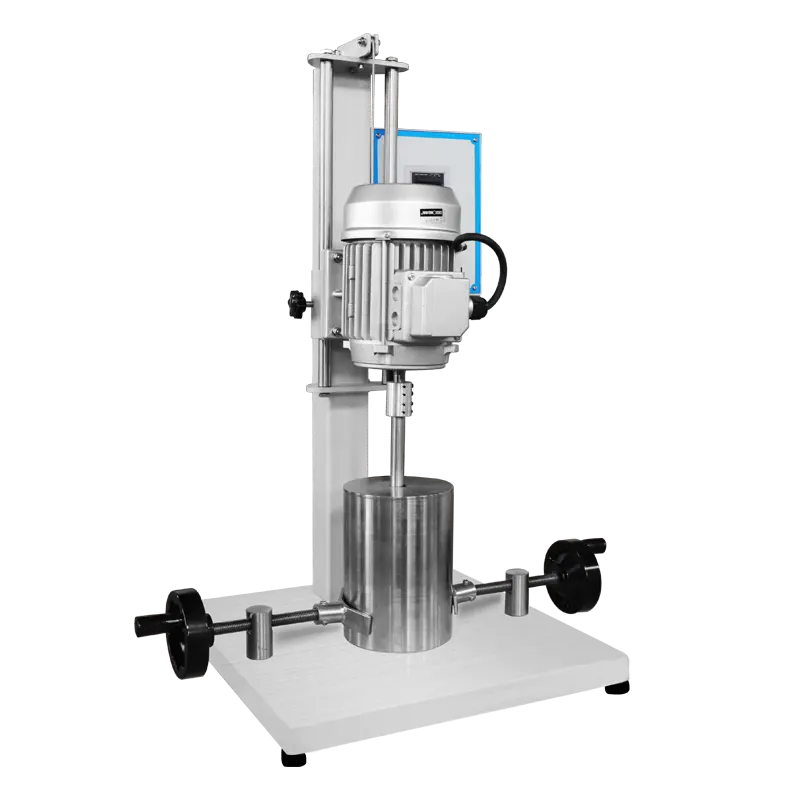
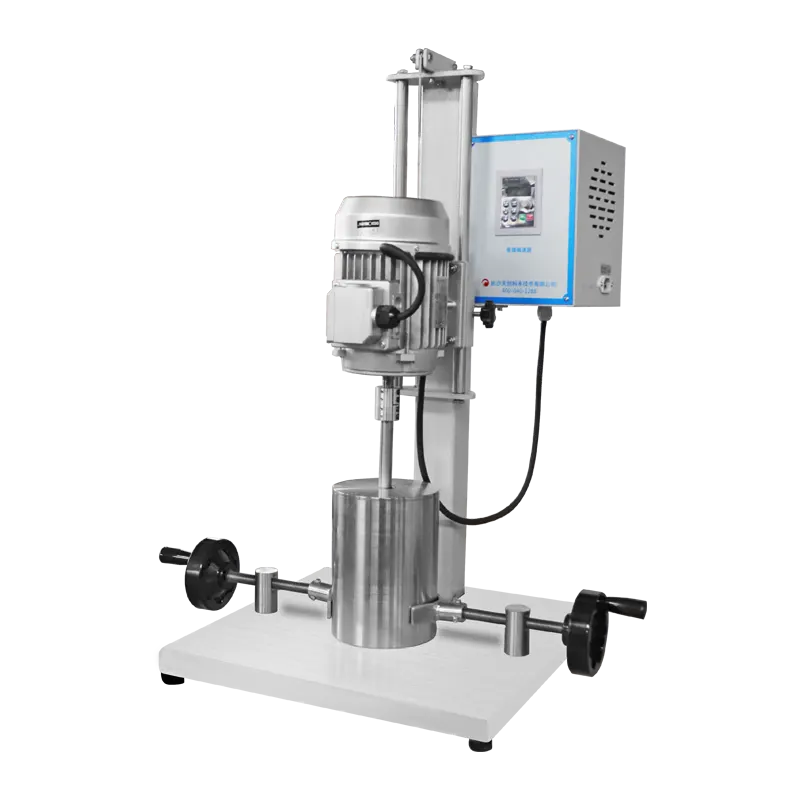
The installation includes a rack with a drive and shaft, a basket with a separating device, a rotor inside the basket, an external dispersing disk, a working vessel (often with a cooling jacket) and a mechanism for raising or lowering the basket.
Basket and separation of grinding media
The basket performs two functions at the same time: it holds the grinding media in a limited volume and serves as a working chamber through which the product passes. The walls and bottom of the basket are perforated, and the size of the holes or slots must be less than the minimum diameter of the grinding body - otherwise the balls will be carried out of the basket into the product. Hence the first rule of thumb for selection: the separating device and the grinding media are considered as a pair. It is impossible to select grinding media without knowing the width of the slot, and it is impossible to select a device without deciding on the fraction of grinding media, since both the separator and the permissible peripheral speed depend on it.
Rotor, pumping effect and circulation
Inside the basket, a rotor is mounted on a shaft, working like a pump wheel. When rotating, it creates a pressure difference: the product is drawn into the basket, pressed through a layer of grinding media and exits through the perforation back into the vessel, after which it returns again to the basket inlet. A closed circulation loop is formed inside one container. The external dispersing disk maintains the solid phase in suspension and equalizes the concentration throughout the volume, preventing the formation of stagnant zones.
Energy is transferred to the layer of grinding bodies through impacts and shear between the bodies, so the result is determined not by one number of revolutions, but by a set of parameters: the diameter and density of the grinding bodies, the degree of filling of the basket, the peripheral speed of the rotor, the viscosity and rheology of the suspension, and processing time. It is useful to distinguish between two operations that look similar. Mixing ensures uniformity throughout the volume of the vessel, and deagglomeration and grinding occur in the basket, in the layer of grinding media. If the product is too viscous and does not pass through the layer, the device actually turns into a mixer: the shaft rotates, the temperature rises, but the particle size does not change.
Heat balance and cooling
Almost all the mechanical energy of the drive is converted into heat, which is released in the volume of the suspension. The higher the viscosity, solid phase concentration and peripheral speed, the greater the heating. The vessel's cooling jacket, coil or cooled basket removes some of the heat, but the temperature of the cooling medium is not equal to the temperature of the product: the operating temperature is measured directly in the suspension by a sensor. Overheating increases solvent vapor pressure, changes rheology and accelerates wear, and can be downright harmful to heat-sensitive components. In such cases, pre-cooling the batch, reducing the speed, or breaking up the batch helps.
Characteristics and their correct reading
Volumes and loading
The documentation for such equipment contains several different volumes, and they should not be mixed.
- The geometric volume of the vessel is the largest value, which is never equal to the loading volume.
- Basket volume is the internal volume of the chamber in which the grinding media are located.
- Filling the basket with grinding media is an independent parameter that does not coincide with the volume of the basket.
- Working batch - a range of suspension volumes that ensure stable circulation and coverage of the basket.
- The mass of the solid phase is a derivative of the volume of the batch and the dry residue content, and not a separate characteristic of the apparatus.
The most common mistake is comparing the volume of the vessel with the volume of the batch. Working “along the top edge” or, conversely, loading in which the basket is not covered are equally bad: in the first case, the product splashes out and cooling cannot cope; in the second, circulation is disrupted and some of the material is processed unevenly.
Speed, viscosity and energy transfer
The number of revolutions in itself says little: with different rotor diameters, the same rotational speed gives different peripheral speeds, and it is this that determines the shear intensity and the amount of energy supplied. An increase in peripheral speed simultaneously increases the dispersing effect, heating and wear of the grinding media and the separating device. Very small grinding media are destroyed faster at high speed, so the mode for them is selected more carefully.
Product viscosity is the second limiting factor. While the suspension flows through the basket, the apparatus operates like a mill. As soon as the rheology becomes incompatible with the pumping effect of the rotor, processing stops, even if the drive continues to rotate the shaft. For this reason, other grinding principles are sometimes preferred for highly viscous pastes and thick pigment concentrates.
Particle size and size distribution
The achievable fineness depends on the sample material, initial particle size, selected grinding media, processing time, formulation composition and measurement method. The result obtained with one pigment does not transfer to another: materials differ in hardness, fragility and tendency to agglomerate. Various methods are used for monitoring - from grindometer to laser diffraction - and they give different numbers that cannot be compared directly. The catalog minimum fineness value should be read as a guide to the capabilities of the principle and not as a guarantee for any sample.
The meaning of the size requirement is determined by the application: in pigment systems, color strength and hiding power are important, in ceramics - sintering behavior, in materials for current sources - electrochemical characteristics. Excessive grinding is not always beneficial: it increases the specific surface area, dispersant consumption and the risk of grinding media material getting into the product.
Zirconium dioxide grinding media: compatibility, wear and impurities
In bead machines, grinding media are consumables that determine both productivity and product purity. Ceramics based on zirconia, usually stabilized, combine high density with hardness and wear resistance, so they are used for wet grinding and dispersion. Due to its higher density compared to glass, such a body with the same diameter carries more energy into the contact zone, which allows the use of smaller diameters. Available versions are shown in the card "Zirconium dioxide grinding balls».
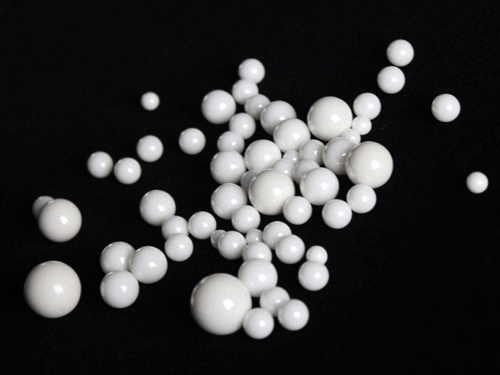
Compatibility with the device is not a formality. The diameter of the ball must obviously be greater than the width of the slot of the basket separating device; if a finer fraction is required, then the separator must be thinner. The density of the grinding media affects power consumption and heating, so switching from one material to another almost always means a review of the mode, and not just a change in the load.
The second issue is the introduction of impurities. Wear resistance does not mean zero contamination: the material of the grinding media gradually transforms into the product, and its quantity depends on the diameter of the balls, peripheral speed, duration of processing, degree of filling of the basket, hardness and abrasiveness of the suspension, as well as on the condition of the apparatus itself - the rotor, basket and vessel. If the purity requirements are high, compare different materials (agate, corundum, tungsten carbide, stabilized zirconium dioxide) and take into account that harder bodies wear out mill parts faster. For aggressive media, such as those containing fluorides or concentrated alkalis, the suitability of a specific material is confirmed separately, according to the manufacturer.
A separate practical topic is cleaning. After changing the product, the grinding media are removed, washed and dried; Remnants of the previous formulation on the surface of the basket become a source of cross-contamination. The compatibility of detergents with the material of the balls and with the seals of the device is checked in advance.
Selection criteria, limitations and common mistakes
The selection begins not with the model, but with the task. It is useful to answer several questions in sequence.
- What is the batch size and what is the viscosity of the product?
- What size is required and how wide is the range of acceptable values?
- What is the liquid phase and is it compatible with seals, hoses and coatings?
- How heat sensitive is the product and how much cooling power is needed?
- How often does the recipe change and what are the cleaning requirements?
- What grinding media are proposed in terms of material and diameter and are they consistent with the separating device?
The limitations of the method include the following. The basket mill only works with liquid media; dry grinding of powders is the task of planetary, drum or vibration mills. The device does not perform coarse crushing: the initial coarseness is limited by the cross-sections of the basket and the pumping effect of the rotor. Batch performance is determined by cycle time, not just vessel volume. If flammable solvents are used, ventilation, grounding, and zone classification issues are site design issues and are not determined by mill selection.
Typical selection mistakes look like this.
- The volume of the vessel is taken as the volume of the working batch.
- Select grinding media smaller than the slot of the separating device.
- Ceramic bodies are expected to be completely free from contamination of the product.
- The mode is assessed by the number of revolutions, without recalculating the peripheral speed.
- Heating is not taken into account and the temperature is not measured in the product.
- Transfer the result of one test to another material or another formulation.
The practical conclusion is simple: the parameters of the apparatus, grinding media and formulation are selected together, and testing is performed on a real sample. This is the only way to talk about a reproducible result.
Frequently asked questions
How is a basket mill different from a flow-through bead mill?
A flow mill requires a feed pump and at least two containers: the product passes through the grinding chamber once or in several passes. The basket works in one container, so it is quicker to set up and easier to clean, but the batch volume is limited by the size of the vessel, and the processing time is set by the cycle.
Is it possible to replace steel grinding media with zirconium ones?
Not automatically. First, check whether the required diameter passes through the basket separator, then whether greater density is required and whether changes in power and heating are acceptable. After replacing the body material, the regime is usually revised.
Is the machine suitable for dry grinding?
No. Basket bead mills are designed for the wet process. For dry powders, other equipment is used - planetary, drum or vibration mills; The choice depends on the required sample size and volume.
Is it possible to rely on the size indicated in the catalogue?
Just as a guide. The actual result depends on the material, initial particle size, grinding media, processing time and measuring method. A reliable conclusion is obtained by testing on a specific sample.
Is it necessary to cool the vessel during normal dispersion?
Cooling is almost always beneficial because most of the energy input is converted into heat. The need and intensity of refrigeration is determined by the temperature of the product, and not by the temperature of the jacket.