
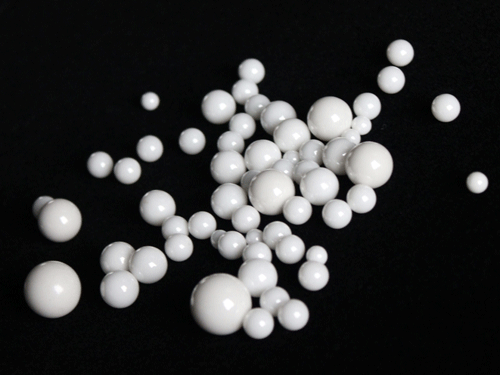
Zirconia grinding balls are ceramic grinding media for ball mills that are loaded into a grinding bowl or drum along with the sample. They are not a stand-alone installation and do not replace the bowl, liner or mill control system. Their task is to transfer impact and friction energy to the material, providing grinding and, depending on the mode, deagglomeration of the powder. In stock TENCAN (Changsha Tianchuang Powder Technology Co., Ltd.) такая позиция представлена в card “Zirconium dioxide grinding balls”; specific dimensions, tolerances, packaging and delivery conditions should be checked there, and not inferred from the name of the material.
What are zirconia grinding balls and where are they found in the process
In the sample preparation system, the grinding balls occupy the position of the working medium, and not the main unit. The mill sets the movement of the chamber, the bowl or drum limits the working space, the lining protects the body, and the balls are in direct contact with the powder. Therefore, the properties of the result depend not on one element, but on their combination: ball material, chamber material, initial size, medium, loading ratio and grinding time.
Zirconium dioxide is a ceramic material. In grinding environments it is valued for its combination of hardness, wear resistance and relatively high density compared to some other ceramics. However, “zirconium dioxide” is not a single formulation. Properties depend on the composition, stabilizing additives, sintering technology, porosity and surface treatment. Therefore, the technical data of a specific batch and model must be checked with the documentation TENCAN, and not transfer from balls of another manufacturer or other ceramics.
How do ceramic balls work in a mill?
When the chamber rotates or oscillates, the balls rise, collide with each other and with the walls, and abrade the material. The ball mill combines impact and abrasion. For brittle powders, the energy of a single impact is important; for agglomerates, the number of contacts and shear forces are important. Large balls give higher impact energy, small ones - more contacts with the same load mass. This is a general principle, but the optimal combination depends on the sample, required size and mill design.
Dry and wet grinding are not interchangeable modes. In the dry process, the powder may stick to the balls and walls, and removal of the product requires additional steps. In the wet process, the liquid removes heat, reduces dusting and can reduce aggregation, but introduces additional requirements for chemical compatibility, suspension viscosity and subsequent drying. In addition, grinding and disagglomeration are different tasks: in the first case, primary particles are destroyed, in the second, their clusters are broken up. The choice of balls and mode should be based on the exact result you need.
Material, wear and contamination risk
Ceramic grinding media should not be described as “completely inert”. During abrasion, the material of the balls and lining wears out, and wear products can enter the sample. For zirconium dioxide, this means that zirconium and ceramic-related elements potentially appear in the sample; their permissible number depends on the analytical task. If the sample is then tested for trace contaminants, the risk of carryover must be assessed in advance, and not just based on the promise of “zero contamination.”
The intensity of wear depends on the hardness of the sample, its abrasiveness, size, grinding time, speed, ratio of balls to powder, as well as the condition of the surface of the balls. Chips, cracks and changes in geometry increase wear. Therefore, a batch of balls is periodically inspected: color, shine, presence of chips, foreign inclusions and traces of adhesion are checked. If different types of materials have been mixed without documented compatibility, it becomes more difficult to interpret the source of contamination.
It is especially important to distinguish between the material of the balls and the material of the grinding bowl or drum. Even if both are based on zirconia, this does not guarantee the same composition, porosity and wear. The lining, agitator, rollers and ball media have different functions; You cannot transfer the properties of one element to another without confirmation. For particularly sensitive applications, other materials are sometimes considered - agate, corundum, tungsten carbide, polymers or stainless steel - but each has its own limitations in wear, hardness and impurity transfer. There is no universal “cleanest” option.
Dimensions, loading and hardware compatibility
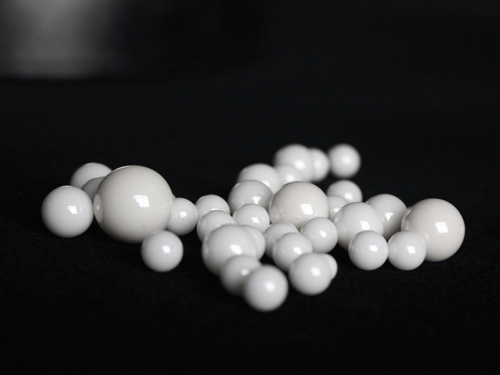
The size range of grinding balls is of practical importance. Small balls increase the contact area and the number of collisions, large ones increase the mass and energy of an individual impact. However, this does not mean that the same diameter is suitable for every sample. Consideration must be given to the chamber's internal dimensions, clearances, lining material, mill load capacity and required particle size distribution. Specific diameters, tolerances and packaging for products TENCAN indicated in the product card and accompanying documents; in the article they are not replaced by assumptions.
When calculating the load, distinguish between the volume of the glass, the total volume of the balls, the free volume for the sample and the mass of the powder. These are different quantities. It is impossible to transfer the mode from one mill to another just because they have a similar chamber volume. Also, the mill’s productivity over time should not be equated with the mass of one load: the result is influenced by the initial particle size, bulk density, grinding time and unloading efficiency.
Compatibility with equipment is confirmed not by the name of the category, but by the design of a particular installation. The balls must be suitable for the type of mill, the size and material of the grinding chamber, the permissible dynamic loads and the cleaning conditions. Availability on the site TENCAN ovens, presses or other equipment does not mean that the grinding balls are intended for them: they are different stages of the process. The furnace does not replace the mill, and the grinding balls are not its accessory. If the card does not directly indicate compatibility, a request to the manufacturer or supplier is required indicating the mill model, beaker and application.
Cleaning, storage and condition monitoring
Before the first use and between samples, the balls are cleaned so as not to introduce new contamination. The choice of detergent depends on the previous sample, the material of the balls and the acceptable reagents. Do not automatically use strong acids, alkalis or abrasive pastes: they can damage the ceramic surface or change its condition. After wet cleaning, the balls are dried without leaving any solvent in the pores or on the surface. Volatile and toxic solvents require laboratory conditions, not household methods.
It is better to store balls in a clean, closed container, away from metal tools and abrasive materials. A metal spatula or scoop may leave marks that will later be perceived as contamination of the sample. If the balls were used with different powders, it is useful to keep a simple log: material, mode, how they were cleaned, condition after inspection. This helps distinguish natural wear from accidental damage and replace the batch in time.
Condition monitoring does not require sophisticated equipment, but must be regular. Pay attention to chips, cracks, darkening, stains, sticky deposits and changes in shape. Heavily worn balls are less predictable in terms of mass and geometry, and their wear debris increases the uncertainty of the result. For critical experiments, it is better to identify the batch and not mix it with balls of unknown origin.
Criteria for selecting zirconia grinding balls
The choice begins with the task, and not with the desire to buy “better balls.” First, it is determined what exactly is required: destruction of primary particles, disagglomeration, preparation of a representative sample, or obtaining a suspension. Then the limitations are recorded: permissible transfer of impurities, chemical compatibility with the sample and liquid, working volume of the chamber, type of mill and available mode. After this, they check what materials and sizes are supplied TENCAN for this position.
The practical criteria look like this:
- Material and cleanliness. You need to understand what elements ceramics can introduce during wear and whether this is acceptable for subsequent analysis.
- Size and uniformity. The diameter must be appropriate for the camera and the task; Balls that are too large may produce excessive impact, while balls that are too small may result in insufficient energy or difficulty unloading.
- Camera compatible. The bowl or drum material, lining and mill load capacity are more important than the appearance of the balls.
- Grinding mode. Dry and wet processes have different adhesion, drying, viscosity and cleanup requirements.
- Wear and maintenance. The possibility of inspection, cleaning and timely replacement of the batch must be considered before work begins.
If there is insufficient data, you should not substitute typical values from another model. In the product card at website TENCAN and in the documentation for a specific item you need to clarify the size range, material, packaging and conditions of use. For mixed tasks, it is better to ask a question describing the sample, mill and required size, rather than relying on general promises.
Brief answers to frequently asked questions
Can zirconia balls be used for wet grinding?
In principle, yes, if the material is compatible with the liquid, the chamber and subsequent cleaning. But the wet mode requires checking the chemical resistance, suspension viscosity and drying method. You cannot assume that any solvent is suitable just because the ball is ceramic.
Do these balls guarantee complete absence of contamination?
No. Any grinding medium wears out. Zirconium dioxide may be preferred for some applications and undesirable for others if zirconium or related elements are being monitored in the sample. The risk is assessed based on a specific sample and regimen.
How are they different from steel grinding balls?
Steel is a metallic medium that, when worn, can introduce iron and alloying elements. Zirconium dioxide ceramics have a different wear and contamination profile. It cannot be argued that one option is “cleaner” in general: it all depends on the sample, analysis and conditions.
Can I mix balloons of different sizes or materials?
Mixing different sizes is sometimes used to change the balance of impact and abrasion, but this must be justified. You should not mix materials without confirmation: different densities, hardness and wear make it difficult to interpret the result and find the source of contamination.