
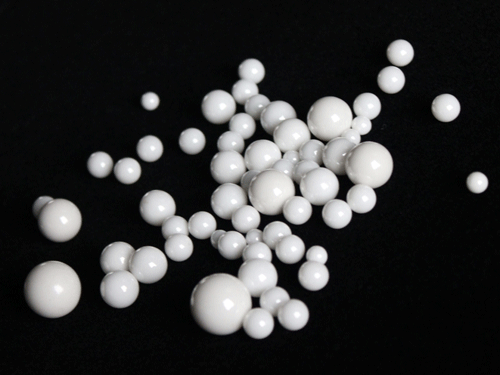
Zirconia grinding balls are grinding media that are loaded into the grinding bowl, drum or mill chamber along with the sample. They transfer impact and abrasion energy to the material, providing grinding, deagglomeration and averaging of the powder. Such balls are chosen when it is necessary to combine high density and wear resistance with limited transfer of metal impurities. Below we look at how these bodies are structured, what parameters are important, how their compatibility is limited, and what to look for when choosing.
What are zirconium dioxide grinding balls and their place in the grinding process
Zirconium dioxide grinding balls are spherical bodies made of ZrO₂ based ceramics. Unlike a liner or beaker, they are a consumable item that is in direct contact with the sample. Their task is to create many contact points in the working chamber and transfer mechanical energy to the powder. When the chamber rotates or vibrates, the balls rise and fall, colliding with each other and with the walls. An abrasive effect also occurs between the balls, which destroys agglomerates and reduces the particle size.
Zirconium dioxide balls are used in planetary, drum, vibration, bead and attritor mills. However, the ball material itself does not determine the type of mill. It only sets the properties of the grinding medium. For each machine there are restrictions on the diameter of the balls, loading volume, speed and permissible weight. Therefore, the selection begins not with the material of the balls, but with the process: what sample needs to be crushed, to what size, in dry or wet mode, with what permissible level of impurities.
Working principle
In a ball mill, grinding occurs due to impact and abrasion. An impact occurs when balls or a ball collide with a wall, when kinetic energy is transferred to the particles. Abrasion occurs when the layers of balls shift relative to each other and the walls. The ratio of the mechanisms depends on the speed of rotation, the diameter of the chamber, the size and density of the balls, as well as on the filling. At low speeds, abrasion predominates; at high speeds, impact predominates. For brittle materials, impact is often preferable; for plastic materials or those prone to agglomeration, abrasion and deagglomeration are preferred.
Zirconium dioxide has a high density compared to agate, corundum or nylon. For the same diameter, a ZrO₂ ball has more mass and therefore more kinetic energy at the same speed. This makes it possible to more efficiently grind dense and hard materials, but at the same time increases the load on the mill, the glass and the balls themselves. Therefore, when switching from a lighter medium to zirconium, you need to check whether the equipment allows such a loading mass and whether the glass can withstand increased dynamic loads.
Basic elements and geometry
From a design point of view, the zirconia grinding ball is a monolithic ceramic body. Key parameters: diameter, sphericity, surface roughness and absence of internal defects. Sphericality affects uniformity of contact and wear. If the shape deviates from the sphere, local stress concentration zones appear, the ball wears out faster and can damage the lining. Surface chips and cracks reduce the service life and increase the risk of contamination of the sample with the ball material.
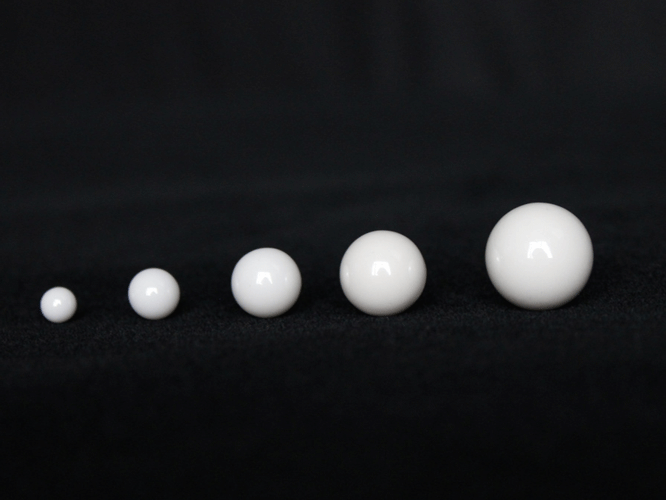
The size of the balls is not chosen arbitrarily. Larger balls provide more power but fewer contact points. Small balls increase the area of abrasive contact, but their mass and impact energy are lower. In practice, a mixture of balls of different diameters is used to combine both mechanisms. However, for laboratory planetary mills with small beakers, balls that are too large may not fit in the required quantities or may place excessive stress on the drive. In the product card TENCAN available diameters and design options are indicated; they should be checked with the specific mill manual.
Material and design: why zirconia
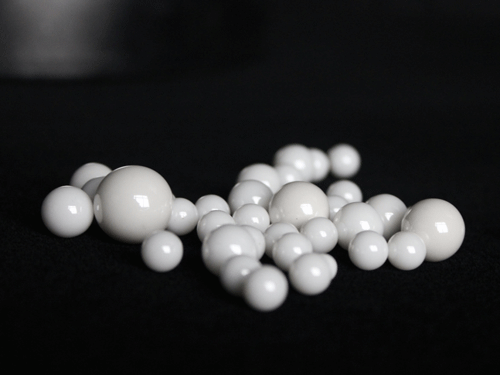
Zirconium dioxide is a ceramic material with high hardness, wear resistance and chemical resistance. In its pure form, ZrO₂ undergoes phase transformations when temperature changes, which can lead to cracking. Therefore, the industry uses stabilized compositions: most often with yttrium oxide, less often with magnesium oxide or other additives. The stabilizer retains the desired crystalline phase and increases crack resistance. The specific composition and amount of stabilizer determines the properties of the balls, so the characteristics of one type of zirconium ceramic cannot be transferred to all products.
Stabilization and phase composition
The most common spheres are yttrium-stabilized tetragonal polycrystalline zirconia (Y-TZP). They combine high strength and wear resistance. There are also ZrO₂-based composites with the addition of aluminum oxide or other phases, which may have different hardness and wear behavior. It is important for the user to understand: the name “zirconium dioxide” does not guarantee the same properties from different suppliers. You need to look at the material passport, which indicates density, hardness, tensile strength and permissible operating temperature.
The phase composition also affects the behavior during grinding. If the ceramic contains unstable phases, during prolonged operation transformations are possible, accompanied by a change in volume and the appearance of microcracks. This can increase wear and release of ball material into the sample. Therefore, for critical applications where powder purity is important, it is worth requesting data on phase stability and wear test results from the supplier.
Density, hardness and wear
The density of zirconia balls is higher than most other ceramic grinding media. This provides high impact energy, but at the same time increases contact stresses. The hardness of zirconium dioxide is high, but inferior to tungsten carbide. At the same time, zirconium ceramics are more crack-resistant than, for example, corundum. This means it has better shock resistance, but is not completely impervious to wear. Any material, to one degree or another, becomes a sample. The only question is the quantity and admissibility of such transfer for a specific analysis.
The wear of the balls depends not only on the material, but also on the conditions: rotation speed, grinding time, sample hardness, the presence of abrasive particles, dry or wet process, chemical aggressiveness of the environment. Wet grinding in water or alcohol may have lower wear than dry grinding due to heat dissipation and reduced friction. However, some liquids can cause corrosion or hydrolysis of the ceramic surface. Therefore, the environment is always selected individually.
Types and versions: what is important to distinguish
In the catalog TENCAN Zirconium dioxide grinding balls are presented as a separate item. The user can choose the diameter and quantity to suit his task. However, do not assume that all balls of the same material are the same. Designs are distinguished by size, ceramic composition, manufacturing accuracy and purpose. Some options are designed for laboratory planetary mills with small beakers, while others are designed for larger drum or bead mills.
Sizes and ranges
The diameter of the ball is the main parameter affecting the grinding efficiency. Small balls are used for fine and ultrafine grinding when it is necessary to obtain a high specific surface area. Large balls are used for pre-grinding or for materials that require significant impact energy. In laboratory practice, multiple diameter arrays are often used to optimize particle size distribution. The exact diameter values for a specific item are indicated in the product card and accompanying documentation. You should not set the size “by eye”: balls that are too small may not crush the sample, and balls that are too large may damage the glass or lead to over-grinding.
Shape and surface quality
An ideal sphere is the optimal shape for a grinding medium. It provides even wear, predictable chamber movement and minimal risk of jamming. The surface of the balls must be smooth, without cracks, chips or foreign inclusions. Visual inspection of the batch before loading is a mandatory procedure. It is better to discard defective balls: they not only perform worse, but can also become a source of contamination and increased wear on other balls.
Characteristics and their correct reading
When selecting zirconia balls, it is important to correctly interpret the specifications. Below are the main parameters and what they mean in practice.
- Ball diameter. Determines mass, impact energy and number of contact points. Indicated in millimeters. Each mill has a recommended range.
- Density. Usually expressed in g/cm³. The higher the density, the greater the energy for the same volume. But high density increases the load on the drive and glass.
- Hardness. May be indicated by Vickers or other scales. High hardness reduces abrasive wear, but does not guarantee the absence of brittle fracture upon impact.
- Crack resistance. Shows resistance to crack propagation. For zirconium ceramics, this parameter is often more important than absolute hardness.
- Wear resistance. Usually assessed by mass loss over a certain time under standard conditions. Direct comparison between different batches is only possible under identical test conditions.
- Chemical resistance. Determines which environments can be used without destroying the balls. Zirconium dioxide is resistant to most acids and alkalis, but not all; Contact with hydrofluoric acid should be especially avoided.
- Purity of the material. Indicates the content of impurities. Even ceramics are not completely inert: they can introduce Zr, Y and other elements. This is critical for trace analysis.
It is important to distinguish between passport data and real conditions. The manufacturer may indicate typical values obtained in the laboratory. In a specific mill with a specific pattern, wear will be different. Therefore, for critical tasks, it is useful to carry out your own control grinding and analyze the sample for contamination.
Compatible with mills and grinding bowls
Compatibility is not only a geometric correspondence. It is necessary to take into account the material of the glass, the hardness of the balls, the permissible load weight, speed and temperature. If the balls are much harder than the glass, the glass will wear out and particles of its material will get into the sample. If the glass is harder than the balls, the wear of the balls will accelerate. It is optimal when the materials are similar in hardness or when a softer element is chosen deliberately, and its contribution to contamination is acceptable. For example, zirconia balls are often used with grinding bowls made of zirconia, polyurethane, nylon or PTFE. But for each combination, real wear must be assessed.
Planetary, drum and bead mills
In planetary ball mills, the glasses rotate around a common axis and at the same time around their own axis. High centrifugal accelerations occur, so the balls experience significant shock loads. Zirconium balls are suitable here due to their high crack resistance, but you need to check whether the glass and drive allow such a mass. In roller driven drum mills, speeds are typically lower and abrasion is more prevalent. Here, zirconium balls can be effective for fine grinding, but their high density requires checking the drive power. Bead mills use small grinding media, often less than 1–2 mm. Zirconium bead balls are used for dispersion and deagglomeration. However, not all bead mills are designed for high density zirconium: you need to check the manual.
Grinding bowl material
When choosing a glass for zirconium balls, take into account hardness, chemical resistance and permissible contamination. Zirconium dioxide beakers provide minimal transfer of foreign elements, but they are fragile and expensive. Polyurethane and nylon cups are softer: they reduce impact noise and the risk of damage to the balls, but they themselves wear out faster, and polymer particles can get into the sample. Stainless steel glasses are durable, but they introduce iron, chromium and nickel as they wear out. Agate glasses are chemically inert, but have low impact strength and can break under high loads. Therefore, there is no universal combination.
Pre-crushing equipment
It is important to distinguish between grinding and crushing. For example, stainless dustless crusher TENCAN Designed for preliminary grinding of lump material, and not for working with grinding balls. Its presence in the catalog does not mean that it is automatically compatible with zirconia balls or that it replaces a ball mill. Ball grinding requires the appropriate type of mill and grinding bowl, and the crusher can only be used in the previous sample preparation stage. If the starting material is too coarse, it is first crushed and then fed into a ball mill.
Applications and Limitations
Zirconia grinding balls are used in a variety of applications, from preparing geological samples and ceramic powders to grinding materials for electronics, batteries, pigments and pharmaceuticals. They are chosen when high grinding energy and relatively low metal contamination are required. However, this material has limitations that are important to consider.
Suitable materials
Zirconium balls work well with brittle and medium-hard materials: oxides, carbonates, silicates, glass, ceramics, and some metal powders. They are suitable for dry and wet grinding. In wet mode, water, ethanol, isopropanol and other liquids are often used, but before this you need to ensure chemical compatibility with the material of the balls and glass. For materials prone to sticking, wet grinding with zirconium balls may be preferable to dry grinding.
Restrictions
You should not use zirconium balls to crush very large pieces: this requires a preliminary crusher. They do not replace tungsten carbide grinding media where maximum hardness and density are required. They are also not completely inert: during long-term grinding, zirconium and yttrium can be added. For tasks where even trace amounts of these elements are unacceptable, control tests must be carried out. In addition, zirconia ceramics are sensitive to sudden thermal shocks and may deteriorate if not dried or cooled properly.
Criteria for selecting grinding balls
To select the right zirconium dioxide balls, it is recommended to follow the following algorithm.
- Define the task. Should the sample be ground to a certain size, deagglomerated, or simply averaged? The required energy and grinding time depend on this.
- Evaluate the source material. Hardness, brittleness, tendency to stick, chemical reactivity and acceptable contamination - all these factors influence the choice.
- Select mill type. Planetary, drum, vibrating or beaded - each has its own limitations on the size and weight of the balls.
- Select the diameter of the balls. Refer to the mill manufacturer's recommendations and the desired coarseness. Fine grinding usually requires smaller balls, and coarse grinding requires larger balls.
- Calculate your load. The mass ratio of the balls to the sample, as well as the degree of filling of the chamber, affect the efficiency. Too few balls - low energy, too many - lack of space for movement.
- Check compatibility with the glass. The glass material must be compatible with the balls in terms of hardness and chemical resistance.
- Check acceptable contamination. If the assay is sensitive to Zr and Y, other materials or additional purification steps may be required.
- Order a trial batch. Before scaling up, it is useful to do a test grind to assess wear and product purity.
You can view the available versions on the page zirconium dioxide grinding balls TENCAN. Size options and accompanying information are indicated there. However, the final decision should be made after checking with the mill management and analyzing the sample requirements. General information about the brand's products is available at website TENCAN.
Care, cleaning and contamination control
In order for the balls to serve for a long time and not spoil the samples, they need to be looked after. After each grinding, they are cleaned of any remaining material. The cleaning method depends on the sample and the acceptable contaminants. Typically, washing in a suitable solvent, ultrasonic bath and drying are used. It is important to avoid cross-contamination between different materials: if the balls have been used for one powder, they must be thoroughly cleaned before loading another.
Cleaning after grinding
To clean zirconium balls, use mild detergents, deionized water, ethanol or isopropanol. It is not recommended to use aggressive acids, especially hydrofluoric acid, which destroys ceramics. After wet cleaning, the balls are dried at a moderate temperature, avoiding sudden changes. If the sample was toxic or radioactive, special procedures provided by the laboratory are followed. You should not clean the balls in the same mill if this could damage the lining or lead to jamming.
Wear monitoring
Periodically check the condition of the balls: measure the diameter, weigh a control batch, inspect the surface for chips and cracks. If wear exceeds the acceptable level, the balls are replaced. It is also worth analyzing the sample for the content of the elements that make up the balls in order to notice an increase in contamination in time. Keeping a grind log detailing the ball lot, sample material, and conditions helps identify patterns and plan replacements.
Frequently Asked Questions
Can zirconia balls be used in any mill?
No. Each mill has limitations on feed weight, ball size and speed. The high density of zirconium creates an increased load on the drive and glass. Before use, you must ensure that the equipment allows such loading. It is also important to check whether the glass material is suitable.
How is zirconium dioxide better than stainless steel?
Zirconium ceramics are chemically more inert and do not introduce iron, chromium and nickel. It is also non-magnetic and corrosion resistant. However, it is more fragile and more expensive. For applications where metallic impurities are not acceptable, zirconium is often preferred, but is not the only option.
How to choose the diameter of the balls?
The diameter depends on the initial sample size and the target size. Large balls are used for coarse grinding, and small ones for fine grinding. A mixture of sizes is often used. Diameter recommendations are usually found in the mill manual or product card.
Are zirconium balls completely free of contamination?
No. Any material in the process of wear passes into the sample. Zirconium dioxide can contribute Zr, Y and other elements. The level of contamination depends on the grinding conditions and is usually lower than with metal balls, but it is not zero. For critical tasks, control analyzes are carried out.