
An automatic electric tablet press is equipment for forming tablets from prepared powder in a matrix using punches. In the technological chain, it takes place after grinding, mixing and, if required, drying, and before monitoring the geometry, mass and strength of the samples. Its task is to obtain repeatable compacts for laboratory research, testing of compositions and small batches. In the catalog TENCAN presented automatic electric tablet press; Specific parameters should be viewed in the card of the selected version.
What is this equipment and where is it located in the process?
Tableting is a special case of powder pressing, in which the shape and size are specified by a matrix and punches. Unlike free-form molding or manual compression, a tablet press dispenses material into a die and compresses it in a repeatable cycle. Therefore, it is used where not only density is important, but also the repeatability of the mass, thickness and diameter of the compact.
The place in the process is determined by the task. First, the powder must be prepared: crushed to the desired size, mixed with additives if necessary, dried or moistened according to the accepted method. Then the press forms a tablet, and further operations - measurement, weighing, strength testing, dissolution or other research - relate to sample control. Therefore, a tablet press does not replace a mill, mixer or drying oven: it works with an already prepared mass.
The automatic cycle itself does not prove that this is a rotary tablet machine. With a single-position press, tablets are formed sequentially, one after another; In rotary equipment, compression occurs on a rotating rotor with several stations. The equipment class must be checked using the card of a specific model, and not just by the word “automatic”.
In laboratory practice, such a press is in demand when you need to obtain a series of tablets with similar weight and geometry, compare several compositions, or test the pressing mode before moving to another scale. For small-scale production, cycle stability, ease of changeover, and quality control are important.
Design and principle of operation
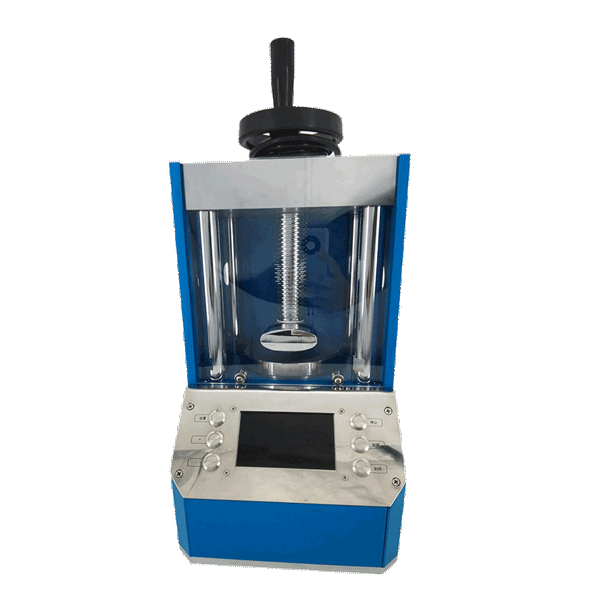
A typical design of an automatic tablet press includes several functional units. Specific equipment varies by design, so the items listed should be taken as a guide for reading the technical documentation and not as a statement about any model.
- The frame and the power circuit absorb the compression force and ensure the rigidity of the structure.
- The electric drive and transmission mechanism convert the rotation of the motor into coordinated movement of the punches.
- The matrix sets the diameter and shape of the tablet, and the upper and lower punches create pressure on the powder.
- The filling device feeds the powder into the matrix; The stability of the mass depends on the uniformity of feeding.
- The ejection unit removes the finished tablet from the matrix, after which it falls into the receiving container.
- Controls, guards and locks provide mode setting and operator safety.
The working cycle is usually built like this: the matrix is filled with powder, the lower punch sets the filling depth, the upper punch compresses the material, then the tablet is pushed out. In an automatic electric press, the sequence is carried out by a drive, and the operator sets the parameters and controls the process. If a model includes a force sensor, cycle counter, or programmable recipes, this is reflected in its manual and card.
The depth of the fill and the position of the punches are not the same thing as the weight of the tablet. With the same volume of powder, the mass depends on the bulk density of the powder, its flowability and uniformity of delivery. Therefore, when switching to another material, you have to re-check not only the force, but also the filling of the matrix.
Replacement equipment must be suitable for the machine and the task. The die and punches are selected based on size, tolerances, material and cleaning requirements. It cannot be assumed that any punch or die is suitable for any press: seat geometry, stroke and force limitations are checked according to the documentation.
What does electrical automation provide?
The automatic electric drive eliminates the need to manually operate a lever or pump each cycle. This reduces the dependence of the result on the pace and effort of the operator, allows you to repeat a given sequence and makes the work more predictable. For a series of samples, not only speed is important, but also stability: uniform die filling, consistent punch stroke and reproducible tablet ejection.
Automation of sequence is not the same as automatic quality management. If the press does not have force or mass feedback, it follows the movement of the mechanism, but does not “correct” poorly flowing powder or compensate for fluctuations in bulk density. The availability of programmable parameters, sensors and recipes should be checked according to the description of a specific model, and not assumed by the name.
Electric drive also changes the requirements for workplace organization: suitable power supply, protection from dust, access to an emergency stop and clear cleaning procedures are needed. Before work, check the guards, the condition of the matrix and punches, and the absence of foreign objects in the compression zone. These measures do not replace the operating instructions, but complement them.
For a laboratory, an automatic press is convenient because it allows you to quickly switch between compounds and keep a log of modes. On the production floor, productivity, inter-shop cleaning and tooling compatibility with multiple products are important. The same term “automatic” in different cards can describe different levels of automation.
How to read characteristics and not confuse pressure with force
In the description of the press there are parameters that are easy to misinterpret. Below are guidelines for reading the card; Specific values apply to the specified model only.
| Parameter in description | What does it mean | What to clarify |
|---|---|---|
| Nominal pressing force | The maximum force that the mechanism develops; upper limit for the intended mode | Tablet area, cycle duration, permissible operating mode |
| Diameter of matrix and punches | Sets the tablet diameter and contact area | Equipment compatibility, tolerances, material |
| Backfill depth | Volume of powder in the matrix before compression | Bulk density and required tablet weight |
| Performance | Number of tablets per unit time for specified conditions | Tablet weight, powder flowability, cycle time, manual operations |
| Hydraulic pressure | Indicator in the hydraulic circuit, if such a circuit is provided | Piston area and sample area; Without this, the pressure on the powder cannot be determined |
| Equipment material | Affects wear, cleaning and possible transfer of impurities | Powder abrasiveness, corrosiveness, cleanliness requirements |
The main methodological mistake is to consider the pressure gauge reading or the nominal force of the machine as pressure on the tablet. Pressure is assessed as the ratio of force to contact area: P = F / S. For a round tablet, the area is related to the diameter, therefore, without diameter and actual force, it is impossible to correctly compare the modes of different presses. The force rating is an equipment boundary and not an automatically recommended operating value for any powder.
Productivity cannot be transferred from one tablet to another without taking into account weight, flowability and cycle time. For a laboratory press, rated performance is often a guideline under certain conditions, rather than a guarantee for a specific composition. The filling depth is also not equal to the mass: a powder with a lower bulk density will give a lighter tablet with the same volume.
Maximum and long-term workload are two different things. If only maximum force is specified in the documentation, it should not be considered the normal mode for series operation. You also need to distinguish between force setting, cycle speed and fill depth setting: changing one parameter affects the density, thickness and strength of the tablet.
Materials, limitations and selection criteria
The suitability of the press is determined not only by the name of the powder, but also by its behavior in the matrix. Flowability, bulk density, compressibility, moisture content, sticking tendency and elastic recovery after unloading affect the weight, strength and appearance of the tablet. Therefore, the same regime is not transferred to all materials without verification.
Suitable tasks
Such equipment is used for preparing samples and forming compacts from ceramic, chemical, catalytic, metallurgical and other powder materials, if the composition and equipment are compatible. In the pharmaceutical and food industries, requirements for cleanliness, cleaning and documentation are additionally important. In materials science, the press helps to compare several formulations with the same tablet geometry and evaluate the effect of additives or preparation regime.
Restrictions
Poorly flowing powder can result in unstable matrix filling and mass scatter. The tendency to stick leads to contamination of the punches and surface defects. For elastic or layered materials, delamination and chipping are possible; for abrasive - increased wear of equipment. The introduction of impurities depends on the material of the matrix and punches, the intensity of wear and cleaning, so it is impossible to promise “zero contamination” without analyzing the specific powder-tooling pair.
Selection criteria
- Formulate the task: laboratory samples, comparison of compositions or a small series, and indicate the required tablet geometry.
- Determine the range of mass and diameter, and then estimate the required force per unit area, not just the maximum force of the press.
- Check the properties of the powder: flowability, bulk density, moisture content, tendency to stick and abrasiveness.
- Select the material of the matrix and punches, taking into account cleaning, wear and acceptable transfer of impurities.
- Clarify the power supply, level of automation, availability of protection and maintenance requirements.
- Request manual and confirmed parameters specifically for the selected version; do not transfer the characteristics of one model to the entire range.
The compatibility of the equipment with the press is checked based on the fit dimensions and power limitations. On website TENCAN You can get acquainted with the directions of the equipment, and the decision on a specific model should be made based on its card and technical documentation.
Frequently asked questions
How does an automatic electric press differ from a manual one?
A hand press requires the operator to apply the force and complete the cycle. The automatic electric press performs the compression sequence by drive, so it is easier to repeat the operation and reduce the effect of operator fatigue. At the same time, automation does not cancel the verification of powder, equipment and parameters.
Is it possible to judge the pressure on a tablet using a pressure gauge?
No, if the contact area is unknown and it is not indicated what exactly the device shows. The pressure gauge may reflect the pressure in the hydraulic system rather than the voltage in the sample. To compare modes, you need to know the force and area of the tablet.
Is the press suitable for any powder?
No. The result depends on flowability, compressibility, humidity and tendency to stick. Each material requires testing on specific equipment; There is no universal test-free regime.
Can grinding media or grinding bowls be used as press equipment?
No. The matrix and punches belong to the pressing circuit, and the grinding media and grinding bowls belong to the grinding. These are different types of equipment and cannot be considered interchangeable without confirmed compatibility from the manufacturer.