
The agate grinding bowl is the working vessel of a planetary ball mill in which the sample and grinding media are placed. It is fixed in the rotor socket, and when the rotor and cup rotate around their own axis, an impact and abrasion effect occurs. Such a glass is used for sample preparation when it is important to limit the transfer of metal impurities and maintain the representativeness of the sample. The specific model, nominal volume and geometry must match the mill; There is no universal glass suitable for any installation. In the catalog TENCAN the product is presented as Agate grinding bowl for planetary mill.
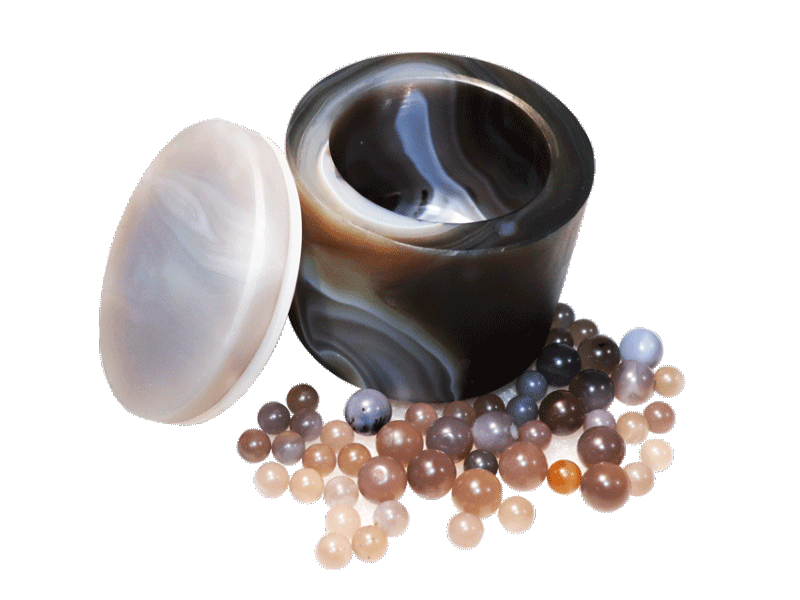
What is agate grinding bowl and where is it found in the process
The grinding bowl is not an independent grinder, but a replaceable working chamber. It does not create the movement itself: the planetary mill transmits the energy, and the glass receives the grinding media, holds the sample and forms the geometry of the grinding zone. Therefore, the properties of the product should be considered together with the parameters of a specific mill, and not as a separate tool for fine grinding.
In the sample preparation chain, the glass is located between the operations of preliminary crushing, sample reduction and analysis. If the sample has already been brought to an acceptable size, fine grinding, homogenization or deagglomeration is performed in a glass. For large pieces, a crusher or other type of mill is first used: the agate glass is not intended to replace a jaw crusher and does not solve the problem of coarse crushing.
The terms “grinding” and “mixing” are not used interchangeably here. When grinding, the particle size decreases and the particle size distribution changes; when mixed, the components are distributed relative to each other, but their size may remain the same. A planetary mill is capable of combining both processes, but the result depends on the mode, environment and properties of the powder. The agate glass only provides a contact surface and load transfer.
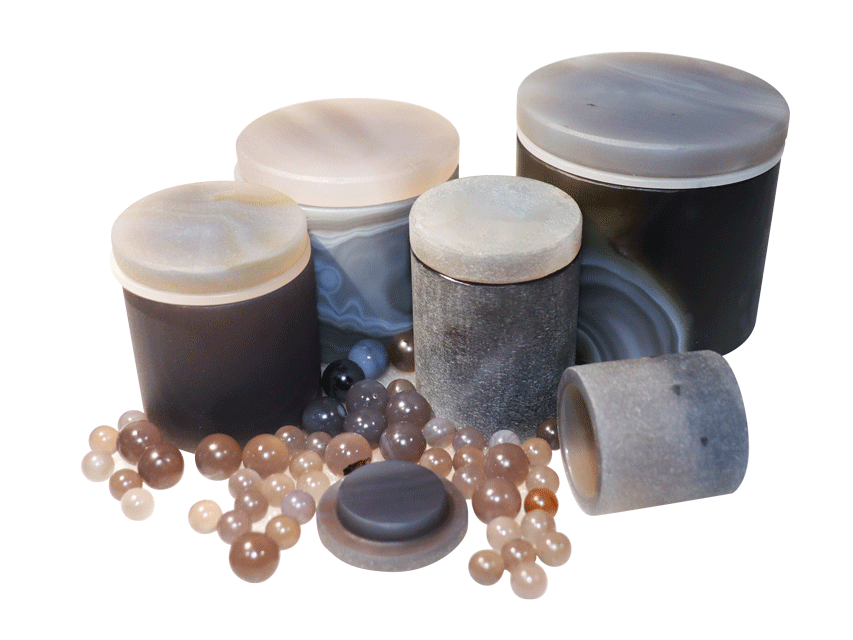
Working principle: how the glass participates in planetary grinding
In a planetary mill, the glasses rotate around a common axis and at the same time around their own axes. Due to the complex movement, the grinding media are pressed against the walls, rise and then collide with the material and the wall. Impacts and abrasions occur; their ratio depends on the speed, the geometry of the glass, the size and density of the balls, as well as on the filling. The glass must withstand these cyclic loads without deformation, cracking or loss of tightness.
During dry grinding, the powder and grinding media are in an air environment. This process is convenient for materials that cannot be introduced into a liquid, but it can be accompanied by dusting, sticking and aggregation. For wet grinding, a liquid medium is added; it changes the rheology of the suspension, heat dissipation and particle behavior. Not every agate glass and not every seal is designed for long-term contact with liquid, so the possibility of wet grinding must be confirmed by the documentation of the specific product.
All other things being equal, agate grinding media have a lower density than zirconia, tungsten carbide or steel balls. This reduces the energy of a single impact, but may increase the time to achieve the desired size. The glass does not guarantee a given particle size: the result depends on the starting material, its hardness and fragility, the ratio of the mass of the balls and the sample, time, speed, medium and method of measurement. The typical minimum specified for equipment cannot be automatically transferred to any powder.
Agate as a material: low metal input, fragility and limitations
Agate is a natural variety of silica, close to chalcedony. For grinding glasses, its comparative chemical stability and the absence of noticeable amounts of iron, nickel and chromium in the composition are valuable. Therefore, agate is often considered for samples where metal contamination is unacceptable or undesirable. However, “agate” does not mean “inert,” much less “zero pollution.”
The material of the glass itself wears out. SiO2 particles, as well as impurities associated with natural raw materials and manufacturing technology, can enter the sample. For many mineralogical and ceramic applications this is less critical than metal ingress, but for trace analysis of silicon or for particularly pure materials the risk must be assessed separately. Agate's hardness on the Mohs scale is typically around 6.5–7; it is harder than many minerals, but inferior to corundum and tungsten carbide.
The main limitation of agate is fragility. It does not withstand shock overloads, falls, jamming of the lid and sudden temperature changes. The agate beaker should not be used on large, hard or abrasive pieces unless confirmed by the manufacturer. Cracks and chips not only shorten the service life, but also create areas where particles from the previous sample are retained.
Chemical resistance also requires a caveat. Silicon dioxide reacts with hydrofluoric acid, and strong alkalis and other corrosive environments can attack the material and seals. If you intend to work with an aggressive reagent, a separate compatibility check is required; The article does not replace the product data sheet and instructions for safe operation.
Alternatives are chosen according to the task, and not according to the principle “more expensive means better.” Corundum and zirconium dioxide provide higher durability and density, tungsten carbide provides high wear resistance, but can introduce metal impurities; Stainless steel is not suitable for all sensitive samples; Polymer cups are convenient for soft materials, but have their own limitations on load and temperature. Agate occupies a niche where low metal input and moderate grinding energy are important.
Volume, dimensions and compatibility with planetary mill
The product card indicates the nominal volume of the glass. This is not the same as sample weight, workload, or total mill output. Part of the volume is occupied by grinding bodies, part is the free space necessary for the movement of balls and powder. In addition, the mill can have several seats; the volume of one glass is not equal to the volume of the entire batch in one cycle.
The working load is selected according to the instructions for the mill and the method. There is no universal formula that relates the volume of the beaker, the diameter of the balls and the mass of any powder: too large a load increases the load and temperature, too small - reduces the efficiency of collisions and can impair reproducibility. For fragile agate, it is especially important not to exceed the permissible impact energy.
Compatibility is determined not only by the diameter of the glass. It is necessary to check the mounting socket, fixing method, cover and seal design, permissible speed, direction of rotation, maximum temperature and balancing requirements. Two glasses with similar dimensions may have different geometries and different load limits. Therefore, transferring a glass from one mill to another without confirmation from the manufacturer is unacceptable.
The planetary mill agate beaker is not a roller mill drum, a bead mill chamber, or a roller crusher part. These are different loading principles and different fastening requirements. Also, the presence of other grinding equipment in the catalog does not prove compatibility with this glass: the type of mill in the main product card is a planetary ball mill, and compatibility with other machines must be checked separately.
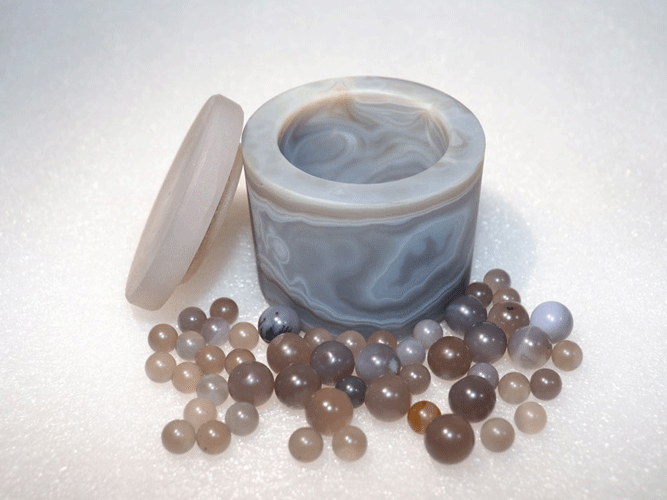
Wear, cleaning and transfer of impurities
The agate glass wears out gradually. Signs include dull spots, indentations, chipped edges, cracks, deterioration of the lid seal and damage to the seal. The inner surface may appear smooth, but the micro-relief is capable of holding fine powder. If after cleaning visible defects remain or the results of control tests change, it is better to remove the product from service.
Cleaning begins by removing the bulk of the powder using a dry method: with a soft brush, a vacuum cleaner with a suitable filter, or by washing in accordance with the instructions. Metal scrapers and abrasive pastes can scratch the agate. Sudden heating and cooling are dangerous due to fragility; After washing, the glass must dry before assembly. The sealing elements are cleaned separately without stretching or damaging them.
The transfer of impurities is not just about the material of the glass. Previous sampling, grinding media residues, water, detergent and environmental dust may change the result. For sensitive analyses, a control experiment with a clean medium or with a sample of known composition is useful. However, even thorough cleaning does not make the glass sterile for all trace determinations; At very low concentrations, separate validation of the method is required.
Grinding media are selected in accordance with the glass. Agate balls reduce the risk of introducing foreign metals, but they themselves wear out and can produce silicon-containing particles. Balls made from other materials increase grinding density and energy, but increase the risk of unwanted element transfer and wall wear. Materials should not be mixed without understanding how they contribute to the sample.
How to choose an agate glass and what to check before ordering
It is convenient to choose based on the task, and not on the name of the material. First, it is determined what exactly is required: to reduce the size, deagglomerate the powder, obtain a representative sample, or preserve certain fractions. Then they check whether the technique allows for agate in terms of hardness, fragility, chemical resistance and permissible level of impurities. After this, the standard size is selected and agreed upon with the mill.
- Mill model, number of seats and permissible load on the glass.
- Nominal volume, payload and sample weight per cycle.
- Dry or wet grinding, composition of the liquid medium and requirements for tightness.
- Hardness, abrasiveness and initial particle size of the material.
- Acceptable impurities: metals, silicon, sealing material.
- The size and material of the grinding media, as well as the method of their separation after grinding.
- Cleaning mode, the ability to control residues and the procedure for replacing a worn glass.
If the material contains large solids, is abrasive, or requires high impact energy, agate may not be the most practical choice. For such tasks, denser and more viscous materials are considered, but the final decision is made based on the manufacturer’s data and the results of trial grinding. Conversely, for soft to medium-hard samples where iron transfer is undesirable, an agate beaker is often a reasonable compromise between sample purity and wear.
Before ordering, it is useful to request a current product card, clarify the available volumes and check that the glass is intended specifically for the planetary mill of the desired model. You should not substitute dimensions and modes from another machine. Current directions of equipment and product cards TENCAN available at manufacturer's website.
Brief answers to frequently asked questions
Is an agate beaker suitable for wet grinding?
This depends on the specific design: cover, seal and permitted liquid medium. If there is no direct indication in the card or instructions, the possibility of wet grinding must be confirmed with the manufacturer. It cannot be assumed that any agate glass is sealed for any liquids.
Why is agate called a low-pollution material if it also wears out?
Agate does not have appreciable amounts of iron, nickel, or chromium, making it less suitable for metal-sensitive samples. But silicon and natural impurities can still transfer into the sample. “Low” application does not mean no contamination.
Is it possible to place a glass from one planetary mill to another?
Only if the geometry, fastening, cover, permissible speed and safety requirements confirmed by the manufacturer match. External similarity in diameter or volume does not guarantee compatibility.
How do you know when it's time to replace the glass?
The reasons include chips, cracks, deep signs of wear, leakage, damage to the seal and changes in the results of control samples. Damaged agate glass cannot be repaired by polishing without evaluation by the manufacturer.
Is it necessary to use agate grinding media?
No. The material of the balls is selected according to the task and acceptable impurities. Agate balls reduce the risk of metal contamination but wear out; Zirconium dioxide or tungsten carbide balls give a different grinding energy and a different impurity profile. Compatibility and implications for analysis need to be checked.